
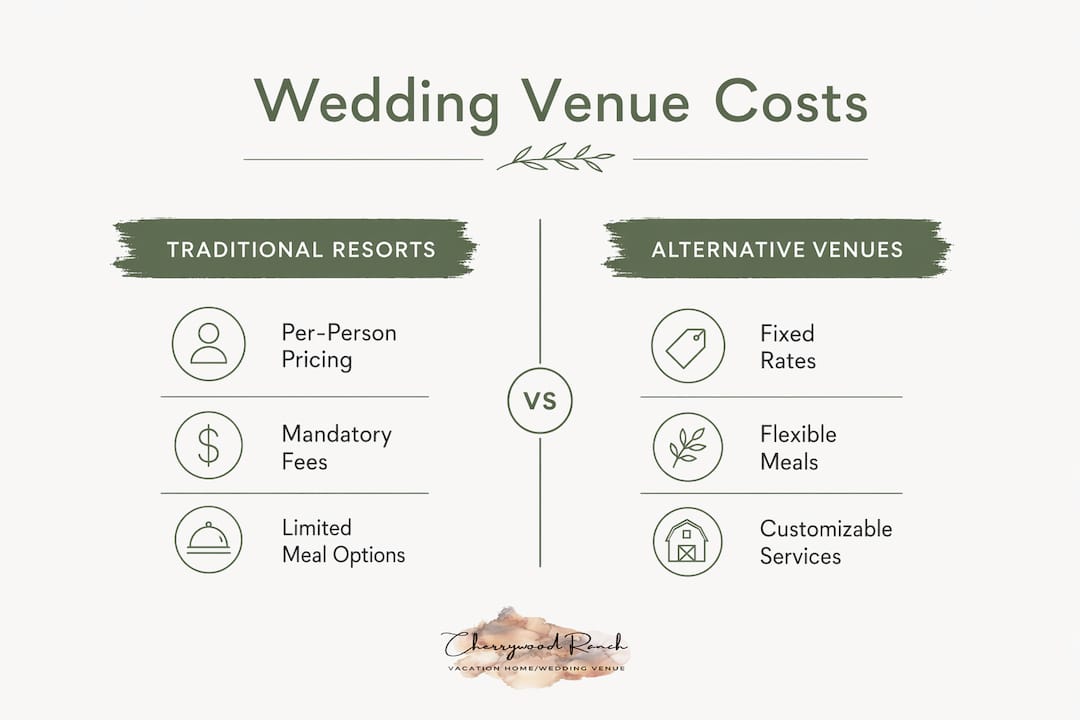
Resort alternatives save money by eliminating the per-person pricing, mandatory fees, and premium markups that make traditional resorts so expensive for wedding groups. Couples planning destination weddings face a specific financial trap: resort pricing scales upward with every guest added, while private venue alternatives charge a flat rate regardless of group size. Vacation rentals save families of four roughly $1,000–$1,500 compared to all-inclusive resorts for a 7-night stay. That gap grows even wider for wedding parties of 8, 10, or 16 guests. Understanding why resort alternatives save money starts with knowing exactly where resort costs pile up.
What makes traditional resorts so expensive for wedding groups?
Resort pricing is built on a per-person model, and that model punishes larger groups. Every guest added to your wedding party triggers another room charge, another resort fee, and another line item on the final bill. The base room rate is rarely the real cost.
Hidden fees are the biggest budget killer at traditional resorts. Common add-ons include:
- Daily resort fees: Resort fees average $35 per room per day, on top of the base room rate.
- Parking charges: Parking runs $30–$60 per vehicle per day at most resort properties.
- Drink upgrades: Base all-inclusive packages often exclude premium liquors, wines, and specialty cocktails.
- Spa and excursion costs: These are almost never included in base pricing and can add hundreds per person.
- Gratuities: Many resorts add mandatory service charges of 15–20% on food and beverage.
These fees cause couples to underestimate total resort expenses by a wide margin. A couple budgeting $4,000 for a resort stay can easily spend $6,500 once every fee is counted.
The per-person cost comparison is stark. Splitting an $800-per-night private home among 8 guests costs $100 per person, while resort rooms plus fees cost $335 per person per night. That is a difference of $235 per person, per night. For a 3-night wedding weekend with 10 guests, that gap represents over $7,000 in total spending.
Pro Tip: Always request a full itemized cost sheet from any resort before comparing it to a private venue. The base rate alone tells you almost nothing about what you will actually pay.
How do alternative venues cut those costs?
Private venues and boutique properties eliminate the per-person pricing model entirely. A flat nightly rate covers the whole property, so adding guests to your wedding party does not add to the base cost. Large groups of 5 or more save $2,000–$3,500 over a 7-night stay with vacation rentals compared to resorts. That predictability makes budgeting far more reliable.
The amenity structure is fundamentally different at private properties. Key advantages include:
- No resort fees: Private properties include resort-style amenities like pools without daily resort fee charges.
- Free parking: Most private venues include on-site parking at no extra cost.
- Full kitchens: Couples can prepare group meals instead of paying resort catering prices.
- Laundry access: Eliminates the need for expensive hotel laundry services during a multi-day stay.
- Group common spaces: Living rooms, dining areas, and outdoor spaces are included, not rented separately.
The fixed rate of vacation rentals maintains cost predictability even as the guest count grows. Resorts price each additional guest as a new revenue opportunity. Private venues do not.
Meal flexibility is one of the most underrated savings at alternative venues. A wedding group that prepares even half their meals in a private kitchen can cut food costs by hundreds of dollars per day. Resort catering for a group of 10 at a formal dinner can easily run $150–$200 per person before gratuity. A home-cooked group meal costs a fraction of that.

Pro Tip: Assign one or two guests to handle group meals as a fun shared activity. It builds connection before the wedding and keeps food costs predictable.
How can couples customize their wedding to save more?
Customization is where alternative venues deliver savings that go beyond the nightly rate. Couples who control their own schedule, vendors, and meals can redirect spending toward what actually matters to them. Alternative accommodations give couples control over budget allocation across meals, activities, and extras.
Four specific strategies produce the most savings:
-
Use local vendors instead of on-property services. Resort vendors charge premium rates because they have a captive audience. Local florists, photographers, and caterers in the surrounding area typically charge significantly less for the same quality of work. Booking local vendors for your wedding also adds authenticity to the experience.
-
Schedule around vendor availability, not resort packages. Resort wedding packages often lock couples into specific dates, times, and service tiers. Private venues give couples the freedom to book vendors on weekdays or off-peak dates when rates are lower.
-
Prepare group meals for casual gatherings. Reserve the catering budget for the ceremony dinner and handle rehearsal dinners, breakfasts, and lunches in the venue kitchen. This single change can save $500–$1,000 over a wedding weekend.
-
Use the private space for group coordination. Resort lobbies and common areas are shared with hundreds of strangers. A private venue gives the wedding party a dedicated space for rehearsals, getting ready, and post-ceremony gatherings without booking additional event rooms at extra cost.
The ability to personalize your wedding experience at a private venue also means couples are not paying for services they do not want. Resort packages bundle services together precisely because unbundling them would reveal how much each one costs individually.
How do region and group size affect your savings?
The financial advantage of resort alternatives is not uniform across every destination. Region and group size both determine how large the savings gap actually is.
DIY travel saves 30–50% compared to all-inclusive resorts in regions like Europe, Asia, and Central America where local costs are low. In these destinations, local food, transportation, and vendor costs are low enough that couples save money at every turn. The resort’s bundled pricing cannot compete with what couples can arrange independently.
The table below shows how group size and region interact to affect savings:
| Region | Group Size | Estimated Resort Cost (7 nights) | Estimated Alternative Cost (7 nights) | Approximate Savings |
|---|---|---|---|---|
| Central America | 4 guests | $4,200–$7,000 | $3,200–$5,500 | $1,000–$1,500 |
| Central America | 8–10 guests | $8,400–$14,000 | $4,500–$7,000 | $3,500–$7,000 |
| Europe / Asia | 4 guests | $3,800–$6,500 | $2,500–$4,500 | $1,300–$2,000 |
| Europe / Asia | 8–10 guests | $7,600–$13,000 | $3,500–$6,000 | $4,100–$7,000 |
| Caribbean | 4 guests | $5,000–$8,000 | $4,000–$6,500 | $500–$1,500 |
| Caribbean | 8–10 guests | $10,000–$16,000 | $6,000–$9,000 | $4,000–$7,000 |
The Caribbean is the one region where all-inclusive resorts remain competitive, but only for small groups. Resorts are financially smart only when amenities are fully used and the property itself is the primary destination. A couple planning to spend most days off-property exploring local culture wastes every dollar of the resort fee.
For groups above 8 guests, the math almost always favors a private venue regardless of region. The per-person pricing model at resorts creates a cost balloon effect that private venues simply do not replicate.
Key Takeaways
Resort alternatives consistently outperform traditional resorts on total cost for destination wedding groups of 5 or more, primarily because flat-rate pricing eliminates the per-person fee structure that inflates resort bills.
| Point | Details |
|---|---|
| Per-person pricing is the core problem | Resort costs scale with every guest added; private venues charge a flat rate. |
| Hidden fees add hundreds per stay | Resort fees, parking, and gratuities routinely add $200–$400 per room to the base rate. |
| Group size amplifies savings | Groups of 8–10 save $3,500–$7,000 over 7 nights at a private venue versus a resort. |
| Region shapes the savings gap | Europe, Asia, and Central America offer the largest savings; the Caribbean is the exception. |
| Customization multiplies value | Local vendors, group meals, and flexible scheduling reduce costs beyond the nightly rate. |
What I’ve learned from watching couples choose the wrong venue
Couples consistently underestimate how much a resort’s pricing model works against them the moment their guest list grows past four or five people. I’ve seen couples budget carefully for a resort stay, then absorb $3,000 in fees they never anticipated. The resort fee alone, multiplied across 10 rooms for three nights, adds up to over $1,000 before anyone orders a drink.
The deeper issue is that resorts sell convenience, and convenience is genuinely valuable. But for a destination wedding, the convenience of a resort often conflicts with what couples actually want: privacy, flexibility, and a space that feels like theirs. A resort lobby shared with 400 other guests is not an intimate wedding backdrop.
The couples who get this right treat the venue as the foundation of the entire weekend, not just a place to sleep. They choose a private property that fits an intimate venue experience, bring in local vendors they have researched, and use the kitchen to turn group meals into part of the celebration. That approach consistently produces a better wedding at a lower total cost.
My honest advice: run the full cost comparison before you commit to anything. Include every resort fee, every parking charge, and every meal. Then price out a private venue for the same group and the same number of nights. The number almost always surprises couples, and it almost always favors the alternative.
— Luis
Cherrywoodranchweddingvenue: a real alternative worth considering
Cherrywoodranchweddingvenue combines a destination wedding venue and a luxury vacation home in the North Georgia Mountains, accommodating up to 16 guests under one roof. That structure eliminates the core problem of resort pricing: your entire wedding party stays together at a flat rate, with a pool, hot tub, and mountain views included.

Couples who book Cherrywoodranchweddingvenue get a destination wedding venue in Georgia that handles both the ceremony and the lodging in one package. There are no mandatory resort fees, no per-person room charges, and no shared lobby with strangers. The venue’s all-in-one model gives couples the freedom to bring their own vendors, prepare group meals, and design a weekend that reflects who they are. If you want to see what an affordable, intimate mountain wedding looks like in practice, Cherrywoodranchweddingvenue is worth a close look.
FAQ
Why do resort alternatives save money for larger wedding groups?
Resort pricing charges per person per room, so costs multiply with every guest added. Private venues charge a flat nightly rate, keeping total costs predictable regardless of group size.
What hidden fees should couples watch for at resorts?
Daily resort fees averaging $35 per room, parking at $30–$60 per vehicle, drink upgrades, spa charges, and mandatory gratuities are the most common fees that inflate resort bills beyond the base rate.
Are all-inclusive resorts ever the better choice for a destination wedding?
All-inclusive resorts offer competitive value only when the group is small (under 4 guests), the resort itself is the primary destination, and the couple plans to use the included amenities fully every day of the stay.
How much can a wedding group of 8–10 people realistically save?
Groups of 8–10 guests typically save $3,500–$7,000 over a 7-night stay by choosing a private venue over a resort, based on the difference in per-person versus flat-rate pricing structures.
Does the destination region affect how much couples save?
Region matters significantly. Europe, Asia, and Central America offer 30–50% savings with private venues over resorts. The Caribbean shows a smaller gap because local costs are higher and all-inclusive pricing is more competitive there.