
Host a short, casual welcome party the night before your wedding, two to three hours of drop-in food, drinks, and low-key activities, and you solve the biggest problem of a multi-day wedding weekend: guests who don’t know each other standing around awkwardly. Keep it informal, keep it brief, and let the couple or parents cover a simple spread. That’s the whole formula. Everything else is customization.
TL;DR:
- Keep your welcome party informal and drop-in style to maximize guest mingling and avoid forcing everyone into rigid schedules.
- Choose a venue that can comfortably accommodate your full guest list with easy access and sufficient restrooms, preferably with an indoor backup option.
- Invitation details should clearly specify whether the event is open to all guests or just out-of-town family and wedding party members.
- Serve casual, move-around food options like appetizers or family-style platters, with simple drinks such as beer, wine, and signature cocktails, to promote conversation.
- Budget typically ranges from $25 to $80 per person, with costs influenced mainly by your food and bar choices, and can be reduced by limiting guest list or opting for buffet-style setups.
Table of Contents
- Wedding Welcome Party Ideas Grouped by Vibe
- Choosing a Venue That Keeps Guests Comfortable
- Who to Invite and How to Set Expectations
- Food and Drink That Keep People Talking
- Entertainment and Icebreakers That Don’t Overpower the Room
- Welcome Bags: A Simple Distribution Checklist
- What a Welcome Party Actually Costs
- Six Ready-to-Copy Welcome Party Themes
- Welcome Party vs. Rehearsal Dinner: What’s the Real Difference
- Venue-Tested Advice From a Multi-Day Wedding Weekend
- Why the Welcome Party Is the Most Underrated Part of the Weekend
- Hosting the Whole Weekend in One Place
- Sources
Wedding Welcome Party Ideas Grouped by Vibe
The right format depends on your guest list and energy level, not on what looks best in photos. A welcome party is fundamentally an informal, inclusive gathering, so match the vibe to your actual crowd, not an aspirational one.
- Casual drop-in cocktail hour. Guests filter in over two hours; no fixed start feels forced. Works for big, spread-out families and tight budgets.
- Rooftop or bar cocktail reception. Passed apps, a signature drink, skyline or mountain views. Good for smaller groups (25-40) who want a polished feel without a sit-down meal.
- Food-truck BBQ. Order at the truck, eat at picnic tables. Ideal for mixed generations and kids in the mix.
- Poolside or backyard picnic. Blankets, string lights, a cooler bar. Fits intimate weekends under 40 guests.
- Wine or bourbon tasting. Stations with tasting notes double as conversation starters. Best for adult-only, food-curious crowds.
- Cultural or heritage-themed night. Family recipes, music, or a small performance that honors both families.
- Game night. Cornhole, giant Jenga, a trivia round about the couple. Great icebreaker for guests who’ve never met.
- Low-key family-style dinner. Shared platters, long tables, no plated service. Fits smaller, close-knit groups who want a real meal without formality.
Choosing a Venue That Keeps Guests Comfortable
Pick a space that lets people arrive on their own schedule and move freely, not one that locks everyone into rows of seating. Hotel bars, breweries, rooftop lounges, restaurant patios, backyards, and a lawn adjacent to your main venue all work, provided they can absorb your headcount without feeling cramped.
- Confirm the space handles your full guest count comfortably, with room to spare for mingling.
- Check for hidden minimum spends at bars or restaurants before booking.
- Walk the entry point. A confusing or narrow entrance kills the “drop-in” energy fast.
- Count restrooms. One bathroom for 50 guests is a bottleneck nobody enjoys.
- Ask about proximity to your hotel block. A five-minute walk beats a 20-minute drive, and simple shuttle or car service planning solves the rest.
- Always line up an indoor or covered backup, especially for outdoor gatherings where weather is a wildcard.
Pro Tip: Walk the venue at the actual time your party starts. Evening lighting, parking availability, and noise levels all shift once the sun goes down, and a daytime site visit won’t show you any of it.
Who to Invite and How to Set Expectations
Decide early whether the welcome party is for everyone or just out-of-town guests and the wedding party. Both work, but mixed signals on invitations cause confusion fast.
- All guests: best for smaller weddings where everyone is already traveling in.
- Out-of-town guests only: common when local friends and family can attend the wedding day itself without a hotel stay.
- Wedding party plus close family: the leanest option, closer in spirit to a rehearsal dinner.
Open invitations for drop-in events typically see a moderate attendance rate, so plan catering with a little cushion rather than an exact headcount. Start the evening between 6 and 7 PM and cap it at two to three hours; The Knot’s planner guidance backs this window specifically because it leaves energy in reserve for the wedding day. Communicate the format clearly on your wedding website or invitation enclosure: “Drop by anytime after 6 PM” reads very differently from “Please RSVP by [date].” If there’s an open bar, say so. If it’s one drink included and cash after that, say that too.
Food and Drink That Keep People Talking
Skip the plated dinner. Passed appetizers, food stations, or family-style platters keep guests on their feet and moving between conversations, which is the entire point of a welcome party. A seated meal locks people into one table for the night.
- Offer at least one clearly labeled vegetarian dish and one allergy-friendly option, and ask about dietary restrictions on your RSVP or wedding website ahead of time.
- Keep the bar simple: beer, wine, and one signature cocktail beat a full open bar for both cost control and pacing.
- Drink tickets (two or three per guest) work well if you want to cap consumption without policing it directly.
- Lean into local specialties, a regional dish or a distillery pour, since showcasing local flavor gives out-of-town guests a real sense of place.
Budget-wise, casual welcome party formats generally run $25 to $80 per person, with the spread depending almost entirely on your bar and food choices.
Entertainment and Icebreakers That Don’t Overpower the Room
The goal is conversation, not a show. A curated playlist, an acoustic guitarist, lawn games like cornhole or giant Jenga, and a simple photo wall all give guests something to do with their hands while they talk.
- Skip the live band or headline act. That energy belongs at the reception, not the night before it.
- Set up a couple’s trivia card on each table. Small icebreaker, big payoff among strangers.
- Use name tags or seating prompts if your guest list spans two families who’ve never met.
- Stage activities in different corners of the venue so guests naturally circulate instead of clustering near the bar.
Welcome Bags: A Simple Distribution Checklist
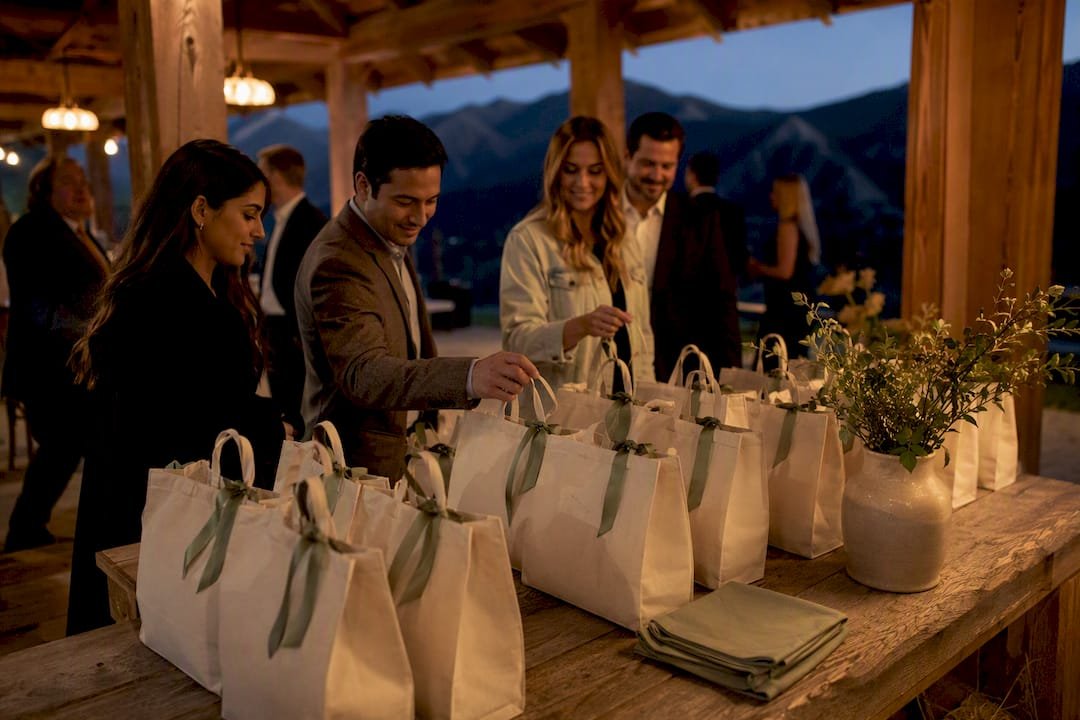
Hand out welcome bags at the party itself rather than counting on the hotel front desk to deliver them; distributing bags at the entrance table is far more reliable than a staggered hotel drop-off.
- Set up a visible table near the entrance with clear signage.
- Assign one or two volunteers, or venue staff, to hand out bags as guests arrive.
- Fill each bag with the weekend schedule, water, a local snack, and a couple of comfort items like sunscreen or aspirin.
- Keep extras on hand for guests who trickle in late or miss the initial rush.
Full contents and packing ideas are covered in this welcome bag guide.
Pro Tip: Print the weekend schedule on a single card, not a folded booklet. Guests actually read a card; a multi-page itinerary usually ends up buried at the bottom of the bag.
What a Welcome Party Actually Costs
Casual formats run $25 to $80 per person, driven mostly by your food and bar setup. A dessert-and-drinks-only party sits at the low end; a full food-truck spread with an open bar climbs toward the top.
- Cut costs by narrowing the guest list to out-of-town travelers only.
- A food truck or family-style platters beats plated catering on price every time.
- A partial host bar (beer and wine covered, cocktails self-pay) trims costs without feeling stingy.
- The couple or the couple’s parents traditionally host; if any part is self-pay, say so plainly on the invite.
Budget data from wedding planners consistently points to sit-down dinners as the priciest format, so if budget is tight, that’s the first thing to cut.
Six Ready-to-Copy Welcome Party Themes
- Cocktail reception: passed hors d’oeuvres, one signature drink, string lights and lounge seating. Mid-range budget.
- Food-truck BBQ: order-at-the-truck barbecue, cornhole on the lawn, mismatched market lights. Budget-friendly.
- Wine and cheese tasting: paired tasting flights, a short guided pour, simple wood-and-linen decor. Mid to upper budget.
- Backyard picnic: shared platters and lemonade, a lawn-game corner, blankets and lanterns. Budget-friendly.
- Poolside chill: light bites and frozen drinks, a photo wall by the water, bright tropical accents. Mid-range budget.
- Cultural celebration: a family recipe or regional dish, a short musical performance, decor drawn from heritage textiles or colors. Budget varies by tradition.
For more weekend-long activity pairings, see these guest experience ideas.
Welcome Party vs. Rehearsal Dinner: What’s the Real Difference
A rehearsal dinner is functionally tied to the ceremony rehearsal and usually stays limited to the wedding party and close family. A welcome party is a broader, purely social kickoff open to the whole guest list.
- Combine them only if your guest list is small enough that “close family” essentially means everyone.
- If you host both, sequence the rehearsal dinner first, then let the welcome party run later or in a separate space.
- If timing overlaps at the same venue, send an emissary to start greeting welcome party guests so nobody feels ignored while the rehearsal dinner wraps up.
Venue-Tested Advice From a Multi-Day Wedding Weekend
Running a welcome party on-site with lodging changes the logistics. Guests check in at different times, so distribution needs flexibility, not a single drop-off window.
- Stage welcome bags at a visible check-in table and staff it through the 90-minute window when most arrivals hit.
- Keep sunscreen, bug spray, and a light blanket on hand for evening temperature swings at elevation.
- Post signage for restrooms and shuttle pickup times so guests aren’t asking the same questions all night.
- Always have an indoor contingency ready; mountain weather shifts fast, and a solid rain plan saves the evening if it does.
Pro Tip: Assign one person whose only job is greeting arrivals and pointing them toward food, restrooms, and welcome bags. That single role prevents more confusion than any amount of signage.
Why the Welcome Party Is the Most Underrated Part of the Weekend
Guests remember how welcomed they felt more than they remember the centerpieces. A well-run welcome party does more for guest experience than most couples give it credit for, and it costs a fraction of the reception. If you’re mapping out the rest of the weekend, our venue planning resources cover the pieces that come next.
— Luis
Hosting the Whole Weekend in One Place
Planning a welcome party gets a lot simpler when your ceremony, reception, and lodging all sit on the same property. The venue offers lodging for a limited number of guests alongside the ceremony and reception spaces, so there’s no shuttle schedule to coordinate and no separate venue to book for the night before. Your welcome party can spill straight onto the lawn, the pool deck, or the porch, with everyone already staying steps away.
That kind of proximity is the difference between chasing down guests scattered across three hotels and just walking outside to greet them. If a private mountain setting with built-in lodging sounds like the weekend you’re picturing, check available dates on the destination wedding venue page and start mapping out your weekend.
Sources
- Rehearsal Dinner vs. Welcome Party: What’s the Difference? | Kate Ford Events
- How to Throw a Great Wedding Welcome Party | The Knot
- Wedding Welcome Party Planning | Plan A Wedding
- How to throw a wedding welcome party | Vogue
- Rehearsal Dinner & Wedding Welcome Party FAQ | Let’s Get Rehearsed