
Planning a large-family overnight stay for an intimate destination wedding is not only feasible — it’s the norm at estate buyouts and lodging-equipped venues that cater to groups of 10–20 guests. The single fastest next step: count your overnight headcount, lock your preferred dates, and send a buyout inquiry to at least two venues this week.
Before you do anything else, complete these three items:
- Count exactly how many guests will sleep on-site (not just attend)
- Confirm your top two or three date windows, including a backup
- Send a venue inquiry that specifically asks about exclusive-use or buyout availability
Table of Contents
- How do you calculate how many bedrooms you actually need?
- Which venue types reliably support a multi-night family stay?
- What rooming strategies keep everyone comfortable and logistics smooth?
- What on-site services should you require before signing?
- When should you book, and what actually drives the price?
- What questions should you ask, and what contract clauses must you confirm?
- Cherrywood Ranch: how an intimate wedding weekend with on-site lodging actually works
- Key Takeaways
- The planning mistake that derails more wedding weekends than any other
- Cherrywoodranchweddingvenue: the ready-made solution for your wedding weekend
How do you calculate how many bedrooms you actually need?
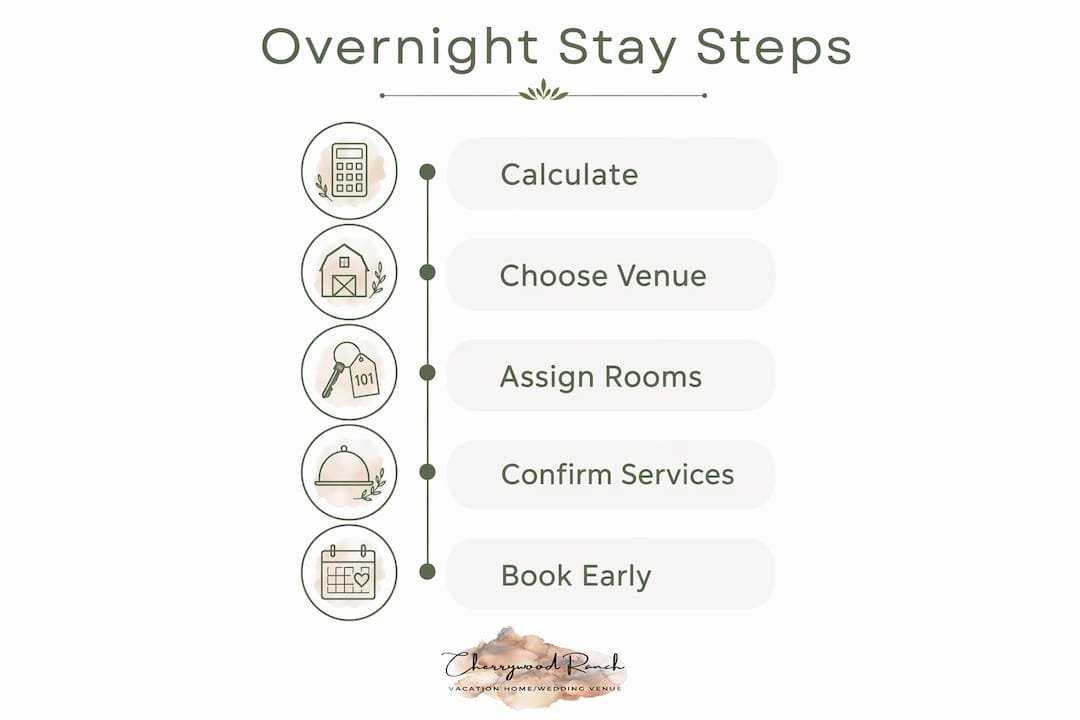
Start with the math, not the venue brochure. Take your total guest list, subtract day-only attendees, then split the remaining overnight guests into adults and children. From there, apply a simple assumption: most adult couples share a room, single adults may need their own, and children typically share bunk or trundle configurations with siblings or cousins.
Worked example: A 40-person guest list with 18 expected overnight guests might break down as 6 couples (6 rooms), 2 solo adults (2 rooms), and 4 children sharing 2 bunk-style rooms. That’s 10 bedrooms minimum. Add one room for a parent or grandparent who needs a ground-floor suite, and you’re at 11.
Don’t forget the edge cases. Plus-ones confirmed late, infants who need a pack-and-play in a parent’s room, and guests who planned to drive home but end up staying — all of these shift your count. Build your inquiry around the number you need, not the number you hope for.
Pro Tip: Ask every venue for its exact sleeping inventory (bed types, room by room) before you sign anything. A “sleeps 16” listing may include a pullout sofa and a daybed — neither is a real bedroom for a wedding weekend.
Which venue types reliably support a multi-night family stay?
Estate buyouts and cabin-cluster resorts are the two most reliable formats for keeping an intimate wedding group together overnight. Properties commonly advertise configurations for intimate groups of 8–14 guests, as well as scalable options for larger family stays (12–49 guests), and can accommodate 90 or more when combining multiple villas or cabins.
| Venue Type | Best For | Cost Structure | Privacy Level |
|---|---|---|---|
| Estate buyout | Intimate groups wanting one roof | Flat buyout fee | Highest |
| Cabin cluster resort | Families wanting separate spaces | Per-cabin pricing | High |
| Boutique inn | Couples needing hotel-style service | Per-room nightly rate | Moderate |
| Small resort with mixed units | Flexible headcounts | Partial or full buyout | Moderate–High |
Estate buyouts give you full privacy, dedicated staff, and exclusive access to every amenity — no strangers at the pool. Booking a property buyout is standard practice to secure exclusive use and avoid scheduling conflicts. The tradeoff is a higher upfront commitment.
Cabin clusters work well when families want their own front porch at night but share a central event space during the day. Mixed-unit properties sometimes publish weekend buyout pricing that simplifies budgeting.
Boutique inns suit groups that want hotel-style housekeeping and a restaurant on-site, but you’ll rarely get true exclusivity unless the property is small enough to buy out entirely.
For a deeper look at how these categories compare for multi-day celebrations, the multi-day family celebration venues guide breaks down the tradeoffs by budget and group size.
What rooming strategies keep everyone comfortable and logistics smooth?
The most effective approach mixes private ensuite suites for adult couples and grandparents with clustered bunk or connecting rooms for children. Venue layouts that combine private suites and large shared spaces — think five ensuite bedrooms opening onto a shared dining hall — let families feel together without sacrificing adult privacy.
| Room Zone | Who Goes Here | Configuration |
|---|---|---|
| Primary suite | Couple (bride and groom) | King bed, private bath |
| Adult couple suites | Parents, siblings with partners | Queen or king, ensuite |
| Grandparent suite | Elderly guests | Ground floor, grab bars preferred |
| Family bunk zone | Children, teens | Bunk beds or twin clusters |
| Overflow room | Late-confirming guests | Flexible bed type |
Accessibility matters more than most couples anticipate. Confirm whether the venue has at least one ground-floor suite with step-free access and, ideally, grab bars in the bathroom. A grandparent who can’t navigate stairs shouldn’t be assigned a third-floor room the night before the ceremony.
Communicate the rooming plan to family at least three weeks before arrival. A shared document with room assignments, bathroom sharing notes, and check-in times cuts the “who’s in which room?” chaos on arrival day. For practical strategies on multi-generational wedding weekends, mixed-age rooming templates are covered in detail.
What on-site services should you require before signing?
The three services that most reduce host workload are on-site or contracted catering, a dedicated event manager or digital concierge, and scheduled housekeeping. Without at least two of these, the couple ends up managing the property instead of enjoying their wedding weekend.
High-end group properties often provide a digital concierge that lets guests book activities and add-ons without overloading venue staff. Event coordinators favor venues with this feature because it offloads meal planning and activity scheduling from the hosts entirely.
Checklist of additional services to confirm:
- Transportation shuttles or a venue-arranged car service for ceremony day
- Activity programming for multi-generational groups (lawn games, guided hikes, pool hours)
- Childcare or supervised kids’ programming during the ceremony and reception
- Pantry pre-stocking or grocery delivery coordination before arrival
- Vendor access windows for florists, photographers, and officiants
Questions to ask every venue:
- How many staff are on-site during the wedding day versus other days?
- Can the catering team accommodate dietary restrictions across a full weekend?
- Are outside vendors permitted, and do they require liability insurance certificates?
- Who is the on-site contact if something goes wrong at 11 PM?
For ideas on keeping guests of all ages engaged across the full weekend, the wedding weekend guest activities guide covers programming that works for grandparents and teenagers alike.
When should you book, and what actually drives the price?
For an estate buyout or specialty lodging venue, 9–12 months out is the practical minimum. Popular dates — fall foliage weekends, holiday weekends, and peak summer — book many months in advance at many properties.
| Milestone | Recommended Lead Time |
|---|---|
| Initial inquiry and date hold | 9–12 months before event |
| Contract signed, deposit paid | 9–12 months out |
| Rooming plan finalized | 4–6 months out |
| Final payment due | Per contract |
The biggest cost drivers beyond the base rate include buyout fees, minimum-night requirements, extra-staff day rates for the ceremony day, vendor corkage or facility fees, and peak-season surcharges that can add significantly to the base price. Resort alternatives often save money compared to booking a hotel room block plus a separate ceremony venue.
Pro Tip: Purchase event insurance as soon as you sign the venue contract. A policy covering cancellation, vendor no-shows, and liability typically costs a fraction of your deposit and protects the full weekend investment.
What questions should you ask, and what contract clauses must you confirm?
No contract is final until it explicitly covers buyout terms, maximum guest capacity, and the cancellation policy. Everything else is negotiable; these three are not.
Questions to ask on every venue call or site visit:
- What is the maximum overnight capacity, and how is it enforced?
- Does our booking include exclusive use of all amenities, or are any shared?
- Which vendors are preferred or required, and what are the fees for outside vendors?
- What is the noise curfew, and are there penalties for violations?
- What does the force majeure clause cover, and how is it triggered?
- What is the deposit schedule, and what percentage is refundable if we cancel?
- Who carries liability insurance for the event, and what documentation is required?
Contract clauses to confirm before signing:
- Deposit schedule and refund terms at each cancellation window
- Noise and curfew rules with specific times, not vague language
- Vendor insurance requirements and approved-vendor lists
- Setup and cleanup access windows (arrival the day before, departure the day after)
- Damage deposit amount and conditions for its return
Red flags that should trigger renegotiation or walking away:
- No written cancellation or refund policy
- Vague “exclusive use” language that doesn’t specify which spaces are included
- A venue that cannot confirm its exact sleeping inventory in writing
- Required vendors with no pricing transparency
Cherrywood Ranch: how an intimate wedding weekend with on-site lodging actually works
Cherrywoodranchweddingvenue is purpose-built for the planning scenario this guide describes: an intimate group of up to 16 guests staying on-site across a multi-day wedding weekend in the North Georgia Mountains.
The venue combines a ceremony and reception space with a vacation home that sleeps up to 16 guests. Amenities include a pool, hot tub, mountain views, and extensive outdoor spaces — the kind of setup where guests arrive Friday and genuinely don’t need to leave until Sunday.
A typical weekend at Cherrywoodranchweddingvenue runs: Friday afternoon arrival and welcome dinner, Saturday ceremony and reception, Sunday morning brunch and checkout. That three-day arc maps directly to the booking timeline and rooming strategies covered earlier in this guide. For couples who want to see the lodging details and booking options, the venue’s availability calendar is the right starting point.
Key Takeaways
Booking an estate-style overnight venue for an intimate wedding weekend requires calculating your true overnight headcount first, then matching that number to a venue type, service level, and contract that protects your investment.
| Point | Details |
|---|---|
| Calculate overnight headcount first | Subtract day-only guests from your list before requesting venue capacity or pricing. |
| Match venue type to privacy needs | Estate buyouts offer the highest privacy; cabin clusters offer flexibility for larger or spread-out groups. |
| Confirm services before signing | On-site catering, an event manager, and scheduled housekeeping are the three services that most reduce host workload. |
| Book 9–12 months out | Peak-season estate venues fill 12–18 months in advance; an early inquiry secures your date hold. |
| Cherrywoodranchweddingvenue | Sleeps up to 16 guests on-site in the North Georgia Mountains with a pool, hot tub, and full ceremony space. |
The planning mistake that derails more wedding weekends than any other
The most common mistake couples make is treating “overnight capacity” and “event capacity” as the same number. They’re not, and confusing them creates real problems.
A venue that sleeps 16 may permit 40 daytime guests for the ceremony. That sounds like a win — until the caterer needs a commercial kitchen the venue doesn’t have, the parking lot fills up, and the couple discovers the noise curfew kicks in at 10 PM. The weekend they imagined doesn’t match the venue they booked.
The corrective habit is simple: on every venue call, ask two separate questions. First, “How many guests can sleep on-site?” Second, “How many guests can attend the ceremony and reception?” Then ask what changes — staffing, parking, catering setup, permits — when the daytime count exceeds the overnight count. Venues that handle this well have clear answers. Venues that hedge or deflect are telling you something.
Cherrywoodranchweddingvenue: the ready-made solution for your wedding weekend
Most couples spend months comparing venues, negotiating room blocks, and coordinating between a ceremony site and a separate rental property. Cherrywoodranchweddingvenue removes that split entirely.
The venue combines a fully equipped wedding ceremony and reception space with on-site lodging for up to 16 guests, a pool, a hot tub, and mountain views that make the North Georgia setting feel like a destination in itself. There’s no separate rental to coordinate, no hotel block to manage, and no guests scattered across three different properties. The whole group stays together, which is exactly what makes a wedding weekend feel different from a wedding day.
For couples ready to check dates and get pricing, the Cherrywood Ranch wedding weekend page is the fastest way to confirm availability and start a buyout inquiry. If you’re still comparing options, the destination wedding venue overview covers what the full experience includes.