

A three-day, single-site wedding weekend with a full-weekend coordinator is the simplest, most reliable way to coordinate a multi-day wedding celebration. It cuts guest transit stress, eliminates vendor handoff gaps, and protects the couple from the burnout that comes from managing three separate events as if they were unrelated. If most of your guests are traveling and you want a rich, unhurried experience, start here: book a property with on-site lodging and hire a full-weekend coordinator as your very first vendor.
The short version of what makes this format work:
- Three anchor events cover everything guests need: a Friday welcome, Saturday ceremony and reception, and Sunday farewell brunch
- Single-site lodging removes the need for multiple shuttle loops and keeps the weekend feeling cohesive
- A 15-minute buffer built into every transportation window prevents the cascade of delays that unravels timelines
- One master timeline shared with every vendor prevents the most common operational failure: each vendor showing up with a different version of the schedule
- Cherrywood Ranch in the North Georgia Mountains is one property that packages all of this under one roof, with on-site lodging for up to 16 guests, multiple event spaces, and full-weekend coordination support
Table of Contents
- Is a multi-day wedding weekend actually right for you?
- How to pick the right destination and venue for a weekend celebration
- What to host across the weekend: sample 3-day and 4-day itineraries
- Which vendors you need and what to put in their contracts
- How to communicate the weekend schedule to guests
- Operational logistics that prevent failure: shuttle loops, buffers, and the Cherrywood Ranch model
- How to budget for a multi-day wedding and when to make each decision
- Day-of coordination, contingency planning, and safety
- Key Takeaways
- The operational truth most couples learn too late
- Cherrywood Ranch: a single-site solution for your wedding weekend
- Useful sources and further reading
Is a multi-day wedding weekend actually right for you?
Not every couple should do this. A wedding weekend adds a significant increase to overall cost compared with a single-day event when you factor in welcome events, brunch, transportation, and extended vendor hours. Before you commit, run through this checklist honestly.
Commit to a wedding weekend if:
- Most guests are traveling more than two hours or flying in
- You want unhurried time with people you rarely see
- Your guest count is under 75 and you can host a genuinely intimate experience
- You have the budget headroom and the willingness to delegate logistics to a coordinator
- Your venue can host multiple events without requiring guests to move between properties
Reconsider (or scale back) if:
- The majority of guests are local and a single evening covers everyone
- Your budget is already stretched to cover one great reception
- Neither partner has the bandwidth to manage a multi-event communication plan
- Your venue has a strict curfew that limits late-night programming
Pro Tip: If you’re on the fence, drop from three days to two rather than cramming three days of events into a compressed schedule. A Friday-evening welcome and a Saturday all-day celebration is a perfectly complete experience. Add Sunday brunch only if you genuinely want it, not because it feels expected.
For couples with a tight inner circle who want an extra layer of connection, consider adding a Thursday arrival day for the wedding party and immediate family. Keep it unstructured: a pool afternoon, a low-key dinner, no formal programming. Couples who do this consistently call it their favorite part of the weekend.
How to pick the right destination and venue for a weekend celebration
The venue decision shapes every other logistics choice you will make. Private, all-inclusive venue rentals simplify multi-day planning by centralizing lodging, event spaces, and coordination under one contract. That single fact is worth more than any other venue criterion.
Venue criteria checklist:
- On-site lodging capacity (can it sleep your inner circle?)
- Exclusive-use availability across multiple days
- Multiple distinct event spaces so each gathering has its own atmosphere
- Vendor flexibility (open vendor list vs. required vendor list)
- Noise curfew and quiet-hours policy
- Accessibility for guests with mobility needs
- Load-in and load-out windows for vendors across multiple days
Single-site vs. multi-site: which model fits your weekend?
| Factor | Single-site (private buyout) | Multi-site (separate venues) |
|---|---|---|
| Guest logistics | No transit between events | Requires shuttle coordination every day |
| Vendor handoffs | One access window, one load-in | Multiple venue contacts and access schedules |
| Cost shape | Higher upfront rental fee | Lower per-venue cost, higher transport spend |
| Guest experience | Immersive, house-party feel | More variety, more travel fatigue |
| Late-night flexibility | Guests walk to their rooms | Requires late-night transport or designated drivers |
| Noise/curfew risk | Managed by one property | Varies by venue; harder to predict |
Private venue buyouts in mountain destinations centralize lodging, eliminate multiple shuttle loops, and make late-night after-parties feasible without noise complaints. Those operational advantages often justify the higher rental fee. For couples planning a mountain wedding weekend, the single-site model is almost always the right call.

When touring venues, ask specifically whether previous couples have hosted welcome events and farewell brunches on the property. A venue with multi-day experience will answer those questions without hesitation.
Pro Tip: Prioritize a venue buyout over negotiated hotel blocks whenever your guest count is under 50. Hotel blocks work well for overflow guests, but putting your inner circle on-site changes the entire emotional texture of the weekend.
What to host across the weekend: sample 3-day and 4-day itineraries
The standard three-event structure has proven itself across hundreds of wedding weekends: Friday welcome, Saturday main event, Sunday farewell brunch. It balances connection with rest and keeps complexity manageable. The practical maximum is five events across three days; beyond that, guest fatigue and couple burnout become real problems.
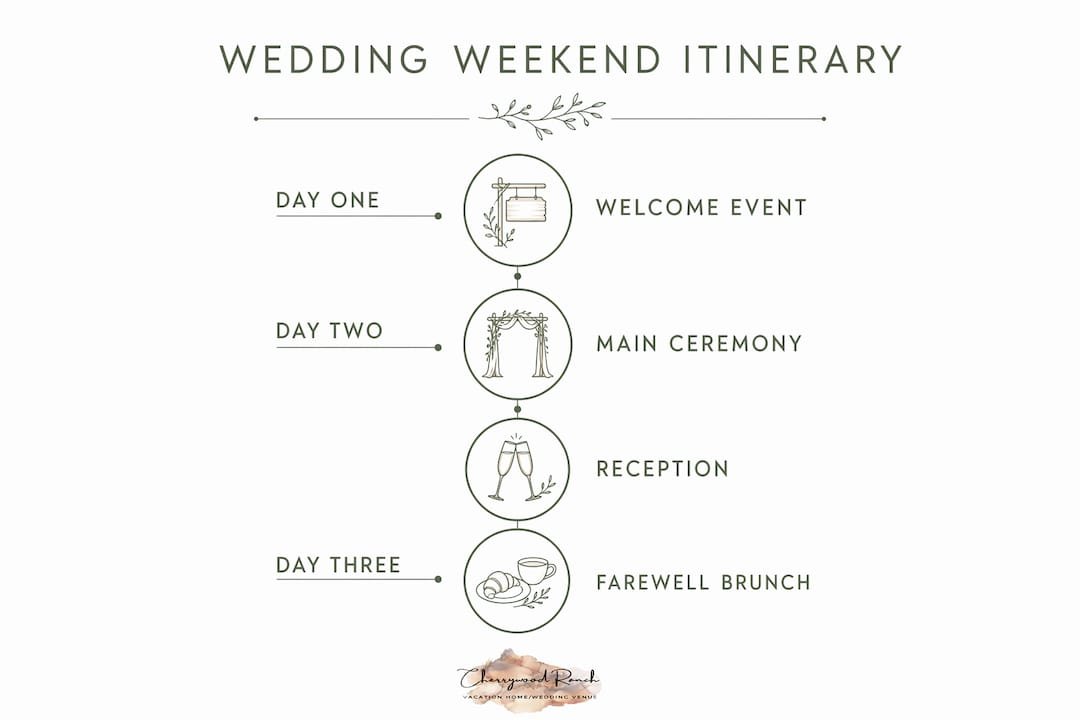
Think of the weekend as a narrative with an energy rhythm. Alternate high-energy and low-energy moments deliberately. The Friday welcome is warm and casual. Saturday builds to the ceremony and reception peak. Sunday winds down gently. That arc is what makes guests feel cared for rather than scheduled.
3-day wedding weekend template
Friday: Arrival and welcome
- 2:00–5:00 PM: Guest arrivals, check-in, welcome bags distributed
- 5:00–6:00 PM: Couple and wedding party downtime (protected, non-negotiable)
- 6:30–9:30 PM: Welcome party (cocktails, light bites, casual mingling)
- 9:30 PM onward: Optional late-night continuation or guests settle in
Saturday: The main event
- 8:00–10:00 AM: Casual breakfast available (low-key, no programming)
- 10:00 AM–1:00 PM: Getting ready; photographer begins detail shots
- 1:00–4:00 PM: Buffer block and ceremony prep (do not schedule anything here)
- 4:00–5:00 PM: Ceremony
- 5:00–6:00 PM: Cocktail hour; wedding party portraits
- 6:00–10:00 PM: Reception (dinner, toasts, dancing)
- 10:00 PM onward: After-party or guests retire
Sunday: Farewell brunch
- 9:00–11:00 AM or 10:00 AM–12:00 PM: Buffet or family-style brunch, no speeches, no program
- 12:00 PM: Guests depart; couple begins honeymoon travel
Keep the brunch short, two hours maximum, and genuinely casual. If the reception ran late, push the start time. A brunch that starts at 10:00 AM after a midnight after-party will have half the guest list missing.
Optional 4-day extension
Add Thursday as an inner-circle arrival day for the wedding party and immediate family. No formal programming. Pool time, a low-key dinner at a local restaurant, early conversations. Alternatively, add Monday for a post-wedding activity (a hike, a local excursion) for guests who extended their stay. This works especially well for destination weekends where guests have already committed to travel. For activity ideas that fit this format, the adventure wedding weekend itinerary guide has a solid range of options.
Which vendors you need and what to put in their contracts
Multi-day coverage costs more, and vendors without multi-day experience often struggle with sustained service. Ask every vendor directly: have you worked a three-day wedding weekend before? The ones who have will tell you exactly what they need. The ones who haven’t will give you a vague answer.
Core vendor roster for a multi-day weekend:
- Full-weekend coordinator (not day-of; see below)
- Caterer with multi-day experience (6+ meals across 3 days, varied menus)
- Photographer and/or videographer with multi-day rates
- AV and entertainment (DJ or band; confirm multi-day availability)
- Shuttle or transport provider
- Bar staff (confirm licensing for all event days)
- Housekeeping for on-site lodging
- On-site hospitality manager or point person
- Security or medical point of contact for larger groups
Contract clauses that matter for multi-day events
Standard single-day contracts miss several items that become critical across a weekend. Add these explicitly:
- Multi-day scope of work — list each event by name and date, not just “the wedding”
- Guaranteed on-site hours per day, not just total hours
- Staff meal and rest breaks — specify timing and responsibility (who provides meals?)
- Overtime rates — define the trigger point and hourly rate in writing
- Staged payment schedule tied to planning milestones, not just a deposit and final payment
- Venue access windows for load-in and load-out on each day
- Force majeure and cancellation language that addresses multi-day partial cancellations
Vendor fatigue is a real operational risk across a three-day event. Build mandatory meal breaks into the master timeline and assign your coordinator to enforce them. A caterer who has been on their feet since Friday morning will not perform at their best Sunday brunch without rest.
How to communicate the weekend schedule to guests
The dual-layer approach works: keep formal invitations streamlined and let your wedding website carry all the logistical detail. Printed itinerary cards in welcome bags handle guests who won’t check a website. Together, these three channels cover everyone.
Communication timeline:
- 12 months out: Save-the-dates noting the multi-day format and general destination
- 9 months out: Wedding website live with preliminary weekend schedule, accommodation options, and travel logistics
- 6 months out: Formal invitations with RSVP for the full weekend (not just the ceremony)
- 3 months out: Accommodation booking deadline reminder; transportation sign-up opens
- 6 weeks out: Final weekend schedule published on website; email reminder to all guests
- 1 week out: Final confirmation email with shuttle times, pickup locations, and emergency contact
RSVP fields to include for a multi-day event:
- Which events will you attend? (checkboxes for each)
- Arrival date and departure date
- Accommodation preference (on-site vs. nearby hotel)
- Transportation needs (shuttle sign-up)
- Dietary restrictions
- Mobility or accessibility needs
- Activity opt-ins (if offering optional programming)
Welcome bag contents for a wedding weekend
A well-assembled welcome bag does real work. It orients guests, reduces questions, and sets the tone. For a wedding weekend welcome bag, include:
- Printed weekend itinerary (guest-facing version, not vendor version)
- Local snacks or a regional specialty item
- Water bottle or reusable cup
- Hangover kit (pain reliever, electrolyte packets, antacids)
- Emergency kit (safety pins, stain remover pen, bandages, phone charger)
- Shuttle schedule card with pickup times and locations
- Handwritten welcome note from the couple
Place bags in guest rooms before arrival. For off-site guests, arrange delivery to the hotel front desk.
Operational logistics that prevent failure: shuttle loops, buffers, and the Cherrywood Ranch model
The number-one operational failure in multi-day weddings is treating each day as a separate event. Every vendor gets a different version of the schedule, load-in windows conflict, and the brunch caterer shows up at the wrong entrance Sunday morning. The fix is simple: one master weekend timeline, distributed to every vendor before the weekend begins.
Shuttle loop planning
Shuttle logistics work best as a single chartered loop between accommodations and event sites. Shuttle costs for a chartered bus per evening can vary, but it’s helpful to plan this as a predictable budget line item to lock in early.
Sample Saturday shuttle loop (ceremony + reception day):
| Time | Direction | Notes |
|---|---|---|
| 3:15 PM | Hotel → Venue | 15-min buffer before 4:00 PM ceremony |
| 3:30 PM | Hotel → Venue | Final pickup run |
| 7:00 PM | Venue → Hotel | Early departure option |
| 9:00 PM | Venue → Hotel | Mid-evening run |
| 11:00 PM | Venue → Hotel | Post-reception run |
| 12:30 AM | Venue → Hotel | Final run (after-party end) |
Build the 15-minute buffer into every departure time, not just the first run. Guest delays compound across a weekend, and a shuttle that leaves on time at 3:15 PM for a 4:00 PM ceremony gives you exactly the margin you need.
Why a full-weekend coordinator changes everything
A day-of coordinator leaves after the reception Saturday night. When the brunch caterer arrives Sunday morning with a question, there is no one to answer it. A full-weekend coordinator maintains continuity across all three days: vendor liaison, morning-after issues, timeline enforcement, and the hundred small decisions that accumulate between Friday afternoon and Sunday noon. It is the single most effective operational upgrade for a multi-day event.
The Cherrywood Ranch model
Cherrywoodranchweddingvenue in the North Georgia Mountains is built specifically for this format. It offers on-site lodging that can accommodate the inner circle so they can stay on the property throughout the weekend. Multiple outdoor event spaces give each gathering its own setting. Resort-style amenities like a pool and hot tub make the unstructured hours between events genuinely enjoyable rather than dead time. And because everything happens on one property, the master timeline has one venue contact, one load-in window, and no transit coordination between events. For couples who want to see how all-inclusive venue rentals simplify logistics, this model is the clearest example of the principle in practice.
Pro Tip: When evaluating any all-inclusive property, ask for a sample master timeline from a previous weekend event. A venue that has done this before will have one. A venue that hasn’t will not know what you’re asking for.
How to budget for a multi-day wedding and when to make each decision
A three-day wedding weekend typically costs 25–45% more than a single-day event when you add welcome events, farewell brunch, transportation, and extended vendor hours. Budget for that increase from the start.
Sample budget allocation for a 3-day weekend:
- Ceremony and reception: 40–45%
- Welcome event (venue, catering, entertainment): 15–18%
- Farewell brunch: 8–10%
- Transportation and shuttle loops: 8–10%
- Welcome bags and on-site signage: 3–5%
- Optional activities: 3–5%
- Full-weekend coordinator: 8–10%
Where to cut if the budget tightens: reduce the welcome event from a catered dinner to a casual cocktail reception, eliminate optional activities, or simplify the farewell brunch to a self-serve buffet. Never cut the coordinator or the shuttle. Those two line items prevent the failures that ruin weekends.
Month-by-month planning milestones
12 months out:
- Set total weekend budget
- Begin venue research; prioritize multi-day properties
- Send save-the-dates noting the multi-day format
9 months out:
- Sign venue contract; confirm exclusive-use terms
- Book full-weekend coordinator
- Book photographer with multi-day experience (they book early)
6 months out:
- Book caterer with multi-day experience
- Launch wedding website with preliminary schedule
- Send formal invitations with full-weekend RSVP fields
- Reserve hotel room blocks for overflow guests
3 months out:
- Finalize all vendor contracts with multi-day clauses
- Confirm shuttle provider and build loop schedule
- Order welcome bag supplies
- Begin activity planning and vendor meal coordination
30 days out:
- Final venue walkthrough with coordinator
- Confirm all vendor arrival times and access windows
- Assemble welcome bags
- Send final weekend schedule to all guests
7 days out:
- Confirm final headcount with every vendor
- Distribute master weekend timeline to all vendors
- Print and deliver guest-facing itinerary cards
- Confirm shuttle driver contacts and pickup locations
Day-of coordination, contingency planning, and safety
No weekend goes exactly as planned. The couples who come out of it well are the ones who assigned clear roles before anything went wrong.
Roles and responsibilities:
- Coordinator: vendor liaison, timeline enforcement, load-in oversight, morning-after issues
- Point person (trusted friend or family member): guest questions, lost-and-found, room assignments
- Couple: present, celebrating, not managing logistics
- Emergency contact: one named person with venue and vendor phone numbers, posted in welcome bags
Contingency checklist:
- Weather backup plan for every outdoor event (tent, indoor space, or date flexibility)
- Vendor no-show protocol (coordinator holds backup vendor contacts)
- Transportation failure plan (rideshare app backup, local taxi contact)
- Medical incident protocol (nearest urgent care address in welcome bag; first-aid kit on-site)
- Quiet-hours enforcement plan (coordinator handles noise complaints, not the couple)
- Late delivery window (30-minute grace period built into master timeline before coordinator escalates)
Safety measures for multi-day events:
- Sober-ride plan posted at the bar and in welcome bags (shuttle schedule, rideshare codes, or designated driver list)
- Accessible transport confirmed for guests with mobility needs
- Alcohol service cutoff time agreed with bar staff in writing before the weekend
- Pickup point signage at venue entrance and parking area
- First-aid kit location communicated to all vendors and the point person
Vendor fatigue across three days is a genuine safety and service issue. Mandatory meal breaks for catering and bar staff should appear in the master timeline, not just in the contract. Your coordinator’s job includes enforcing those breaks, not just tracking the couple’s schedule.
Key Takeaways
A three-day, single-site wedding weekend with a full-weekend coordinator and a shared master timeline is the most reliable structure for coordinating a multi-day wedding celebration.
| Point | Details |
|---|---|
| Single-site beats multi-site | One property eliminates transit, reduces vendor handoffs, and keeps the weekend cohesive. |
| Budget for a notably higher amount | A three-day weekend typically costs 25–45% more than a single-day event when you add welcome events, brunch, transport, and extended vendor hours to the base cost. |
| Shuttle buffers prevent cascades | Build a 15-minute buffer into every departure window; shuttle loops run $500–$1,500 per evening. |
| One master timeline for all vendors | Distributing a single weekend document to every vendor prevents the most common multi-day failure. |
| Cherrywoodranchweddingvenue | On-site lodging for up to 16 guests, multiple event spaces, and resort-style amenities centralize the entire weekend at one North Georgia property. |
The operational truth most couples learn too late
Here is what I keep coming back to after watching multi-day weddings succeed and fall apart: the couples who treat Friday, Saturday, and Sunday as three separate events spend the whole weekend in recovery mode. Something goes sideways Friday night, and they spend Saturday morning fixing it instead of getting ready. The couples who plan it as one continuous operation, with a single timeline, a single coordinator, and a single venue contact, rarely have that problem.
The most emotionally rich moments at these weekends almost never happen during the formal events. They happen at the casual Saturday morning breakfast, around a bonfire Friday night, or at the farewell brunch when nobody wants to leave. You cannot schedule those moments, but you can create the conditions for them by keeping the structure loose enough that they have room to happen.
One practical example worth sharing: a coordinator I know once caught a catering conflict at 7:00 AM Sunday morning because she was already on-site and had the master timeline in hand. The brunch caterer had the wrong setup location. Fixed in ten minutes. Without a full-weekend coordinator on-site, that becomes a 45-minute scramble that the couple hears about. With one, it never reaches them at all. That is the operational case for the full-weekend coordinator in one story.
Cherrywood Ranch: a single-site solution for your wedding weekend
If the single-site model is what you want, Cherrywoodranchweddingvenue in the North Georgia Mountains was designed for exactly this format.

The property offers on-site lodging for up to 16 guests, so your inner circle stays on the property from Friday arrival through Sunday brunch. Multiple outdoor event spaces give each gathering its own setting and atmosphere. The pool, hot tub, and mountain views turn the unstructured hours between events into genuine highlights rather than dead time. And because everything happens in one place, your master timeline has one venue contact, one load-in window, and no transit coordination between events.
For couples who want to see the full picture before booking, the destination wedding venue in Georgia page covers packages, availability, and what a weekend at the property actually looks like. If on-site lodging is your priority, the wedding venue with lodging in Georgia page goes deeper on how the accommodation model works.
Check availability and schedule a walkthrough to see whether the dates and guest count align with your plans.
Useful sources and further reading
External planning guides:
- WedStay: Complete Wedding Weekend Planning Guide — 3-day timeline, budget figures, and vendor guidance
- Plan A Wedding: Multi-Day Wedding Weekend — pacing advice, welcome event and brunch recommendations
- Plan A Wedding: Wedding Weekend Itinerary Guide — shuttle cost ranges and budget framework
- Vogue: The Wedding Weekend Guide — event planner perspectives on scheduling and guest communication
- Villa Sakis Journal — destination planning examples and multi-day itinerary ideas from a private villa perspective
Cherrywoodranchweddingvenue internal pages:
- All-inclusive weekend venue rental benefits — how single-property rentals simplify logistics
- How to plan a mountain wedding weekend — North Georgia-specific planning guidance
- Wedding weekend welcome bags — contents checklist and assembly tips
- Types of wedding weekend guest activities — optional programming ideas for Friday and Sunday
- What is a three-day wedding celebration? — format overview and guest expectations