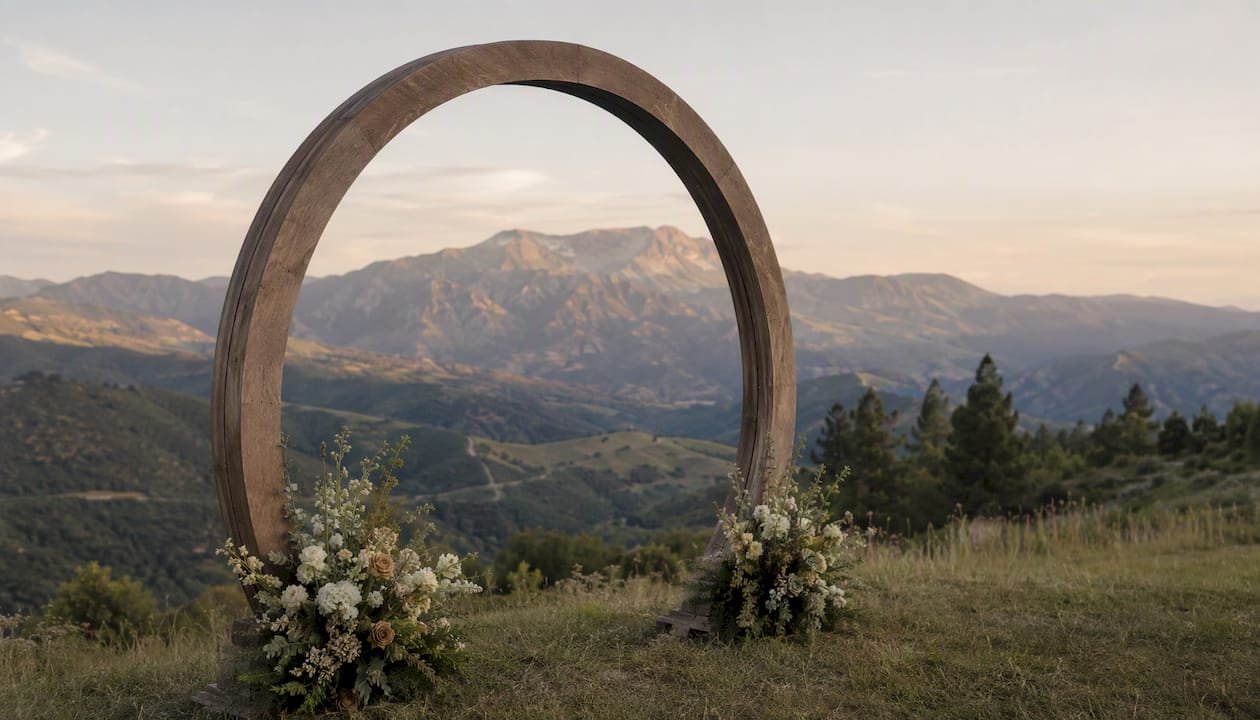
The best mountain ceremony arch does one job: it frames the peaks, it never blocks them. Everything else, wood versus metal, florals versus dried grasses, big versus barely-there, comes second to that single rule.
If you take nothing else from this, take this: pick a design that lets the mountain range stay the backdrop, not the competition. At Cherrywood Ranch, we see couples get this right most often with three approaches: a slim triangle arch that echoes the peaks behind it, a grounded floral installation that sits low and lets the sky do the heavy lifting, or an asymmetrical arrangement anchored to one side so the view spills through the open half. Each keeps sightlines open for guests and photographers alike.
Here’s the working rule we give couples during a site walk: when you stand at the back row and look toward the ceremony spot, the arch should cover a limited portion of your view to avoid blocking scenic mountain backdrops. Anything bigger starts eating the scenery you paid to marry in front of.
- Triangle arch: narrow footprint, echoes mountain silhouettes
- Grounded floral installation: zero overhead structure, full sky visible
- Asymmetrical open frame: one strong side, one open side for the view to pour through
Key Takeaways
The most reliable mountain ceremony arch is scaled small, positioned asymmetrically or grounded, and anchored regardless of forecast.
| Point | Details |
|---|---|
| Frame, don’t block | Keep the arch under about a third of the visible skyline from the back row of guests. |
| Match style to setting | Triangle arches suit forested ridgelines; grounded installations suit wide-open vistas. |
| Anchor every time | Use sandbags, ground anchors, or weighted bases regardless of the day’s forecast. |
| Choose durable florals | Dried pampas and large foliage read better at distance than delicate filler blooms. |
| Cherrywood Ranch offers design help | Our team helps couples plan, source, and install a mountain-friendly arch during their wedding weekend stay. |
Table of Contents
- Mountain-Friendly Ceremony Arch Ideas and When to Use Each
- How Do You Size an Arch So It Doesn’t Block the View?
- Materials and Anchoring for Windy Mountain Sites
- Choosing Florals and Colors That Read Well in Mountain Light
- DIY, Rental, or Hired Designer: What Fits Your Mountain Wedding?
- What Actually Works on a Mountain Ceremony Site
- Designing an Arch That Honors the Land
- Let Us Help You Design and Install Your Mountain Arch
- Further Inspiration and Vendor Resources
- Sources
Mountain-Friendly Ceremony Arch Ideas and When to Use Each
Ten styles cover almost every mountain ceremony we’ve seen work, and each one earns its place for a different reason.
- Triangle or peak arch. Two angled beams meeting at a point, often in raw or stained wood. It mirrors the ridgeline behind it instead of fighting it, which is why rustic wedding arch designers favor it for forest and alpine settings. Rentals often run 9 to 12 feet tall and 10 to 14 feet wide, per Rugged Horizon’s triangle arch specs, which gives you a real number to check against your venue’s sightlines.
- Circular hoop. A single steel or wood ring, minimal and modern. Handles wind better than a wide rectangular frame because there’s less surface area to catch a gust.
- Asymmetrical open frame. One vertical leg loaded with florals, the other bare or absent entirely. This is the designer favorite for wide-open vistas, since it keeps the peaks as the visual anchor.
- Grounded floral installation. No overhead structure at all, just urns, pampas grass, or branches arranged at ground level. This keeps the entire panorama visible and gives photographers a clean foreground element without a canopy in the frame.
- Multi-arch cluster. Two or three smaller arches staggered instead of one large one. Reads as intentional and modern, and each piece is easier to transport up a mountain access road than one oversized frame.
- Floating or hidden-support frame. Uses thin, nearly invisible supports so the florals appear to hang unassisted. Striking in photos, trickier in wind, so it needs a calm-day backup plan.
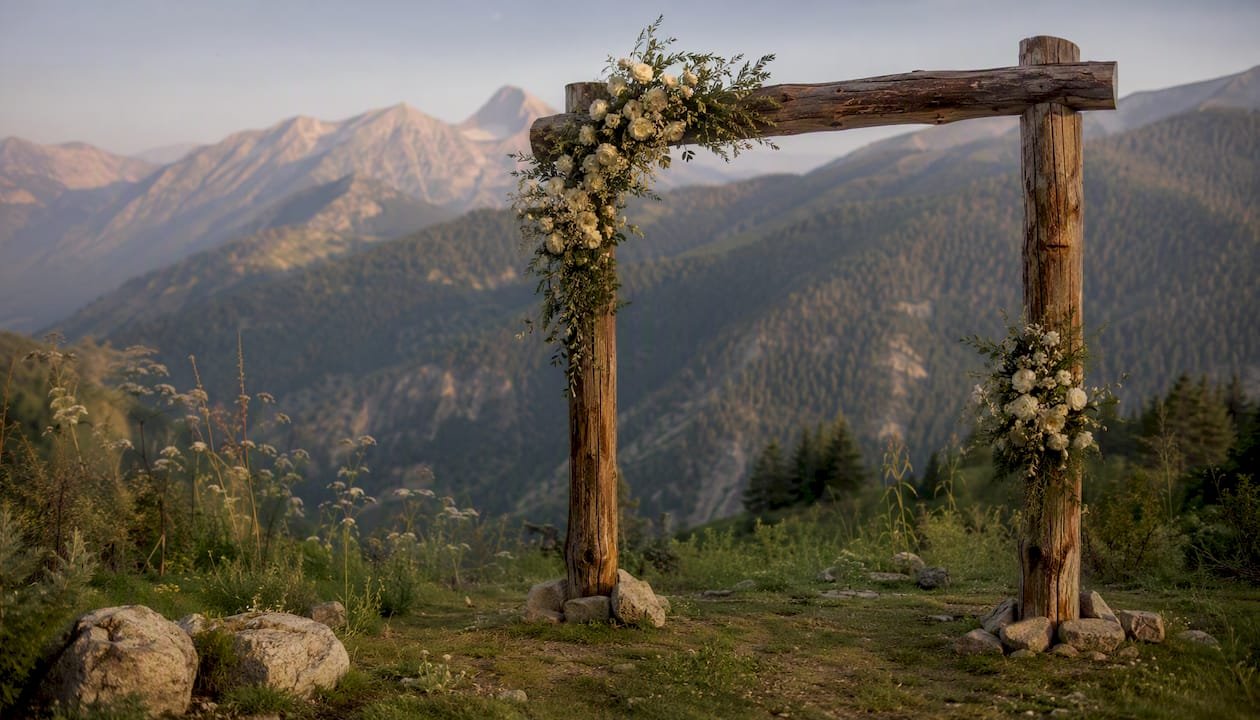
- Reclaimed wood barn frame. Thick, weathered timber beams, often salvaged. Pairs naturally with ranch and farmhouse-adjacent mountain venues and holds up structurally in a way lighter materials don’t.
- Metal geometric frame. Copper, black steel, or brass in hexagon or square shapes. Low-maintenance and wind-stable, a good pick if you want a modern edge against a rugged backdrop.
- Pampas or boho grouping. Loose, textural arrangements of dried grasses and neutral tones, often grounded rather than arched overhead. Reads beautifully at a distance, which matters when your ceremony spot is 40 yards from your farthest guest.
- Minimal fabric drape. A single length of fabric draped over a simple frame. Soft and romantic, but the one style here that genuinely struggles in wind, so it’s a fair-weather-only choice.
Every one of these appears in some form in Brontë Bride’s mountain arch roundup, where florist credits show how differently the same basic shape reads depending on the florals attached to it.
How Do You Size an Arch So It Doesn’t Block the View?
Scale is the detail most couples skip and regret. Stand where your farthest guest will sit, then look toward the ceremony spot. If the arch swallows the mountain range behind it, it’s too big for that site.
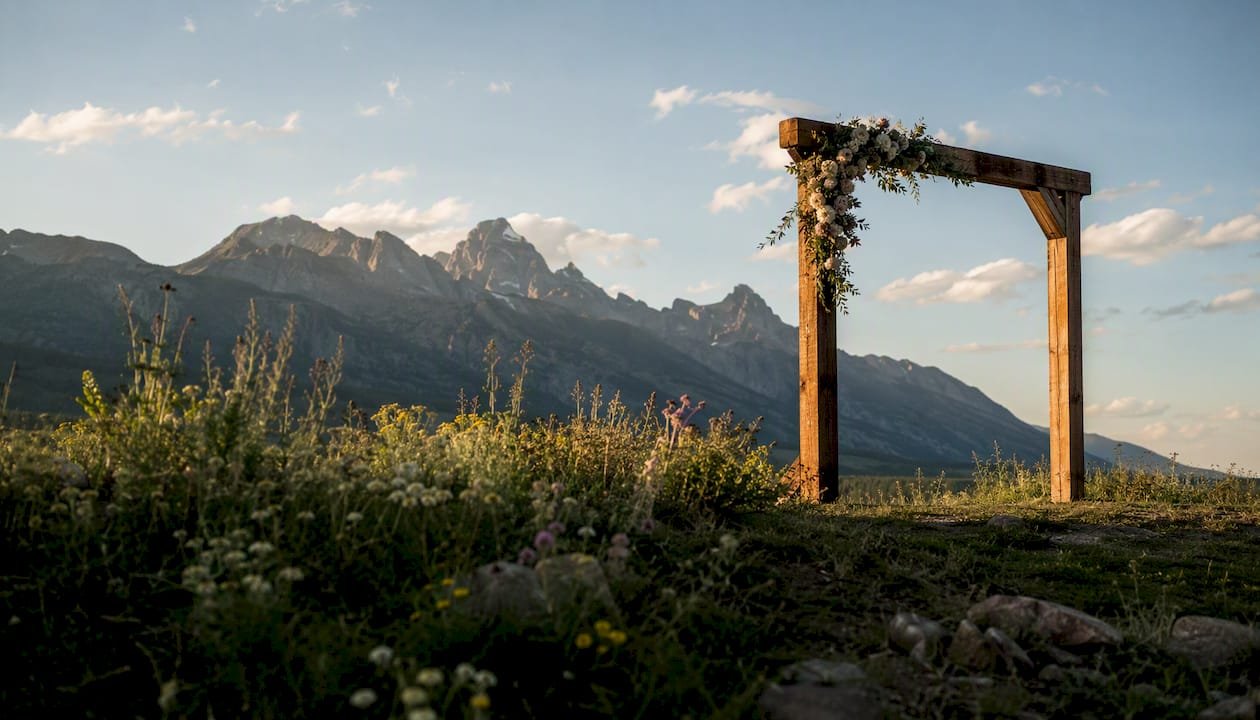
A good working ratio: the arch should occupy a modest fraction of the visible skyline from the back row. Face it so the peaks sit slightly off-center behind the couple rather than dead center, since a perfectly symmetrical composition can look staged in photos while an offset one looks natural. Position the ceremony so the sun sits behind your photographer during the vows, not behind the couple, or you’ll end up with silhouettes instead of faces.
Photographers lean on foreground framing and negative space to make small arches feel intentional rather than sparse. A grounded floral cluster at the base of the arch gives them something to shoot through, adding depth without adding height.
Pro Tip: Walk the ceremony site with your phone camera before you book any florals. Stand at the back row, snap a photo, and check whether the mountain peak is still visible above where the arch will sit. If it disappears in your test photo, it’ll disappear on the wedding day too.
Materials and Anchoring for Windy Mountain Sites
Wood, metal, and grounded vessel arrangements each handle mountain wind differently, and picking the wrong one for your site is the most common installation mistake we see.
- Reclaimed or new wood offers weight and stability but needs a solid base plate or ground stakes on sloped terrain.
- Steel or copper frames are lighter to transport and shed wind better than flat wooden panels.
- Grounded vessel displays, using urns, crates, or weighted planters, skip the overhead structure entirely and sidestep most wind risk.
- Anchoring on rocky or sloped ground usually means sandbags, weighted bases, or driven ground anchors rather than the simple stake-in-soil method that works on flat lawns.
Check forecasted wind speeds the morning of setup and have a grounded-installation backup ready if gusts look severe. DIY-friendly rustic arch guides often recommend grounding decor directly in weighted vessels for exactly this reason. Confirm your venue’s rules on stakes, ground anchors, and vehicle access before you finalize a design, since mountain properties often restrict digging or heavy equipment near trails.
Choosing Florals and Colors That Read Well in Mountain Light
Mountain light shifts fast, harsh midday sun, soft golden hour, cool blue dusk, so the palette and texture you choose need to hold up across that range.
- Spring favors soft alpine pastels: blush, sage, dusty lavender.
- Summer leans into greens and whites that stay crisp against bright sun.
- Fall calls for rust, burgundy, and amber tones that echo turning leaves.
- Winter works best with evergreens, white, and metallic accents.
Fresh florals look richer up close but wilt faster in wind and sun exposure; dried and preserved elements like pampas grass hold their shape and color for the entire ceremony and photograph well from a distance, which matters when guests are seated 30 or more feet back. Large-textured foliage tends to read well at distance, contrasted with delicate filler flowers which may blur in wide shots. Work with a florist who has installed at elevation before. Transport, wind, and temperature swings change how blooms behave compared to a flat, sheltered venue.
DIY, Rental, or Hired Designer: What Fits Your Mountain Wedding?
Three paths get you to a finished arch, and the right one depends on your timeline, your comfort with logistics, and how much of the install you want to manage yourself.
- DIY costs the least but demands the most planning: sourcing materials, building the frame, and hauling it up mountain access roads yourself. It fits couples with time, a truck, and a clear plan for wind.
- Rental sits in the middle. Companies deliver a finished frame, sometimes with setup included, and give you published dimensions to check against your site, similar to the size ranges Rugged Horizon lists for triangle arches. Ask about their teardown policy and what happens if winds exceed safe limits on the day.
- Hiring a florist or designer costs the most but removes the guesswork. Ask every prospective vendor about their mountain-install experience, their anchoring methods, and their wind contingency plan before booking.
Red flags worth walking away from: no offer to visit the site in advance, no answer for what happens in high wind, and no willingness to show past install photos or references.
What Actually Works on a Mountain Ceremony Site
We’ve watched enough ceremonies unfold on our property to know the arches that hold up are almost never the biggest ones.
The installs that photograph best and survive the wind are asymmetrical or grounded, positioned so the ridgeline stays visible over one shoulder of the frame rather than dead center behind it. We stage delivery and install during the same morning window as vendor load-in, anchor every base regardless of forecast, and coordinate lodging access so florists can pull vehicles close without crossing guest paths later in the day.
One thing worth borrowing for your own site: build your install schedule around a single morning window, and treat the anchor as non-optional even on a calm-looking day.
Designing an Arch That Honors the Land
I’d rather see a couple choose fewer florals and more open sky than a design that fights the mountain for attention. Walk lightly: avoid disturbing plant beds, coordinate with venue staff before staking anything into the ground, and let the landscape stay the reason your guests came.
Let Us Help You Design and Install Your Mountain Arch
Cherrywood Ranch is the option that skips the vendor-hunting entirely: instead of coordinating a separate florist, rental company, and install crew on your own, our team helps you design and set up a mountain-friendly arch as part of your wedding weekend stay.
We know which arch styles and anchoring methods hold up on our own ridgeline, and we’ve staged enough installs here to know what the wind actually does on any given morning. If you’re planning a multi-day mountain wedding for up to 16 lodging guests, check available dates on our destination wedding venue page and let’s talk through what design fits your ceremony spot.
Further Inspiration and Vendor Resources
- 89 Wedding Arches for broad visual range
- Instagram-worthy installations by region
- Real mountain ceremony setup with aisle styling
Sources
- 13 Wedding Arches to Inspire your Rocky Mountain Ceremony
- 10 Ceremony Arch Ideas Perfect For Your Mountain Wedding or Intimate Elopement | Brontë Bride
- Rustic wedding arch ideas that instantly transform your ceremony space – Wedport
- 89 Wedding Arches For (Nearly) Endless Ceremony Inspiration