
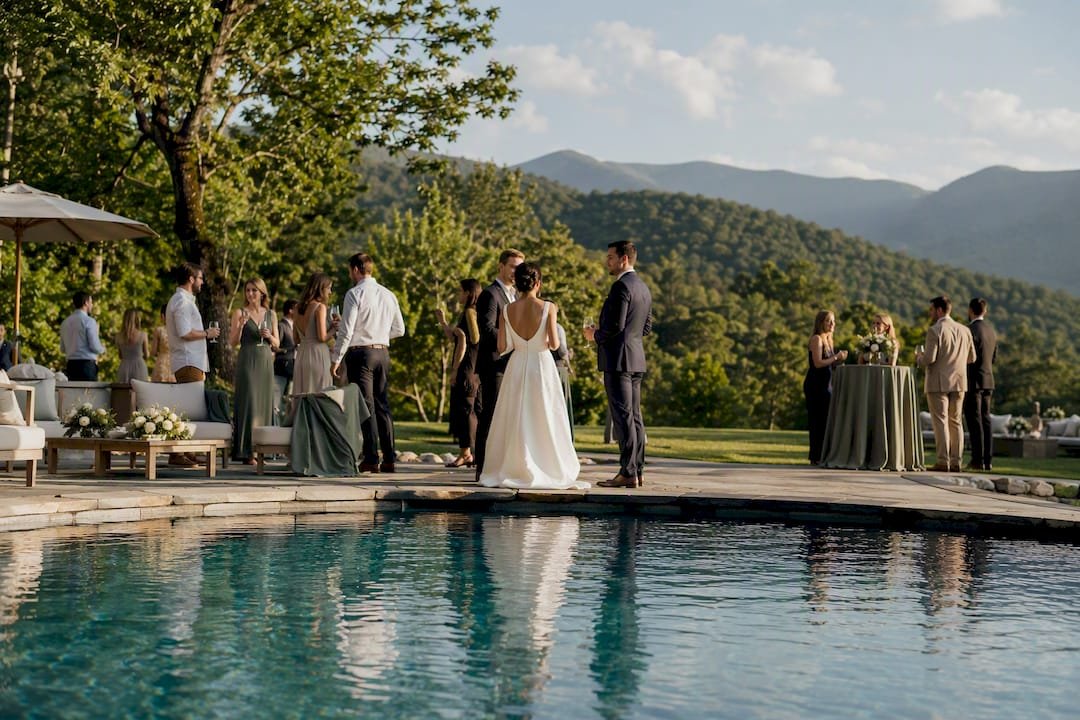
Use the pool as a designed social event, ideally the welcome gathering or the day-after recovery party, so the main wedding day stays focused on the ceremony. This format works well for small groups in North Georgia, and the ideas below cover decor, food, timing, and safety so you can build your own version.
TL;DR:
- Ensuring a safe poolside event requires clear signage, designated water watchers, and non-slip mats, especially with multiple hours of guest activity.
- Scheduling the pool event as a welcome gathering or recovery brunch, rather than pre-ceremony, reduces stress and fits better into the wedding weekend flow.
- Floating decor, shaded lounge zones, and minimal styling focused on water and lighting create an elegant atmosphere without clutter or safety risks.
- Food stations and continuous bar service accommodate staggered guest arrival and pool time, preventing bottlenecks during the event.
- Guests should stay within a short drive or on-site lodging to simplify transportation, reduce logistical issues, and promote relaxed socializing around the pool.
Table of Contents
- Poolside Wedding Weekend Ideas: Decor, Amenities, and Guest Activations
- When to Schedule the Pool Event in Your Wedding Weekend
- Poolside Decor and Lighting That Photograph Well and Stay Safe
- A Food and Beverage Plan That Holds Up in the Heat
- Entertainment and Flow: How to Pace a 3 to 5 Hour Pool Event
- The Safety and Logistics Checklist Every Poolside Event Needs
- Sample Itineraries: 1-Day, 2-Day, and 3-Day Templates
- How Cherrywood Ranch Runs a Poolside Wedding Weekend
- Where Guests Should Stay Near a Poolside Wedding Venue
- Transportation and Parking for a Poolside Wedding Event
- A Planner’s Note on Pacing a Poolside Weekend
- Book an Intimate Poolside Wedding Weekend at Cherrywood Ranch
- Sources
Poolside Wedding Weekend Ideas: Decor, Amenities, and Guest Activations
A pool event succeeds or fails on a handful of choices, not a hundred small ones. Here’s what to prioritize, in order of impact.
- Floating decor over hanging decor. Floating candles, minimalist arrangements, and reflective glassware create a polished look without cluttering the water’s edge, a combination wedding planners consistently return to because it photographs well in low light.
- Shaded lounge zones that double as design. Striped umbrellas, low daybeds, and grouped seating give guests somewhere to land and give your photographer a backdrop that doesn’t need extra styling.
- Two to three interactive food stations, staffed continuously rather than served at one sitting, since guests drift in and out of the water at different times.
- One signature cocktail, one mocktail, and a visible hydration station. Heat cuts drinking capacity fast, so infused water needs to be as easy to grab as the bar.
- Low-effort entertainment: a playlist that builds gradually, a pool volleyball net, maybe a float relay for the less self-conscious guests.
- Comfort amenities that read as thoughtful: rolled towels in a basket, a sunscreen station, and a small pile of flip-flops or robes near the exit path.
None of this requires a big production budget. It requires deciding early which three or four items you’ll actually execute well, then skipping the rest.
When to Schedule the Pool Event in Your Wedding Weekend
Placement matters more than decor. Two slots work consistently, and a couple of others tend to underperform.
- Day-one welcome (3 to 5 hours, late afternoon into evening): Best when most guests arrive by early afternoon. It breaks the ice before the ceremony and gives out-of-town guests something to do besides sit in a hotel room.
- Day-after recovery (late morning into afternoon): Lower stakes for vendors, since nobody’s hair or makeup depends on staying dry. This slot also gives guests who overdid it the night before a slower reentry point.
- Pre-ceremony or pre-welcome slots generally underperform, since they compress prep time and add stress right before a formal event. Planners frequently favor the welcome or recovery placement specifically because it removes that pressure.
A multi-day celebration guide can help you map exact timing against vendor arrival windows if you’re juggling more than two events.
Poolside Decor and Lighting That Photograph Well and Stay Safe
Pick one visual direction and commit. Terracotta paired with cobalt reads as warm and grounded; a Riviera-inspired yellow and white feels bright and casual. Mixing both usually looks indecisive in photos.
- Floating decor should stay soft (fabric, wax, silk petals). No glass, ever, near a pool edge.
- Overhead lighting, string lights or lanterns, throws reflections onto the water without adding anything you need to fish out later.
- LED floats and perimeter lighting extend usability into the evening; keep cords and outlets well away from the deck’s edge.
- Choose decor your venue’s cleanup crew can clear in under 20 minutes. Anything that takes longer usually gets left behind.
Pro Tip: Skip elaborate centerpieces entirely if your pool has a good view or a sunset angle. Planners who work these events often say the water itself does the heavy lifting, so minimal styling reads as more expensive, not less.
A Food and Beverage Plan That Holds Up in the Heat
Skip plated service. It creates a bottleneck exactly when half your guests are still in the water.
- Station combo that works: a taco or slider bar, a fresh fruit and gelato station, and a light appetizer table (think chilled shrimp, crudités, hummus). Interactive stations like these let guests eat on their own schedule instead of during one fixed window, which matters when arrivals and pool time stagger naturally.
- Bar plan: one signature cocktail, one non-alcoholic mocktail poured with the same care, and infused water refreshed every 30 to 45 minutes.
- Staff the bar and stations continuously rather than opening and closing them, and keep at least one server monitoring drink strength as the afternoon heats up. A full outdoor bar checklist is worth reviewing before you finalize vendor orders.
Entertainment and Flow: How to Pace a 3 to 5 Hour Pool Event
Structure the afternoon in phases instead of letting it run flat.
- Arrival and socializing (45 to 60 minutes): Light music, drinks in hand, no pressure to swim yet.
- Food opens (60 to 90 minutes): Stations go live; this is when energy typically peaks for conversation.
- Swim and games (60 to 90 minutes): Pool volleyball, float relays, anything low-prep that doesn’t require a rulebook.
- Music peak (45 to 60 minutes): This is where a progressive DJ set earns its money, building from background music toward something people actually dance to.
- Wind-down (30 minutes): Slower songs, last drinks, a natural exit point before guests head off to dinner or bed.
Pro Tip: A progressive set that builds gradually keeps the whole event feeling effortless. Starting loud and fast burns out the energy before the food even opens.
The Safety and Logistics Checklist Every Poolside Event Needs
This is the part that protects the whole weekend, not just the photos.
- Towel and sunscreen station, staffed or self-serve, positioned near the entry point.
- Shaded seating for at least a third of your guest count, more if kids or older relatives are attending.
- Clear signage on pool depth, no-diving zones, and any house rules.
- A designated water watcher or lifeguard whenever open swimming is happening, plus a visible first aid kit.
- Non-slip mats at wet entry and exit points.
- Confirm your venue’s permit and insurance coverage for pool use; operational guidance for pool parties recommends locking this down before the guest list goes out, not after.
Drowning incidents at private residential pools spike during exactly the kind of unsupervised, multi-hour gathering a wedding weekend produces, which is the single strongest argument for a paid water watcher over an informal “someone’s keeping an eye out” arrangement.
Sample Itineraries: 1-Day, 2-Day, and 3-Day Templates
Copy whichever matches your guest count and travel distance, then adjust for vendor arrival windows.
- One-day template: Ceremony at 4 PM, cocktail hour by the pool from 5 to 6:30 PM instead of a separate reception space, dinner and dancing indoors or on a terrace afterward. Works well for smaller guest lists where a full second day isn’t practical.
- Two-day template: Friday evening pool welcome from 5 to 9 PM (light bites, one cocktail, music), Saturday ceremony and formal reception. This is the most common structure for weekend guests flying or driving in Friday morning.
- Three-day template: Friday welcome dinner (non-pool), Saturday ceremony and reception, Sunday poolside recovery brunch from 11 AM to 2 PM before guests depart. Alternatively, flip it: Friday pool welcome, Saturday ceremony, Sunday quiet farewell brunch without the pool.
A weekend getaway planning resource can help you build out vendor call times around whichever template you pick.
How Cherrywood Ranch Runs a Poolside Wedding Weekend
Some venues host small groups in a single property with a pool, hot tub, and lodging on site, which removes the coordination headache of shuttling guests between a hotel and a separate event space.
- The pool event stays on a different day or a clearly separate block from the ceremony, so hair, makeup, and formalwear never compete with swim time.
- Staff often handle towel restocking, drink refills, and shade adjustments throughout the event rather than leaving guests to manage it themselves.
- Because lodging and the pool sit on the same property, the transition from “wedding formal” to “pool casual” takes minutes, not a car ride.
Where Guests Should Stay Near a Poolside Wedding Venue
Lodging strategy changes everything about how a poolside weekend feels. If guests are scattered across three different hotels ten minutes apart, the pool event becomes a coordination project instead of a party.
The simplest fix is booking a venue with on-site lodging for at least your immediate wedding party and out-of-town family, so the people most likely to show up for a 9 AM pool brunch don’t have to drive to get there. For guests beyond that core group, look for accommodations within a short drive, ideally under 20 minutes, and share a short list in your invitation suite rather than leaving people to search on their own.
A few practical notes worth building into your planning:
- Book room blocks or rental clusters early if your weekend falls during a regional peak season; mountain and lake destinations fill up fast in fall and early summer.
- If your venue offers on-site lodging, prioritize it for guests attending the pool event itself. It’s the difference between someone showing up in a swimsuit at 10 AM and someone skipping the event because they didn’t want to pack a bag for a day trip.
- For guests staying off-site, confirm checkout times against your Sunday brunch or recovery event so nobody is rushing out mid-celebration.
Venues that combine ceremony space, reception space, and lodging under one roof, like a private vacation-home format, solve most of this automatically. It’s worth understanding what that format actually includes before you commit to a traditional hotel-and-venue split.
Transportation and Parking for a Poolside Wedding Event
Parking is the detail nobody thinks about until forty cars show up for a backyard-style pool party.
If your pool event happens at a private residence or vacation-home venue, confirm the property’s parking capacity in writing before finalizing your guest count. Many residential-style venues cap parking well below their guest capacity, which means you’ll need a shuttle plan, a designated overflow lot, or a hard limit on driving versus riding together. A look at how private-pool rental properties handle event logistics is useful background if you’re hosting anywhere other than a dedicated event venue.
For weekend-long celebrations, transportation gets easier once most guests are staying on-site or nearby. If your pool event follows a rehearsal dinner or precedes a Sunday brunch, keep the group in one location as long as possible; every additional shuttle run is another point where the schedule can slip. Golf carts or a single designated driver rotation work well for smaller properties where guests need to move between a ceremony lawn, a pool deck, and a lodging area a few hundred feet apart.
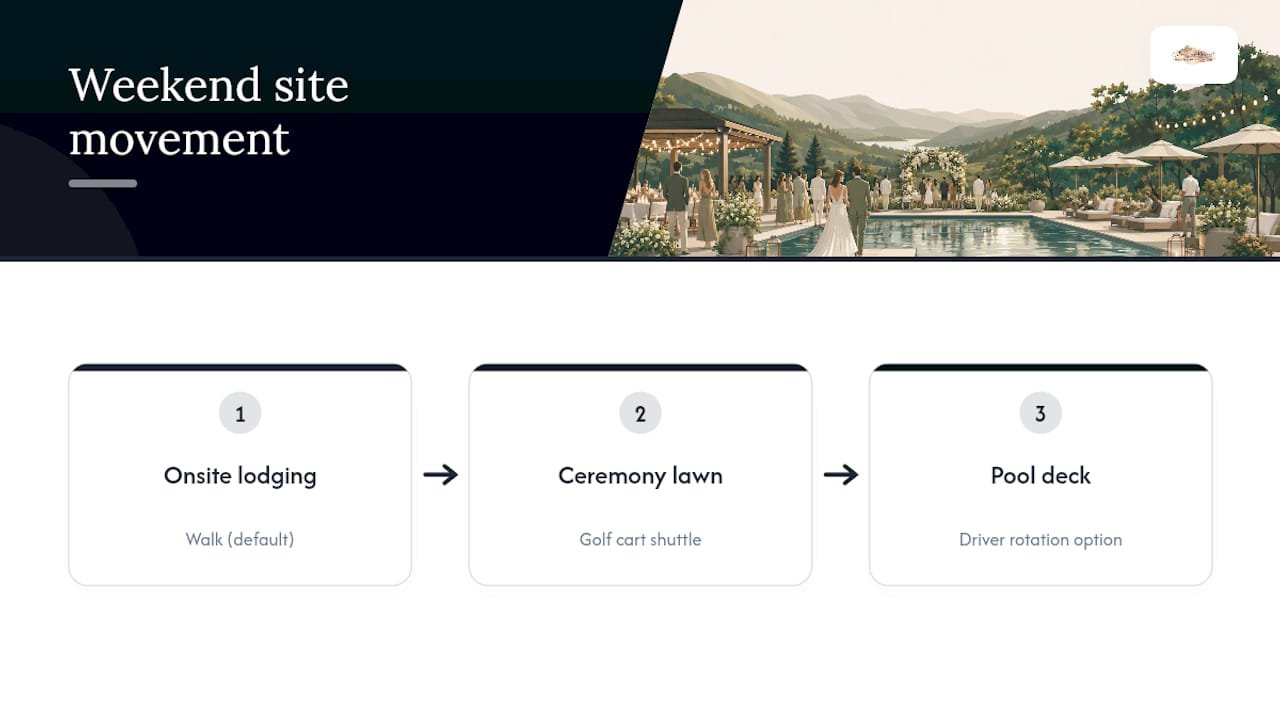
If your venue sits on acreage with multiple event spaces, confirm walking distances and surface conditions (gravel, grass, hills) in advance, especially for guests in formalwear or with mobility considerations. A short golf cart shuttle solves most of that friction for under the cost of a full transportation vendor.
A Planner’s Note on Pacing a Poolside Weekend
The biggest mistake couples make is over-programming the pool event, stacking games, a full menu, and loud music into one afternoon until nobody relaxes. Build in unscheduled time and let guests choose whether to swim, eat, or just sit.
— Luis
Book an Intimate Poolside Wedding Weekend at Cherrywood Ranch
This article describes an intimate ceremony with on-site lodging and a pool and hot tub built into the property instead of bolted on as an afterthought. That means no shuttling guests between a hotel and a rented event hall, no negotiating separate vendor contracts for lodging and ceremony space, and no guessing whether your pool event and your ceremony day will clash.
Events from the welcome gathering to recovery brunch sometimes happen on one property, with staff handling turnovers between events so hosts are not managing towels and drink refills themselves. Check available dates and see the pool and lodging setup for yourself on the Cherrywood Ranch destination wedding venue page.
Sources
- 21 Poolside Wedding Ideas We Love | Wedding Spot Blog
- Wedding pool party ideas in France | Photos Mariage
- Pool Party Wedding Italy | Destination wedding weekend inspiration