
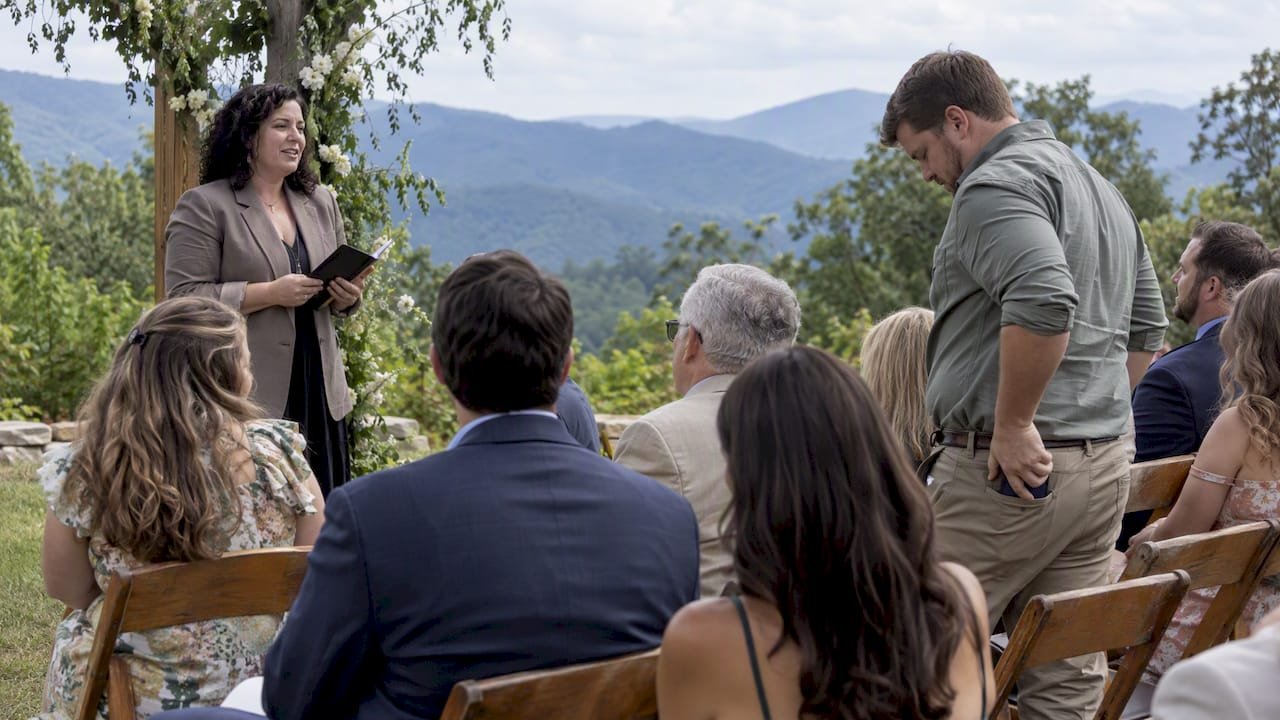
Good unplugged ceremony wording does three things: it gives a reason, names the exact window when phones stay away, and says when photos are welcome again. Say it in four places (website, sign, program and the officiant’s spoken line), and make the spoken line the one you rely on. Below you will find wording you can copy and adapt for each spot, plus advice on timing, tone and the guests who push back.
TL;DR
- Lead with the reason (“we want to see your faces”), then the rule, then the moment phones come back. That order feels like an invitation, not an order.
- Say “put away,” not just “silence.” If you also mean no video, livestreaming or posting, spell that out.
- Layer the message: website before the wedding, sign on arrival, one line in the program, and the officiant’s announcement after everyone is seated and before the processional.
- Name your photographer in the wording. Guests relax when they know the images will be shared.
- Leave a quiet path for guests who truly need a phone, such as a seat near the exit.
Table of Contents
- What an unplugged ceremony actually asks of guests
- Where to put the wording, and how long each version should be
- Wording for the officiant to say aloud
- Wording for your ceremony sign
- Wording for your program
- Wording for your wedding website and invitations
- Why the reason belongs in the wording
- Unplugged ceremony vs. phones allowed: which fits you
- Silent is not the same as unplugged
- Handling guests who need their phones
- How we think about unplugged ceremonies at Cherrywood
- Plan the whole weekend, not just the ceremony
- A simple timeline for communicating your unplugged request
- Common wording mistakes
- FAQ
- Sources
What an unplugged ceremony actually asks of guests
An unplugged ceremony is one where guests are asked to silence and put away phones and cameras, and to refrain from taking photos, recording video or livestreaming while the ceremony is happening. Vancity Officiant’s guide draws a useful line between silencing a device and putting it away, and recommends naming photography, video and livestreaming when privacy matters to you.
That distinction is the heart of good wording. Zola’s etiquette advice frames an unplugged wedding as a request that guests not use phones, cameras or other recording devices during the ceremony, so attendees stay present and the photographer gets clean shots. If your sign says only “please silence your phones,” a guest can reasonably hold up a silent phone and film the vows.
Three questions settle most of the wording before you write a word:
- When does it start and end? Usually from the processional until the recessional.
- What is covered? Phones, tablets, cameras, smartwatches, video, livestreams, social posts.
- When can guests pick their phones back up? Typically once you have walked back down the aisle, or at the reception.
Where to put the wording, and how long each version should be
Each location has different space and a different job. Shots Left’s wording guide recommends the website for explanation, the sign for a short reminder, the program for a single line and the officiant for the final spoken instruction. That split works well in practice.
| Where | Job it does | Length |
|---|---|---|
| Wedding website or FAQ | Explain the why, name the photographer | 2 to 4 sentences |
| Invitation insert or save-the-date | Plant the idea early | 1 sentence |
| Entrance sign | Remind on arrival | 2 short lines |
| Program or order of service | Quiet backup | 1 line |
| Officiant announcement | The one guests actually hear | 3 to 4 sentences |
The AMM officiant guide warns that guests may overlook website or invitation wording, and says the announcement should not wait until cameras flash or phones ring. Treat the written pieces as setup and the spoken line as the payoff.
Wording for the officiant to say aloud
This is the version that matters most. Have your officiant say it after everyone is seated and before the processional, as part of the housekeeping remarks. The AMM ceremony outline places the unplugged announcement before the formal ceremony begins, alongside logistics, and keeps the vows themselves focused on the couple. Do not wedge the phone request into the vows.
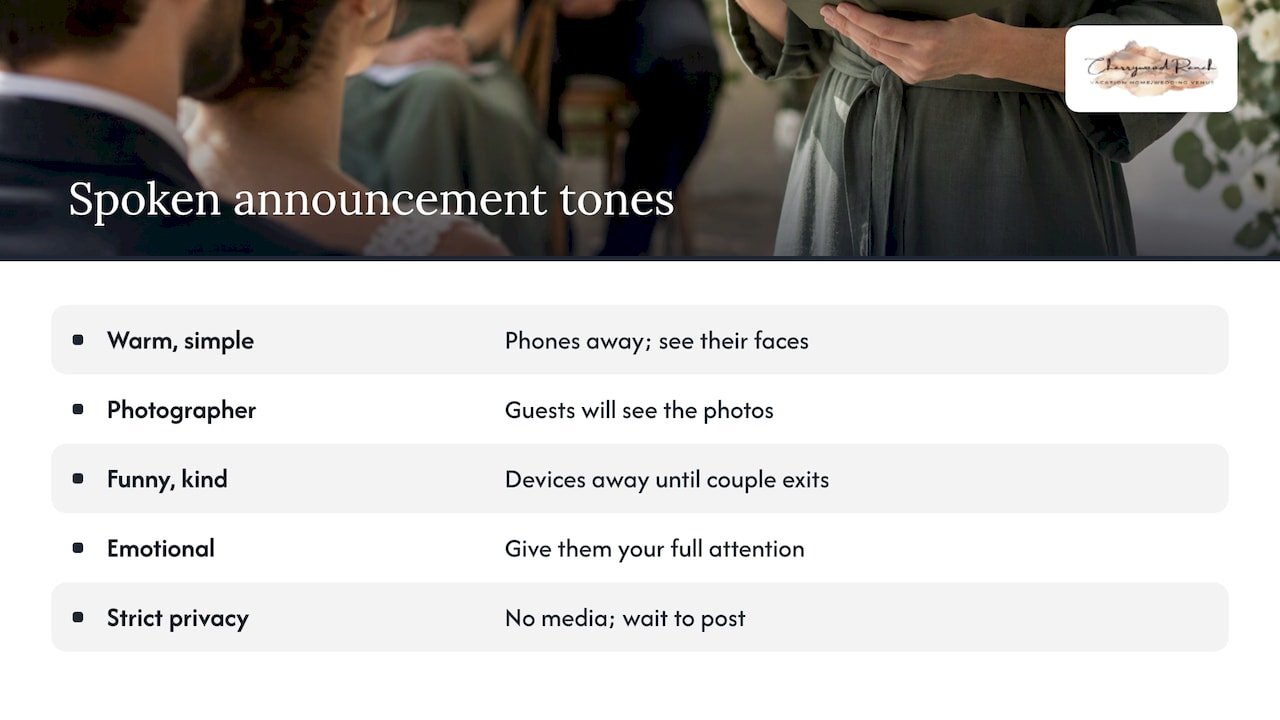
Pick the tone that sounds like you. Here are five spoken options, written fresh so you can adjust names and details.
Warm and simple
“Before we begin, [Name] and [Name] have a small favor to ask. Please turn your phones off or silence them, and tuck them away until the ceremony ends. They want to look out and see your faces, not your screens.”
With the photographer named
“[Name] and [Name] have hired [Photographer] to capture every moment, and you’ll all get to see the photos. For the next twenty minutes, they’d love for you to put your phones and cameras away and simply be here with them.”
Funny but kind
“If you’ve ever wanted to be in the front row of something without holding a phone, today is your day. Please put your devices away until the couple walks back up the aisle. Then photograph everything. We promise to wait.”
Emotional
“You are here because you are loved by these two. In this moment, the best gift you can give them is your full attention. Please put your phones away until the ceremony is over.”
Strict (when privacy matters)
“Please put away all phones, tablets, smartwatches and cameras. There is no photography, video or livestreaming during the ceremony, and please don’t post anything until the couple has shared their own photos. Thank you for respecting that.”
Two delivery tips. First, ask your officiant to say it conversationally. The AMM officiant-preparation guidance recommends reading a ceremony aloud during revisions because wording that looks elegant on paper can sound stiff when spoken. Run the same test on your announcement, and rehearse the handoff into the processional so it doesn’t feel like a stop sign. Second, ask the officiant to smile and pause when they finish. A beat of silence is what signals everyone to actually reach for the pocket.
Wording for your ceremony sign
Signs work because they are seen at the exact moment guests walk in. Keep them short and welcoming. Jason Anderson Photography’s guide suggests the request works best in two or three places and that the one guests really hear is a short spoken line, so treat the sign as a nudge, not the whole plan.
Sign options you can adapt:
- “Our ceremony is unplugged. Please put your phones away and be here with us. Photos are welcome at the reception.”
- “We’d love to see your faces, not your screens. [Photographer] has the ceremony covered.”
- “Today you’re a guest, not a photographer. Phones away until we walk back down the aisle.”
- “Be present with us. Phones and cameras away until the recessional.”
- “The best seat in the house comes with no screen. Please enjoy it.”
Place one at the ceremony entrance and one at the welcome table or on an easel near the first row. If you are hosting outdoors, put it where guests stop to get a program or a seat, so no one walks past it.
Wording for your program
Programs have little room, so one line is enough. Something like “Unplugged ceremony: phones away until the recessional” does the job. If you also restrict recording and posting, expand it a little:
“Please silence and put away phones, smartwatches and cameras from the processional through the recessional. Photos are welcome at the reception.”
Daisychat’s wedding wording roundup makes the same point that the clearest wording names a specific window and then says when photos are welcome again. The program line should echo your sign and your officiant, so guests hear one consistent rule.
Wording for your wedding website and invitations
Your website is the place for the reason. Guests who understand the why are far more likely to comply than guests who simply see a rule. Try:
“We’ve chosen to have an unplugged ceremony. [Photographer] will be capturing everything, and we’d love to look out and see your faces instead of a row of screens. Please keep phones and cameras put away until we walk back down the aisle. After that, photograph away.”
For a save-the-date or invitation insert, one line is plenty: “We’re keeping our ceremony unplugged. Your presence is our favorite present.”
If you want to cover a destination wedding, add a sentence about the keepsake. Vogue’s explainer notes that trust in the professional photographer is part of the wording strategy: guests are more receptive when they learn the photographer is documenting the ceremony and images will be shared afterward, especially when relatives traveled a long way. A promise like “We’ll share the gallery within [timeframe] of the wedding” works only if you can keep it, so ask your photographer for their delivery window first.
Why the reason belongs in the wording
Couples sometimes worry that asking guests to put phones away sounds controlling. The reason is what makes it feel generous. Wedding professionals quoted by The Knot describe the purpose as connection rather than disconnection: guests set technology down so they can take part in real time. The same piece warns that guests leaning into the aisle for “the shot” can block the professional photographer’s view of the processional or first kiss.
There is a benefit for you, too. In the Vogue piece, photographer Kara McCurdy explains that removing phones increases guests’ presence and takes pressure off the couple to perform for unofficial cameras. Her practical advice is to choose a photographer you trust completely before asking guests to rely on the professional images.
Photographers notice the difference visually, too. Meghan LaRosa tells The Guardian that without phones she can see guests’ real faces. That matters most outdoors, where raised phones and tablets stand out against a sunset or a mountain backdrop.
The wish to be present is not unique to land weddings. Couples planning yacht weddings with small guest lists face the same tension: when only a handful of people are on board, every phone in the frame is very noticeable. The smaller the group, the more each guest’s attention matters.
Unplugged ceremony vs. phones allowed: which fits you
This is not all or nothing. You have a spectrum.
| Approach | What guests do | Best for |
|---|---|---|
| Fully unplugged ceremony | Phones away, no photos or video | Intimate ceremonies, outdoor scenic shots, couples who hired a photographer |
| Unplugged ceremony, phones at reception | Phones away until the recessional | Most couples |
| Partial unplugged | Phones away for ceremony, first dance and cake cutting | Couples who want phones during cocktail hour |
| Phones allowed, no flash, no aisle | Guests may photograph from their seats | Couples without a hired photographer |
The middle options are common. One couple reported by AP News restricted phones during a 15-minute ceremony, first dance and cake cutting while allowing them during cocktail hour and the rest of the reception. If you are hosting a multi-day wedding, state whether the rule applies only to the ceremony or also to other planned moments, so a rehearsal dinner toast doesn’t cause confusion.
Silent is not the same as unplugged
The most common wording mistake is using “silent” when you mean “away.” Zola notes that you should say exactly which actions you mean, whether photos, video, livestreaming or social posting. Otherwise guests may reasonably read the request as simply turning off ringers.
Quick checklist for your final wording:
- Does it say put away, not only silence?
- Does it name the start (processional) and the end (recessional)?
- Does it include smartwatches if you care about them?
- Does it say whether posting to social media is okay, and when?
- Does it say when photos are welcome again?
- Does it mention the photographer and that images will be shared?
Handling guests who need their phones
Some guests have a real reason to keep a phone close: a parent on call for a babysitter, someone expecting an urgent call, an older relative who uses a phone for medical alerts. Brides advises etiquette that understands those needs rather than demanding anyone surrender a device. A seat near an exit or a designated trusted contact lets those guests step out quietly without breaking the mood.
You can build that into the wording: “If you need to stay reachable, please let [Name] know and we’ll save you a seat near the back.” It signals that the rule is about warmth, not control.
For the occasional guest who ignores the request, assign one friendly person, such as a sibling or friend, to gently remind. Do not ask the officiant to call someone out mid-ceremony. A quick, kind word before the processional does far more than a scolding after it starts.
How we think about unplugged ceremonies at Cherrywood
Our venue hosts private wedding weekends in the North Georgia mountains, with lodging for up to 16 guests on site. That setup changes the unplugged conversation in a few ways, and we want to share what we see.
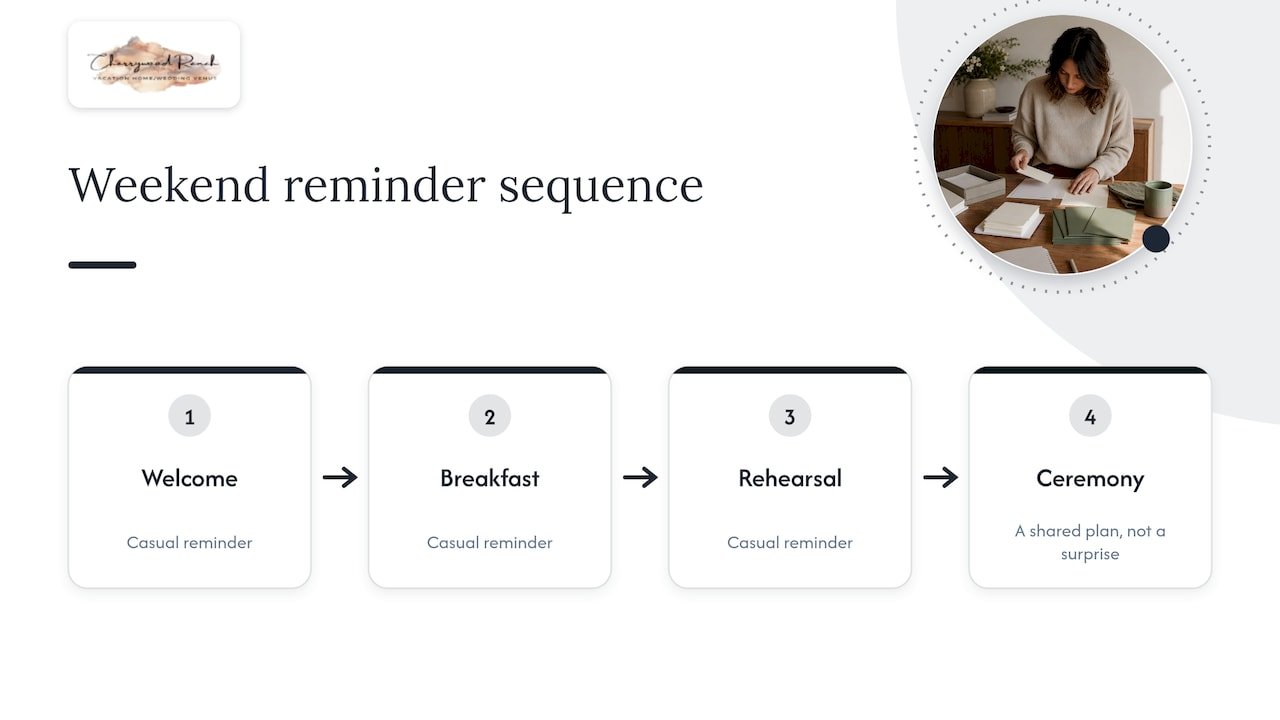
First, your guests aren’t strangers arriving for an hour. Many of them stay at the property, so you can reinforce the message casually the day before: at a welcome gathering, over breakfast, at the rehearsal. By the ceremony, the request has been heard three times and feels like a shared plan, not a surprise. If you are planning that opening evening, our welcome party ideas and at-home rehearsal dinner run sheet are good places to slot in the reminder.
Second, the setting is the reason. Mountain views and sunsets are the backdrop of your ceremony, and a screen held up in the middle of that picture is the thing couples tell us they regret. Framing the request around the view and the people usually lands better than any rule.
Third, a weekend wedding lets you be flexible. You might keep the ceremony fully unplugged and then invite everyone to shoot freely at a sunset family portrait session or around the pool. Planning that in your wedding weekend photo timeline gives guests a clear moment to take their own pictures, which makes the quiet window easier to honor.
Our advice is simple: write the wording last, after you know your photographer, your timeline and your guest list. Then say it warmly, say it out loud, and say what comes next.
— Luis
Plan the whole weekend, not just the ceremony
If you are weighing venues for a small wedding where phones-away feels natural, we host elopements, micro weddings and three-day wedding weekends in the North Georgia mountains. Our published rates include a day session at $1,950 per day, an hourly option at $350 per hour and a mini session at $175, with guest fees of $10 per guest over 10 and over 75 listed on our services page. You can see current details on our services page or book your stay. If you are still deciding on size, our guide to choosing between a micro wedding and an elopement can help.
A simple timeline for communicating your unplugged request
Layering is the most reliable pattern, and the AMM guidance recommends mentioning the request before the wedding, repeating it on arrival, and having the officiant say it after guests are seated and immediately before the processional. Here is how that looks in practice:
- Six to eight weeks out: add a line to your website FAQ and, if you like, an insert in the invitation.
- Two weeks out: send a short message with logistics, including the photographer’s name and when guests will see photos.
- The day before: remind guests casually at your welcome event or rehearsal dinner.
- Arrival: place the sign at the entrance and print one line in the program.
- Five minutes before the processional: the officiant makes the announcement.
- At the recessional: the officiant says, “You may pick up your phones and photograph the couple on their way out,” or whatever matches your plan.
That final line is a small touch that makes a big difference. It turns the end of the quiet window into a moment of release, and guests tend to enjoy it.
Common wording mistakes
- Sounding like a threat. Phrases like “any guest caught” backfire. Lead with warmth.
- Being vague. “Please be mindful of technology” tells nobody what to do.
- Forgetting the end. If guests don’t know when phones return, many will hold them out of habit during the processional.
- Using too many signs. One at the entrance and one at the seating area is enough.
- Skipping the spoken line. The written pieces are easy to miss. Say it out loud.
- Promising photos you can’t deliver. If you tell guests the photographer will share images, confirm the delivery timeline first.
FAQ
What should you say to guests about an unplugged ceremony?
Keep it to a reason, a request and an end point. For example: “We want to see your faces during our ceremony, so please put your phones away until we walk back down the aisle. Photos are welcome at the reception.” Say it on your website, on a sign and aloud from your officiant.
When should the officiant make the unplugged announcement?
After guests are seated and before the processional begins, as part of the short housekeeping remarks. That timing catches everyone while their phones are still in hand, and it keeps the request out of the vows themselves.
Does an unplugged ceremony mean no phones all day?
No. Most couples limit it to the ceremony, from the processional to the recessional, and many allow phones at the cocktail hour and reception. If you want other moments covered, such as the first dance, say so in your wording.
How do you handle guests who need to keep their phones?
Ask them to tell a trusted person ahead of time, and offer a seat near an exit so they can step out quietly. Etiquette guidance favors understanding real needs over demanding that phones be handed over.
Sources
- Vancity Officiant: What Is an Unplugged Wedding Ceremony?
- AMM: What to Say at the Start of an Unplugged Wedding Ceremony
- AMM: Wedding Ceremony Outline and Order
- AMM: Officiant Ceremony Preparation
- Zola: Unplugged Wedding, How and Why to Ban Phones
- Shots Left: Unplugged Ceremony Wording
- Jason Anderson Photography: Unplugged Wedding Ceremony Guide
- Daisychat: Unplugged Wedding Wording
- Vogue: Should You Have a Phone-Free Wedding Ceremony?
- The Knot: Hosting an Unplugged Wedding
- The Guardian: Unplugged weddings and the no-photos rule
- AP News: Here comes the bride, down go the phones
- Brides: Enforcing an Unplugged Ceremony