
Most rehearsal dinners happen the evening after the ceremony rehearsal, usually the night before the wedding, and run about 2–3 hours. Dinner commonly starts around 6–7 p.m., so plan a 45–60 minute buffer between the end of the rehearsal and the first guest sitting down. That gap covers travel and a quick freshen-up.
TL;DR:
- A plated dinner with three courses needs about 90 minutes from seating to dessert, while a buffet can serve guests in 30–40 minutes.
- Keep individual toasts to 2–3 minutes and the full program near 15–20 minutes, with one emcee managing speakers after dessert or between courses.
- Reserve the venue and set the budget 3–6 months ahead, send invitations 4–6 weeks before, and give the caterer final counts two weeks out.
- For outdoor dinners, choose an indoor backup and a forecast decision time in advance; schedule lawn or porch toasts before sunset and provide wraps.
- When rehearsal and dinner share a property, a 30–45 minute changeover may be enough; otherwise, extend the buffer for drives longer than 15–20 minutes.
Table of Contents
- Three copy-ready rehearsal dinner schedules
- What to book and when: a planning checklist
- Who to invite, sample wording and how to handle RSVPs
- How long speeches should run and who goes first
- Rehearsal length, travel time and day-of checks
- Menu planning and catering that fit your timeline
- Using your venue’s outdoor spaces in the evening schedule
- Coordinating transportation and lodging for guests who stay on site
- Activity ideas for a scenic mountain dinner
- Planning around mountain weather and outdoor timing
- Weekend planning from the host’s point of view
- Planning a rehearsal dinner with us at Cherrywood Ranch
- FAQ
- Sources
Three copy-ready rehearsal dinner schedules
A model seated timeline from Glamour runs from a rehearsal at 5:00 to a wrap-up by roughly 9:30–9:45. We used that shape as the base for the formal column below and adjusted the other two styles to fit how each one actually feels. Copy whichever fits your evening into your run sheet or coordinator notes.
| Time | Formal seated | Casual buffet or backyard | Destination or weekend |
|---|---|---|---|
| 5:00 p.m. | Ceremony rehearsal begins | Ceremony rehearsal begins | Rehearsal at the venue, earlier if guests arrive by midday |
| 6:00 p.m. | Rehearsal ends, travel and freshen up | Rehearsal ends, short break | Welcome drinks on the lawn or porch |
| 6:30 p.m. | Cocktail hour begins | Guests arrive, mingling and drinks | Guests gather, host welcome |
| 7:30 p.m. | Seating and first two toasts | Buffet opens | Seated or family-style dinner |
| 7:45 p.m. | Appetizer and main course | Open toasts between plates | Dinner service continues |
| 9:30 p.m. | Dessert and final toasts | Dessert and last toasts | Dessert, toasts and slideshow |
| 9:30 p.m. | Coffee, mingling, wrap-up | Wrap-up for out-of-towners | Fire pit or free time, early night |
A few notes on how to use each style:
- Formal seated: Keep the cocktail hour to 60 minutes and the first toasts short so the kitchen can fire the main course on time.
- Casual buffet: Let guests drift in over a 30-minute window and keep toasts open-mic so nobody feels scheduled.
- Destination or weekend: Start with an activity or welcome drink, because guests who traveled all day want to settle in before they sit down.
- Any style: Print the times, hand a copy to your caterer and your emcee, and leave some slack before dessert.
What to book and when: a planning checklist
Work backward from the date and the evening takes care of itself. Start rehearsal dinner preparations 3–6 months before the wedding, and send invitations about 4–6 weeks ahead. Here is the order we suggest:
- 3–6 months out: Decide who is hosting, reserve the space, and set a budget and date that sits comfortably with the rehearsal time.
- 2–3 months out: Settle the menu, prepare invitations or wedding-weekend inserts, line up your speakers, and decide on any gifts for the wedding party.
- 4–6 weeks out: Send the invitations, with RSVP details and a note on dress code and location.
- 2 weeks out: Confirm RSVPs and dietary needs, give the caterer a headcount, and share the run sheet with vendors and speakers.
- The day before: Confirm arrival times, gifts, place cards and any rentals, then send one last reminder message to the group.
Treat that checklist as a rolling list. If the wedding is coming up soon, combine the first steps and adjust the rest to suit your timeline.
Who to invite, sample wording and how to handle RSVPs
The guest list typically includes immediate family, the wedding party, anyone involved in the ceremony rehearsal, and out-of-town guests. Plus-ones for wedding party members are optional; match whatever rule you used on the wedding invitations so no one feels singled out.
Keep the invitation wording concise: hosts’ names, date, time, location, RSVP details and the wedding website. Paper invitations are standard, though digital ones work fine when time is short.
- Formal: “Mr. and Mrs. Smith request the pleasure of your company at a rehearsal dinner honoring Anna and James, Friday, June 12, at 6:30 p.m.”
- Casual: “Join us for a backyard dinner the night before Anna and James’s wedding. Friday, June 12, 6:30 p.m. Please let us know by May 29.”
- Email: “Hi all, we’re hosting a rehearsal dinner on Friday, June 12, at 6:30 p.m. at the ranch. Reply to this email by May 29 with your headcount and any dietary needs.”
RSVPs are often handled informally. Hosts can collect replies by phone, email or a wedding website link, whichever your guests actually use.
How long speeches should run and who goes first
Toasts are the part of the night most likely to drift. Event planners advise about 2–3 minutes per speech, with a total of around 15–20 minutes so the evening stays lively and intimate.
A workable speaking order:
- The host, traditionally a parent of the groom, opens and welcomes everyone.
- The couple’s parents say a few words.
- The wedding party speaks, with the maid of honor and best man taking the longest turns.
- Friends and extended family follow, by invitation only.
- The couple closes with thank-yous and a toast to the guests.
Pro Tip: Choose one emcee, tell speakers their slot in advance, and schedule toasts after dessert or between courses so food never goes cold.
Limiting the number of speakers is the simplest fix of all. A few well-prepared toasts beat a long string of rambling ones, and nobody will remember the toast that did not happen.
Rehearsal length, travel time and day-of checks
The ceremony rehearsal itself usually takes 30–60 minutes. Build in a 45–60 minute buffer before dinner, and stretch it if the drive between sites exceeds 15–20 minutes. Share the route and parking details with guests in advance, especially anyone arriving from out of town.
On the day, run through this short list:
- Pick up gifts, place cards and any signage or printed run sheets.
- Confirm each speaker’s slot and give them the time limit again.
- Send the caterer or kitchen a final headcount.
- Name an emcee or point person who keeps the schedule moving.
- Check the seating chart so the wedding party and parents sit together.
- Charge a phone or speaker if you plan to play music or a slideshow.
If anything slips, cut cocktail time before you cut dinner. Guests forgive a short drink hour much faster than a late meal.
Menu planning and catering that fit your timeline
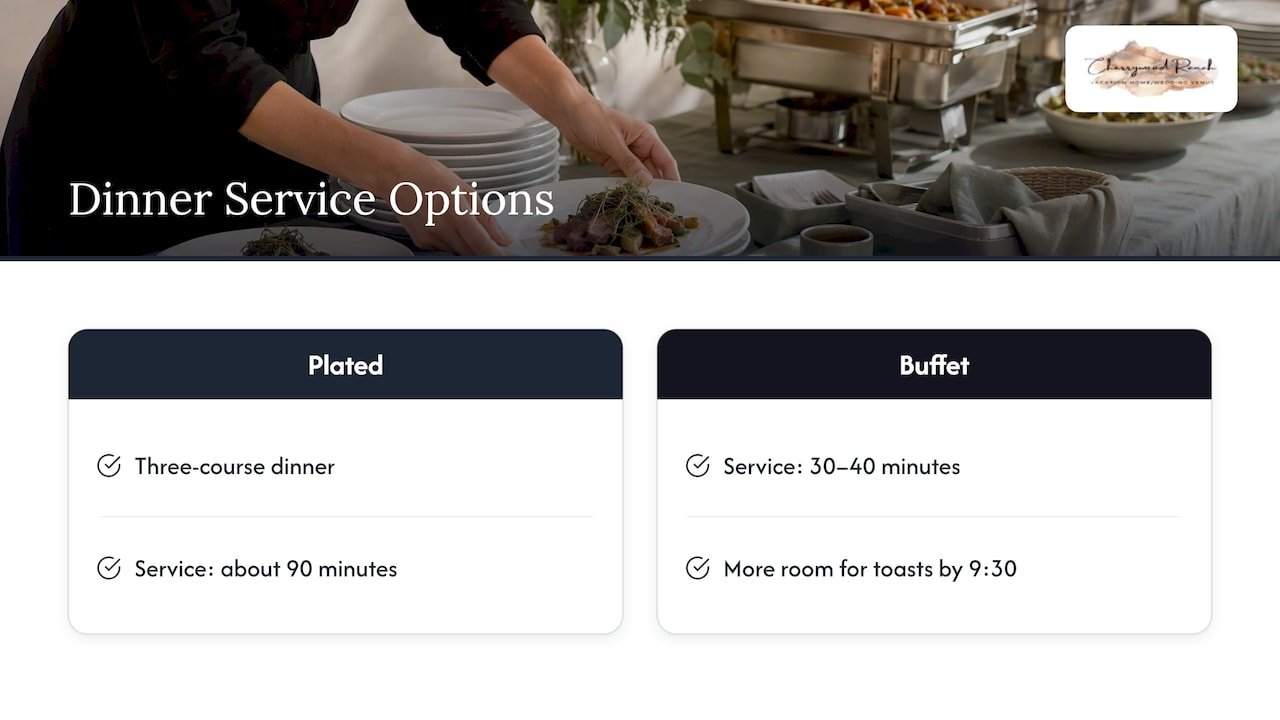
Your menu decides your timeline more than almost anything else. A plated three-course dinner needs about 90 minutes between seating and dessert, while a buffet can move guests through in 30–40 minutes. If you want the evening to end by 9:30 p.m., a buffet or family-style meal gives you more room for toasts.
Tell your caterer your exact start time and the toast windows so the kitchen can pace courses around them. Ask whether appetizers can be passed during the cocktail hour, which lets guests mingle and keeps the first service from bunching up.
Match the food to the mood. A formal seated dinner suits a limited menu with entrée choices collected on the RSVP. A casual evening works well with regional favorites, such as barbecue, sides and a dessert table. For a weekend gathering, think about comfort food that travels well and holds on a warming tray, because guests will have their own schedules and arrive in waves.
Finally, ask about dietary needs when you collect RSVPs, not at the table. A short note on the invitation, such as “tell us about allergies when you reply,” saves the kitchen a scramble and keeps the evening on schedule.
Using your venue’s outdoor spaces in the evening schedule
A setting with mountain views gives you more to schedule than a restaurant back room. At our ranch, guests can use the outdoor spaces and resort-style features, including the pool and hot tub, so build them into the plan instead of leaving them to chance.
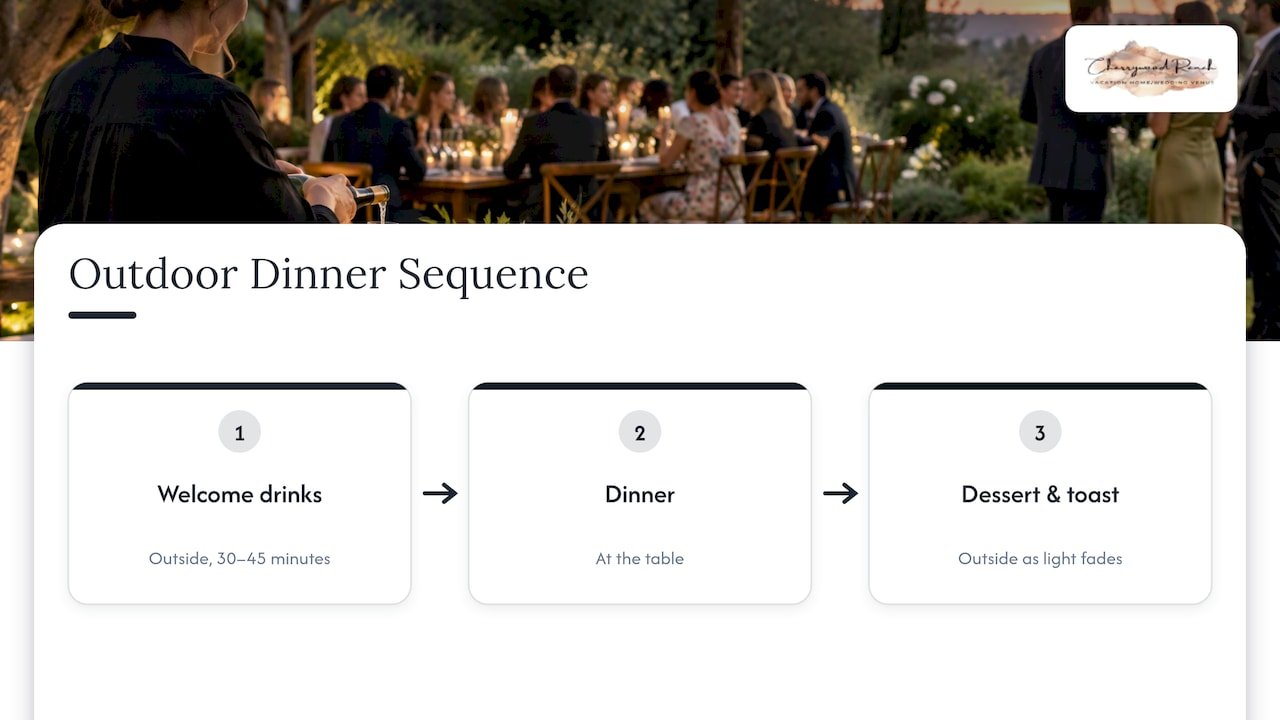
A simple approach is to start the evening outside. Welcome drinks on the lawn or porch fill the first 30–45 minutes while the last guests arrive, and the views do the entertaining. Move the group to the table for dinner, then bring everyone back outside for dessert and a final toast as the light fades.
Because we offer lodging on the property, the wedding party can walk from their rooms to dinner without worrying about drives or parking. That changes the math on your buffer: when the rehearsal and the dinner happen in the same place, a shorter gap of 30–45 minutes can be enough for everyone to change.
If you are hosting a smaller dinner at the house itself, our at-home rehearsal dinner run sheet walks through how we pace the evening. Keep the pool and hot tub for the next day or for late guests, and let the dinner stay the main event.
Coordinating transportation and lodging for guests who stay on site
When guests sleep where they dine, transportation becomes a small problem instead of a big one. Even so, plan it deliberately. Send a short arrival guide with check-in times, parking, room assignments and the dinner start time well ahead.
Assign rooms ahead of time so no one stands in the driveway deciding. Put early arrivals and late arrivals in separate parts of the house if you can, and tell the late group when the toasts begin so they can join without interrupting.
For guests staying off site, arrange a shared ride or a designated driver list, especially if the roads are winding or dark after dinner. A small group chat or a one-page printout with phone numbers helps everyone find their way back.
If you are building a full wedding weekend, our guide to coordinating a multi-day wedding celebration shows how to stack arrivals, dinner and the next morning. For travelers, destination wedding etiquette covers the small kindnesses that make out-of-town guests feel looked after.
Planning an itinerary across several days, including transfers? Hidden Door Travel’s destination wedding timeline breaks the work into planning windows you can borrow.
Activity ideas for a scenic mountain dinner
You do not need a program to fill a mountain evening, but a few light ideas keep the energy up between courses. Pick one or two, not all of them.
- Lawn games before dinner: Cornhole, ring toss or bocce give guests something to do while they wait for the group to gather.
- Sunset toast: Move the first toast to the porch or lawn when the light is best, then walk everyone inside.
- Photo slideshow: Play childhood photos of the couple during dessert, on a small screen or projector.
- Fire pit time: After dinner, offer s’mores and coffee outdoors for anyone who is not ready to leave.
- Story circle: Invite guests to share a favorite memory of the couple while they eat dessert.
For guests who want to stay engaged for a short window, our welcome party ideas are written for a 2–3 hour evening. If you plan to have a photographer join, our wedding weekend photo timeline helps you decide when to capture the dinner without pulling people away from it.
Planning around mountain weather and outdoor timing
Mountain weather changes quickly, so decide in advance what happens if it turns. Temperatures drop after sunset even in warm months, and a clear afternoon can end with an evening shower. Build a backup into the schedule instead of improvising at 6:30 p.m.
Set a decision time, such as 3:00 p.m., when the host and the venue contact check the forecast and choose indoor or outdoor seating. Tell guests and vendors at the same time. If you have an outdoor cocktail hour, identify the covered space where everyone will move if it rains.
Think about light and temperature too. Sunset times shift through the year, so look up the exact time for your date and schedule outdoor toasts before it. Offer blankets or wraps for cooler evenings, and have bug spray and water on hand during warmer months.
Keep dessert and the last toast flexible. If the weather is perfect, linger outside; if it is not, move the final moments indoors and let the evening finish early. A good timeline works as a guide, and a good host knows when to bend it.
Weekend planning from the host’s point of view
A rehearsal dinner is the opening scene of the wedding weekend, and it sets the pace for everything that follows. Guests who arrive tired and leave late tend to show up the next day tired too. Keeping the evening to about 2–3 hours, with a firm wrap-up, is a gift to everyone, including the couple.
Our view is that the schedule matters more than the menu or the décor. Guests remember whether they felt welcome, fed on time and free to talk, and a plain run sheet delivers all three.
- Use the sample timelines above as the first page of a full weekend itinerary.
- Share the itinerary with the wedding party and vendors early.
- Read our venue weekend planning resources to stack arrivals, dinner, ceremony and brunch.
— Luis
Planning a rehearsal dinner with us at Cherrywood Ranch
If you want the rehearsal, dinner and a full wedding weekend in one place, we host private mountain celebrations in North Georgia with lodging for up to 16 guests, outdoor spaces, a pool and a hot tub. That means no shuttle between sites and a buffer you can shorten, because everyone is already on the property. You can see our venue with lodging in Georgia, compare our wedding services, or book your stay to check dates for your wedding weekend.
FAQ
How many days before the wedding is the rehearsal dinner?
It is usually held the evening before the wedding, right after the ceremony rehearsal. Some couples hold it earlier when guests arrive from far away or the wedding day is packed.
How long does a rehearsal dinner typically last?
Plan for about 2–3 hours from the first drink to the last goodbye, according to etiquette guidance from ThePerfectWedding.com. Shorter buffets can wrap closer to 2 hours.
Is it okay to skip the rehearsal dinner?
Yes. It is a tradition, not a requirement. If you skip it, a simple welcome gathering or a casual meal with the wedding party still gives everyone a chance to connect before the big day.
Who should be invited to a rehearsal dinner?
Start with immediate family, the wedding party and anyone taking part in the ceremony, then add out-of-town guests. Brides lists these groups as the usual core, and plus-ones follow the couple’s preference.
Sources
- How to plan a rehearsal dinner: your complete guide to the perfect pre-wedding celebration
- Your Step-by-Step Rehearsal Dinner Checklist to Easily Plan
- The Rehearsal Dinner: 6 Steps to a Flawless Wedding Weekend Kick-Off
- Who to Invite to Your Rehearsal Dinner: Everything You Need to Know