
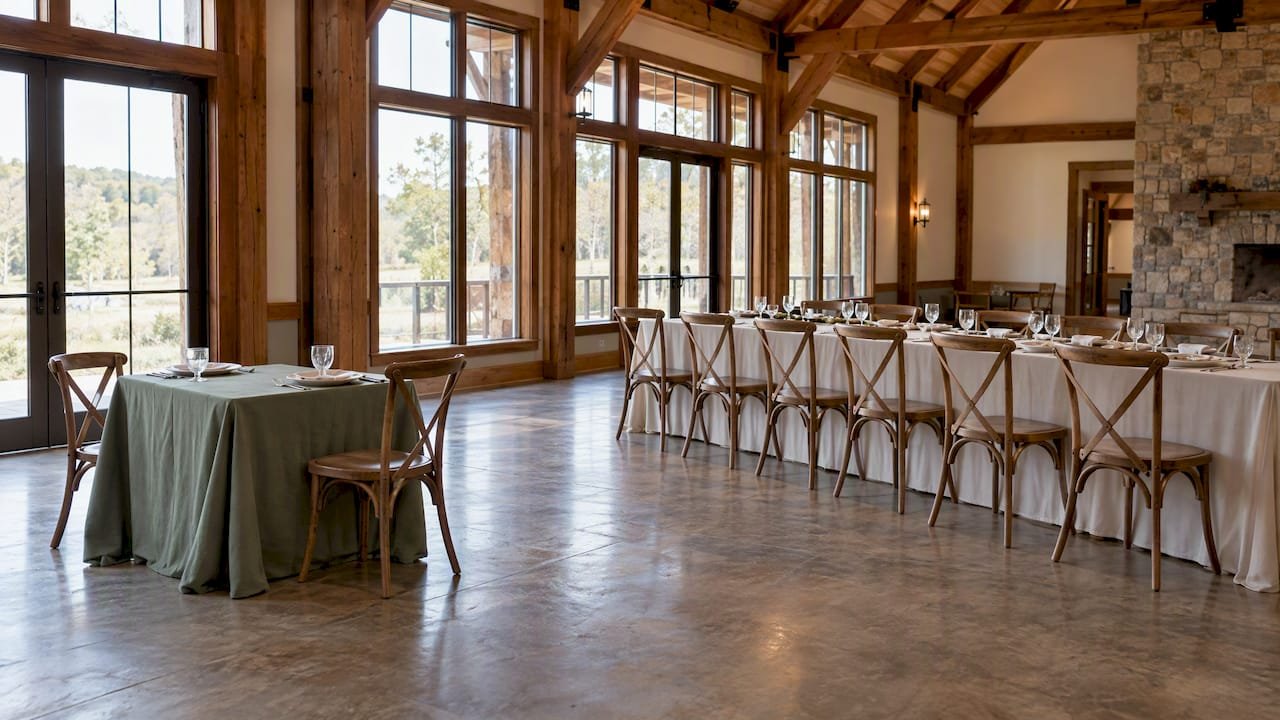
Choose a sweetheart table if you want a private moment, a small footprint, and your wedding party seated with their dates. Choose a head table if you want your people beside you and a ceremonial focal point for toasts and photos. Decide by checking three things: whether partners are attending, how much floor space you have, and how much you want to be on display.
TL;DR:
- If most wedding party partners are attending, include them at a head table or use a hybrid; otherwise, a sweetheart table avoids separating couples.
- When the venue is near capacity, choose the sweetheart layout; a head table for 8 to 12 people needs much more floor space.
- A hybrid keeps the couple at a sweetheart table beside the wedding party, preserving dinner privacy while keeping friends close and in photographs.
- Head tables create a natural stage for toasts, but long rows limit conversation to nearby seats and can leave plus ones isolated.
- A sweetheart table needs one focal arrangement, while a head table takes longer floral runners; styling every side raises cost and complexity.
Table of Contents
- 1. How do sweetheart and head tables compare at a glance?
- 2. What is a sweetheart table, and when does it work best?
- 3. What is a head table, and when does it work best?
- 4. Which three questions settle the choice?
- 5. How much space do the two layouts need?
- 6. How do decor and cost change between the two?
- 7. Who sits where, and what about plus-ones?
- 8. How do photos, toasts, and timing play out?
- 9. Where did sweetheart and head tables come from?
- 10. Where do these tables usually go in the room?
- 11. What are the alternatives to a sweetheart or head table?
- 12. My take on seating at a mountain wedding weekend
- 13. Plan your seating at Cherrywood Ranch
- FAQ
- Sources
1. How do sweetheart and head tables compare at a glance?
| Sweetheart table | Head table | |
|---|---|---|
| Intimacy | High, just the two of you | Lower, shared with the party |
| Wedding-party logistics | Party sits with their dates | Party sits in one row, dates may be elsewhere |
| Floor-space footprint | Small | Large |
| Decor and floral cost | Lower, one focal piece | Higher, longer runs of decor |
| Photo and visibility | Clear view of the couple alone | Strong group focal point |
A head table commonly seats four to ten people at joined banquet tables, while a sweetheart table is usually a 48-inch round or a table built for two.
- Sweetheart take: private, flexible, easy to place.
- Head table take: social, ceremonial, space-hungry.
2. What is a sweetheart table, and when does it work best?
A sweetheart table seats just the two of you, usually facing your guests. Most couples use a small round or a short rectangle built for two.
Couples choose it for a few reasons:
- You get real time together on a day that moves fast. Sitting together lets the couple actually talk during the reception.
- Wedding-party members stay beside their partners instead of being split up.
- It can ease family friction, since everyone else sits where they feel most comfortable.
- It tucks into tight rooms and needs less floral styling.
Keep it reachable. Guests should be able to walk up for a quick hello, and your photographer needs a clear angle. Seat your wedding party at nearby tables rather than in a long front row, so the couple still feels connected to them.
Pro Tip: Set out two extra chairs or stools near your table after dinner so guests can sit for a minute without hovering.
3. What is a head table, and when does it work best?
A head table puts you with some or all of your wedding party in one row. Head tables can be built many ways: the couple with honor attendants, the whole party, or immediate family. Variants include the traditional one-sided row, a king’s table that seats a dozen or more, and mixed family tables. A king’s table is a large rectangle, often placed centrally for dramatic effect.
The upside is energy. Everyone you love sits in one visible spot, and toasts and speeches have a natural stage.
The trade-offs are practical:
- It consumes a lot of floor space.
- Conversation across a long row is hard, since you mostly talk to the people beside you.
- Plus-ones can end up isolated if they sit elsewhere.
- Seats at the ends feel far from the middle of the action.
Pick a head table when your party is close, mostly single or all attending together, and the room can handle the length.
4. Which three questions settle the choice?
Run through these in order. Most couples have their answer by the third.
- Are most wedding-party partners attending? If yes, lean toward a head table that includes them or a hybrid. If no, a sweetheart table is simpler.
- Is the room tight or roomy? If the venue is near capacity, go sweetheart. If floor space is abundant, a head table is workable.
- Do you want a private sit-down moment with your partner? If yes, choose the sweetheart table. If you want a party atmosphere around you, choose the head table.
For a hybrid, seat the two of you at a sweetheart table and place your wedding party at a long table right beside it. You get privacy at dinner and your people stay in the frame. In a poll of 116+ U.S. venue owners, about 67% preferred the sweetheart table versus 22% for a traditional head table.
5. How much space do the two layouts need?
Draw both on your floor plan before you commit. A few checks help:
- Seat count: your guest-table needs shrink or grow depending on where the couple and party sit. A big head table can cost you the equivalent of one guest table.
- Footprint: a sweetheart table fits in a much smaller footprint, even dead space. A head table for 8 to 12 people needs far more room.
- Clearance: leave enough room behind the head table for servers and guests to pass.
- Width math: allow enough space for each person along a long table, then compare the total to your wall length.
Do keep sightlines open to the dance floor and keep your backdrop free of exit signs. Don’t block service aisles or crowd the dance floor with a long row.
6. How do decor and cost change between the two?
A sweetheart table needs one focal treatment, so a modest garland or a few bud vases often do the job. A head table needs longer runners and more flowers to look finished. Exact prices vary by florist and region, so ask your florist to quote both options for your room.
| Decor element | Sweetheart table | Head table |
|---|---|---|
| Floral scale | One compact arrangement | Long runs across the full table |
| Viewing angle | Usually one side | One side or all sides |
| Design effort | Low | Higher |
Viewing from all sides raises cost and complexity, because every angle needs styling. One-sided viewing keeps you in budget.
Savings tactics that work:
- Reuse your ceremony bouquets as table pieces.
- Run a low garland instead of tall centerpieces.
- Space bud vases strategically so the table looks full without a florist-built runner.
For dessert and favor ideas to pair with your table styling, this wedding dessert table guide has useful inspiration.
Pro Tip: Put your biggest floral investment where the photographer will point the camera, then keep everything else simple.
7. Who sits where, and what about plus-ones?
Seating etiquette has softened. Many modern couples prioritize guest comfort and choose seating based on who they want nearby, not strict tradition.
- Include wedding-party plus-ones at the head table when you can. If you can’t, pick a sweetheart table so no one sits apart from a date.
- Seat divorced parents at separate tables with people they enjoy.
- Don’t “rank” guests. Seat people by comfort and familiarity.
- Keep honor attendants close, wherever the table lands.
8. How do photos, toasts, and timing play out?
Placement shapes what your photographer can capture and how easy speeches feel.
- A head table gives toasts a built-in stage, and everyone faces one point.
- A sweetheart table keeps the frame clean for portraits of just the two of you, with the backdrop behind you.
- Plan a table-hop window after dinner so you greet guests without missing the cake or first dance.
- Schedule formal photos before the meal when possible, so you aren’t pulled away from private time.
9. Where did sweetheart and head tables come from?
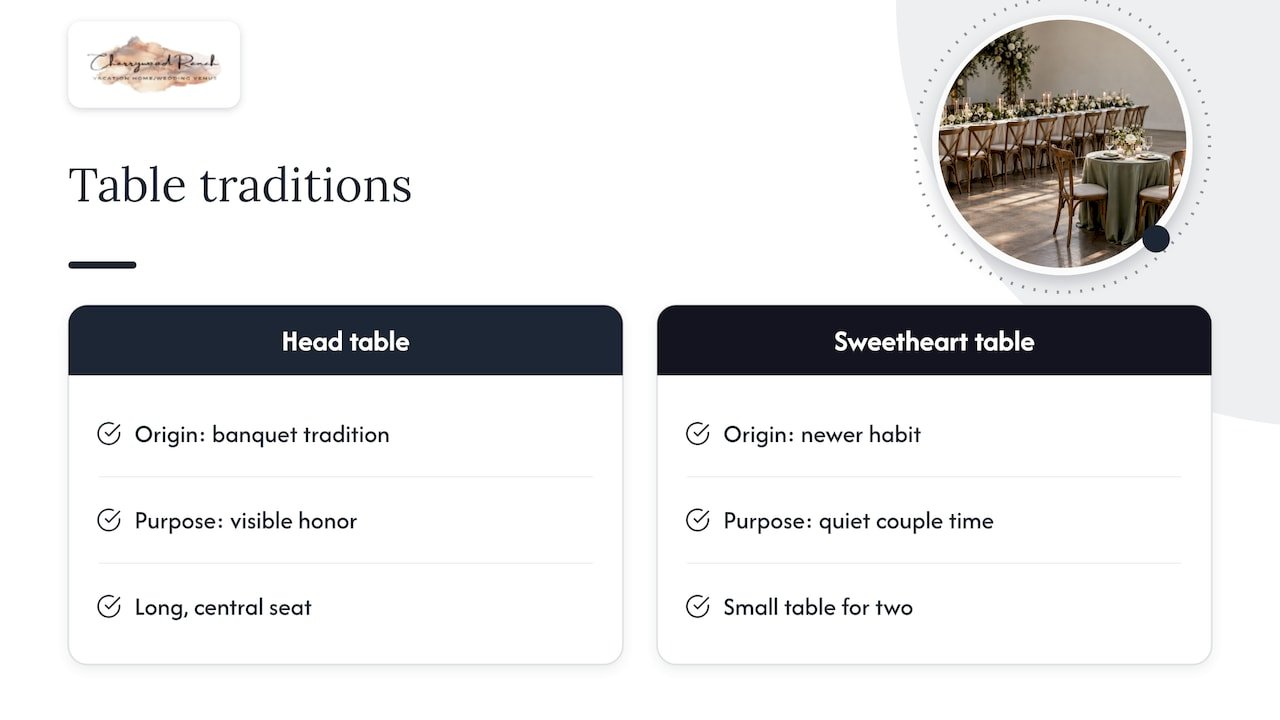
The head table grew out of old banquet traditions in which the host and honored guests sat at a raised or central table facing the room. Weddings borrowed that setup, so the couple and their closest people sat in view while everyone else watched toasts and dances. The king’s table carries that same idea of a long, central, almost royal seat of honor, which is why it still reads as a statement piece.
The sweetheart table is a newer habit. As couples began treating the reception as a personal celebration rather than a formal procession, many wanted a quiet pocket in a loud day. Seating two people at a small table gave them a place to eat, breathe, and talk while the party carried on around them.
Planners often describe the choice as privacy versus pageantry. Neither is objectively better. Both formats keep changing, too. Many modern head tables seat people on both sides or sit among guest tables instead of facing the room in a rigid line. That flexibility is the real takeaway: you can borrow the ceremony of the old format without copying its stiffness.
10. Where do these tables usually go in the room?
Placement depends on the venue’s shape and where the action happens.
- Ballrooms and banquet halls: the head table typically anchors the front wall with the dance floor in the middle. A sweetheart table often sits in the same spot, with the wedding party at the first guest tables.
- Barns and long rooms: a head table can run along the long wall, or a sweetheart table can sit at one end facing down the room.
- Tents and outdoor spaces: the table often goes near a natural backdrop, such as trees or a view, with clearance for caterers. Our outdoor wedding layout guide covers footprint and circulation for outdoor receptions.
- Small or intimate rooms: a sweetheart table slides into corners or dead space that a long table never could. Our ideas for intimate wedding receptions show how small groups use the room.
Whatever the venue, keep the couple visible from most seats, keep the backdrop clean, and keep servers able to move behind the table.
11. What are the alternatives to a sweetheart or head table?
You aren’t stuck choosing between two formats.
- No head table at all: sit at a regular guest table with family or friends. It feels relaxed and removes any “ranking” question.
- Family-style seating: long shared tables where everyone, including you, sits together and passes platters. Our guide to long table seating for weddings covers layouts and etiquette.
- King’s table: one big central table for a larger inner circle. It works best when the room has the space.
- Hybrid layouts: a sweetheart table beside a wedding-party table, so you get privacy and company.
- Mixed seating: the couple and a few friends at a small round, with the rest of the party scattered among guests.
Choose the version that matches how you want the evening to feel, then test it against your floor plan.
12. My take on seating at a mountain wedding weekend
At a small, multi-day celebration, most couples I talk with choose a sweetheart table. When everyone is staying under one roof, the whole group is already close, so you don’t need a long table to feel surrounded. Before you decide, run a quick floor plan check with your venue coordinator to confirm clearance and sightlines.
— Luis
13. Plan your seating at Cherrywood Ranch
At Cherrywood Ranch Wedding Venue, we host all-inclusive wedding weekends in the North Georgia mountains, with onsite lodging for guests. When your group sleeps on the property, there are no shuttle runs to plan around, so table-hopping and visits feel easy.
- Wedding weekends and elopement and wedding packages
- Onsite luxury lodging and resort-style amenities
- Venue coordination that helps with floor plans
Check our available weekend packages or ask us for a floor-plan review at our booking page.
FAQ
What’s a sweetheart table for a wedding?
A sweetheart table is a small table for just the couple, usually facing guests. It gives you a private place to eat and talk during the reception. Most are a 48-inch round or a table built for two.
What is the 30-5 rule for weddings?
There is no widely recognized rule by that name in the sources we reviewed, so definitions vary. For table planning, leave enough space behind a head table for circulation. Ask your venue coordinator which spacing standards they use.
What is another word for a head table?
Common alternatives are “wedding party table” and “king’s table.” A king’s table is a large rectangle, often placed centrally. It is a variant of the head table.
What side does the groom sit on at the head table?
Tradition seats the groom on the bride’s left, but modern couples place themselves wherever the room and sightlines work best. There’s no required rule. Seat yourselves where your photographer and guests get the best view.
Sources
- Wedding Head Table Layout: Head Table or Sweetheart Table
- 23 Sweetheart Table Ideas for Your Wedding Reception Decor