

Good destination wedding etiquette comes down to four things: couples give guests early notice and honest cost expectations, host the essentials while clearly labeling anything optional, and hand off travel logistics in writing; guests RSVP fast, budget realistically, and show up treating the trip itself as their real contribution. Venues built for this, like Cherrywood Ranch Wedding Venue & Vacation Home, work precisely because they remove the guesswork that causes most of the friction.
TL;DR:
- Guests should plan for total costs between $1,050 and $2,800 for a 3 to 4 day destination wedding, based on flights, lodging, and meals.
- Couples are expected to host only the core events like the ceremony, reception, welcome dinner, and possibly a farewell brunch, with optional activities clearly labeled and guest-paid.
- RSVP promptly and decisively, as late responses cause logistical issues, and a modest gift or travel contribution is appreciated but not mandatory.
- Venues that combine ceremony, reception, and lodging on a single property substantially reduce logistical complexity and improve guest experience.
- Proper planning includes detailed communication of logistics, local customs, tipping practices, and weather considerations to ensure respectful and smooth event execution.
Table of Contents
- Destination Wedding Etiquette for Couples: Hosting and Communicating
- Destination Wedding Guest Etiquette: Deciding, RSVPing, and Behaving
- Destination Wedding Invitation Etiquette, Timing, and the Wedding Website
- Who Pays for What at a Destination Wedding
- Destination Wedding Gift Etiquette: What’s Expected and What’s Not
- Travel Logistics and Guest Care Couples Should Handle
- On-Site Behavior: Dress Codes, Photos, and Knowing When to Leave
- Behavior Expectations Regarding Local Customs and Laws
- Appropriate Tipping Practices at the Destination
- Advice for Guests on Packing and Weather Considerations
- How to Decline Gracefully and Other RSVP Etiquette
- A Publisher’s Perspective: How One Venue Handles the Etiquette Load
- Let Cherrywood Ranch Handle the Logistics for You
- Sources
- FAQ
Destination Wedding Etiquette for Couples: Hosting and Communicating
Send save-the-dates 8 to 12 months out, then follow with formal invitations 3 to 5 months before the wedding. That window gives guests time to price flights, request time off, and arrange childcare, none of which happens on short notice.
Not every event needs to be on your dime, but a few should be. Etiquette experts generally expect couples to host:
- The ceremony and reception, full stop
- A welcome dinner or gathering the first night
- Often a farewell brunch, though this one is genuinely optional
Anything else, whether it’s a group hike or a spa morning, should be labeled clearly as an optional, guest-paid activity. Vague wording is where resentment starts.
On the money question, say it plainly: “Travel and accommodations are the responsibility of our guests; all wedding weekend events are hosted by us.” One sentence, no ambiguity. Behind the scenes, tell guests about your wedding transportation plan and negotiate a hotel room block with a firm deadline, since providing transport between venues is standard practice when guests are staying off-site.
Pro Tip: If you want to cover a flight or hotel night for a parent or a member of your wedding party, do it through a private message or a mailed check, never a group text. Quiet consistency avoids the appearance of favoritism.
Destination Wedding Guest Etiquette: Deciding, RSVPing, and Behaving
Before you say yes, run the numbers. A typical 3 to 4 day destination wedding costs guests roughly $1,050 to $2,800 once flights, hotel, meals, and incidentals are added up. That’s real money, and no couple should expect an automatic yes.
- Check your calendar and your bank account first. If either one says no, decline early rather than tentatively agreeing and backing out later.
- RSVP the moment you decide, not at the deadline. Destination weddings run on room blocks and catering counts locked in months ahead, so a late RSVP creates real logistical problems for the couple.
- Read the invitation literally for plus-ones and kids. If it says only your name, that’s the answer. A polite, private question to the couple is fine; assuming otherwise is not.
- Budget separately for a gift. Attendees typically bring something modest; guests who can’t make the trip aren’t obligated to send a gift at all, though many choose a small token anyway.
Once you commit, treat that “yes” as a promise, not a placeholder.
Destination Wedding Invitation Etiquette, Timing, and the Wedding Website
Timing is the backbone of the whole event. Save-the-dates go out 8 to 12 months ahead, formal invitations follow at the 3 to 5 month mark, and the RSVP deadline should land early enough to still adjust hotel blocks and catering numbers if the count shifts.
Keep the paper invitation itself simple: names, date, location, RSVP deadline. Everything else belongs on the wedding website, where you have room to explain:
- Hotel links, booking codes, and room block deadlines
- Which events are hosted versus optional, spelled out event by event
- Dress code details per event, plus terrain and weather notes so guests pack right
- A simple line like “welcome dinner hosted by the couple; Saturday excursion optional and self-paid”
A hybrid approach works best: mail the formal invitation for the ceremonial weight, then drive guests to the website (via a QR code or printed URL on an insert card) for every logistical detail. Nobody wants a wedding invitation cluttered with shuttle schedules.
Who Pays for What at a Destination Wedding
The standard split isn’t complicated. Couples cover the ceremony, reception, and any event they’ve explicitly labeled as hosted. Guests cover their own flights, hotel stay, and any meal or activity that isn’t on the official hosted list.
- Couple pays: ceremony, reception, welcome event, often the farewell brunch
- Guests pay: flights, lodging, ground transport to the destination, off-schedule meals, optional excursions
Covering a family member’s or bridal party member’s travel costs is reasonable, and plenty of couples do it, but keep it private rather than announced to the group.
Guest costs, by the numbers: total spend for a 3 to 4 day destination wedding typically falls between $1,050 and $2,800 per guest, depending on flight distance and hotel category. Couples who understand that range before sending invites tend to draw guest lists that fit their circle’s actual budget, and a destination wedding budgeting worksheet can help sort hosted costs from guest-side ones early.
Destination Wedding Gift Etiquette: What’s Expected and What’s Not
Here’s the thing most guests get wrong: showing up is already a gift. Travel itself counts as a meaningful contribution, and a modest gift in the $50 to $150 range is common among attendees, though never mandatory.
If you’d rather skip gifts entirely, say so on the wedding website in a warm, direct line, something like “your presence is the only gift we need.” That single sentence relieves a surprising amount of guest anxiety.
Practical notes for both sides:
- Don’t pack a wrapped gift for the flight. Ship it to the couple’s home before or after the trip instead.
- Registries should lean toward ship-to-home items, not anything a guest has to carry.
- Honeymoon or experience funds are ideal for destination weddings since there’s nothing physical to transport.
Travel Logistics and Guest Care Couples Should Handle
Room blocks are the single biggest logistics lever you control. Set up two or three price tiers so guests at different budgets can still stay close by, and post a firm booking deadline, ideally 60 to 90 days out, so the block doesn’t quietly expire.
- Offer a tiered room block with a clear cutoff date
- Suggest an arrival window (Thursday or Friday) and a departure window (Sunday) on the website
- Run shuttles whenever the ceremony and lodging sit at different addresses, and post the pickup schedule in advance
- Build welcome bags with water, snacks, sunscreen or hand warmers depending on climate, and a printed weekend itinerary
- List accessibility notes (elevator access, step-free paths, hearing assistance) directly on the website rather than waiting for guests to ask
Pro Tip: Print the shuttle schedule on paper and tape a copy inside every hotel room door. Phones die, signal drops, and a paper backup saves you a dozen “where do I go” texts on the wedding morning.
On-Site Behavior: Dress Codes, Photos, and Knowing When to Leave
Dress codes like “breezy formal” or “beach cocktail” aren’t decorative language, they’re instructions: breathable fabric, no stilettos on sand, nothing that fights the climate. When an invite says unplugged ceremony, that means phones stay in pockets until the recessional, full stop.
Once the reception starts, social media is fair game unless told otherwise, though it’s still good form to let the couple post their own photos first. On leaving early: staying through the cake cutting or the couple’s formal exit is the baseline courtesy, even if the dance floor isn’t your scene. And wherever the wedding is held, follow the venue’s and the region’s own customs rather than your hometown norms.
Behavior Expectations Regarding Local Customs and Laws
Destination weddings put guests in someone else’s community for a weekend, and that comes with real obligations, not just polite suggestions. Before the trip, both the couple and guests should look into local dress norms, especially around religious or cultural sites, since a ceremony venue that doubles as a place of worship may expect covered shoulders or specific footwear rules that a beach resort never would.
Alcohol laws, noise ordinances, and public conduct rules vary widely by location, and “we didn’t know” rarely helps if a local official gets involved. If the wedding is happening abroad, check passport validity requirements, visa rules, and any vaccination or health documentation well ahead of travel, since these details differ by country and change without much warning.
Couples hosting on private property, like a ranch or vacation home venue, should walk guests through property-specific expectations too: quiet hours, pool rules, parking limits, and any local noise restrictions that apply after dark. Posting these on the wedding website alongside the schedule keeps the tone practical rather than scolding.
Respecting the destination also means respecting the people who live there year-round. Guests who treat a local town as a backdrop rather than a real community, loud in restaurants, dismissive of staff, careless with property, reflect poorly on the couple who invited them. A short “know before you go” section on the website covering local norms costs the couple ten minutes and saves everyone an awkward moment later.
Appropriate Tipping Practices at the Destination
Tipping etiquette shifts more than almost anything else when a wedding moves away from a guest’s hometown, and getting it wrong is one of the most common destination wedding mistakes. Couples should plan for gratuities separately from the venue contract, since many vendor quotes don’t automatically include tips even when a service charge appears on the invoice.
For venue and vendor staff, a general guideline many planners use: 15 to 20% for catering and bar staff when a service charge isn’t already built in, a flat gratuity for the officiant (often $50 to $100, more if they traveled), and something for the coordinator or day-of manager who kept the weekend on schedule. Hair and makeup artists typically expect the same 15 to 20% range guests would tip at any salon.
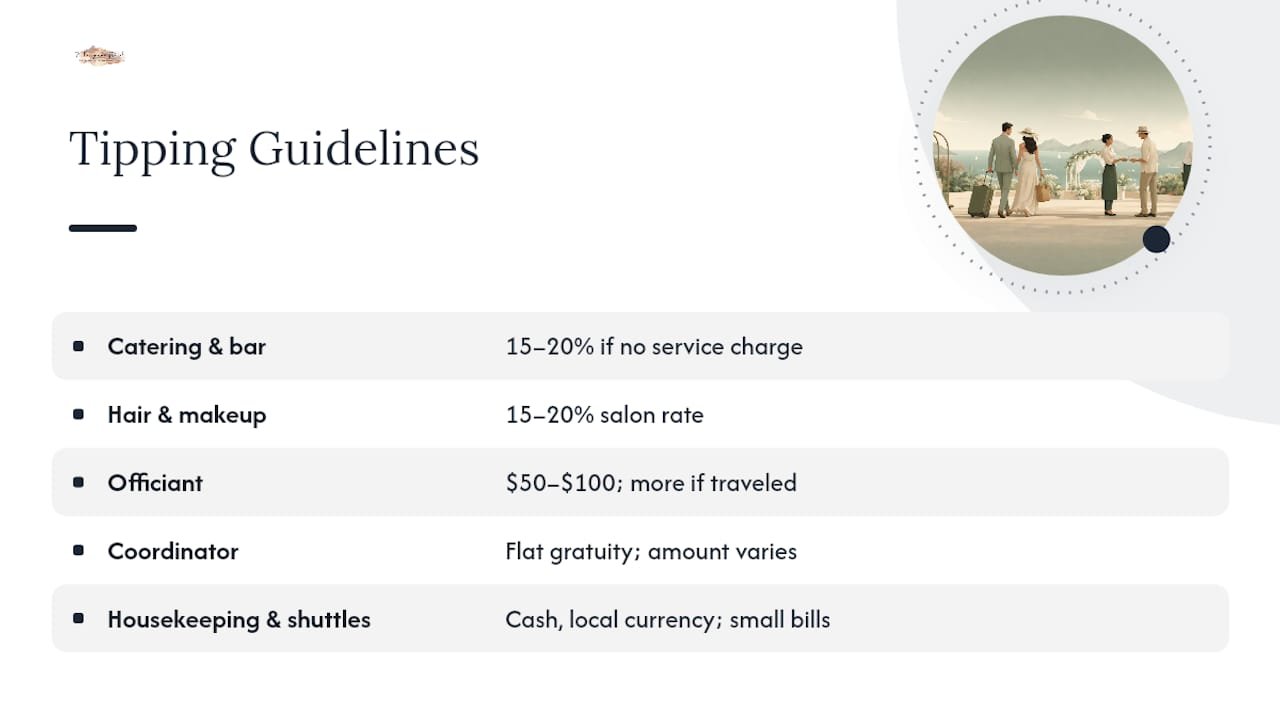
Guests staying on-site or using resort and venue services should tip housekeeping and shuttle drivers directly, in cash, in the local currency when traveling internationally. Small bills matter here; nobody wants to ask hotel staff to break a large note.
Couples booking through an all-inclusive venue should ask directly whether gratuities are already folded into the package price. Some venue contracts build staff tips into the total fee, which simplifies things considerably and avoids the awkward math of tipping ten different vendors individually over one weekend.
Advice for Guests on Packing and Weather Considerations
Pack for the location, not for the wedding you’re picturing in your head. A dress code note like “breezy formal” only helps if the invite or website also mentions the climate, terrain, and season, which is exactly why dress-code and weather details belong on the wedding website rather than buried in a group chat.
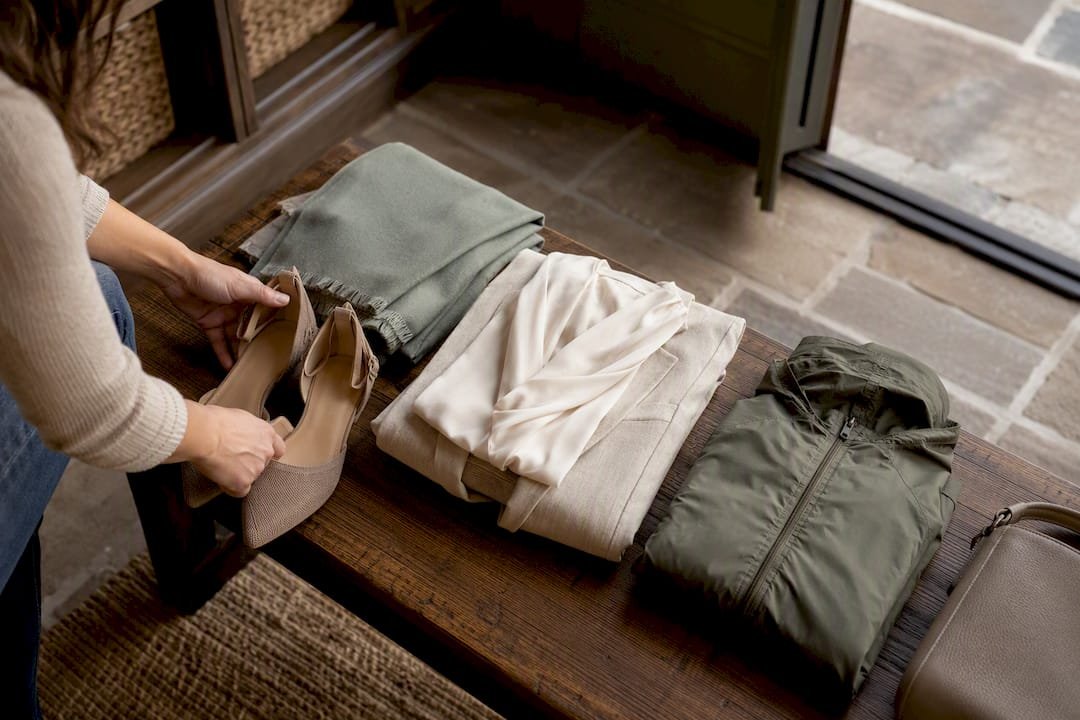
Mountain venues swing in temperature between morning and evening even in warmer months, so layering matters more than any single “statement piece.” A light jacket or wrap for an outdoor ceremony after sundown solves more problems than an extra pair of shoes. Beach and coastal weddings call for the opposite calculation: breathable fabrics, sandals or flats that won’t sink into sand, and a backup indoor outfit in case of rain.
A few packing habits solve most on-site problems before they start:
- Bring one weather backup layer regardless of forecast, since mountain and coastal weather both change fast
- Choose shoes for the actual ceremony surface, gravel, grass, or sand, not for the aesthetic alone
- Pack a printed copy of the itinerary and hotel confirmation in case phone service is unreliable
- Check the venue’s specific guidance on footwear or fabric restrictions for outdoor spaces
How to Decline Gracefully and Other RSVP Etiquette
Declining a destination wedding invitation isn’t rude, but doing it late is. The moment cost, timing, or personal circumstances make attendance impossible, send the RSVP back with a simple “no” and a short, warm note. There’s no need to over-explain or apologize repeatedly. Something like “we’re so sorry to miss it, but we’ll be celebrating from home and can’t wait to see photos” covers it completely.
What actually damages the relationship is a slow or wavering response. Couples build room blocks, catering counts, and shuttle schedules around RSVP numbers, and a guest who sits on the fence for weeks forces last-minute recalculations that ripple through the entire weekend. If you’re genuinely unsure whether travel or budget will work out, tell the couple directly rather than letting the deadline pass in silence.
A gift is never required from a guest who declines, though a small card or note is a kind gesture, especially for close family or friends. If you do want to send something, mail it rather than promising to bring it “next time you see them,” since those good intentions have a way of quietly disappearing.
A Publisher’s Perspective: How One Venue Handles the Etiquette Load
At Cherrywood Ranch, the schedule itself does most of the etiquette work. On-site lodging for up to 16 guests means no room-block juggling, and a single property removes the shuttle question entirely. The natural sequence, arrival, welcome gathering, ceremony, farewell, keeps guests oriented without a single confusing text thread.
— Luis
Let Cherrywood Ranch Handle the Logistics for You
A lot of destination wedding etiquette problems disappear the moment guests aren’t shuttling between three separate locations trying to figure out who’s paying for what. Venues that combine ceremony, reception, and lodging on the same property simplify logistics and reduce confusion about which events are hosted.

Couples get a pool, hot tub, and mountain views for the whole weekend rather than a single ceremony slot, which means the welcome dinner, the wedding day, and the farewell morning all happen without anyone leaving the property. If that kind of all-inclusive weekend sounds like the fix your guest list needs, check availability and pricing on the Cherrywood Ranch destination wedding venue page or book your stay to start planning your dates.
Sources
- Destination Wedding Invitation Etiquette | The Knot
- Destination wedding gifting etiquette — Condé Nast Traveler
- Destination Wedding Etiquette: What Couples and Guests Should Know — Reagan Events
- Destination Wedding Etiquette: A Complete Guest & Couple Guide | WeddingClever
FAQ
What is gift etiquette for a destination wedding?
Travel counts as a meaningful contribution, so a modest gift of $50 to $150 is common among attendees but never required, and couples who prefer no gifts should state that clearly on their wedding website.
What is the 30 minute to 5 minute rule for weddings?
This isn’t a standard etiquette rule covered by destination wedding sources; if you’ve seen it referenced elsewhere, it likely refers to arrival buffers for ceremonies rather than a formal destination wedding guideline.
How much notice should you give guests for a destination wedding?
Send save-the-dates 8 to 12 months before the wedding and formal invitations 3 to 5 months before, giving guests enough runway to book flights and request time off.
Who typically pays for what at a destination wedding?
Couples generally cover the ceremony, reception, and any event labeled as hosted, while guests cover their own flights, hotel stay, and any activities marked optional.
Is it rude to decline a destination wedding invitation?
No, declining is completely acceptable as long as the RSVP comes back promptly with a brief, warm note, since a late or wavering response is what actually creates problems for the couple’s planning.