
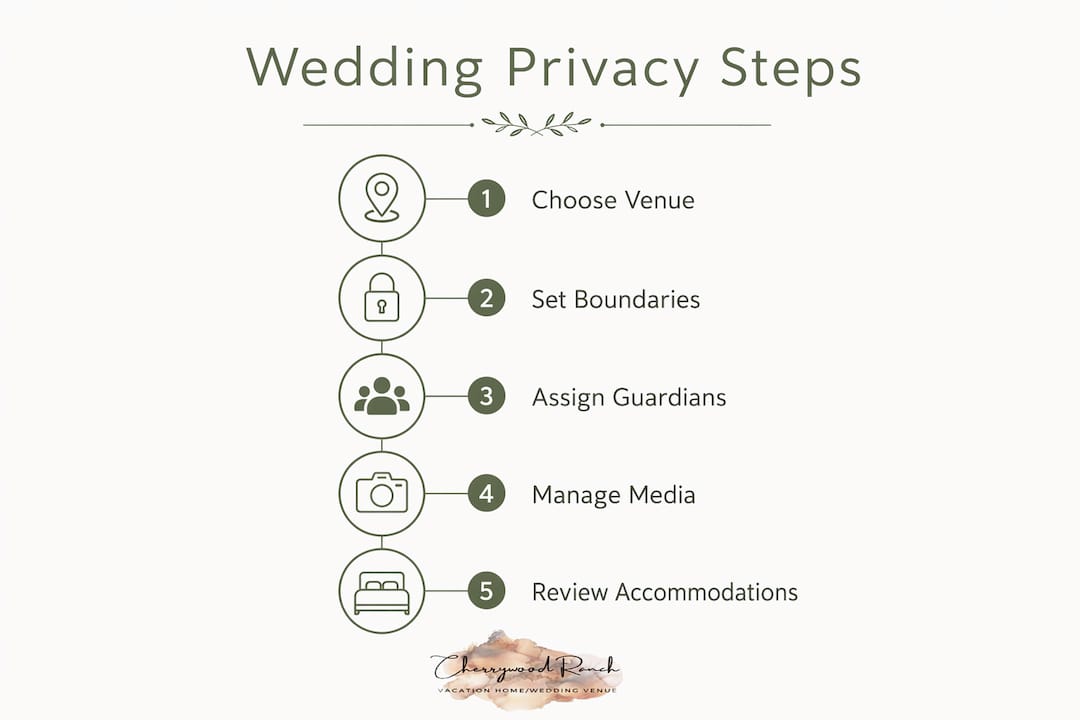
Family privacy at wedding weekends isn’t a nice bonus. It’s the structural foundation that determines whether your multi-day celebration feels joyful or exhausting. Relational privacy means controlling access to your personal spaces, time, and information, and that control becomes especially critical when two families spend several days together under one roof. The couples who come out of wedding weekends with relationships intact almost always did one thing in common: they planned for privacy before the first guest arrived.
Here’s what that looks like in practice:
- Decide in advance which spaces belong to the couple alone
- Set explicit rules for photography and social media before the weekend begins
- Communicate boundaries privately with key family members, not in group announcements
- Build scheduled downtime into the event timeline so you can recharge
- Assign trusted people to handle difficult interactions so you don’t have to
Weddings intensify existing family dynamics by compressing high-stress proximity into a short window. Conflict that simmers quietly during normal life tends to surface fast when everyone is sharing a kitchen and a schedule. Proactive planning doesn’t eliminate that tension, but it gives you a structure to contain it.
1. How venue choice shapes your privacy during a wedding weekend
The single most powerful privacy decision you make happens before the weekend starts: choosing where everyone stays and gathers. A secluded wedding venue controls who can access the property, which removes a whole category of uninvited disruption. When the venue sits on private land, you don’t have to manage strangers wandering through your ceremony or neighbors filming from a fence line.
Physical layout matters just as much as location. Look for venues that offer distinct zones: a main gathering area, a private suite for the couple, and quieter outdoor spaces where guests can decompose from the crowd. The difference between a venue with natural separation and one that funnels everyone into a single open floor plan is the difference between a weekend that breathes and one that suffocates.
- Outdoor spaces with natural buffers (tree lines, hills, separate patios) create informal privacy without requiring anyone to enforce rules
- Indoor rooms with lockable doors give the couple a genuine retreat
- Gated or single-entry properties simplify access control without visible security
- Venues with on-site lodging reduce the logistical chaos of guests coming and going at all hours
Venue size and layout directly affect how much natural privacy you can build into a family event. A property that’s too small forces constant proximity; one that’s too spread out makes coordination difficult. The sweet spot is a venue where guests can find each other easily but also disappear when they need to.
Pro Tip: Designate one room or outdoor area as a no-gathering zone for the couple only. Tell your wedding coordinator and one trusted family member. You don’t need to announce it to everyone; just make sure the people managing the day know where to send you when you need five minutes alone.
2. How to set clear boundaries with family, vendors, and guests
Proactive boundary setting before the wedding weekend begins is the most reliable way to protect your emotional well-being. Boundaries set in the middle of a conflict are almost impossible to enforce calmly. Boundaries set weeks in advance, in a private conversation, land entirely differently.
The key word is “private.” Communicating privacy rules individually rather than in group announcements prevents defensiveness and public conflict. A group message that says “please don’t ask about seating” reads as a rebuke. The same message delivered one-on-one reads as a confidence.
- Guest list control: decide who has authority to invite people and communicate that clearly before names start circulating
- Event access: specify which parts of the weekend are open to all guests versus reserved for immediate family
- Vendor interactions: brief your photographer, coordinator, and caterer on which family dynamics require careful handling
- Seating: share assignments with key family members at least a week before the event, not on the day itself
- Private conversations: let your coordinator know which topics are off-limits for vendor small talk
Families that prepare with clear roles and communication experience fewer conflicts during the weekend itself. Written guidelines, even a simple one-page document shared with your coordinator, give everyone a reference point when a situation gets ambiguous.
Pro Tip: For any family member who might cause conflict, have a private, direct conversation before the rehearsal dinner. “I want to talk through the weekend before it starts” is far easier to manage than a real-time incident. Keep the conversation short, specific, and warm.

3. How to manage photography and social media privacy at your wedding
Social media sharing without consent can turn a private family moment into permanent public content within minutes. A guest who posts a candid photo of a difficult family interaction, or tags the couple before they’ve made their own announcement, creates a problem that can’t be undone. Written guidelines distributed before the weekend are the only reliable prevention.
Your photography privacy plan needs three components: rules for guests, a designated official photographer, and one person who isn’t the couple enforcing the rules on the day.
- State your photo policy on the invitation or in a pre-event message, in plain language
- Specify whether guests may post in real time or only after the couple shares their own announcement
- Appoint your photographer as the sole source of official images
- Identify one calm, trusted person to remind guests of the policy without making it confrontational
- Decide in advance whether any moments (first look, ceremony, family portraits) are completely off-limits to guest cameras
The couple should never be the ones policing phones on their own wedding day. That job belongs to your designated media liaison, your coordinator, or a trusted friend who understands the stakes.
Pro Tip: Include one sentence on your invitation: “We ask that you keep phones away during the ceremony and hold off on posting until we share our first photos.” Most guests will comply without pushback when the request comes in advance and in writing.
4. How to personalize privacy strategies for your family’s specific dynamics
Weddings bring emotional shifts as families adjust to new roles, and those shifts don’t affect every family the same way. A blended family with two sets of divorced parents needs a completely different privacy architecture than a small, close-knit family with no history of conflict. Copying a generic privacy checklist without adapting it to your actual family is how couples end up blindsided.
For families with trauma histories, safety comes before optics. That might mean limiting a difficult family member’s access to planning decisions, assigning them a specific role with clear limits, or structuring the weekend so they never have unsupervised time with the couple. These aren’t punitive decisions. They’re practical ones.
- Identify which family members are likely to generate stress and plan around them specifically
- Consider the multi-generational dynamics at play: grandparents, step-parents, and adult siblings all have different needs
- Build private recharge time into the schedule for the couple, not just open blocks but actual protected time
- For cultural or religious backgrounds with specific privacy expectations, address those explicitly in vendor briefings
Assigning trusted emotional guardians is one of the most practical tools available. These are people who know the family dynamics, stay close to the couple during the event, and handle difficult interactions before they escalate. They’re not bouncers. They’re buffers, and their presence alone tends to keep reactive family members calmer.
5. How shared accommodations affect privacy during a wedding weekend
Shared lodging is where wedding weekend privacy either holds or falls apart. When multiple family groups share a house or property for two or three nights, the absence of clear structure creates friction fast. Family sleepover venues work best when sleeping arrangements, common area schedules, and quiet hours are communicated before anyone arrives.
The most common mistake is assuming that goodwill will substitute for logistics. It won’t. Two families who genuinely like each other can still create conflict when they have different expectations about when the kitchen is available, whether the pool is open at midnight, or whose job it is to clean up after breakfast.
- Assign sleeping areas by family group, keeping potential conflict pairs in separate wings or floors when possible
- Communicate quiet hours in writing before the weekend, not as a rule posted on a refrigerator
- Designate one common area as a gathering space and one as a quieter retreat
- Brief a trusted host or buffer companion to manage the shared space during high-traffic moments like morning coffee and post-rehearsal dinner
- Plan structured activities that give guests something to do together so unstructured time doesn’t become a pressure cooker
Well-managed accommodations reduce stress and create the conditions for genuine family bonding. The goal isn’t to over-schedule the weekend. It’s to give people enough structure that privacy feels natural rather than forced.
Plan your private wedding weekend at Cherrywoodranchweddingvenue

Cherrywoodranchweddingvenue was built for exactly this kind of weekend. Set in the North Georgia Mountains, the property combines a full wedding venue with a private vacation home that sleeps up to 16 guests, giving couples the physical separation and natural seclusion that make privacy planning actually work. Mountain views, a pool, a hot tub, and distinct indoor and outdoor spaces mean your family has room to gather and room to retreat.
If you’re planning a multi-day celebration where privacy, comfort, and family dynamics all matter, explore the venue and see how Cherrywoodranchweddingvenue handles the logistics so you can focus on the people.
Key Takeaways
Family privacy at wedding weekends requires intentional planning before the event, not reactive management during it.
| Point | Details |
|---|---|
| Venue seclusion matters | A private, gated property removes access control problems before the weekend begins. |
| Boundaries work best when set early | Private, one-on-one conversations with key family members prevent public conflict far better than group announcements. |
| Social media needs written rules | Distribute a clear photo and posting policy before the event so guests know expectations in advance. |
| Emotional guardians reduce couple stress | Assigning trusted people to handle difficult interactions keeps the couple present and protected. |
| Shared lodging needs structure | Quiet hours, designated spaces, and sleeping assignments prevent friction in shared accommodations. |