Your first decision is the setting, not the flowers. Choose where you’re getting married, confirm a weather backup for that exact location, and every other styling choice falls into place. Before you browse a single arch photo, lock these four items:
- Permit status: Check with your local parks department or venue authority months in advance. Public parks, beaches, and forests often require event permits with guest-count caps and sound restrictions.
- Power source: Confirm whether the site has grid power or needs a generator. Outdoor ceremonies almost always need one.
- Sound plan: A wireless lavalier microphone setup for the officiant and couple is non-negotiable outdoors. Wind, distance, and ambient noise swallow unamplified vows.
- Guest comfort: Identify shade sources, plan a hydration station, and confirm accessible restroom access before you finalize the site.
Pro Tip: Call the permitting office, not just the venue coordinator. Parks and recreation departments, the U.S. Army Corps of Engineers (for waterfront sites), and local fire marshals each have separate rules. One phone call per agency saves weeks of back-and-forth.
Key Takeaways
The most reliable outdoor ceremony is built in this order: choose the setting, lock the logistics, then style around one hero element.
| Point | Details |
|---|---|
| Setting drives everything | Choose your venue type first; it determines backdrop, seating layout, lighting, and every logistics check that follows. |
| Lock four items before styling | Permit, power source, sound plan, and guest comfort (shade and restrooms) must be confirmed before any decor decisions. |
| Sound is non-negotiable | A professional portable sound setup runs roughly $150–$400; lavalier mics with wind covers protect vow audio outdoors. |
| One hero element, restrained supporting decor | Pick one statement piece (arch, planted aisle, or string-light canopy) and repeat one material; avoid mixing five different accents. |
| Cherrywoodranchweddingvenue | Offers a private North Georgia mountain venue with onsite lodging, generator and A/V, and sunset ceremony coordination in one package. |
Table of Contents
- What outdoor wedding ceremony ideas work best for your setting?
- How to use styling elements that survive wind, sun, and uneven ground
- Seasonal planning and the logistics every outdoor ceremony needs
- Budget-friendly and DIY decor that photographs well
- Personalization and ritual ideas that make the moment yours
- How to choose ideas that actually fit your venue and budget
- A Cherrywood Ranch sunset mountain ceremony: what makes it work
- What venue hosts consistently see work at mountain ceremonies
- Cherrywoodranchweddingvenue brings these ideas to life in the North Georgia Mountains
- Sources
What outdoor wedding ceremony ideas work best for your setting?
The right idea for a cliffside ceremony will look wrong on a beach and vice versa. Match the concept to the site first, then check the one logistics item that can derail each.
Beach
Salt air, soft sand, and natural light make beach ceremonies feel effortless. The challenge is everything else: wind, tides, and uneven footing. Ideas that hold up well:
- A driftwood arch draped with dried pampas and sea grass (no fresh florals that wilt in heat)
- Barefoot aisles marked with shells or smooth river stones instead of petals that blow away
- Low bamboo lanterns anchored in sand buckets, clustered at the aisle ends
- Mismatched wooden chairs or rented benches set back from the waterline
Confirm: the tide window for your ceremony time. A low-tide ceremony on a wide beach looks stunning; a high-tide surprise leaves you knee-deep in seawater.
Garden
A garden setting gives you the most styling flexibility because the backdrop is already doing the work. Complementing a scenic site rather than competing with it is the guiding principle here. Draped arches, lanterns, and chair ribbons read as romantic without overwhelming the greenery.
- Floral arch in seasonal blooms (peonies in May, dahlias in September)
- Potted topiaries flanking the aisle that double as living décor guests can take home
- Vintage rug runner down a grass aisle
- Ribbon-tied chairs in a soft neutral palette
Confirm: ground leveling. Uneven garden paths create accessibility issues for elderly guests and heels.
Vineyard
Rows of vines create natural framing that photographers love. Keep the arch minimal so the vines stay the hero.
- A simple geometric metal arch with trailing greenery
- Wooden barrel pedestals holding single-stem arrangements
- Staggered seating on a slight slope for natural sightlines
- Warm Edison-bulb string lights overhead for late-afternoon ceremonies
Confirm: harvest schedule. Vineyards in active harvest (typically September through October) may restrict access to certain rows.
Mountain and sunset
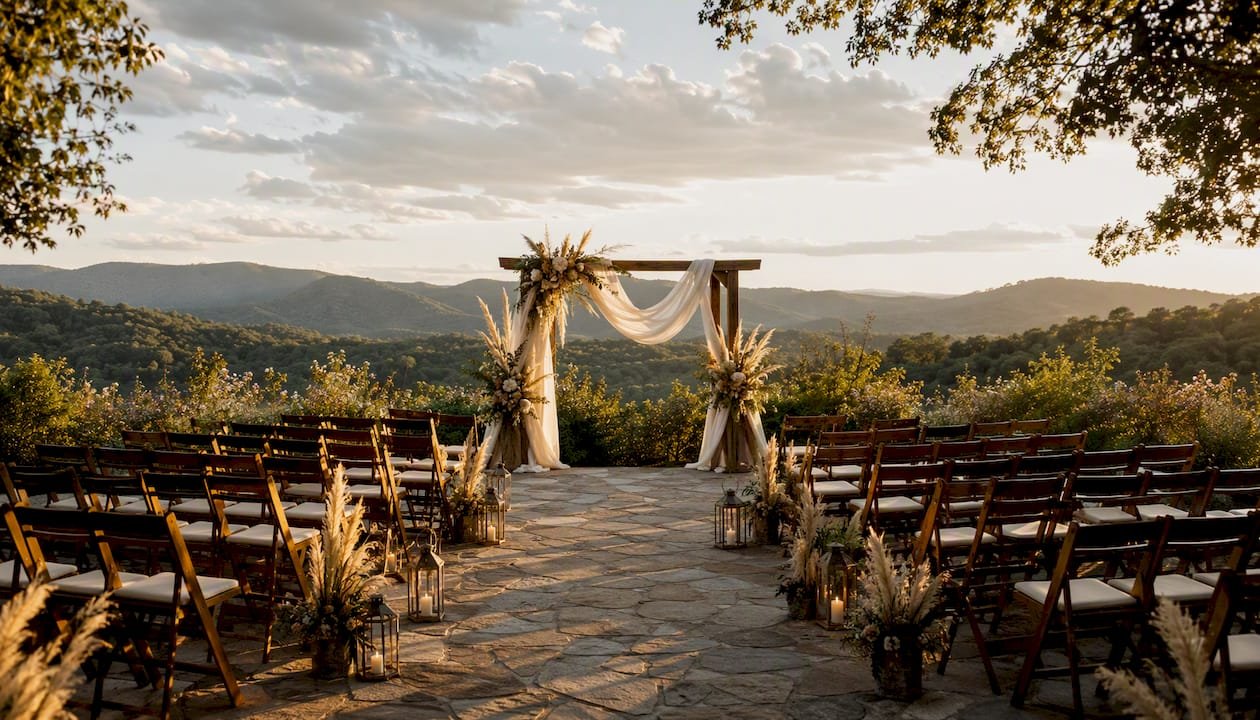
Golden-hour mountain ceremonies produce some of the most dramatic ceremony photos available anywhere. The light quality at 6:00–7:30 PM during summer months is genuinely hard to replicate indoors. A mountain view ceremony setup works best when the arch frames the valley below rather than blocking it.
- Minimal arch (macramé or thin metal) that doesn’t obstruct the view
- Circular seating so every guest faces the couple and the horizon
- Blankets or pashminas on chairs for the temperature drop after sunset
- Uplighting on tree trunks to extend the ceremony into dusk
Confirm: sun position at your exact ceremony time. The sun setting behind the couple creates a silhouette effect; behind the guests creates a warm backlit glow on the couple’s faces.
Backyard
Backyard ceremonies are intimate by nature. The constraint is usually power and parking, not aesthetics.
- Macramé backdrop hung from a wooden frame (portable, no permanent installation)
- Mason jar posies on shepherd’s hooks lining the aisle
- Mismatched vintage chairs sourced from estate sales
- A simple arbor built from PVC pipe wrapped in greenery
Confirm: parking capacity and neighbor noise ordinances. A generator running during vows is a problem nobody plans for.
Rooftop and urban terrace
Urban settings reward minimalism. The skyline is the backdrop; over-decorating kills it.
- A single draped fabric arch in white or ivory
- Potted olive trees or tall grasses in terracotta pots flanking the ceremony space
- Candlelight in hurricane glass holders (check fire codes first)
- Ghost chairs for a clean, unobtrusive look
Confirm: building permits for temporary structures and weight limits for large floral installations.
Forest
Forest ceremonies feel ancient and cinematic. Filtered light through a tree canopy is naturally soft and flattering.
- Hanging floral installations from low branches
- Moss and fern aisle runners
- Wooden stumps as pedestals for candles or small arrangements
- Circular seating to use the natural clearing efficiently
Confirm: ground accessibility for guests with mobility needs and whether the site requires a fire permit for candles.
How to use styling elements that survive wind, sun, and uneven ground
Arches and backdrops
The arch is usually the ceremony’s focal point, so its orientation matters as much as its design. Position it so the sun is behind the guests at ceremony time, not behind the couple. A backlit couple looks like a silhouette in every photo.
- Floral arch: Most photogenic, highest cost, most wind-vulnerable. Use a heavy wooden base and wire florals to the frame rather than relying on foam.
- Wooden arch: Durable and neutral. Works in rustic, garden, and mountain settings. Anchor with sandbags or stake into soft ground.
- Geometric metal arch: Clean lines suit vineyard and urban settings. Lightweight, so it needs ballast in any breeze.
- Macramé backdrop: Boho and backyard-friendly. Hang from a freestanding frame; never rely on a single overhead tie point outdoors.
Aisle decor
Hurricane lanterns, tree-stump pedestals, ribbons on chairs, vintage rugs, and planted aisles all hold up outdoors with minimal fuss. The rule that separates a curated aisle from a cluttered one: pick two statement arrangements to anchor each end, then keep the middle restrained. The Knot’s planner guidance makes the same point — budget for impact pieces rather than many small accents.
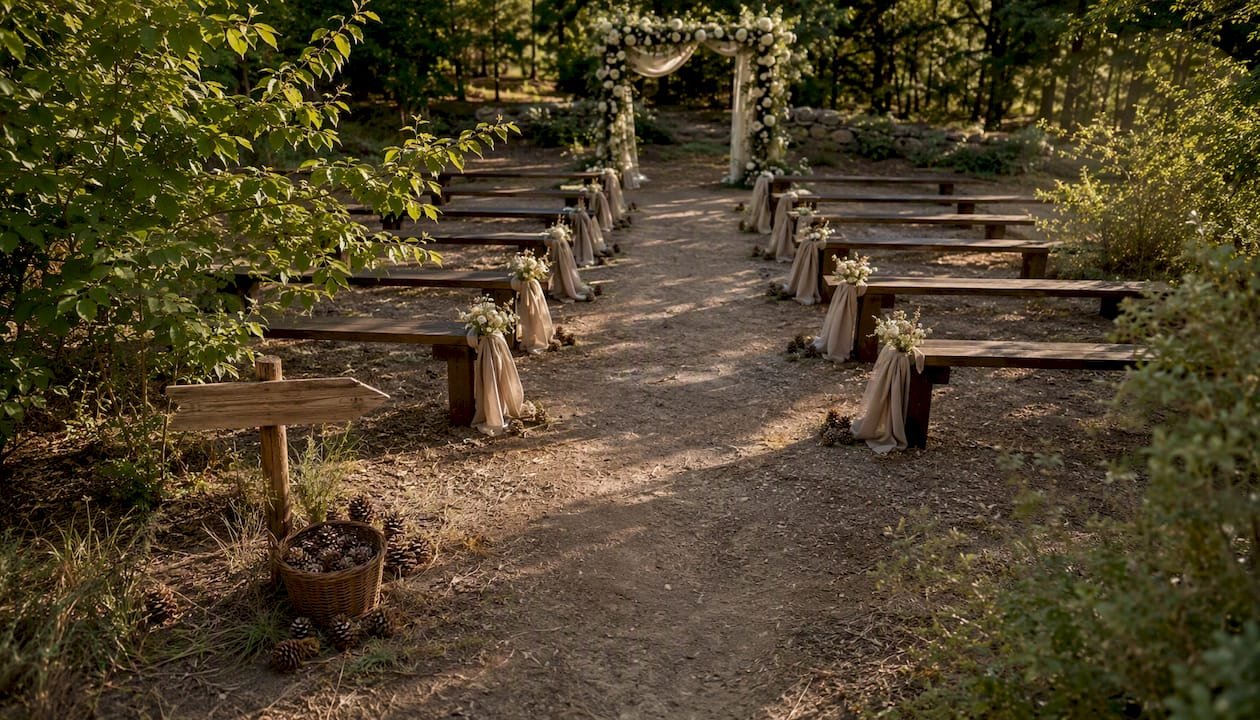
Spacing matters practically, not just visually. Leave at least 5 feet of clear aisle width for the processional and for wheelchair access.
Seating layouts
Circular and semi-circle seating is growing fast for outdoor ceremonies because it puts more guests within 20 feet of the couple and eliminates the “back row” problem. Traditional rows work on long, narrow sites. Staggered rows on a slope give everyone a sightline without risking a tumbling chair. Benches read rustic and save rental cost; ghost chairs disappear visually and suit almost any setting.
Lighting and florals
String lights strung between trees or poles create a canopy effect that photographs beautifully at dusk. Uplighting on tree trunks or stone walls adds depth after sunset. Lanterns at ground level mark paths and add warmth.
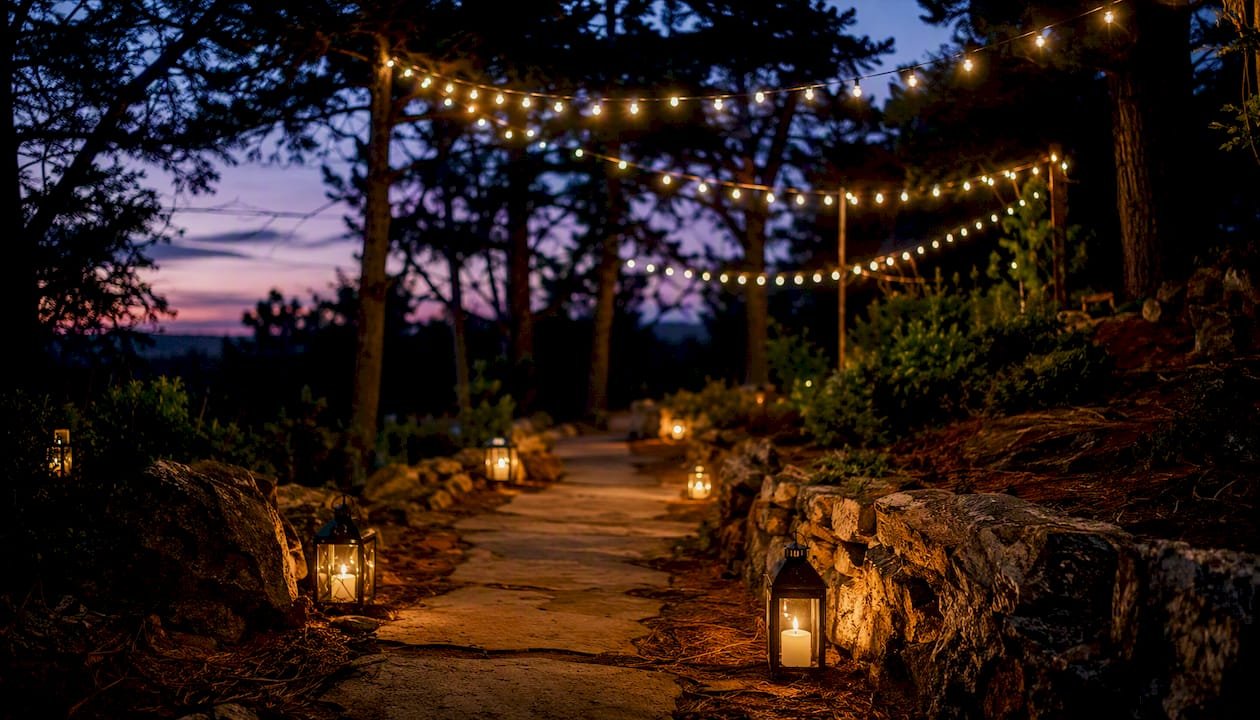
For florals, dried pampas and preserved grasses survive heat and wind far better than fresh arrangements. Sustainable living décor — potted trees or shrubs guests can take home — is a growing preference among couples who want to reduce single-use waste. If you’re using fresh blooms, choose locally grown seasonal varieties and keep them in water until 30 minutes before setup.
Pro Tip: For wind protection, stake every arch leg, weight every lantern base, and use biodegradable petal confetti instead of loose petals that scatter before the processional. Deadcat wind covers on lavalier mics prevent the rustling noise that ruins ceremony audio recordings.
Seasonal planning and the logistics every outdoor ceremony needs
Weather contingency
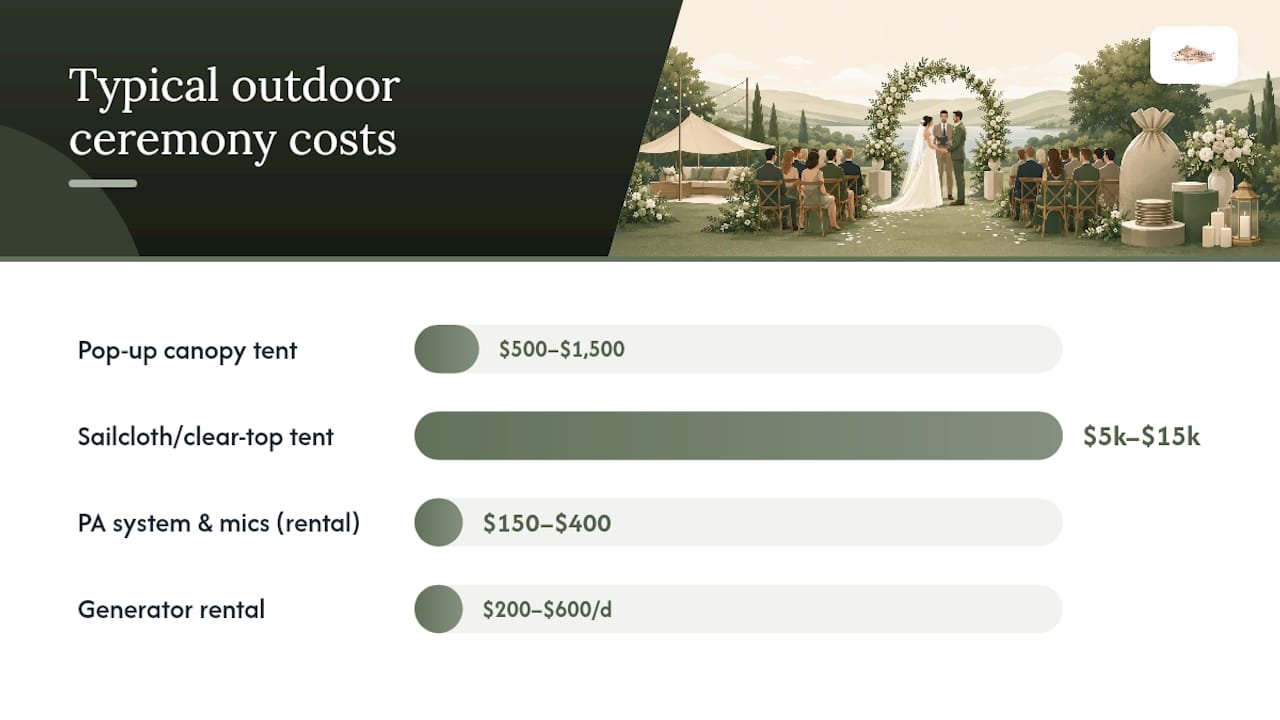
Weather contingency is the single most critical planning element for any outdoor ceremony. A pop-up tent starts around $500; an elegant clear-top or sailcloth tent runs $5,000–$15,000 depending on size and region. Set a firm decision time with your coordinator — typically 3–6 hours before the ceremony — so vendors can pivot without chaos. Umbrellas and parasols handle light drizzle; they don’t handle wind or a genuine storm.
Permits and public-space rules
Apply for permits at least 3–4 months before the date. Common restrictions include:
- Decibel limits and cutoff times for amplified sound
- Maximum guest counts per site
- Prohibitions on open flames, staked structures, or confetti
- Required insurance certificates naming the park or agency as additional insured
Sound and power
Outdoor amplification is not optional. Wind, distance, and ambient noise (birds, traffic, water) make unamplified vows inaudible past the third row. A professional portable sound setup runs roughly $150–$400 for a ceremony. Lavalier mics on the officiant and both partners give the clearest audio. Place the generator at least 50 feet from the ceremony space and behind a natural barrier if possible. Reviewing common event setup mistakes before your site visit can prevent the most avoidable power and staging errors.
Timing and golden hour
The sun’s position at your ceremony time determines guest comfort and photo quality. Placing the sun behind the guests (so it illuminates the couple’s faces) is the standard approach. A ceremony starting 60–90 minutes before sunset gives you warm light without squinting guests. After sunset, clearly lit paths from the ceremony space to the reception area are a safety requirement, not a styling choice.
| Item | Typical cost range | Notes |
|---|---|---|
| Pop-up canopy tent | $500–$1,500 | Basic weather cover; limited elegance |
| Sailcloth or clear-top tent | $5,000–$15,000 | Elegant; requires professional installation |
| PA system and mics (rental) | $150–$400 | Includes lavalier mics and small speakers |
| Generator rental | $200–$600/day | Size depends on power load; place away from ceremony |
Pro Tip: Visit the site at the exact time of day your ceremony will start. Walk the aisle, stand where the couple will stand, and look directly at where the sun is. That 20-minute visit catches sightline and lighting problems that no floor plan reveals.
Budget-friendly and DIY decor that photographs well
You don’t need a large budget to create a ceremony that looks considered and beautiful. The key is knowing which items to hire out and which to build yourself.
Low-cost swaps that read expensive:
- Rented vintage rugs instead of a floral runner (often $50–$150 to rent vs. $400+ for a custom floral runner)
- Potted plants from a local nursery that guests take home as favors
- Lanterns from a home goods store, repurposed as aisle markers
- Reusable wooden signs for directional and welcome signage
DIY projects worth attempting:
- Macramé backdrop: Cotton rope, a wooden dowel, and a weekend. Seal knots with a small dot of fabric glue so they don’t loosen in humidity.
- Painted aisle runner: A canvas drop cloth, outdoor paint, and a stencil. Roll it up for transport; unroll on a flat surface only.
- Mason jar posies: Wildflowers or grocery-store blooms, twine, and a mason jar. Keep jars filled with water until 20 minutes before setup.
Always hire a professional for:
Tents, sound systems, and any electrical work. A tent that collapses or a microphone that cuts out mid-vow is not a DIY recoverable moment. Event electricians at outdoor weddings handle generator connections, lighting rigs, and safety compliance that go well beyond a standard extension cord setup.
The resort-alternative model for private-property weddings often bundles tent, power, and A/V into the venue package, which removes the need to source and coordinate those vendors separately.
| DIY item | Approx. materials cost | Time to build | Key durability tip |
|---|---|---|---|
| Macramé backdrop (6×4 ft) | $40–$80 | 6–10 hours | Fabric glue on knots; store dry |
| Painted canvas aisle runner | $30–$60 | 3–4 hours | Use outdoor/acrylic paint; seal with matte finish |
| Mason jar posy centerpieces (10) | $25–$50 | 1–2 hours | Keep in water until 20 min before setup |
| Wooden welcome sign | $20–$40 | 2–3 hours | Seal with exterior polyurethane |
| Hire vs. DIY | Recommendation |
|---|---|
| Tent installation | Always hire |
| Sound system and mics | Always hire |
| Generator and electrical | Always hire |
| Floral arch | DIY if you have 4+ helpers and 3+ hours |
| Signage and small florals | DIY-friendly |
Personalization and ritual ideas that make the moment yours
The ceremony itself is 20–30 minutes. What you put inside that window shapes how guests remember the day.
Personalization ideas that work outdoors:
- Plant-a-tree ritual: The couple plants a sapling together during the ceremony. The tree goes home with them or stays at the venue as a living marker of the day.
- Sand or water ceremony: Two vessels of sand or water poured into one. Simple, visual, and works in any setting.
- Handfasting: A cord or ribbon wrapped around joined hands during vows. No props beyond the cord; takes about 90 seconds.
- Family heirloom display: A small table near the arch holding photos, jewelry, or objects from family members who have passed. Requires no ceremony time.
- Unity cocktail: The couple mixes two spirits into a shared glass at a welcome table. Guests watch; it doubles as a reception opener.
- Ring warming: The rings pass through the guest rows before the exchange. Works best for intimate ceremonies under 50 guests.
For elopements and intimate gatherings:
- Vow-only ceremony with no processional: takes 8–12 minutes, requires only an officiant and two witnesses.
- Brief reading by a guest: one poem or passage, 2–3 minutes. Assign a confident reader; outdoor acoustics punish mumbling.
- Moment of silence or shared breath: 30 seconds of stillness before vows. Surprisingly powerful outdoors where ambient sound fills the quiet.
One practical note: open flames (unity candles, fire rituals), releasing live animals, and biodegradable confetti each carry separate permitting considerations depending on the jurisdiction. Check with the venue and local fire marshal before committing to any of these.
How to choose ideas that actually fit your venue and budget
Not every idea that looks good on a mood board works at your site. A simple scoring pass before you commit saves money and stress.
Site constraint checklist:
- Is the ground level enough for chairs, a runner, and guest mobility?
- Is there vehicle access for vendor load-in and breakdown?
- Are restrooms within 200 feet of the ceremony space, or do you need portable units?
- Is parking adequate, or do you need a shuttle?
- What is the noise ordinance cutoff time?
A quick scoring matrix: For each idea you’re considering, rate it 1–3 on three criteria: visual impact (does it photograph well at your site?), logistics complexity (how many vendors or hours does it require?), and cost (does it fit your remaining budget?). Any idea scoring 1 on two or more criteria gets cut. This takes about five minutes per idea and prevents the “we loved it on Pinterest but it was a nightmare to execute” regret.
Pro Tip: Run a 20-minute rehearsal mockup with a few chairs, a stand-in arch, and your photographer. Walk the processional, stand at the altar, and have your photographer shoot from the back row. You’ll catch sightline blocks, sun angle problems, and accessibility gaps before the wedding day.
Additional checks:
- Confirm vendor load-in windows (caterers, florists, and tent crews often need 4–6 hours)
- Identify a shaded holding area for the wedding party before the processional
- Mark the post-ceremony path to the reception with lighting if it continues after sunset
A Cherrywood Ranch sunset mountain ceremony: what makes it work
Sunset mountain ceremonies are memorable for three reasons: the light quality in the 60–90 minutes before dark is warm and directional, the temperature drop after sunset creates a natural shift in atmosphere, and the elevation gives photographers a backdrop that no ballroom can replicate.
At Cherrywoodranchweddingvenue in the North Georgia Mountains, the outdoor ceremony setup is designed around the mountain view, not in spite of it. The arch placement frames the valley below; circular seating keeps every guest within a close radius of the couple. Onsite lodging for up to 16 guests means the wedding party arrives the day before, rehearses without the time pressure of a hotel checkout, and wakes up on the wedding morning already at the venue.
Operational specifics that matter:
- The generator is positioned away from the main ceremony and photo areas to eliminate background noise in audio recordings.
- Sound checks happen with microphones in position, not just at a table in a parking lot.
- Guest paths from the lodging to the ceremony space are lit for post-sunset movement.
- The pool and hot tub serve as natural gathering points for the welcome evening, reducing the need for additional entertainment vendors.
A weekend wedding celebration at Cherrywoodranchweddingvenue builds the ceremony timeline around lodging check-in, a Friday welcome event, the Saturday ceremony and reception, and a Sunday morning farewell — which eliminates the vendor timing conflicts that plague single-day events.
Pro Tip: Pull the exact sunset time for your wedding date and location from a source like timeanddate.com. Build your ceremony start time backward from that: 75 minutes before sunset for processional. Share that time with your photographer, officiant, and sound technician so everyone is working from the same clock.
Mountain ceremony coordination checklist:
- Confirm sunset time for exact date and location
- Schedule sound check 2 hours before ceremony start
- Position generator 50+ feet from ceremony space
- Light all guest paths before sunset
- Brief photographer on golden-hour window and arch orientation
- Assign a coordinator to hold the timeline during the ceremony
| Element | Mountain venue approach | Generic venue approach |
|---|---|---|
| Arch orientation | Framing the valley view | Facing a neutral wall or curtain |
| Seating layout | Circular for intimacy and sightlines | Traditional rows |
| Lighting | Natural golden hour + uplighting | Overhead fluorescent or static spots |
| Guest comfort | Onsite lodging, blankets, hot tub | Hotel blocks miles away |
| Sound setup | Generator + lavalier mics, pre-checked | Portable speaker, often unchecked |
What venue hosts consistently see work at mountain ceremonies
Three trends show up reliably at mountain venues, and they’re not accidents.
Circular seating keeps the ceremony feeling intimate even when the guest list reaches 50–75 people. At a mountain venue with a wide-open view, traditional rows push the back guests 40+ feet from the couple. A semi-circle cuts that distance roughly in half and gives everyone a clear sightline to the arch and the valley behind it.
Living décor — potted olive trees, ferns in terracotta, or small shrubs — holds up through a full weekend of weather changes in a way that fresh-cut arrangements don’t. Couples who use living décor also leave with something tangible from the day.
Sunset timing is the single most requested feature at mountain venues, and the couples who get it right are the ones who treated the timeline as non-negotiable. The ones who don’t are usually delayed by a late processional or an extended cocktail hour that ran into the ceremony window.
What couples most often forget:
- A dedicated power plan (not just “the venue has outlets”)
- Portable restroom units if the indoor facilities are more than a 3-minute walk from the ceremony
- Insect control — citronella candles or a perimeter spray service — especially for evening ceremonies in wooded areas
- A clear rain-day decision protocol with a named person authorized to call it
Pro Tip: At a weekend venue, align the ceremony start time with the lodging check-in schedule. Guests who arrive Friday afternoon and stay through Sunday morning are relaxed and present in a way that day-trip guests simply aren’t. That ease shows in every photo.
Cherrywoodranchweddingvenue brings these ideas to life in the North Georgia Mountains
Most couples spend months collecting outdoor wedding ceremony ideas and then realize they’ve never found a single site that handles the view, the lodging, the power, and the coordination together.

Cherrywoodranchweddingvenue is a private mountain venue in the North Georgia Mountains offering all-inclusive wedding weekends with onsite luxury lodging for up to 16 guests. The property combines a ceremony and reception space with resort-style amenities — pool, hot tub, and multiple outdoor gathering areas — so the entire wedding party stays, celebrates, and wakes up together. Packages include sunset ceremony coordination, onsite generator and A/V setup, and the full weekend structure (Friday arrival through Sunday morning) that eliminates the vendor timing conflicts common to single-day events. For couples who want a destination wedding experience in Georgia without coordinating a dozen separate vendors, Cherrywoodranchweddingvenue handles the infrastructure so the styling decisions stay creative rather than stressful. Check availability and request a venue tour at Cherrywoodranchweddingvenue.
Sources
- The Ultimate Guide to Outdoor Wedding Ceremony Ideas for 2025-2026 | OurVows
- Outdoor Ceremony Planning: Everything You Need for a Beautiful Open-Air ‘I Do’ | Plan A Wedding
- 20 Outdoor Wedding Aisle Decor Ideas for Your Ceremony | WeddingWire
- 65 Wedding Aisle Decor Ideas to Adorn Your Ceremony | The Knot
- 22 Outdoor Wedding Ceremony Decor Ideas for a Romantic Setting | The Decor Guide