
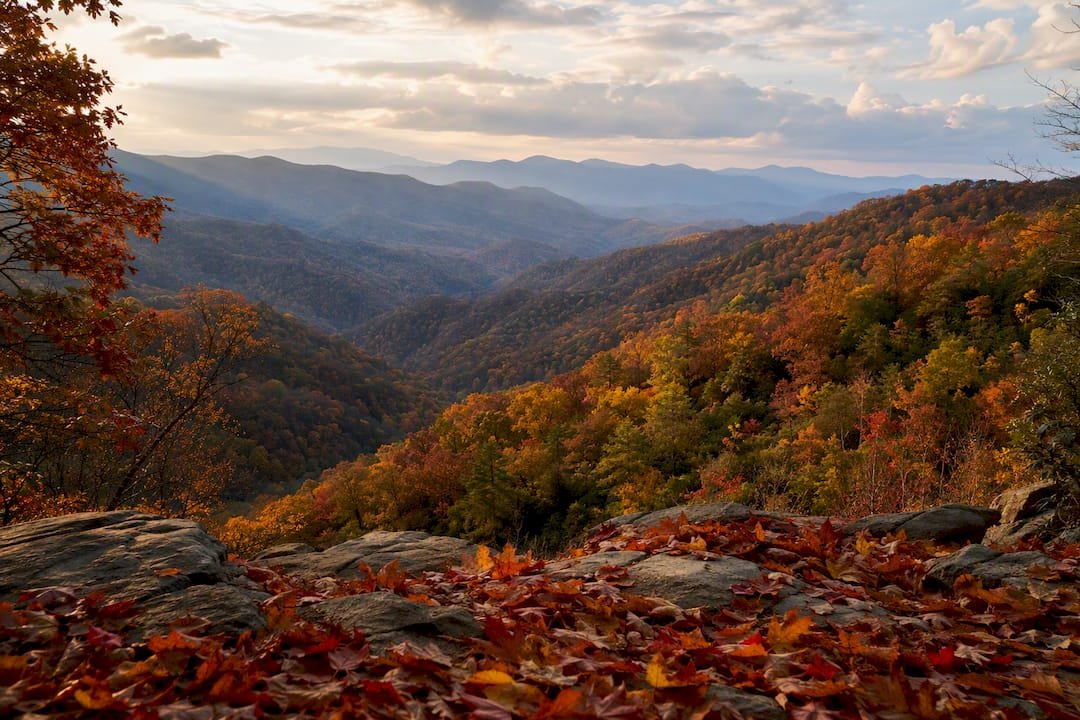
Leaf watching in Georgia peaks earliest at high elevation and latest in the lowlands, so the short answer is: head to North Georgia’s mountains from mid to late October, then watch the color wave roll downhill into early November for the Piedmont and metro Atlanta. Before you book anything, check three live sources: Georgia State Parks Leaf Watch, the Georgia Forestry Commission’s Leaf Watch, and the interactive ExploreFall foliage map. Timing shifts every year because day length, temperature, and tree species all interact differently.
- Start monitoring reports in late September.
- Prioritize Black Rock Mountain, Vogel, and Brasstown Bald for early color.
- Save metro-area parks like Red Top Mountain for your early November trip.
Weekly Leaf Watch reports track color progress across dozens of Georgia state parks, giving you a real number to plan around instead of guessing.
Key Takeaways
Georgia’s fall color moves from high-elevation North Georgia in mid-October down to metro Atlanta and beyond by early November, and tracking live reports beats guessing every time.
| Point | Details |
|---|---|
| Follow the elevation wave | Start in North Georgia’s mountains mid to late October, then chase color south into November. |
| Check three live tools | Use Georgia State Parks Leaf Watch, GFC Leaf Watch, and ExploreFall before finalizing dates. |
| Shortlist 3 to 4 parks | Prioritize Vogel, Black Rock Mountain, Tallulah Gorge, and Brasstown Bald for reliable color. |
| Book lodging early | Cabins and campsites near peak weekends fill up well in advance. |
| Go midweek when possible | Avoid parking capacity limits and crowded overlooks by visiting on weekdays. |
Table of Contents
- When and Where Fall Colors Peak by Region
- Which Parks and Overlooks Rank Highest for Leaf Watching?
- What Are the Best Scenic Drives and Short Hikes?
- How Do You Use Leaf Watch Reports and Foliage Maps?
- How Do You Avoid Crowds and Book Lodging in Time?
- What’s the Best Way to Experience Fall Color in Georgia?
- What Safety and Stewardship Steps Should You Follow?
- Where Should You Check for Official Leaf Watching Updates?
- Frequently Asked Questions
- Sources
When and Where Fall Colors Peak by Region
Georgia doesn’t turn all at once. Elevation drives the calendar more than the calendar drives itself, and that’s the single most useful fact for planning a trip.
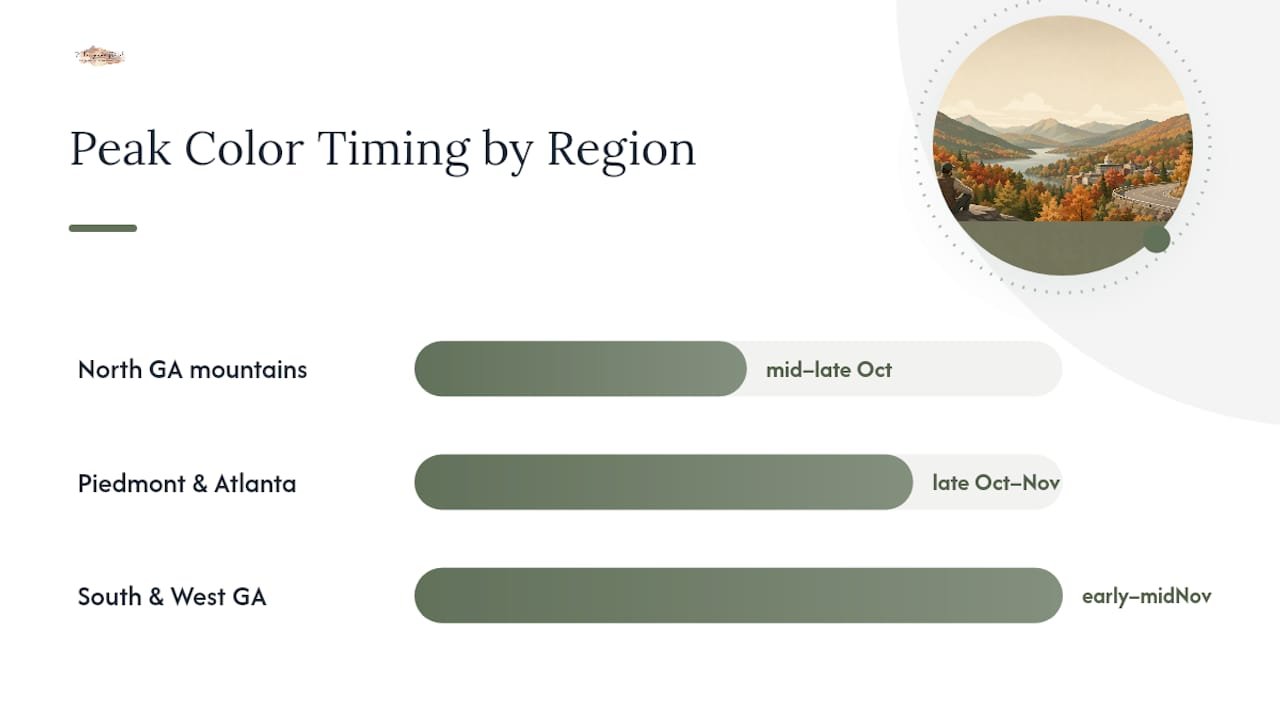
In the North Georgia mountains, color typically peaks from mid to late October. Head south toward the Piedmont and metro Atlanta, and peak often arrives in early November instead. Southern and western Georgia, being lower and warmer, lag even further behind, with muted color that can stretch into mid-November in a mild year.
Elevation matters because cooler nights trigger the chemical shift that turns green chlorophyll into the reds, oranges, and golds you’re driving up to see. Cool, crisp mountain mornings tend to intensify reds, while a hot, dry September can delay or mute the whole show. That’s the wildcard every year: drought stress and unseasonable heat push the display later and duller, while a normal, cool fall makes the colors pop right on schedule.
- North Georgia mountains: mid to late October
- Piedmont and metro Atlanta: late October into early November
- South and west Georgia: early to mid November, generally less vibrant
Pro Tip: Treat your itinerary like a moving target, not a fixed date. Book flexible lodging where possible and let the weekly reports, not the calendar, decide your final route.
Which Parks and Overlooks Rank Highest for Leaf Watching?
Georgia’s best fall color spots aren’t interchangeable. Some reward a five-minute walk from the parking lot; others demand a real hike. Here’s a shortlist worth building a trip around.
- Amicalola Falls State Park: Georgia’s tallest waterfall framed by fall color, peaks mid to late October, easy overlooks near the lodge plus strenuous approach trails, cabins and a lodge on site.
- Brasstown Bald: the state’s highest point, with 360-degree views; peaks early to mid October at that elevation, short paved summit walk from the parking area.
- Vogel State Park: classic lake and mountain reflections, peaks mid to late October, easy lakeside trails and moderate ridge hikes, cabins and campsites available.
- Black Rock Mountain State Park: Georgia’s highest state park, peaks mid October first among the parks, overlooks are easy, backcountry trails are more demanding, cabins on site.
- Tallulah Gorge State Park: dramatic gorge walls and suspension bridge views, peaks mid to late October, moderate to strenuous rim and gorge-floor trails.
- Cloudland Canyon State Park: canyon rim views in northwest Georgia, peaks mid to late October, easy overlooks and a steep staircase trail to the falls, cabins and campgrounds available.
- Russell-Brasstown Scenic Byway: a driving corridor connecting several of the above, peaks mid to late October.
- Fort Mountain State Park: a quieter alternative with lake views, peaks late October, easy trails, cabins and campsites.
- Unicoi State Park & Lodge: lake and forest color near Helen, peaks mid to late October, easy walking trails, full-service lodge and cabins.
- Moccasin Creek State Park: small, easy, family-friendly lake park, peaks mid to late October.
- Don Carter State Park: Lake Lanier reflections, peaks late October into early November, easy trails, cottages and campsites.
- Red Top Mountain State Park: a metro-adjacent option, peaks late October into early November, easy trails, cottages and RV sites.
- James H. Floyd State Park: low-traffic and scenic, peaks mid to late October, easy to moderate trails.
- Victoria Bryant State Park: quiet Piedmont park, peaks late October, easy trails, golf course setting.
- Blue Ridge Scenic Railway: a seated, no-hiking way to see color from the rails, running through late October and into November depending on the schedule.
Cross-check any of these against ExploreFall’s map before locking dates, since it updates faster than a static list ever could.
What Are the Best Scenic Drives and Short Hikes?
For maximum color per hour behind the wheel, the Russell-Brasstown Scenic Byway is hard to beat: it climbs through national forest, past overlooks, and connects Vogel to Brasstown Bald. Wolf Pen Gap Road near Suches offers a tighter, twistier alternative with fewer crowds.
For hikes and overlooks:
- Bear Hair Gap Trail, Vogel State Park: moderate loop, about 2 hours, lake and ridge views.
- West Rim Loop, Cloudland Canyon: moderate to strenuous, 2 to 3 hours, canyon views throughout.
- Brasstown Bald summit walk: easy, under 30 minutes, best 360-degree vantage in the state.
- Tallulah Gorge rim trails: easy overlooks, moderate gorge floor access requiring a permit.
Families do best at paved overlooks like Brasstown Bald or Amicalola’s lodge-area views. Photographers should budget extra time at Tallulah Gorge and Cloudland Canyon for shifting light on the rock walls.
How Do You Use Leaf Watch Reports and Foliage Maps?
Three tools do the real work of narrowing down your travel dates. Georgia State Parks Leaf Watch publishes weekly reports naming which parks are near, at, or past peak, along with trail and lodging suggestions. The Georgia Forestry Commission’s Leaf Watch adds a forestry angle, tracking regional color progress tied to temperature and species mix. ExploreFall layers daily, near-real-time updates on top of both, blending observation reports with short-term weather trends so you can make a call days out, not weeks out.
- Check weekly starting in late September.
- Bump that to every 2 to 3 days once you’re inside October.
- Read the map’s color gradient as a range, not a guarantee: darker shades mean more reports of peak color, not certainty.
Pro Tip: Cross-reference the map’s color gradient with a 7-day weather forecast for your target park. A run of cool nights in the 40s or 50s right before your trip is a strong sign color is about to intensify fast.
How Do You Avoid Crowds and Book Lodging in Time?
Weekend crowds at Georgia’s most photogenic parks are real, and parking lots at Amicalola, Vogel, and Tallulah Gorge fill fast on peak Saturdays. A midweek visit, or arriving before 9 a.m., solves most of the congestion problem outright.
Lodging is the bigger constraint. Cabins and campsites at popular parks routinely book well in advance for peak-color weekends, and some travelers reserve a full year out. If you want flexibility, private lodging near the mountains gives you a base camp without fighting the state park booking calendar.
- Pack for layering: mornings run cold, afternoons warm up fast.
- Bring sturdy footwear for wet, leaf-covered trails.
- Carry water, bug spray, and a paper map or downloaded trail app.
- Pre-trip checklist: confirm parking rules, lock in lodging, and check Leaf Watch the week before you leave.
Pro Tip: Book two backup parks alongside your first choice. If reports show your top pick past peak, you can pivot without losing the weekend.
What’s the Best Way to Experience Fall Color in Georgia?
Match the experience to what you actually want out of the trip. The Blue Ridge Scenic Railway suits travelers who want color without a hike. Paddlers get calm-water reflections at Don Carter or Fort Mountain, best at sunrise before wind picks up. Waterfall and overlook seekers belong at Tallulah Gorge and Amicalola Falls, ideally shooting golden hour for the richest light.
- Families: stick to paved overlooks and lake parks like Moccasin Creek.
- Solo travelers or photographers: aim for quieter spots like James H. Floyd or an early morning gorge walk.
What Safety and Stewardship Steps Should You Follow?
Wet, fallen leaves make trails slicker than they look, so pack layers, carry water, and check trail difficulty before you commit to a route. Respect posted parking limits. When a lot is full, it’s full for a reason.
- Leave No Trace on every trail.
- Don’t transport firewood between counties or campgrounds.
- Buy or gather firewood locally instead, since the Georgia Forestry Commission warns that moving it spreads invasive pests that damage the forests you came to see.
Pro Tip: A cheap firewood bundle from a gas station near the park costs less than the risk of introducing a pest that outlives your weekend trip by decades.
A Local Note on Choosing Quieter Parks
I’d rather spend an afternoon at Victoria Bryant with nobody else on the trail than fight for a parking spot at a marquee park on a Saturday. My planning rhythm: monitor Leaf Watch weekly, pick two backup parks, and book midweek whenever the schedule allows. If your crew wants a multi-day base camp near the color, Cherrywood Ranch’s lodging in the North Georgia mountains puts you close to several of these parks without the scramble for a state park cabin.
Planning a multi-day leaf-watching trip through North Georgia often means the lodging search is harder than the hiking. If your group is already dreaming about a mountain getaway, or even weighing a future wedding weekend against that same backdrop, Cherrywood Ranch Wedding Venue & Vacation Home offers private lodging for up to 16 guests, with mountain views, a pool, and a hot tub, right in the heart of the color corridor. It’s built for groups who want a home base first and a schedule of day trips second.
Where Should You Check for Official Leaf Watching Updates?
- Georgia State Parks Leaf Watch: weekly foliage reports and lodging tips, check weekly starting late September.
- Georgia Forestry Commission Leaf Watch: forestry-based color updates and stewardship guidance, check weekly.
- ExploreFall Georgia map: daily, near-real-time foliage map, check every 2 to 3 days as your trip nears.
- Official park pages: confirm lodging availability and trail closures a few days before arrival.
Frequently Asked Questions
When is the best time for leaf watching in Georgia?
Mid to late October for the North Georgia mountains, sliding to late October through early November for metro Atlanta and the Piedmont.
What’s the single best resource for tracking fall color in real time?
ExploreFall’s interactive map updates daily and combines observation reports with weather trends, making it the fastest way to confirm timing close to your trip.
Do I need reservations for state park cabins during peak weekends?
Yes. Cabins and campsites at popular parks routinely book out well ahead of peak-color weekends, so reserve as early as your travel plans allow.
Which parks are best for avoiding crowds?
James H. Floyd, Victoria Bryant, and Moccasin Creek State Parks see far less traffic than Amicalola Falls or Tallulah Gorge, especially on weekends.
Can weather really change when leaves peak?
Yes. A hot, dry September delays and mutes color, while cool, crisp October mornings intensify reds and oranges, sometimes shifting peak timing by a week or more.
Sources
- Fall foliage forecast: When will leaves peak in Georgia? | FOX 5 Atlanta
- Leaf Watch | Georgia State Parks & Historic Sites
- GFC Leaf Watch | Georgia Forestry Commission
- Georgia fall foliage map | ExploreFall