
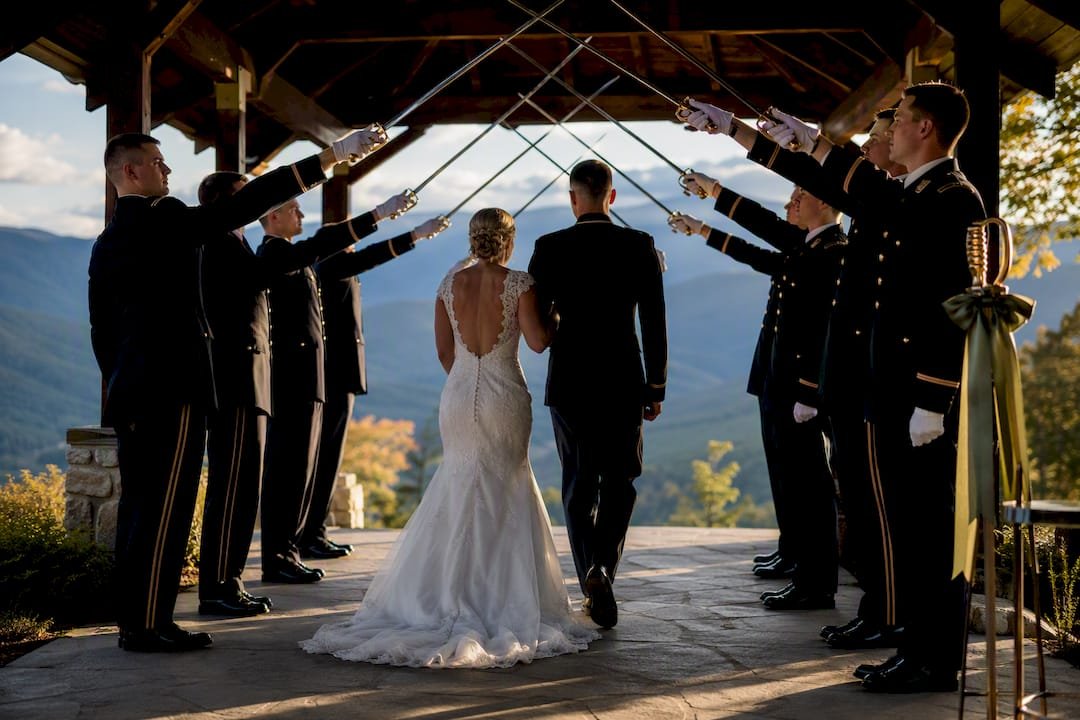
Most military weddings feature an exit saber or sword arch, uniforms in place of tuxedos, rank spelled out on invitations, flag displays near the altar, and reception nods like cutting the cake with a ceremonial saber. Nearly all of it is optional, and every piece can be adapted to a civilian venue with the right rehearsal and a little advance planning. Traditions vary by branch, so an Army couple and a Navy couple will make some different calls. What follows covers the mechanics, the etiquette, and how to fit it all into a private wedding weekend without a permit headache.
TL;DR:
- The saber or sword arch is a popular but optional tradition, often outdoors due to weapon restrictions at indoor venues.
- Uniform dress codes and medals vary by branch, with mess dress being rare and easier-to-manage options like service dress often preferred for weddings.
- Invitations should list guests’ full ranks and titles, and flags must be displayed respectfully, never touching the ground or using as decoration.
- Rehearsing the saber arch separately on an outdoor lawn and staging gear in advance prevents mishaps and ensures smooth execution.
- Hosting a private wedding weekend on a venue like Cherrywood Ranch provides more flexibility for traditions, rehearsals, and logistics.
Table of Contents
- Which Military Wedding Customs Are Standard vs. Optional
- How the Saber Arch Actually Works, Step by Step
- Uniforms, Medals, and Appearance Rules Guests Should Know
- Invitations, Seating, and Flag Etiquette That Show Respect
- Rehearsal Day: The Checklist That Keeps Everything on Schedule
- Running These Traditions at a Private, Multi-Day Venue
- What Couples Get Wrong About Military Wedding Traditions
- Host Your Military Wedding Traditions at Cherrywood Ranch
- Sources
- FAQ
Which Military Wedding Customs Are Standard vs. Optional
Military wedding customs fall into two buckets: near-universal ones and branch-flavored extras couples pick based on personal preference. The saber or sword arch tends to be the one couples want most, but nothing on this list is mandatory.
- Arch of Sabers or Arch of Swords: an honor guard forms a tunnel of unsheathed blades for the couple to walk through, typically right after the ceremony.
- Uniforms: mess dress, service dress (Army calls it Class A), or dress blues stand in for civilian formalwear for the service member and often the wedding party.
- Rank on invitations: full titles and branch designations appear on the outer envelope as a mark of respect.
- Seating by rank: senior officers and distinguished guests often get reserved rows or tables.
- Flag displays: the American flag and a branch or unit flag flank the ceremony space or reception entrance.
- Cake-cutting with a saber: the couple uses the officer’s presentation saber instead of a knife.
- Branch songs and send-offs: reception moments built around “The Army Goes Rolling Along,” “Anchors Aweigh,” or similar branch anthems.
Most of these customs travel well to a civilian venue, according to The Knot, which notes couples pick and choose based on venue rules, branch custom, and what actually feels like them. The one recurring hurdle is weapons policy: some churches and event spaces restrict unsheathed blades indoors, which pushes the saber arch outdoors or off the agenda entirely.
How the Saber Arch Actually Works, Step by Step
The Arch of Sabers (Army and Air Force) or Arch of Swords (Navy and Marine Corps) uses a group of service members who form a tunnel of unsheathed blades for the newlyweds to walk through, typically right after the ceremony ends, a stunning moment among wedding proposal ideas that wow to incorporate in your celebration. The U.S. Military Academy at West Point describes it as a symbol of protection, the honor guard literally shielding the couple as they step into married life together.
The sequence usually runs like this:
- Sabers are drawn on command as the couple approaches the arch.
- Bearers raise blades to form the arch overhead, edges up.
- The couple walks through while the arch holds.
- The last two bearers lower their blades briefly at the exit point, sometimes tapping the bride lightly (a lighthearted “toll,” in some units) before letting the couple pass.
- Sabers close and the arch dissolves as the couple clears the tunnel.
If a unit can’t field eight bearers, four or six works fine. The arrangement matters less than the alignment.
Pro Tip: Rehearse the arch separately from the main wedding rehearsal. Sort bearers by height so blade tips meet cleanly, assign one bearer as arch lead to call commands, and stage saber cases and gloves ahead of time so nobody is fumbling gear in front of guests.
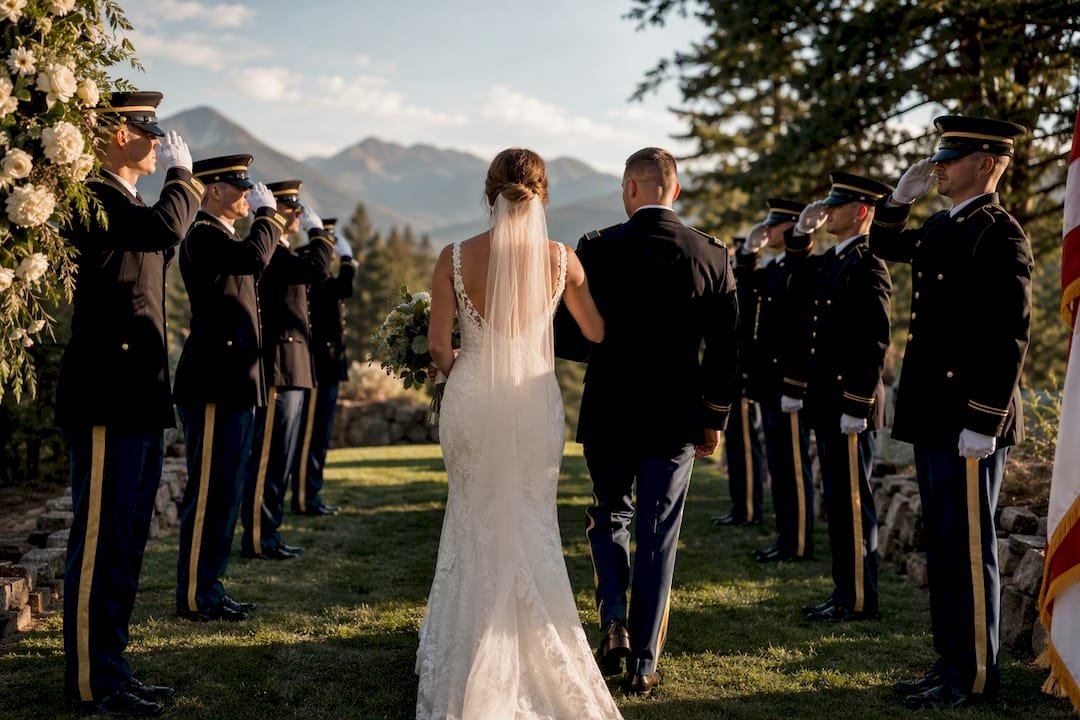
Guest proximity makes even small missteps obvious, which is exactly why West Point’s guidance stresses a dedicated saber rehearsal. Indoors, check with the officiant or venue first. Many churches and some private venues restrict unsheathed weapons, and a mountain-view outdoor space often solves that problem outright while giving photographers a cleaner background. Where an arch isn’t permitted, some couples substitute a flag corridor or an honor guard salute at the recessional instead.
Uniforms, Medals, and Appearance Rules Guests Should Know
Formal military dress breaks into three general tiers, and which one shows up at a wedding depends on the branch, the season, and what the service member actually owns. Mess dress is the most formal option and functions as the military’s answer to a tuxedo, but not every service member owns a set since it’s typically purchased at their own expense. Service dress (Army’s Class A) is more common and still looks sharp in photos. Navy weddings in warmer months sometimes see dress whites instead of the standard blues.
A few appearance rules trip up couples who assume uniforms work like rented tuxedos:
- Boutonnieres are typically not worn on the uniform. Skip the pin and let the ribbons and rank insignia do the visual work.
- Medals are for formal dress uniforms; day-to-day service uniforms usually call for ribbons instead, and mixing the two is a common mistake.
- Alterations are limited. Uniforms follow branch regulations, so there’s no letting out a jacket for a better photo silhouette.
- Grooming standards (hair length, facial hair limits) still apply on the wedding day for anyone in uniform.
The Knot’s reporting confirms mess dress ownership isn’t universal across service members, which is one reason many couples mix uniforms with civilian formalwear for the wedding party rather than forcing everyone into dress blues. If you’re coordinating a mixed-branch wedding party, plan a group photo runthrough. An Army Class A jacket and a Navy dress blue jacket read very differently in the same frame, and it helps everyone to know that going in rather than noticing it in the proofs.
Invitations, Seating, and Flag Etiquette That Show Respect
Addressing invitations correctly is one of the simplest ways to honor military service, and it’s also the etiquette point couples get wrong most often. West Point’s guidance is direct on this: outer envelopes should carry the guest’s full rank and title, spelled out, never abbreviated (“Colonel,” not “Col.”), with the inner envelope facing the recipient when the invitation is opened.
A few more etiquette basics worth locking in early:
- Seat senior officers and their spouses in a distinguished-guest section, whether that’s a front pew or a reserved reception table.
- Reserve visible, convenient parking for senior officers arriving separately from the wedding party.
- Display the American flag near the altar or arbor, paired with a branch or unit flag if the couple wants that detail included.
- Save a folded, presentation-style flag for a specific honor (a retired parent, a deployed relative) rather than using it as generic décor.
- Never let a flag touch the ground or drape over a table as a tablecloth. Stand it, hang it, or frame it.
None of this requires a protocol officer to execute. It requires a printed seating chart and someone on the day who knows which guests outrank which.
Rehearsal Day: The Checklist That Keeps Everything on Schedule
Rehearsal is where military traditions either come together cleanly or turn into a scramble ten minutes before the ceremony. Run through this short list the day before:
- Confirm the venue allows unsheathed sabers outdoors (or indoors, if that’s the plan) and identify a backup spot if weather forces a last-minute move.
- Stage sabers, gloves, and cases at a fixed spot near the arch location so bearers aren’t hunting for gear.
- Walk the saber bearers through the full command sequence at least twice, height-sorted, with one designated lead calling the moves.
- Confirm flag placement and who’s responsible for setting it up and taking it down.
- Set the alcohol policy for uniformed participants before the reception starts. Bearers handling sabers should stay dry until the ceremonial duties are done.
Pro Tip: Build fifteen minutes of buffer into the rehearsal schedule specifically for the saber arch. It always takes longer than couples expect, and rushing it is how spacing mistakes happen in front of guests.
One administrative note worth flagging while everyone’s already thinking logistics: after the wedding, service members typically need the marriage certificate to enroll a spouse in DEERS, which means a follow-up visit to an ID card facility. It’s not a rehearsal-day task, but it’s easy to forget once the weekend’s momentum takes over.
Running These Traditions at a Private, Multi-Day Venue
Outdoor mountain settings solve the weapons-and-indoor-space problem that trips up a lot of military ceremonies. Staging the arch on open lawn gives bearers room to align by height without guests crowding the exit path, and it gives photographers a clean angle to shoot through the blades toward the mountain backdrop.
A sample rehearsal-day run sheet for a weekend venue stay might include:
- Morning: walk the ceremony site, mark the exact arch location, and confirm sightlines with the photographer.
- Midday: rehearse saber commands separately from the full wedding party rehearsal.
- Afternoon: stage flags, confirm distinguished-guest seating, and lock the reception timeline.
For deployment timing or base-specific rules, a Military OneSource consult or a chaplain’s office is the right call. For rehearsal flexibility, custom décor, and the extra time a base chapel schedule rarely allows, a private wedding weekend is often the better fit.
What Couples Get Wrong About Military Wedding Traditions
The advice couples usually get is a checklist: do the arch, wear the uniform, fly the flag, done. That misses the actual point. Every one of these customs is a formality that exists to communicate honor. It only reads as honor when it’s executed well, and a poorly rehearsed saber arch or a seating chart that puts a colonel behind a cousin’s plus-one communicates the opposite of what you intended.
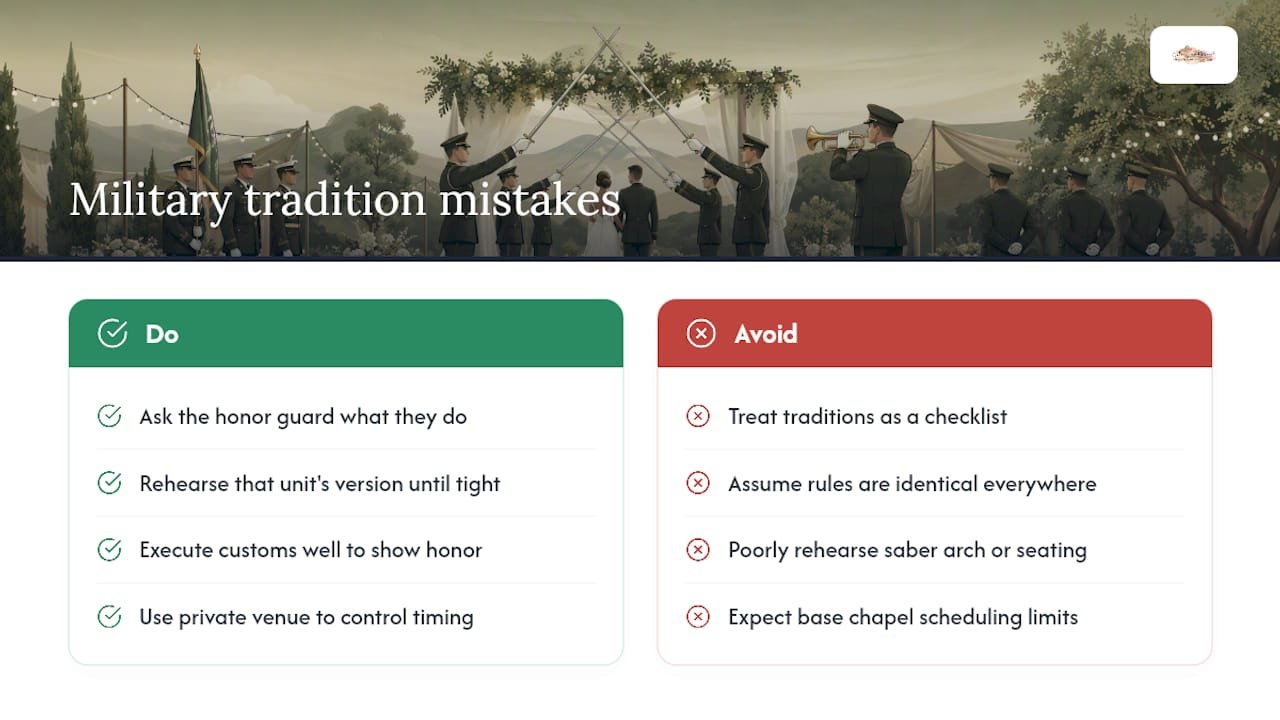
The conventional wisdom also oversells rigidity. Couples act like these traditions are handed down whole from regulation, when in practice branches differ, units differ, and even individual officers have different comfort levels with things like the “toll” at the saber arch. The real skill isn’t memorizing every rule. It’s asking your honor guard what their unit actually does, then rehearsing that specific version until it’s tight.
If you’re marrying at a private venue instead of a base chapel, you have more room to get this right, not less. You control timing, you control the rehearsal schedule, and you’re not squeezed between someone else’s ceremony slots.
— Luis
Host Your Military Wedding Traditions at Cherrywood Ranch
Cherrywood Ranch offers military couples unhurried rehearsal time and open mountain lawns where a saber arch has room to breathe. Instead of squeezing a ceremony rehearsal into a short window, couples may have a full wedding weekend on private grounds, with lodging available for guests so the whole honor guard can rehearse the night before without the need to race back to hotels.

The venue’s outdoor spaces work naturally for staging an arch, positioning flags near the ceremony site, and giving photographers the sightlines that make a saber arch look as sharp as it did in rehearsal. Onsite lodging means your bearers, officiant, and family are already on the property the morning of, which solves most of the timing problems that come from coordinating a saber arch across separate hotels. Check available dates for your destination wedding weekend at Cherrywood Ranch and start building a rehearsal schedule that actually has room in it for the traditions you want to include.
Sources
- Military Weddings — U.S. Military Academy West Point
- Planning a Military Wedding: Tips, Questions & Traditions — The Knot
FAQ
What are the etiquette rules for a military wedding?
Address invitations with full rank and title, seat senior officers in a distinguished-guest section, and treat flags with care by never letting one touch the ground or serve as a tablecloth.
What are five military wedding traditions?
The Arch of Sabers or Swords, uniformed dress instead of tuxedos, rank listed on invitations, flag displays at the ceremony, and cutting the cake with a ceremonial saber cover the most common five.
Why do military couples sometimes marry quickly?
Deployment schedules, permanent-change-of-station orders, and benefits timelines can push couples toward a faster timeline than civilian weddings typically follow, though this varies widely by service member and situation.
What are the rules for marriage in the military?
There’s no special legal process for a service member to marry. A regular civil marriage license and certificate are needed, and the certificate is later required for DEERS enrollment at an ID card facility.
Is the saber arch mandatory at a military wedding?
No. Nearly all military wedding traditions, including the saber arch, are optional and adapted based on venue rules, branch custom, and personal preference.