

A modest wedding weekend runs about $15,000 to $20,000, an average one lands near $34,200, and a full multi-day celebration with lodging and extra events can push past $50,000. Guest count drives the swing more than any other factor. Set your ceiling now using savings plus confirmed family contributions plus your monthly savings rate between now and the wedding, and build every other number down from that figure.
TL;DR:
- A wedding weekend with multiple events can easily exceed $50,000, especially with larger guest lists, upgraded amenities, and additional lodging expenses.
- Setting a realistic budget ceiling involves adding current savings, confirmed contributions, and monthly savings, then allocating 10 to 15 percent for hidden fees and buffer costs.
- Per-guest costs range from approximately $220 to $350, with additional guests increasing total expenses by $200 to $300 each, mainly for catering and rentals.
- Booking vendors separately for a multi-day event often raises costs by 9 to 15 percent due to overtime, transport, and staffing fees, so bundled packages can save money.
- An all-in-one venue with lodging and event spaces reduces transportation, staff overtime, and setup fees, making the budget easier to control and predict.
Table of Contents
- Wedding Weekend Budget Breakdown by Category
- How Do You Set Your Wedding Weekend Ceiling?
- Per-Guest Costs: What Each Additional Guest Really Adds
- What Extra Costs Come With a Multi-Day Wedding Weekend?
- Smart Ways to Cut Costs Without Cutting the Experience
- How Do You Get Accurate Vendor Quotes for a Wedding Weekend?
- Budget Tracker Template and Weekend Checklist
- How Do You Split Costs Among Families for a Wedding Weekend?
- What Wedding Planners Get Wrong About Weekend Budgets
- Why an All-in-One Weekend Venue Simplifies the Budget
- Where These Numbers Come From
- Sources
- FAQ
Wedding Weekend Budget Breakdown by Category
Once you have a ceiling number, the next move is splitting it into categories that actually reflect how multi-day weddings spend money. The average U.S. wedding costs about $34,200, and most planners still build percentage breakdowns around a familiar structure, even when a wedding stretches across two or three days instead of one evening.
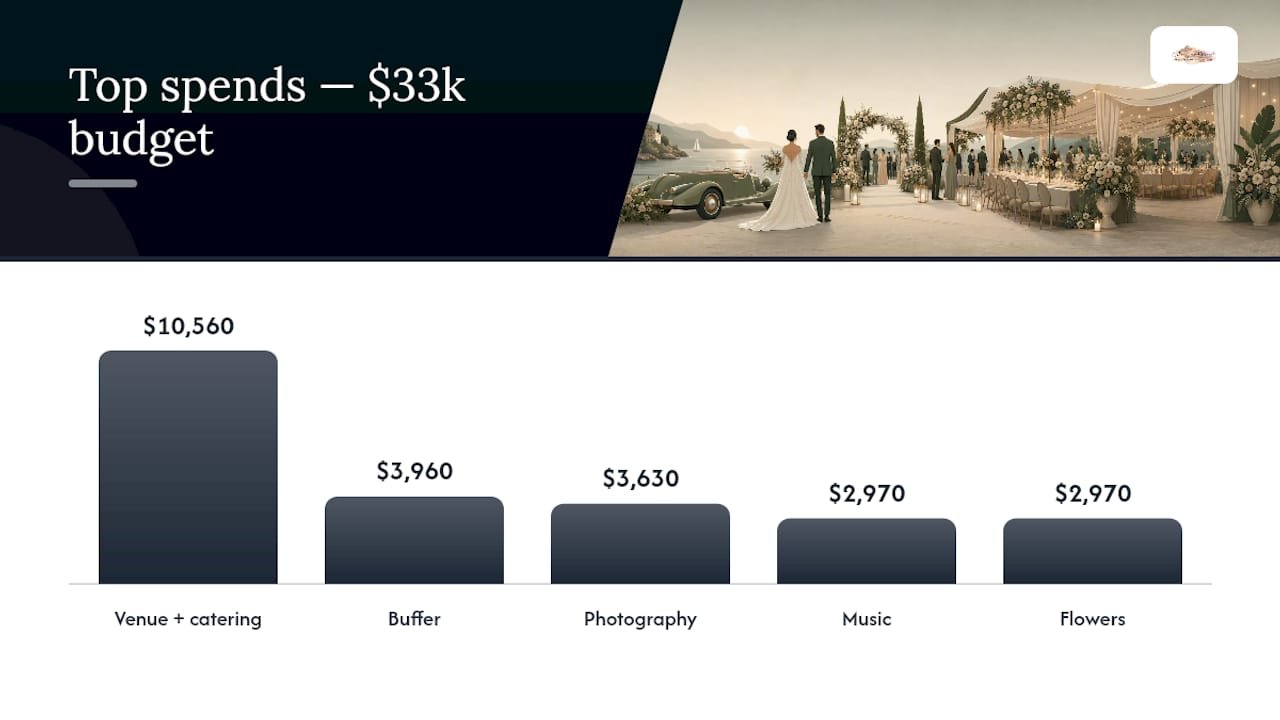
Venue and catering together typically eat up 30 to 35 percent of the total budget, which makes sense once you count rehearsal dinners and welcome events as part of the same food and space line. Photography usually runs about 10 to 12 percent, music about 8 to 10 percent, and flowers about 8 to 10 percent. Attire is around 5 to 8 percent, a planner or coordinator about 4 to 6 percent, rings 3 to 5 percent, stationery 2 to 3 percent, and transportation 2 to 3 percent. A buffer of roughly 10 to 15 percent is recommended to absorb additional costs. It is the line that absorbs the hidden fees almost every couple runs into.
Here is how those percentages translate into real dollars across three common ceiling sizes:
| Category | $20,000 budget | $33,000 budget | $50,000 budget |
|---|---|---|---|
| Venue + catering (30–35%) | $6,400 | $10,560 | $16,000 |
| Photography (10–12%) | $2,200 | $3,630 | $5,500 |
| Music (9%) | $1,800 | $2,970 | $4,500 |
| Flowers (9%) | $1,800 | $2,970 | $4,500 |
| Attire (6%) | $1,200 | $1,980 | $3,000 |
| Planner (5%) | $1,000 | $1,650 | $2,500 |
| Rings (4%) | $800 | $1,320 | $2,000 |
| Stationery (2%) | $400 | $660 | $1,000 |
| Transportation (2%) | $400 | $660 | $1,000 |
| Buffer (12%) | $2,400 | $3,960 | $6,000 |
The $20,000 tier fits an intimate weekend with a small guest list and a single-venue setup, where you’re not paying for separate ceremony and reception locations. The $33,000 tier roughly matches the national average and assumes a mid-sized guest list with at least one additional weekend event, like a welcome dinner. The $50,000 tier covers a fuller weekend: multiple events, upgraded catering, and often some guest lodging support.
Notice the buffer scales with the budget rather than staying fixed. A $6,000 buffer on a $50,000 wedding sounds large until you remember that hidden fees alone commonly add 9 to 15 percent to initial vendor quotes. Skimping on that line is the single most common budgeting mistake couples make, and it’s usually the first thing that forces a last-minute guest list cut or a maxed-out credit card two weeks before the wedding.
If your guest list sits closer to 50 people, a smaller-scale weekend often lets you shift dollars from catering into experience upgrades, like a better band or an extra day of lodging, without changing your ceiling at all.
How Do You Set Your Wedding Weekend Ceiling?
Setting a ceiling isn’t about guessing what feels reasonable. It’s arithmetic, and the formula is short enough to do on a napkin:
Current savings + confirmed family contributions + (monthly savings × months until the wedding) = your ceiling.
Every number in that equation should be real, not hoped for. “Confirmed” means a parent has actually said a dollar figure out loud, not that they seemed excited at dinner. Here’s how to work through it step by step.
- Total your current savings earmarked specifically for the wedding, separate from your emergency fund or other goals.
- Add confirmed contributions. If your parents have committed $8,000, that number goes in. If it’s still “we’ll help out,” leave it out until it’s a real figure.
- Calculate your monthly savings capacity. Look at your last three months of actual spending, not your ideal budget, and figure out what you can realistically set aside.
- Multiply that monthly figure by the number of months remaining until the wedding weekend.
- Add all three numbers together to get your ceiling.
- Split the ceiling 85 to 90 to line items and 10 to 15 to buffer, following the same buffer logic recommended for general wedding budgets.
Say you have $6,000 saved, your parents have committed $5,000, and you can realistically save $700 a month for 14 months. That’s $6,000 + $5,000 + ($700 × 14) = $20,800. Reserve $2,600 to $3,100 of that as buffer, leaving roughly $17,700 to $18,200 for actual line items.
Automate the savings piece the same week you set the ceiling. A recurring transfer into a dedicated savings account on payday removes the temptation to skip a month, and most banks let you set this up in under five minutes. Couples who automate tend to hit their number closer to on schedule than those who plan to “transfer manually each month,” mostly because manual transfers are the first thing that gets postponed when a paycheck feels tight.
Revisit the formula every three months. If a bonus comes in or a contribution changes, adjust the ceiling immediately rather than waiting until six weeks before the wedding to discover you’re short.
Per-Guest Costs: What Each Additional Guest Really Adds
Guest count is the single biggest lever in any wedding weekend budget, and the math is more predictable than most couples expect. Per-guest costs typically fall into three tiers: a modest tier around $220 per guest, a mid-range tier closer to $285, and a premium tier around $350. Each additional guest beyond your initial count typically adds $200 to $300 to your total, once you factor in catering, favors, seating, and rentals scaled to headcount.
| Guest count | Modest ($220/guest) | Mid-range ($285/guest) | Premium ($350/guest) |
|---|---|---|---|
| 50 guests | $11,000 | $14,250 | $17,500 |
| 100 guests | $22,000 | $28,500 | $35,000 |
| 150 guests | $33,000 | $42,750 | $52,500 |
| 200 guests | $44,000 | $57,000 | $70,000 |
These per-head figures generally include catering, rentals like chairs and linens, favors, and printed materials scaled to headcount. They typically exclude venue rental fees, photography, music, and attire, since those costs stay largely fixed whether you host 50 guests or 150. That’s an important distinction: a bigger guest list doesn’t just add catering cost, it adds pressure on every fixed-cost category too, because a venue built for 50 starts feeling cramped at 100 and may require rental upgrades to compensate.
This is exactly why the guest list is the first thing to interrogate when a budget feels tight. Cutting 20 names off a 150-person list at the mid-range tier saves roughly $5,700, more than most couples save by negotiating with a single vendor. If you’re weighing formats for a mid-sized group, reception ideas built around 10 to 80 guests often reveal how much a tighter list simplifies both cost and logistics at the same time.
What Extra Costs Come With a Multi-Day Wedding Weekend?
A single-day wedding and a wedding weekend are not the same financial event. Once you stretch a celebration across two or three days, an entirely new set of line items shows up that a standard one-day budget breakdown doesn’t account for.
- Lodging or venue buyout: Expect $2,000 to $8,000 depending on group size and whether you’re booking a hotel block or a private property for the full weekend.
- Rehearsal dinner: Typically $1,500 to $4,000 for a group of 20 to 40, roughly 4 to 8 percent of a mid-size total budget.
- Welcome party or welcome drinks: Often $800 to $2,500, frequently absorbed into the venue’s evening-one programming if the space allows it.
- Farewell brunch: Usually $500 to $1,500 for a smaller subset of guests staying through Sunday.
- Multi-day transportation: Shuttle service across two or three days can run $1,000 to $3,000, more if guests are spread across multiple lodging locations.
- Extended vendor hours and staffing: Photographers, coordinators, and catering staff working across multiple days often add 15 to 25 percent to their standard single-day rate.
- Permits and activity costs: Outdoor ceremony permits, welcome-activity rentals, or pool and grounds fees can add another $200 to $1,000 depending on the setting.
These additions can push a weekend’s total cost up by 20 to 40 percent compared with a single-evening wedding for the same guest count, which is a real number to plan around rather than discover midway through booking.
Here’s where the packaging question matters most. Booking vendor by vendor for a three-day event means paying separate delivery fees, separate overtime charges, and separate transportation costs for every service. All-inclusive packages bundle those costs, and some data suggests DIY vendor-by-vendor booking can run about 24 percent more than a comparable bundled weekend, largely because bundled pricing absorbs gratuities and coordination that would otherwise be billed separately by each vendor. A destination wedding weekend budget built around one consolidated package tends to have fewer surprise line items than one assembled from five separate vendor contracts.
Smart Ways to Cut Costs Without Cutting the Experience
Cutting a wedding weekend budget doesn’t have to mean cutting what guests remember. Some levers save real money with almost no visible impact on the day; others save money but change the experience in ways guests will notice. Knowing which is which matters more than any individual tip.
- Trim the guest list first. As shown earlier, removing 20 guests from a mid-range 150 person wedding saves around $5,700. No other single change moves the number that fast.
- Move off Saturday. Friday or Sunday weddings, especially in off-peak months, can cost 10 to 30 percent less on venue and vendor rates than a peak Saturday date.
- Switch the meal format. Buffet or family-style service cuts catering labor costs meaningfully compared with plated dinners, and can actually raise guest satisfaction on multi-day weekends where a more relaxed pace fits better. A family-style dinner works especially well for groups between 50 and 150.
- Limit the bar. A beer, wine, and one signature cocktail bar cuts alcohol spend by roughly 55 to 65 percent compared with a full open bar, with almost no complaint from guests who rarely notice the difference.
- Consolidate to one venue. Holding the ceremony and reception in the same location eliminates a second set of setup fees and cuts the risk of overtime charges piling up across multiple vendor contracts.
- Bundle vendor deposits where possible. Some venues and planners offer a discount for paying multiple deposits together rather than staggering them, which is worth asking about directly.
Pro Tip: Ask your florist to repurpose ceremony arrangements as reception centerpieces instead of ordering two separate sets. Also ask upfront whether your venue charges a cake-cutting fee. It’s a small line item most couples never think to negotiate away until they’re already signing the contract.
How Do You Get Accurate Vendor Quotes for a Wedding Weekend?
Every vendor quote you receive before signing anything should be treated as a starting point, not a final number. The gap between an initial estimate and the actual invoice is where most wedding weekend budgets quietly blow past their ceiling.
Before signing, confirm each of these line items in writing:
- Service charges and gratuities, and whether gratuity is already included in the quoted total or added separately.
- Overtime fees if the event runs past the contracted hours, and what that hourly rate actually is.
- Setup and teardown charges, particularly for outdoor ceremonies or rented equipment.
- Cake-cutting fees, corkage fees, and any “outside vendor” surcharges the venue applies.
- Permit fees for anything happening outdoors, from ceremony space to parking.
Get three quotes for every major vendor category, not just one or two. Request an itemized breakdown from each, not a single bundled number, since itemized quotes are the only way to compare apples to apples across vendors who structure pricing differently. Hidden fees commonly add 9 to 15 percent to an initial estimate, which is exactly why your buffer exists and exactly why you should never treat a first quote as your real cost.
Negotiation works best when you ask for concessions rather than discounts. A venue that won’t lower its rental fee might waive a cake-cutting charge, comp a room for the wedding night, or throw in an extra hour of setup time. All of those have real dollar value even when the headline price doesn’t move.
Once a vendor contract is signed, update your tracker the same day, moving that line from “estimated” to “committed” immediately. Waiting until the following week to update your numbers is how couples lose track of where they actually stand two months before the wedding.
Budget Tracker Template and Weekend Checklist
A working budget tracker needs exactly three columns: budgeted, actual, and variance. That structure sounds almost too simple to matter, but couples who update it weekly tend to spend less overall than those who batch-update monthly, mostly because weekly tracking catches small overages before they compound.
Build one row per vendor, plus separate rows for taxes, gratuities, and your buffer line, so nothing gets buried inside a bigger category:
- Venue, catering, photography, music, flowers, attire, and planner each as individual rows.
- A dedicated row for taxes and fees, tracked separately from the vendor’s base quote.
- A dedicated row for gratuities, even when a vendor says they’re included, so you can verify it later.
- A buffer row that only shrinks, never gets reallocated to cover a want rather than a genuine overage.
For the weekend logistics side, a separate checklist prevents the kind of last-minute scramble that costs money in rush fees and same-day upgrades:
- Confirm your hotel block or lodging reservation with a final headcount at least three weeks out.
- Set vendor arrival windows for each day of the weekend, not just the wedding day itself.
- Assign one point person per day who can answer vendor questions so the couple isn’t fielding calls during the rehearsal dinner.
- Finalize a welcome-bag plan, including who assembles them and when they get delivered to guest rooms.
On the question of hiring help, a full-service planner typically costs $3,000 to $8,000 and tends to pay for itself on larger budgets through negotiated vendor discounts and avoided mistakes. On tighter budgets, a day-of coordinator is usually the better value, handling the logistics checklist above without the full planning fee.
| Planning approach | Typical cost | Best fit |
|---|---|---|
| Full-service planner | $3,000 to $8,000 | Larger budgets, multi-day weekends with several events |
| Day-of coordinator | Lower fixed fee | Tighter budgets, couples who’ve handled most planning themselves |
| All-inclusive venue package | Varies by venue | Weekends where reducing vendor count matters most |
An all-in-one venue that combines ceremony space, reception space, and lodging under a single booking removes several of these tracker rows entirely, since transportation and staffing overtime tend to shrink when everyone stays in one place for the weekend.
How Do You Split Costs Among Families for a Wedding Weekend?
Splitting costs across multiple contributors gets more complicated on a wedding weekend than on a single-day event, simply because there are more distinct expenses to divide: the ceremony and reception, the rehearsal dinner, lodging, and often a farewell brunch.
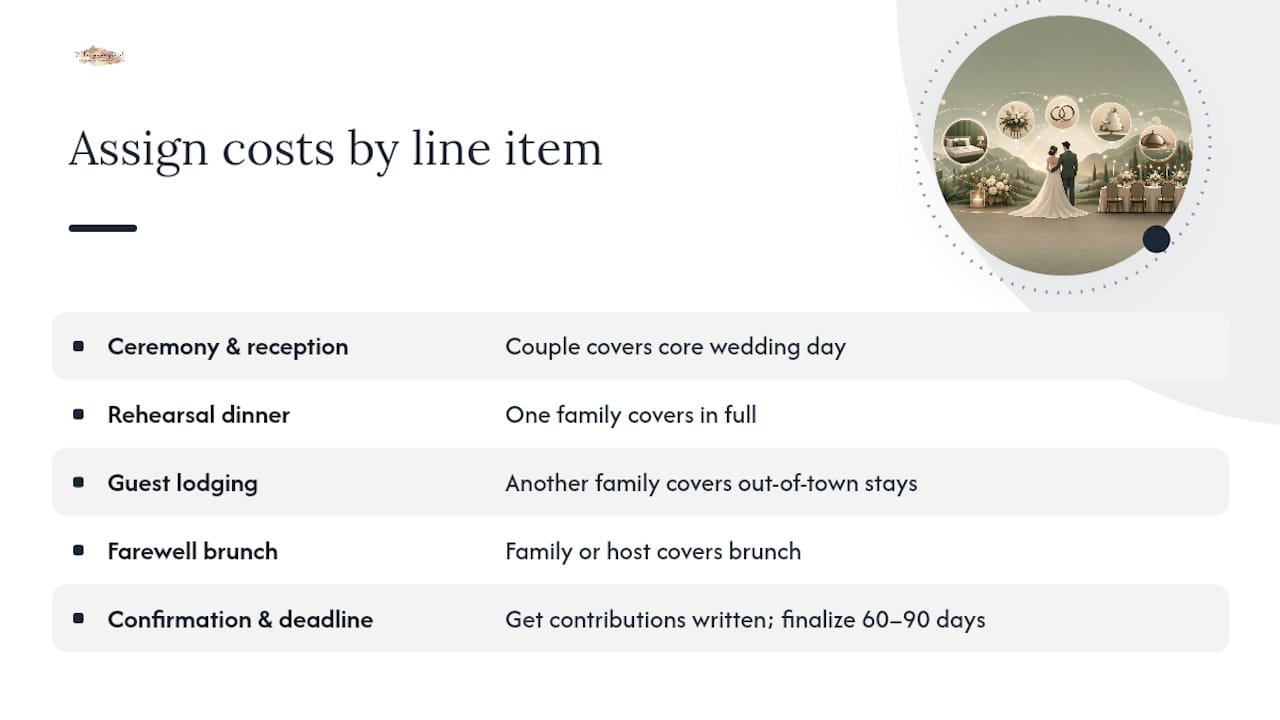
The cleanest approach is assigning contributors to specific line items rather than splitting a lump sum by percentage. One family might cover the rehearsal dinner in full, another might cover lodging for out-of-town guests, and the couple covers the core wedding day. This avoids the awkwardness of tracking who owes what share of a combined total, and it gives each contributor a clear, finite commitment they can plan around.
Get every contribution in writing before it goes into your ceiling formula, even if it’s just a text message confirming the number. Verbal offers made in the excitement of an engagement announcement have a way of shrinking by the time invoices are due.
Set a deadline for contributions to be finalized, ideally 60 to 90 days before the wedding weekend, so your ceiling isn’t still shifting when final vendor payments come due. If a contribution falls through after that point, your buffer is what absorbs the gap, not a scramble to renegotiate a signed catering contract.
For blended families or multiple sets of parents contributing, a short written summary of who’s covering what prevents the same expense from getting double-covered or, worse, forgotten entirely.
What Wedding Planners Get Wrong About Weekend Budgets
Most wedding budget advice treats a wedding weekend like a single-day wedding with a few extra line items tacked on. That’s backwards. The additional days aren’t an add-on, they’re where a huge share of the hidden cost actually lives, in overtime rates, extra staffing, and lodging logistics that a standard percentage breakdown never accounts for.
My honest take: lock your venue and photographer first, before flowers, before attire, before anything else. Those two vendors have the least flexibility once a date is set, and their pricing moves the most with lead time. Everything else can flex around them.
Set your buffer before you set anything else, not after you’ve spent down to what feels comfortable. And decide now, on paper, what gets cut first if money gets tight two months out. Guest list, bar package, or florals, in that order, works for most couples. Making that call in advance beats making it under pressure the week invoices are due.
— Luis
Why an All-in-One Weekend Venue Simplifies the Budget
Every extra vendor you add to a wedding weekend is another delivery fee, another overtime clause, another set of gratuities to track. An all-in-one weekend venue merges ceremony, reception, and lodging in one place, which can avoid transport and staffing markups.

That consolidation shows up directly in your tracker. When the wedding party and immediate family sleep on site, you’re not paying a shuttle vendor for multi-day transportation, and you’re not paying overtime to a second location’s staff because everything wraps in one place. Cherrywoodranchweddingvenue’s 3-day wedding package is built around exactly that logic, and couples who want to see the property before committing can book a day session starting at $1,950 to walk the grounds and pool area firsthand. For families weighing a luxury vacation home format against a traditional hotel block plus separate venue rental, the math from the multi-day section above tends to favor the single-property approach. If you’re ready to check dates, get started here and see what a consolidated weekend actually costs for your guest count.
Where These Numbers Come From
The percentages, per-guest tiers, and buffer recommendations throughout this guide draw on a handful of sources worth bookmarking if you want to run your own numbers. The Knot Real Weddings Study provides the national average cost figure and category benchmarks. The Penny Hoarder’s wedding budgeting guide covers the buffer math and hidden-fee percentages in more detail. Zola’s average cost guide breaks down off-peak savings and bar package comparisons. For hands-on math, the CalcWyse wedding budget calculator lets you plug in your own guest count and category weights. For weekend-specific planning, Cherrywoodranchweddingvenue’s guide on budgeting for a destination wedding weekend walks through the lodging and multi-day cost drivers covered above in more depth.
Sources
- Wedding Budget Breakdown, Based on Real Couples’ Data
- Wedding Budget: How to Plan + Tips on How to Save
- Average Cost of Weddings in 2026: (A Real Numbers Guide)
- Wedding Budget Calculator 2026 — Cost by Guest Count & … | CalcWyse
FAQ
What Is the 50/20/30 Rule for Weddings?
There’s no universally recognized “50/20/30 rule” specific to wedding budgeting. The closest standard framework is the percentage breakdown covered above, where venue and catering take 30 to 35 percent of the total, with the remaining categories split across photography, music, flowers, attire, and a buffer.
Is $5,000 a Reasonable Budget for a Wedding?
A $5,000 budget can work for a very small, intimate wedding, typically 20 guests or fewer, held at a low-cost or free venue with a simple meal format. At the modest per-guest tier of around $220, $5,000 comfortably covers roughly 20 guests once you build in a buffer, but it leaves little room for extras like a live band or a multi-day weekend format.
What Is a Reasonable Wedding Budget for 100 Guests?
For 100 guests, a reasonable range runs from about $22,000 at the modest tier to roughly $35,000 at the premium tier, based on the $220 to $350 per-guest range covered earlier. The national average of $34,200 sits right in that range for a mid-to-full-service wedding.
Is $10,000 a Reasonable Wedding Budget?
Yes, for a smaller guest list. At the modest per-guest tier of around $220, $10,000 covers roughly 45 guests once you set aside a proper buffer, which makes it workable for an intimate wedding weekend, especially one held at a single consolidated venue where transportation and multi-day staffing costs are minimized.
How Much Should I Set Aside for a Wedding Weekend Buffer?
Reserve 10 to 15 percent of your total ceiling as buffer, since hidden fees commonly add 9 to 15 percent to initial vendor estimates. On a wedding weekend specifically, lean toward the higher end of that range, since multi-day events carry more line items where surprise costs can appear.