
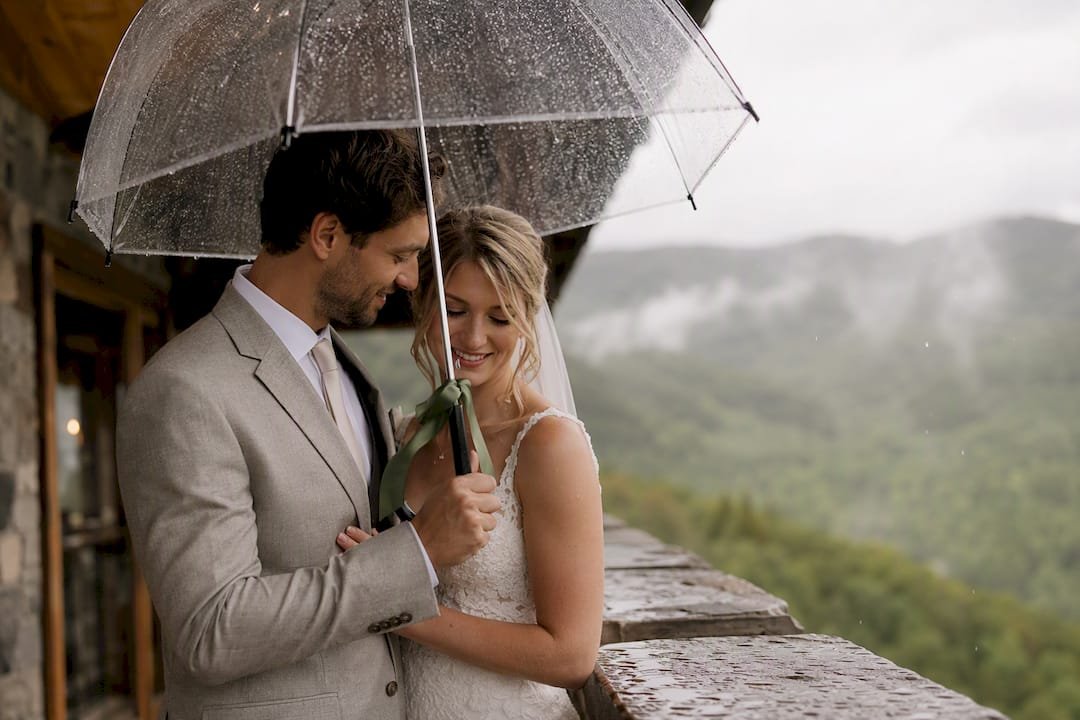
Yes, rain can make your wedding photos more cinematic. The trick is knowing which shots to chase and how to stay safe while you chase them. Start with three go-to concepts: umbrella portraits, puddle reflections, and sheltered alternatives to golden hour. One caveat overrides all of it: if you hear thunder, stop shooting outside immediately.
TL;DR:
- Rain enhances wedding photos by providing unique reflections, motion shots, and atmospheric lighting conditions that create more authentic and artistic images.
- Overcast skies naturally diffuse light, helping to reduce harsh shadows and give portraits a softer, more flattering appearance without relying on golden hour timing.
- Safety guidelines require moving indoors immediately at the first sign of thunder, waiting at least 30 minutes after the last lightning strike before resuming outdoor photography.
- Proper preparation, including sheltered spots, rain gear, and a clear weather plan, ensures couples and vendors capture high-quality images regardless of weather conditions.
Table of Contents
- 1. Photo ideas that work best in the rain
- 2. Camera settings and techniques for shooting in the rain
- 3. Lightning safety rules every wedding party should follow
- 4. The best shots to grab right after the rain stops
- 5. A rainy wedding day checklist for couples and vendors
- 6. How Cherrywood Ranch handles rainy-day photography
- 7. Why the rain often makes the best photos
- 8. Let Cherrywood Ranch handle your weather backup plan
- 9. Where to learn more about rain photography and safety
- Sources
- FAQ
1. Photo ideas that work best in the rain
Rain changes the rules of wedding photography, and that works in your favor once you know what to aim for. These categories cover the range from quiet portraits to full-motion joy, so pick two or three that match your couple’s personality rather than trying to force every idea into one session.
- Clear umbrella close-ups. A transparent umbrella keeps your faces visible while rain streaks the surface above you, giving photographers a frame within a frame without hiding your expressions behind fabric.
- Puddle and reflection compositions. Have your photographer crouch low and shoot toward a puddle, positioning you and your partner just outside the bottom edge of the frame so the reflection carries the visual weight.
- Running or dancing in the rain. Motion shots capture genuine laughter better than posed ones, and a slight blur in the arms or skirt reads as joy rather than a mistake.
- Coordinated bridal-party umbrellas. Matching or color-blocked umbrellas held in a line create symmetry that a sunny-day photo can’t replicate, especially shot from slightly above.
- Porch and doorway portraits. Standing just inside a covered entry with rain visible behind you gives a dry, comfortable pose while the weather still tells the story.
- Car window shots. Fogged glass and droplets on the window turn a quiet moment in the car into a soft, romantic frame, particularly effective for getting-ready or exit shots.
- Night rain with streetlights. After dark, wet pavement picks up light from streetlamps or venue string lights, and a touch of flash can freeze raindrops mid-air for a dramatic effect.
- Macro detail shots. Water droplets clinging to a ring, a bouquet, or a table setting add texture to the gallery and give you images to fill the quieter pages of an album.
- Color-pop props. A single bright umbrella or pair of rain boots against a gray, wet background draws the eye and adds a playful note to an otherwise moody palette.
None of these require perfect weather. They require a photographer willing to work with the rain instead of waiting it out, and a couple willing to get a little wet on purpose.
2. Camera settings and techniques for shooting in the rain
Overcast skies act as a natural diffuser. Clouds soften direct light and prevent the harsh shadows that midday sun throws across a face, which is why many rainy day wedding photos end up looking more flattering than sunny ones. That soft light is the biggest advantage rain gives you, and it’s available all day, not just during a short golden-hour window.
For portraits, a wider aperture around f/2.8 helps separate the couple from a busy, wet background. For puddle reflections, switch to something in the f/8 to f/16 range so both the reflection and the subject stay sharp, since a shallow depth of field will blur one or the other. Shutter speed decides whether raindrops freeze in the air or streak into motion blur: a faster shutter around 1/500 or higher freezes individual drops, while dropping below 1/125 lets the rain blur into soft vertical lines that read as atmosphere rather than clutter.
Practical tactics from Adobe’s wedding photography guidance include packing rain covers for the camera body, raising ISO in low light instead of slowing the shutter too far, and using flash to add a pop of light when the sky goes flat and gray.
- Keep a lens hood on at all times to block drops from landing directly on the glass.
- Wipe the lens with a microfiber cloth between every few frames, not just when you notice spotting.
- Use a plastic rain cover or even a shower cap over the camera body when shooting for more than a few minutes at a stretch.
- Bring a small dry bag or towel-lined case to swap gear in and out of the rain quickly.
For low light or evening shots, dragging the shutter (a slower shutter speed paired with a flash pop) lets ambient light and streetlamp glow register in the frame while the flash freezes the couple sharply. A study of overcast conditions found that soft, diffused light reduces contrast and harsh shadows on the face, which is part of why cloudy-day portraits often look gentler than shots taken in direct sun.
Pro Tip: Bring a small reflector or a thin off-camera rim light to separate the couple from a dark, stormy background. Even a little edge light keeps them from disappearing into the gray.
3. Lightning safety rules every wedding party should follow
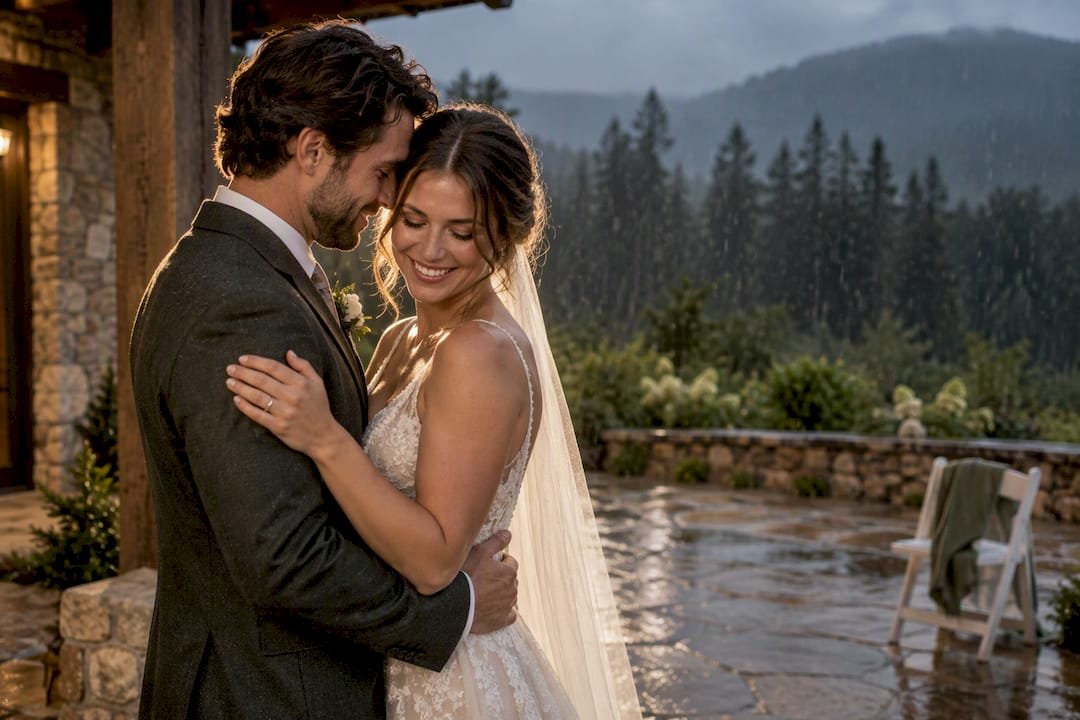
No outdoor location is safe once a storm arrives. According to the National Weather Service’s lightning safety guidance for outdoor venues, the only safe response to thunder is to move everyone into a substantial building or an enclosed vehicle, not a small tent or open-sided pavilion. Those structures do not protect against lightning no matter how sturdy they look.
- The moment you hear thunder or see lightning, stop the ceremony or photo session and head indoors or into a hard-roofed vehicle.
- Wait a full safe interval after the last thunder before anyone returns outside, a rule the National Weather Service calls the standard safe interval.
- Assign one person, ideally someone not in the wedding party, to monitor a NOAA Weather Radio or a radar app throughout the day.
- Build the evacuation plan into your written vendor timeline so the DJ, coordinator, and photographer all know the shelter location in advance.
The same guidance recommends that venues keep a written lightning-safety plan on hand, covering shelter locations and how the news gets communicated to guests. If your coordinator announces a move indoors, treat it as final rather than optional. Thirty minutes feels long in the middle of a wedding day, but it is the documented safe waiting period before conditions are considered clear again.
4. The best shots to grab right after the rain stops
The first fifteen to thirty minutes after rain often produce the richest images of the day. Wet surfaces still hold reflections, colors read more saturated than they did an hour earlier, and the light is frequently softer than it will be once the clouds fully clear. Nikon’s guidance on shifting weather notes that these short windows after a storm often deliver the most dramatic atmospheric effects, including rainbows and dynamic skies, so it pays to have your photographer ready before the rain fully stops.
- Shoot puddle reflections from a low angle, keeping the horizon line near the middle of the frame so both the sky and its mirror image read clearly.
- Clear the immediate foreground of stray leaves or debris before the shot, since small distractions read louder in a reflection than in the original scene.
- If a rainbow appears, position the couple with the sun behind the photographer and the rain still falling in the distance, which is typically where the arc will show.
- Use the same wet minutes for macro shots: droplets on flower petals, table settings, or the edge of a veil add texture you can’t fake later.
According to Morina Photography’s rainy-day shooting notes, wet pavement and wooden surfaces make striking mirrored images, and ambient light sources like streetlamps or string lights can add color into those reflections after dark.
5. A rainy wedding day checklist for couples and vendors
Turning inspiration into usable photos comes down to preparation. A short pack list and a clear division of roles prevent the scramble that usually kills good rainy-day shots.
- Pack the essentials the night before: clear umbrellas, extra towels, lens cloths, ponchos for the wedding party, waterproof shoe covers, and large trash bags to protect the gown between locations.
- Assign specific roles: one person carries umbrellas during portraits, another runs towels for wet shoes or hems, and a third keeps an eye on the weather radar all day.
- Scout sheltered photo spots on-site in advance, so the photographer already knows where to move the group if the rain picks up mid-session.
- Build extra buffer time into the day’s schedule to account for slower transitions between covered and uncovered areas.
- Print a one-page rain plan and hand it to your coordinator, photographer, and DJ so nobody is guessing when the weather shifts.
6. How Cherrywood Ranch handles rainy-day photography
Cherrywood Ranch built its rain plan for outdoor weddings around exactly this kind of preparation, pairing covered porches and staged towel and umbrella stations with backup lighting so portraits keep moving even when the sky doesn’t cooperate.
- Sheltered porches and covered outdoor spaces double as portrait spots when rain rules out the open lawn.
- Staged umbrella and towel stations mean the wedding party isn’t caught improvising mid-shoot.
- Backup lighting helps maintain portrait quality if natural light diminishes unexpectedly.
- Booking a multi-day event rather than a single day gives couples flexibility to schedule portraits when weather permits.
7. Why the rain often makes the best photos
Some of the most honest, unposed moments I’ve seen in wedding galleries happened because it was raining, not despite it. Couples laughing under one umbrella or ducking into a doorway together tend to look more like themselves than they do in a stiff, sunny pose. Plan for it, bring the right gear, and rain stops being a threat to the day. It becomes one more thing that makes the photos yours.
— Luis
8. Let Cherrywood Ranch handle your weather backup plan
Booking a venue built with rain in mind means you spend less energy worrying about the forecast and more time enjoying the weekend. The venue pairs onsite lodging with covered porches and multi-day event options, so a rainy morning doesn’t force a rushed, single-day timeline.

- Read the full rain plan for outdoor weddings to see how the venue stages shelter and lighting for weather-ready photos.
- Browse wedding and elopement packages to find a format that fits your guest count and timeline.
- Check availability and book your stay to lock in a weekend with room to work around the weather.
9. Where to learn more about rain photography and safety
For technical rain-shooting tips, Adobe’s rain photography guide covers lens protection and exposure basics. For official safety rules, rely on the National Weather Service’s lightning safety guidance.
Sources
- Rainy day wedding photography tips | Caitlin and Luke
- Embracing the unexpected: rainy day wedding photography tips | Morina Photography
- Lightning Safety Toolkit for Outdoor Venues | National Weather Service
- Wedding photography tips | Adobe
- Weather report: changing conditions followed by opportunities for beautiful images | Nikon USA
FAQ
What should you do for wedding photos if it rains?
Lean into umbrella portraits, puddle reflections, and sheltered doorway or porch shots rather than waiting for the rain to stop. Pack clear umbrellas and towels in advance, and ask your photographer to use the soft, overcast light to their advantage for portraits.
What is the 30 minute rule for weddings?
It’s a lightning safety rule stating that once thunder is heard, everyone should shelter in a substantial building or vehicle and wait a full 30 minutes after the last thunder before going back outside, according to the National Weather Service. Small tents and open-sided structures do not count as safe shelter.
What are some good photo ideas for rainy weather?
Clear umbrella close-ups, puddle reflections shot from a low angle, and running or dancing shots that capture motion all work well in the rain. Macro shots of droplets on rings or flowers and porch portraits are easy additions that round out the gallery.
What do photographers do when it’s raining?
They adjust settings for the light and the effect they want, using a faster shutter to freeze raindrops or a slower one to let them blur into streaks, and they protect their gear with rain covers and frequent lens wipes, as described in Adobe’s wedding photography tips. Many also shift portraits toward covered areas or wait for the short, photogenic window right after the rain stops.