
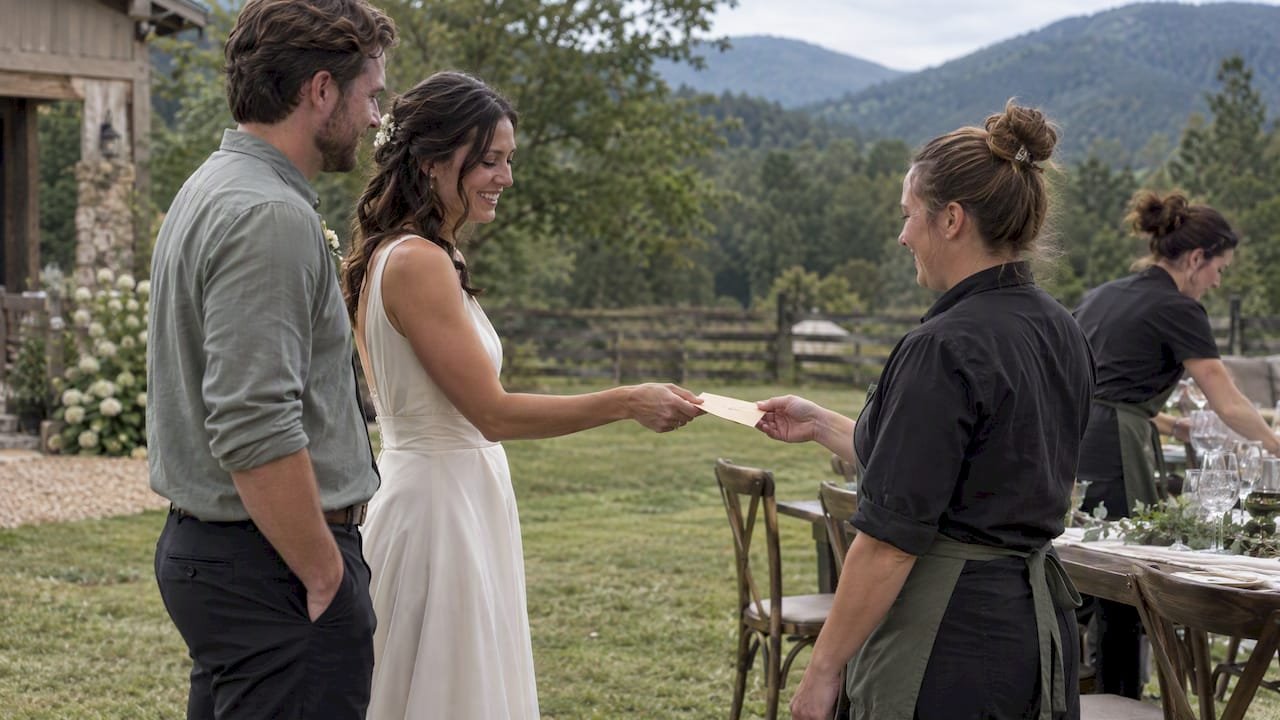
Most couples should budget roughly 5 to 10% of their total wedding spend for gratuities, then check each contract before handing out a dollar. Catering and bar staff, hair and makeup artists, and delivery crews are the vendors most often tipped. Photographers, DJs, planners and other business owners are optional, and a review often means more to them than cash. Below you’ll find amounts by vendor, the contract wording that causes double-tipping, and a simple system for the day itself.
TL;DR
- Read every contract first. A line labeled “service charge” or “gratuity” may already cover your tip, or it may not reach staff at all. Ask.
- Typical amounts: 15 to 20% of the food and drink bill for catering, 15 to 20% for hair and makeup, $50 to $200 for a photographer or DJ, $50 to $100 for an officiant.
- Set aside about 5 to 10% of your wedding budget for all tips so the final payment deadline doesn’t surprise you.
- Independent business owners don’t expect a tip. A public five-star review and a referral are real thanks.
- Put cash in labeled envelopes two weeks ahead and hand the job to someone you trust.
Table of Contents
- Is tipping wedding vendors required?
- Check your contracts before you tip
- How much to tip each vendor
- Working out your total tip budget
- How to hand out tips without stress
- Thanking vendors who don’t expect a tip
- Our view on tipping, from the venue side
- Planning a tip-friendly wedding weekend with us
- FAQ
- Sources
Is tipping wedding vendors required?
No. Tipping is at the couple’s sole discretion, and The Knot’s tipping guide frames a gratuity as something offered beyond obligation. In practice, though, certain people on your wedding day are paid modestly and rely on tips: servers, bartenders, hair and makeup artists, drivers and the crews who haul and set up equipment. For them, a tip is part of how the job works.
Business owners are different. Zola’s guidance notes that people who run their own business, such as a photographer, planner or florist, typically don’t expect a tip but appreciate one when service is exceptional. Their pricing already reflects what they need to earn.
That gives you a simple sorting rule. Tip the people who work for someone else and serve you in person. Thank owners with a note, a review or a tip only if they went beyond the contract.
Check your contracts before you tip
This is the step that saves the most money. Brides advises reviewing contracts carefully to avoid tipping twice, because service fees are often included but are not the same thing as a tip.
The distinction matters legally too. The IRS explains in Fact Sheet 2015-8 that automatic gratuities are service charges, not tips. When the business sets the fee, it is a service charge and is treated as wages for the employee, rather than a tip the customer decides on. So a 20% “gratuity” printed on your catering invoice isn’t necessarily money your servers keep as tips.
Before you set cash aside, ask each vendor with a percentage fee on the invoice:
- Is this charge distributed to the staff, or is it an administrative fee?
- If it is distributed, is it the full amount, or only part of it?
- Is there any additional tip you’d suggest for the team on the day?
Get the answer in writing. A one-line email is enough, and it settles the question for your planner or whoever is handling envelopes.
How much to tip each vendor
The figures below pull together ranges from Zola, The Knot and Pix. They differ a little from site to site, which is normal. Treat them as a range and choose by the quality of service and the size of your event.
| Vendor | Typical tip | Notes |
|---|---|---|
| Caterer and servers | 15 to 20% of the food and drink bill | Skip or reduce if gratuity is already in the contract |
| Bartenders | $20 to $50 each, or a percentage of the bar total | Check whether a bar service charge is already added |
| Hair and makeup | 15 to 20% of each artist’s service fee | Tip each artist individually |
| Officiant | $50 to $100 | Often a donation to a house of worship if one hosts you |
| Photographer | $50 to $200 | Optional for owners; per team member if staff shoot for a studio |
| Videographer | $50 to $200 | Same logic as photography |
| DJ or band | $50 to $200 | Bands may be tipped per musician at the low end |
| Planner or coordinator | $50 to $500, or 10 to 20% for exceptional service | Optional for owners |
| Delivery and setup crews | $5 to $20 per person | Florist, rental and cake deliveries |
| Transportation drivers | Check the contract first | Often a gratuity is already added |
The ranges for photographers, DJs and planners above come from The Knot’s guide, and the catering, hair and makeup and delivery figures from Zola’s. Percentages on planners vary more than any other category, so read the next section before you pick a number.
Catering and bar staff
This is usually your largest tip, so it’s where double-tipping hurts most. If a 20% service charge is on the invoice and the caterer confirms it goes to staff, you may add nothing, or add a modest extra amount for servers who worked hard. If there is no gratuity and the contract says nothing, 15 to 20% of the food and drink bill is the standard range. Our own planning pages on buffet versus plated service and family style dinners explain how the dinner format changes staffing, which in turn changes who is on the receiving end of your tip.
A common practice is to give the catering lead one envelope for the whole team and let them split it. Ask whether they prefer that or individual envelopes.
Hair and makeup
Hair and makeup artists are tipped like salon professionals: 15 to 20% of each artist’s own fee, according to Zola. If a studio owner did your makeup herself, the owner rule applies and the tip is optional, though it’s still a kind gesture. Tip at the end of the appointment, since the artist may leave before the ceremony and it’s easier than tracking someone down later.
Photographers and videographers
If the person who shot your wedding owns the business, a flat tip isn’t expected. If a studio sent associate shooters who are paid by the studio, giving each one $50 to $200 is a thoughtful gesture. Whatever you choose, review the contract for what you get and when, because a good thank-you works best when you already know the final gallery matched what you were promised. If you are still choosing, this list of questions to ask a wedding videographer helps you protect what matters before you book.
DJs, bands and officiants
The Knot lists $50 to $200 as typical for a DJ. For an officiant, Pix suggests $50 to $100. If the officiant is a friend who performed the ceremony as a gift, a thoughtful present and a handwritten note usually serve better than cash.
Planners and coordinators
Planners and day-of coordinators sit in the optional zone for owners, yet the range is wide: The Knot cites $50 to $500 or 10 to 20% of the fee for exceptional service. Use the lower end when the person did what the contract said, and the higher end when they solved real problems on the day. For a planner who was a salaried employee of a larger firm, a flat tip to each team member is the more common approach.
Delivery and setup crews
Florists, rental companies and cake bakers often send one or two people to drop things off and set up. Zola puts a tip of $5 to $20 per person in the usual range. Keep a small stack of labeled envelopes or bills with whoever is at the venue in the morning.

Working out your total tip budget
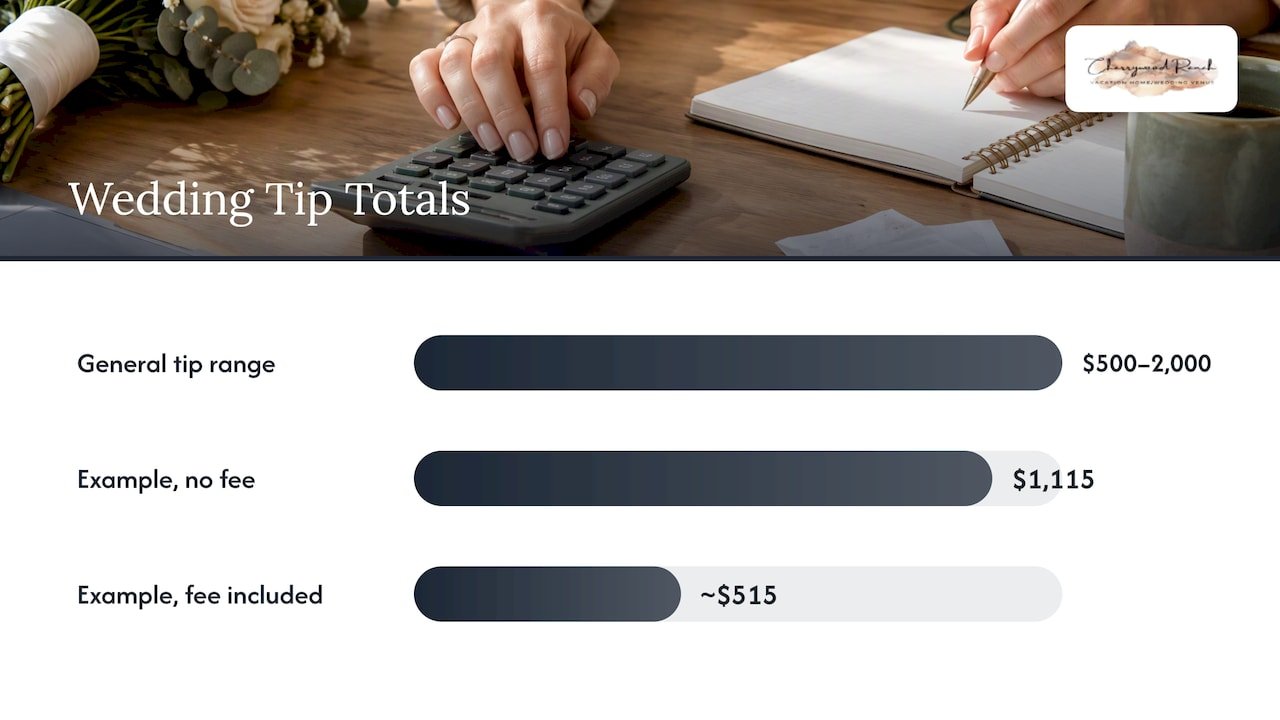
You don’t need a formula with fancy ratios. Pix points out that the “50/20/30” rule isn’t an official wedding industry standard and suggests setting aside about 5 to 10% of your total wedding budget for all expected gratuities. Another 2026 guide, Paperlust, estimates that most US couples spend between $500 and $2,000 in total on tips, depending on the size of the vendor team.
Here is a worked example for a small 50-guest wedding with a modest vendor team. These are our illustrations using the ranges above, not quotes from any single vendor:
- Catering bill of $4,000 with no gratuity in the contract, tipped at 15%: $600
- Two bartenders at $40 each: $80
- Two hair and makeup artists on $150 each, tipped at 15%: $45 each, or $90
- Officiant: $75
- Two photography associates at $75 each: $150
- DJ: $100
- Two delivery people at $10 each: $20
That total comes to $1,115, comfortably inside the $500 to $2,000 range. If the caterer’s contract had included gratuity, the first line would drop to zero and the whole budget would come to about $515.
To see where tips fit in the larger picture, our wedding weekend budget guide and the page on what a 50-guest wedding costs break down the main line items so a tip line doesn’t arrive as a surprise.
How to hand out tips without stress
The goal is that you never touch cash on your wedding day. The Knot’s suggested system works well:
- Two weeks out: prepare envelopes for every vendor you plan to tip. Label each one with the vendor’s name, the exact amount and the name of the person who will hand it over.
- Appoint a distributor: a planner, a coordinator or a trusted relative or friend. Don’t try to do it yourself on the wedding day.
- Match timing to the job: hand envelopes to hair and makeup at the end of the appointment, to delivery crews on arrival, and to the catering lead and bartenders near the end of service. Photographers and DJs can get theirs when they pack up.
- Keep a backup: a few extra $20 bills in a separate envelope cover the surprise person who went out of their way.
- Keep the checklist: after the wedding, you’ll want a record of what you gave, especially if you add gratuities to a final invoice.
For vendors paid by invoice, you can often add the tip to the last payment by card instead of using cash. Ask if the vendor passes card tips along to the team.
Thanking vendors who don’t expect a tip
For independent business owners, Zola’s advice on thanking vendors is that a public five-star review or a referral to friends is often more valuable and longer lasting than a standard cash tip. Reviews bring in new clients, and that directly helps a small business grow.
A good thank-you has three parts:
- A handwritten note naming something specific they did, such as how they calmed your grandmother down before the processional.
- A review on the platforms where couples search.
- Permission to share your photos or details, if you are comfortable with it.
Cash is never refused, so if you want to tip an owner who was extraordinary, do it. The point is that you aren’t obliged to.
Our view on tipping, from the venue side
We run a private mountain wedding venue with on-site lodging in North Georgia, and the same question comes up in nearly every planning conversation: who do we tip, and how do we keep track of it?
Our advice is to simplify before you calculate. A wedding weekend at one property tends to involve fewer separate deliveries and fewer vendors arriving and leaving at odd hours, which means fewer envelopes to prepare and fewer people to keep track of. When your guests stay on site and you aren’t coordinating shuttles between a hotel and a venue, there’s also less transportation gratuity to sort out. If you’re comparing options, our guide on cutting shuttle hours and costs with on-site lodging shows how this works.
Second, we’d ask every vendor the same three contract questions early, not in the final week. Couples who ask while they’re still negotiating get clear answers, and those who wait until the last invoice often find themselves guessing. A vendor who is open about where a service charge goes is usually a vendor you want.
Third, put your tip money in the budget from the first day. It’s much easier to commit 5 to 10% in the planning stage than to find a few hundred dollars in the week of the wedding. If you need a starting list of professionals who work in our area, our vendor list is the place to begin.
— Luis
Planning a tip-friendly wedding weekend with us
If you’re picturing a small, private celebration in the mountains with your guests staying under one roof, Cherrywood Ranch hosts weddings and elopements with luxury lodging for up to 16 guests on site. Our published day session is $1,950 per day, with hourly time at $350 per hour and a mini session at $175. You can see current options on our booking page, or read about weddings and packages to ask about multi-day plans.
FAQ
Do you tip the venue owner or coordinator?
It depends on who they are. Owners don’t usually expect a tip, but a thank-you note, a review or a tip for an exceptional job is welcome. If the venue has a coordinator on staff who ran your day, a tip in the $50 to $500 range cited for planners is typical, and you should check whether a service fee already covers it.
Should I tip if gratuity is already in the contract?
Usually not, or only a small extra amount for outstanding work. Confirm with the vendor whether the charge goes to the staff. If it’s an administrative fee, your tip fund is still needed.
Is $100 a good tip for a wedding DJ?
Yes. The Knot lists $50 to $200 as typical for a DJ, so $100 sits in the middle of the range. Go higher if the DJ also served as an emcee and handled the timeline smoothly.
When should wedding tips be given?
At the end of each vendor’s service, or earlier for people who leave before the reception, such as hair and makeup. Prepare the envelopes about two weeks in advance and assign someone else to hand them out, so you stay present for your own wedding.
What if I can’t afford to tip everyone?
Tip the in-person service staff first: servers, bartenders, hair and makeup artists and delivery crews. For everyone else, written thanks and a public review carry real value, especially for small business owners.
Sources
- Zola: How Much To Tip Wedding Vendors
- Zola: 10 of the Best Ways to Thank Wedding Vendors
- The Knot: How Much to Tip Wedding Vendors
- Brides: How Much to Tip Your Wedding Vendors
- Pix: How Much to Tip Wedding Vendors, 2026 Cheat Sheet
- IRS: Tips Versus Service Charges (FS-2015-8)
- Paperlust: How Much to Tip Wedding Vendors (2026 Guide)