For a wedding of 25 to 75 guests, round tables are the safer default when you want one lively conversation per table, and rectangular tables win when your room is long and narrow or you want a communal, family-style feel. Neither shape is better in general. The right one depends on your guest count, the shape of your reception space and how your guests know each other. This guide gives you the numbers and a worked example so you can decide with a tape measure instead of a hunch.
TL;DR
- Round tables put everyone in one conversation and suit wide, open rooms; rectangular tables suit long, narrow rooms and a communal look.
- A 60-inch round seats 8 comfortably (10 at a squeeze), and an 8-foot rectangle also seats 8 to 10, so seat count alone rarely decides it.
- Rectangles usually use less floor area per guest, while rounds give each guest more legroom and are easier to serve.
- A mix works well: rounds for guests, one long table for the couple or family.
- Count seats, not tables, and measure the room with aisles before you commit.
Table of Contents
- The short answer, by the kind of wedding you are planning
- How the two shapes feel at the table
- How many guests each table seats
- How much room each shape needs
- A worked example: 60 guests
- Service: why the table shape changes dinner
- When mixing shapes is the best answer
- Choosing for a mountain wedding weekend
- Our perspective
- Plan your table layout at Cherrywood Ranch
- FAQ
- Sources
The short answer, by the kind of wedding you are planning
Start with the room, then the guests.
Choose rounds if the space is wide and open and your guests fall into clear groups, such as family, college friends and coworkers. Seatbee’s guidance is to pick rounds for that kind of room, rectangles for a long, narrow space like a barn or gallery or when you want a communal farm-table feel, and a mix when you want both and the room allows it.
Choose rectangles if you have a smaller group that already knows each other, you want a long banquet look, or the room is narrow.
Choose a mix if you want a head or family table plus relaxed rounds for everyone else.
If your reception is part of a full wedding weekend, with guests staying together rather than driving home, the table question changes a little. People who have shared a weekend are easier to seat at a long table, because they already know each other. We come back to that below.
How the two shapes feel at the table
Round tables: one conversation
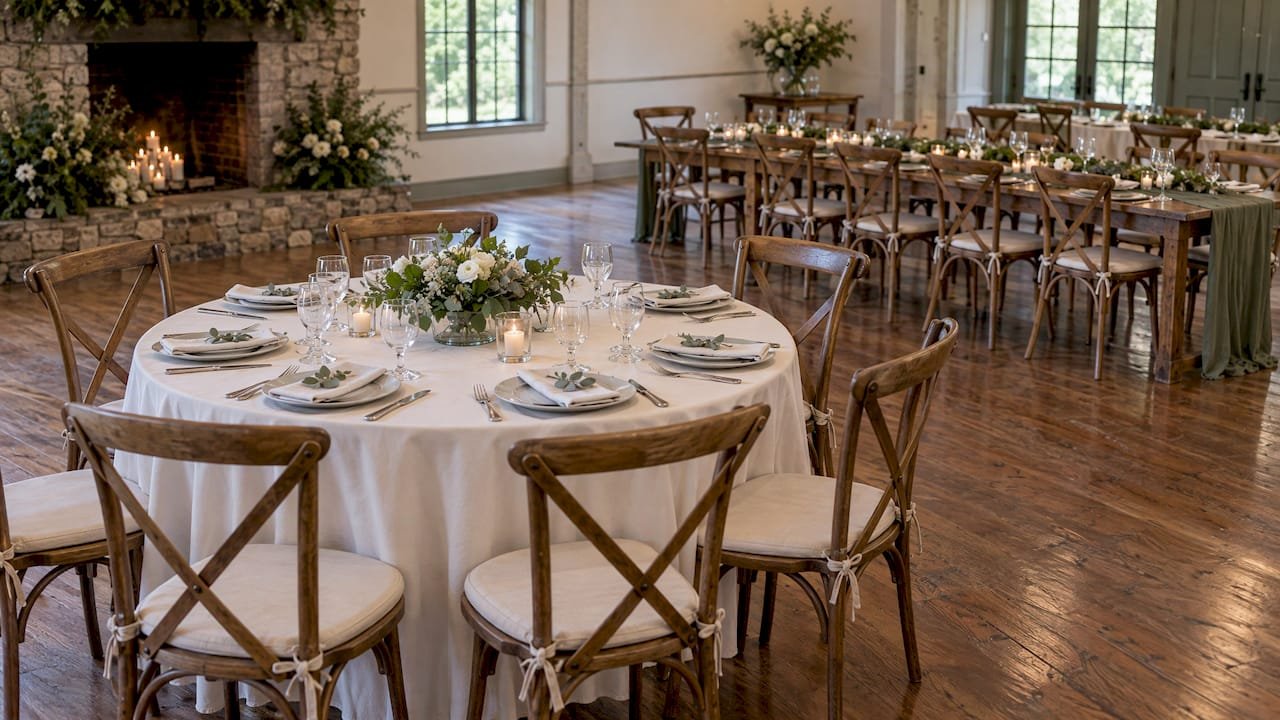
At a round table everyone faces the center, which is why round tables are described as encouraging conversation and feeling classic and a little more formal. A single centerpiece also looks balanced in the middle. Zola’s seating-chart advice adds two practical points: round tables give guests more legroom, and they simplify seating because only immediate neighbors matter.
Rounds are especially good when a table of eight is made up of people who only half-know each other. Everyone can see everyone, so the shape does some of the introducing for you.
The downside to plan around is sightlines. One rental guide notes that guests at a round table can have trouble seeing the stage or dance floor, which is why it suggests mixing shapes. If your reception includes toasts or a first dance, seat the table’s chairs so a few guests are not turned away from the action, or place tables so the focal point is within easy view.
Rectangular tables: sleek and efficient
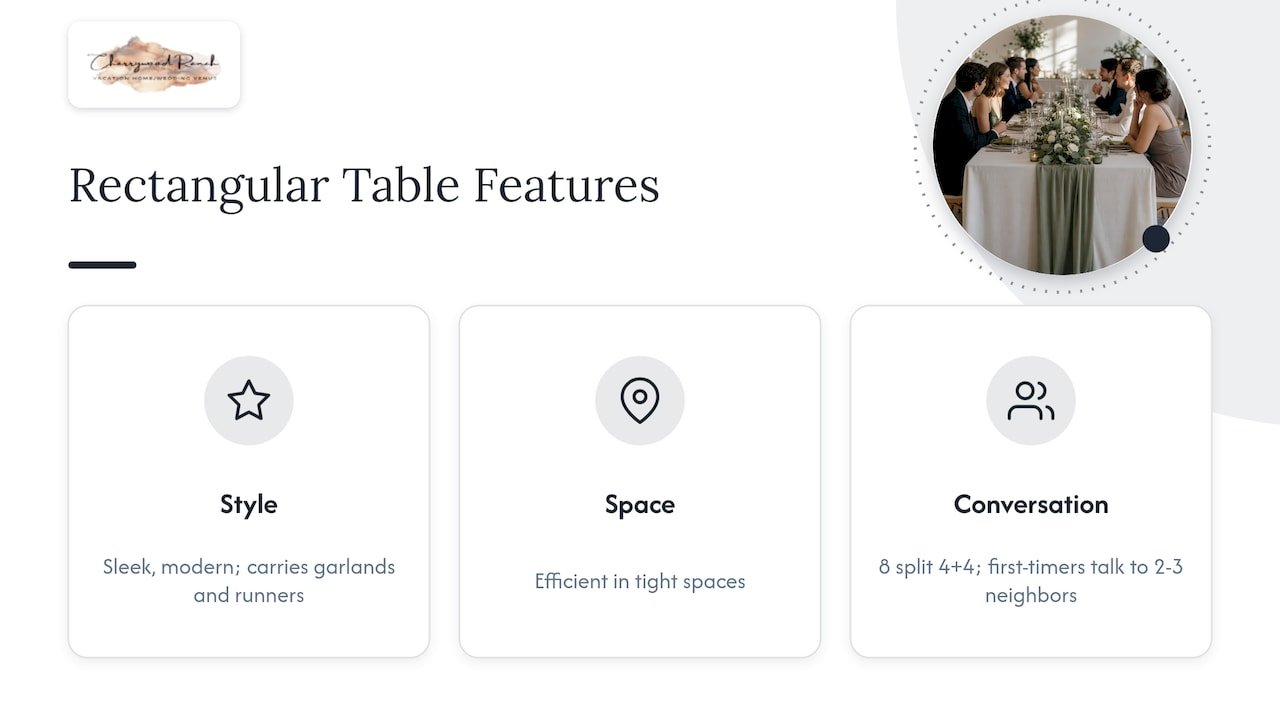
Rectangular tables look sleek and modern, from rustic to minimalist, and they carry garlands and runners beautifully. They are also efficient in tight spaces. The trade-off is conversation: at a long table you mostly talk to your neighbors. Seatbee observes that at a rectangular table of 8, guests tend to split into two groups of four at each end. The same source points out the upside: when people are meeting for the first time, they only have to talk to two or three neighbors rather than a whole table.
If you choose rectangles, seat in clusters. Put outgoing guests at both ends and in the middle, and keep couples and friends together. Our guide to long table seating for weddings covers the etiquette and layout ideas in more depth.
How many guests each table seats
Seat counts come from table edge: roughly 22 to 24 inches per guest for comfort, and 19 to 20 inches if you squeeze, according to SeatFlow. Rental companies publish the results as a comfortable number and a maximum. Using Lovely Seating’s 2026 figures:
| Table | Comfortable | Maximum |
|---|---|---|
| 48-inch round | 6 | 8 |
| 60-inch round | 8 | 10 |
| 72-inch round | 10 | 12 |
| 6-foot rectangle | 6 | 8 |
| 8-foot rectangle | 8 | 10 |
| 3-foot square | 4 | 4 |
The same source reports that couples seat a median of 8 guests per table, and the 60-inch round is the size one rental company calls the most popular for weddings. Plan for the comfortable number, not the maximum. A plated dinner with a full place setting, charger, glassware and a centerpiece is the moment you will feel every extra chair.
For 4’ x 8’ rectangles, Brides.com notes that planners like them for seated dinners because they leave room for chargers, glassware and center florals.
How much room each shape needs
This is where the shapes really separate. Chairs need pull-out room, servers need a lane, and guests need to walk.
Matters of Gathering’s floor-plan guidelines give a minimum of 60 inches between round banquet tables. Rectangular tables need 52 inches minimum with no service aisle and 60 inches with one. Main aisles should be 3 to 4 feet, and 4 to 5 feet if a wedding procession will walk through, to allow for gowns and attire.
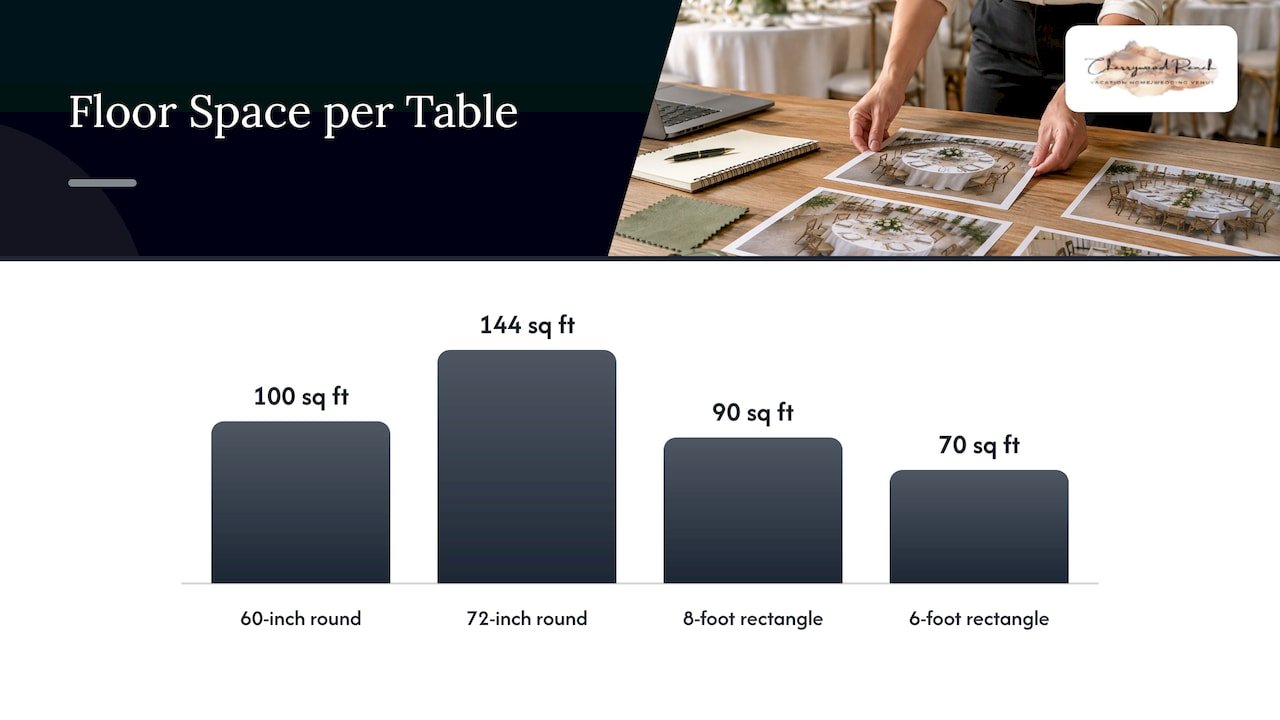
Hughes Rental’s capacity matrix shows the footprint per table, based on 18-inch chairs and a 36-inch service corridor:
| Table | Seats (comfortable / max) | Floor space |
|---|---|---|
| 60-inch round | 8 / 10 | 100 sq ft |
| 72-inch round | 10 / 12 | 144 sq ft |
| 8-foot rectangle | 8 / 10 | 90 sq ft |
| 6-foot rectangle | 6 / 8 | 70 sq ft |
So a 60-inch round and an 8-foot rectangle both seat 8, but the rectangle takes about 10 square feet less. Seatly puts the difference at about 15% less floor area per guest, because rectangles tile neatly in a rectangular room. Seatbee’s 100-guest comparison comes to roughly 1,400 square feet for 13 rounds against about 1,200 for 13 rectangles, a gap that could become a larger dance floor.
There is a catch for rooms packed close to capacity. Milestone Events Group points out that a 72-inch round fits 10 guests, where a standard 8-foot rectangle seats 8. If your guest count is close to what the room holds, large rounds can seat more people.
A note on aisles and safety
If you are renting a space, the building’s occupancy and exit rules apply to your table layout. SeatPlanning explains that under the International Building Code, aisle width is measured from a line 19 inches out from the table edge, so a 36-inch aisle between rows needs about 74 inches edge to edge. The same page notes the code sets occupant load at 15 net square feet per person for tables and chairs, and requires a second exit above 49 occupants. Ask your venue or local fire authority for the layout limits that apply to your space, and keep accessible routes at least 36 inches wide, as accessibility guidance for event spaces cites.
A worked example: 60 guests
Say you are inviting 60 guests, including yourselves, and you want to know how many tables you need.
The basic formula, per PlanSeats, is guests divided by guests per table, always rounded up. If you and your wedding party sit at a separate head table, subtract those people first. Add separate tables for the cake, gifts and any vendors.
- With 60-inch rounds at 8 each: 60 ÷ 8 = 7.5, so 8 tables. At 100 square feet each, that is about 800 square feet.
- With 8-foot rectangles at 8 each: also 8 tables. At 90 square feet each, about 720 square feet.
- With one long head table for the couple and six, plus rounds for the other 52: 52 ÷ 8 = 6.5, so 7 rounds plus the head table.
Now the same exercise at 75 guests: 75 ÷ 8 = 9.4, so 10 tables of 8 (or 8 tables if you seat 10 at 72-inch rounds, which is the tight option).
The numbers are close enough that the room’s shape should break the tie. Measure the reception space, draw the tables to scale including aisles and a dance floor, and check that the total fits before choosing a shape. Our small wedding seating chart guide for 20 to 75 guests walks through layouts at this size.
Service: why the table shape changes dinner
Shape affects how fast dinner reaches guests. Brides.com quotes a planner who says a 40-person long table would need 20 servers to plate everyone at once, against 4 servers for an eight-top round. Rectangular tables are also flagged as costing more and needing more servers than rounds.
That matters most for a plated meal. For buffet or family-style service, where guests pass dishes or walk to a line, long tables work very well. Our pieces on buffet vs plated wedding weekends and family-style dinners cover how to match the table shape to the meal.
The floor plan matters here too. A tight 24-inch server lane works with a 60-inch round at 60 inches edge to edge, while SeatLark’s calculator shows that a standard 36-inch plated-service aisle takes the same table to 72 inches edge to edge. If your layout is close, a guest-flow plan for everything else in the room, from the dance floor to a photo booth, helps you keep those lanes clear.
When mixing shapes is the best answer
Mixing is common, and it solves the weaknesses of both shapes. Seatbee suggests rounds on the main floor with a rectangular head or family table anchoring one end of the room. Some couples use rectangles for cocktail hour and rounds for the seated dinner. Keep the centerpiece style consistent, and vary the height: low on long tables, slightly taller on rounds.
Two practical rules from Seat the Day: put the head table on the long wall, facing down the room, and count seats rather than tables, using the actual layout and inventory you have.
A planner quoted by Brides.com adds a style point: mixing at least two shapes creates the sense that the space was made for you, and mixing linens helps. For very small weddings of 20 to 30 guests, pushing 4’ x 8’ tables together lets everyone sit at one table. If you are deciding how the two of you sit, see our comparison of a sweetheart table versus a head table.
Choosing for a mountain wedding weekend
A wedding weekend with lodging on site changes the guest list dynamic. Your guests are not arriving cold at a reception; they have shared meals, a pool day and a rehearsal. That makes a long table, or a couple of them, a natural fit, because guests already know their neighbors. It is also why outdoor and tented layouts deserve their own planning. Our five-zone outdoor wedding layout puts tents and flooring first, and tables fit around that.
For outdoor dinners, long tables also line up well with a view. Seat guests along one side facing the mountains, or at both sides for conversation, and keep the walkway wide enough for service.
A simple decision path:
- Write your count, and subtract the head or sweetheart table.
- Decide the meal style: plated favors rounds, family-style and buffet work with either.
- Measure the space, with aisles of at least 60 inches between rounds.
- Pick the shape that fits with the dance floor still in place.
- Build the seating chart around clusters of four to eight friendly guests.
Our perspective
At a private mountain wedding with 25 to 75 guests, we would rather you design the table around your people than around a rule. Guests who spend the whole weekend together do not need a table shape to introduce them. They need a long table for the toast and a way to move around to see everyone.
What we like about a weekend format is that the dinner is one part of several days. A long table can make the reception feel like a family dinner, and rounds can give a calm, classic look. Either way, the point is that your guests stay together without shuttling between places, so the seating can be relaxed.
Our advice is to count seats, measure the space, and then pick the shape that keeps the room easy to move through.
Luis
Plan your table layout at Cherrywood Ranch
Cherrywood Ranch is a private North Georgia mountain venue with onsite luxury lodging for up to 16 guests, outdoor ceremony and reception spaces, and a pool and hot tub, so your family and friends celebrate together for the whole weekend. See our wedding packages and pricing for one-day and three-night wedding options.
If you are comparing layouts for your guest count, bring your list and your preferred table style, and we will talk it through with you.
FAQ
Is a 42-inch round table big enough for four wedding guests?
Yes, for four it can work, though it is tight with a full place setting and centerpiece. Published guides put a 36-inch round at 4 guests and a 48-inch round at 6, so a 42-inch table sits between them. Use it for a sweetheart-plus-two table or a small cocktail-style seating group rather than a plated dinner for a main guest table.
How many tables do I need for 100 guests?
Divide guests by seats per table and round up. At 8 per table, 100 guests need 13 tables; at 10 per table, 10 tables. Subtract anyone seated at a head table, and add tables for the cake, gifts and vendors.
Is a round or rectangular table better for conversation?
Round tables are better for whole-table conversation, since everyone faces the center. Rectangular tables mostly support talk with your neighbors, which suits groups who already know each other or meeting for the first time with only a few people to talk to.
Can I mix round and rectangular tables?
Yes, and it is very common. A typical layout uses rounds for guests and a long rectangular table for the couple or family on the long wall. Keep centerpieces consistent in style but vary the height.
Sources
- Should I Use Round or Rectangular Tables at My Wedding?
- How to Create a Wedding Seating Chart (Zola)
- Round Tables vs Rectangular: Which Is Best? (Seatbee)
- The Wedding Table Rental Guide
- How Many Guests Per Table at a Wedding? (Lovely Seating)
- How Many People Does a 5 ft or 6 ft Round Table Seat? (SeatFlow)
- How to Calculate Table Size & Seating Capacity
- How to Choose the Right Wedding Reception Tables (Brides)
- Essential Floor Plan Guidelines for a Successful Event
- How Many Chairs Fit Around an Event Table? (Hughes Rental)
- Round vs. Rectangular Wedding Tables (Seatly)
- Wedding Reception Tables: Round vs. Square vs. Rectangular
- Event Table Spacing Standards (SeatPlanning)
- Seating Capacity & Space Planning
- Banquet Table Spacing Calculator (SeatLark)
- How many tables do you need for your wedding? (PlanSeats)
- Wedding Table Shapes (Seat the Day)
- Photo Booth Guest Flow