
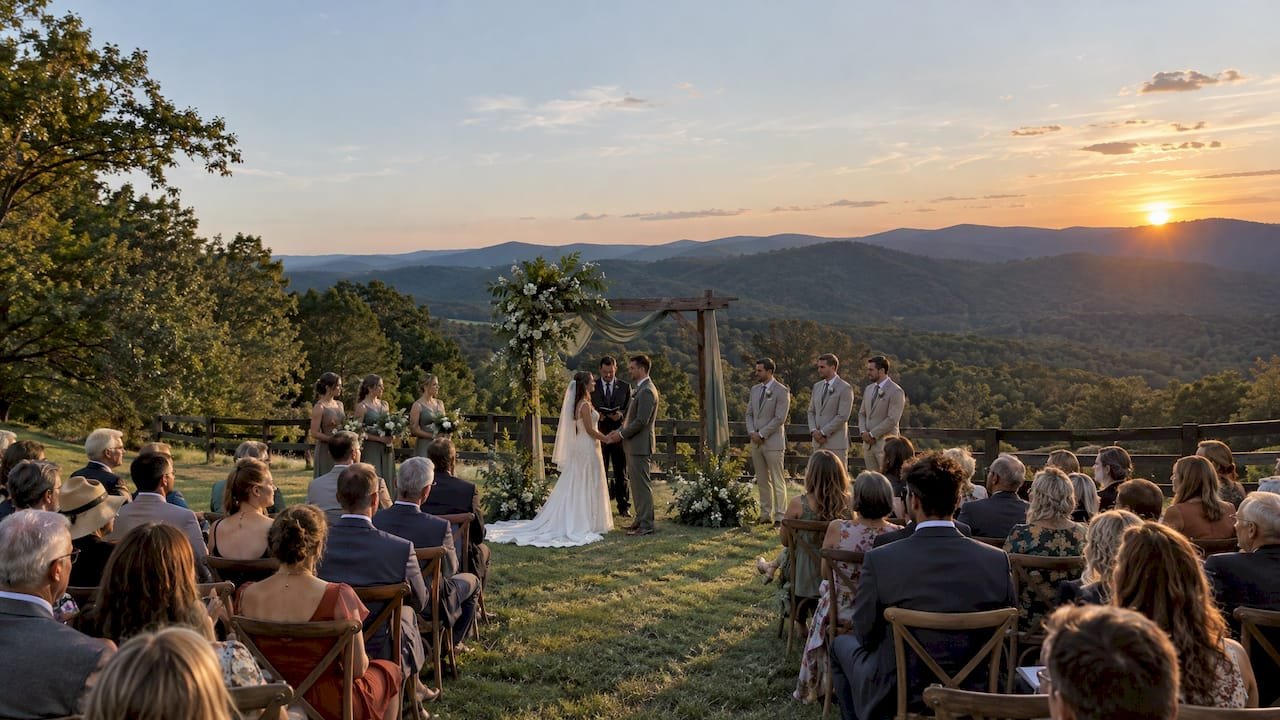
The best sunset ceremony timeline starts with one number, your exact sunset time, and works backward from it. Most planners advise starting the ceremony somewhere between 1.5 and 3.5 hours before sunset, depending on whether you do a first look and where you want the glow to land: during the vows, during cocktail hour, or during dinner. Below you will find the formulas, a sample schedule you can copy, and the adjustments that matter for mountain settings.
TL;DR
- Look up sunset for your date and venue, then count backward. A ceremony about 1.5 hours before sunset puts the glow around the vows, and about 2 to 3.5 hours before moves it to cocktail hour or dinner.
- Protect the 20 to 40 minutes before sunset for portraits of the two of you. Nothing else on the schedule should be allowed to eat that block.
- A first look moves most formal photos ahead of the ceremony, so you can start later and keep the evening relaxed.
- Add 10 to 20 minutes of buffer at each transition. A late shuttle costs you nothing with a buffer and costs you the sunset without one.
- In hills and mountains the sun can drop behind a ridge before the calculated sunset, so plan for earlier light.
Table of Contents
- Start with the real sunset time for your date and place
- Pick where you want the sunset to land
- A sample sunset timeline you can copy
- How much time to protect for photos
- First look or no first look
- Adjust for season
- What mountains do to your sunset
- Build in buffers
- Perspective: why one location makes the timeline easier
- Plan your sunset weekend at Cherrywood Ranch
- A short checklist before you lock the schedule
- FAQ
- Sources
Start with the real sunset time for your date and place
Every formula below depends on one input, and it is easy to get wrong by using a generic number for your region. Sunset changes by minutes from one week to the next, and it differs between towns.
NOAA’s Solar Calculator gives sunrise, sunset and solar noon for any location once you pin the place and enter the date. Wedding-specific tools do the same math and add golden hour. One of them, a wedding sunset times tool, draws on NOAA’s equations, returns the evening golden hour and last light in the venue’s own time zone, and is accurate to a minute or two.
Both sources carry the same caution: the figure is calculated for a clear, flat horizon. NOAA notes that observed values may differ with atmospheric conditions, and the wedding sunset tool warns that hills, buildings, valleys and cloud can make the visible sunset arrive earlier than the calculated figure. Keep that in mind, because it matters a great deal if your venue sits in mountains. We come back to it below.
A few terms you will see:
- Sunset: the moment the sun’s center drops below the horizon, as calculated.
- Golden hour: the warm, low light before sunset. Sources define it differently, from 45 to 60 minutes before sunset, and it peaks in the last 20 to 30 minutes.
- Civil twilight: the usable glow after sunset. One Ohio photographer, citing the Naval Observatory definition, puts usable daylight ending about half an hour after sunset.
Pick where you want the sunset to land
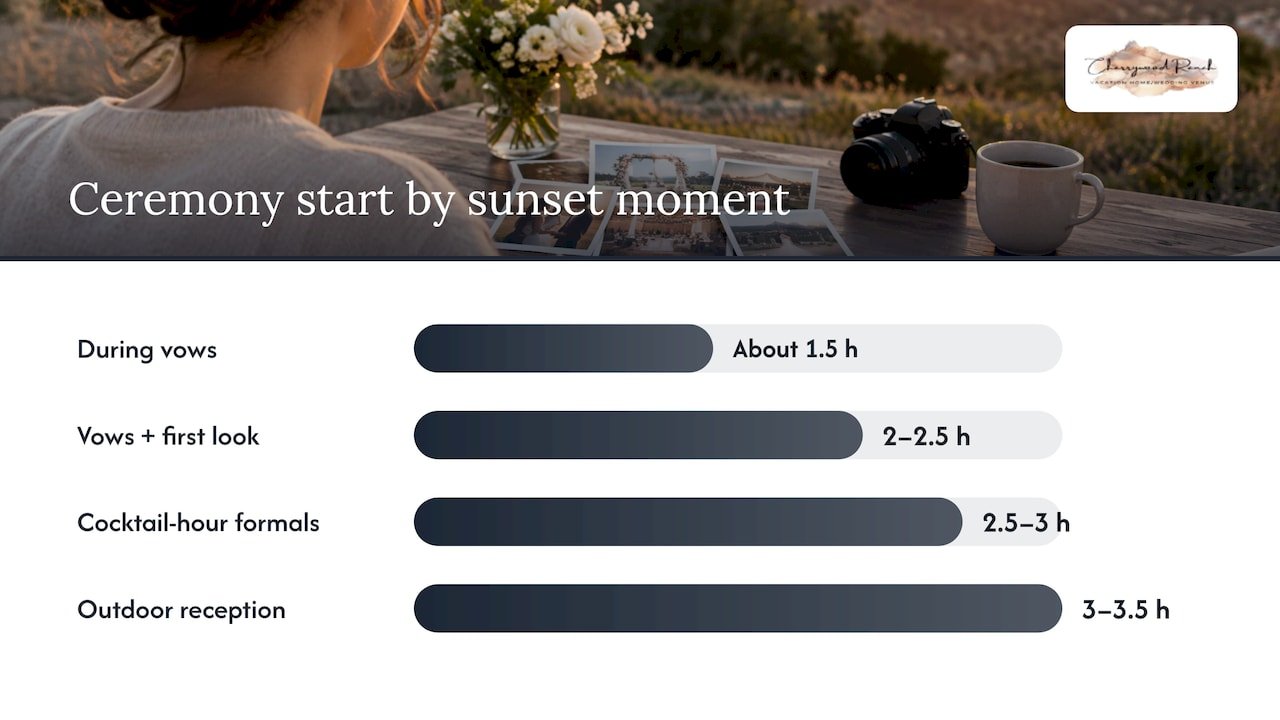
Before choosing a start time, decide what the sunset is for. Do you want it behind you while you say your vows, or glowing over dinner? The answer sets your ceremony time. The Knot quotes planner Lisa Lafferty with a clear menu, and her numbers are the cleanest way to see the options in one place:
| Where you want the sunset | Ceremony starts before sunset | Source |
|---|---|---|
| During the vows (20 to 30 minute ceremony) | About 1.5 hours | The Knot |
| During vows, with a first look earlier | 2 to 2.5 hours | The Knot |
| During cocktail-hour formals | 2.5 to 3 hours | The Knot |
| During an outdoor reception | 3 to 3.5 hours | The Knot |
Other planners and photographers land in the same neighborhood. Brides.com says to plan the vow exchange 30 minutes before scheduled sunset, and it reports that the average U.S. sunset lasts 33 minutes, so the show is short. A Paperlust formula uses sunset minus about 3.5 hours for the ceremony start, which leaves room for the ceremony, cocktail hour and the start of the reception before portraits at golden hour.
The spread comes from a real choice. Ceremony at sunset gives you the most dramatic backdrop for the vows but squeezes photos into fading light. Ceremony earlier gives everyone comfortable light for the ceremony, and you step away from the reception for a short portrait session when the sun is low.
For most couples with 25 to 75 guests, we suggest the second approach. It keeps the ceremony relaxed, lets guests enjoy cocktail hour, and gives the two of you a private window at the best light of the day. Our guide to planning golden hour wedding photos minute by minute goes deeper on that window, and golden hour versus blue hour explains the light that follows.
A sample sunset timeline you can copy
Here is a worked example for a 7:45 p.m. sunset, adapted from a published template built around that exact time. It uses a 25-minute ceremony and a 20-minute portrait slip-out.
| Time | What happens |
|---|---|
| 5:30 p.m. | Guests arrive and are seated, with a buffer before the ceremony |
| 6:00 p.m. | Ceremony begins (sunset minus 1 hour 45 minutes) |
| 6:25 p.m. | Ceremony ends, a few minutes to breathe |
| 6:30 p.m. | Cocktail hour starts; family groups photographed first |
| 6:45 p.m. | You join cocktail hour |
| 7:15 p.m. | Golden hour portraits, 20 minutes, just the two of you |
| 7:35 p.m. | Grand entrance |
| 7:45 p.m. | Dinner starts as the sun sets |
| 8:45 p.m. | Toasts |
| 9:05 p.m. | First dance and open dancing |
| 10:00 p.m. | Cake |
| 11:30 p.m. | Send-off |
The logic is worth copying more than the exact times. The ceremony finishes with more than an hour of daylight left. Family photos happen during cocktail hour rather than after the ceremony, so they do not compete with the portrait window. And the entrance and dinner fall right as the light goes, which gives the room a glow.
A second approach: portraits right before sunset
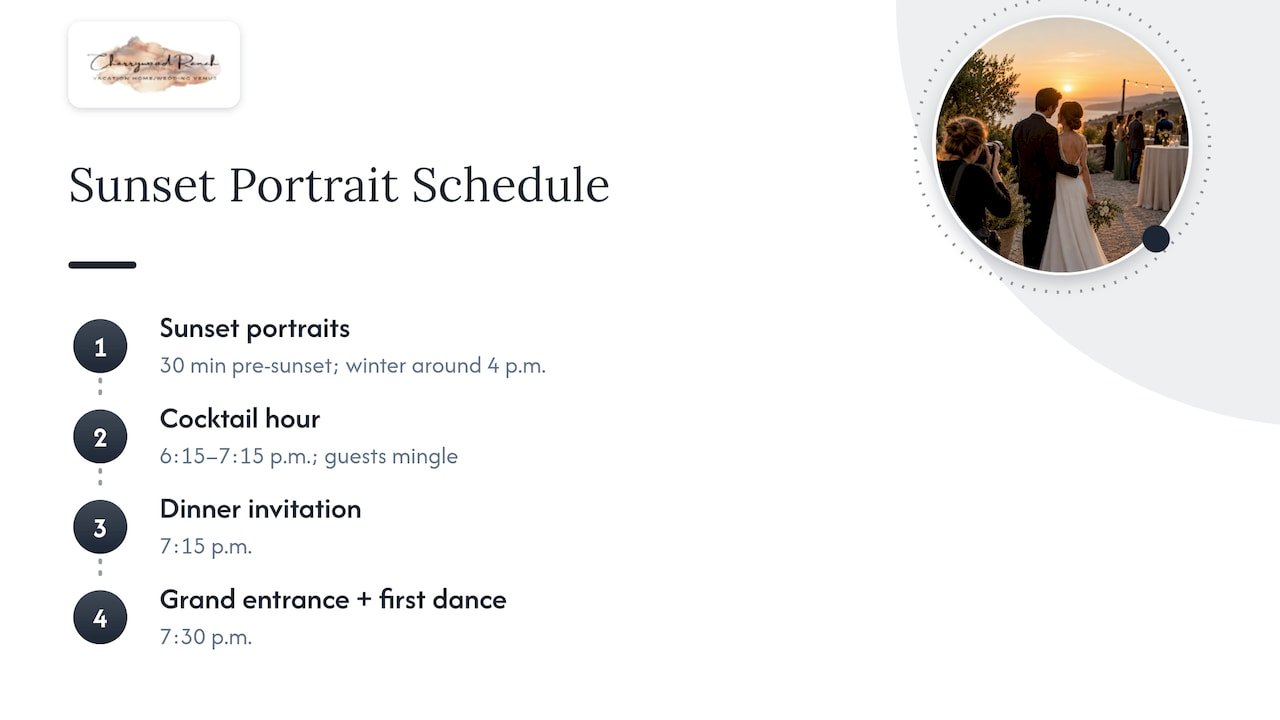
Brides.com’s expert-approved timeline schedules sunset photos in the roughly 30 minutes leading up to sunset, with the cocktail hour running 6:15 to 7:15 p.m. while the couple takes photos. Guests are invited to dinner at 7:15, and the grand entrance and first dance follow at 7:30. It also notes that in winter, pre-sunset photos may need to happen around 4 p.m. That works well when the sunset itself is the main event and you are happy to keep guests mingling a bit longer.
How much time to protect for photos
Photographers agree on a handful of numbers. Here is how they stack up, and where each one belongs on your schedule.
- Couple portraits at sunset: block 20 to 40 minutes before sunset, according to one backward-timeline guide. Several others suggest 15 to 20 minutes as the minimum for a slip-out during the reception.
- A simple rule: one mid-Atlantic photographer says to subtract 75 minutes from sunset, and that is when you walk out for portraits, because the best light falls in the 45 minutes before sunset and cannot be moved.
- Starting earlier than you think: another photographer suggests starting the golden hour session 90 minutes before sunset, not 60, to allow for travel, positioning and variety, with the best light in the last 30 minutes.
- Family formals: 30 to 45 minutes. The photo-block budget from one scheduling guide counts 3 to 5 minutes per wedding-party grouping, and says 10 family groupings need at least 45 minutes.
- Wedding party: 30 to 45 minutes from the same source.
A practical way to use these: write your must-have family groupings as a short list before the wedding, count about two to four minutes each, and subtract the total from your cocktail hour or pre-ceremony window. If it does not fit, trim the list. The golden hour block is the one piece you should not trim.
First look or no first look
The choice changes your start time by about an hour. With a first look, you photograph most couple, wedding party and family portraits before the ceremony. Mouna Photography notes this keeps the evening from feeling rushed and lets you enjoy cocktail hour, while you still save a short sunset session for just the two of you.
Without a first look, all of that moves after the ceremony. The same guide budgets about 20 minutes for the wedding party, 25 minutes for family and 45 minutes to 1 hour 15 minutes for couple portraits. That is why no-first-look weddings need to start earlier. One calculation puts the ceremony about 2 hours 25 minutes before sunset without a first look and about 1 hour 25 minutes before with one.
| First look | No first look | |
|---|---|---|
| Ceremony start (before sunset) | About 1.5 to 2.5 hours | About 2 to 2.5 hours or more |
| Formal photos | Mostly before the ceremony | After the ceremony |
| Cocktail hour for you | Mostly with guests | Partly spent on photos |
| Evening pace | Relaxed | Tighter, depends on the buffer |
If you want the traditional moment of seeing each other at the aisle, we have written out sample schedules for a wedding without a first look. Cocktail hour is also where family formals tend to happen in that version, so it helps to think about choosing tequila for your wedding bar and a signature drink that guests can enjoy while you finish photos.
Adjust for season
Sunset moves by hours across the year, so a timeline that works in June can leave you in the dark in December. Sources give consistent seasonal ranges, but these come from photographers in different regions, so use them as a pattern and then plug in your own sunset.
- Summer: sunset often runs from about 7:50 to 8:30 p.m. in the Southeast, according to a Central Florida timeline guide, which pairs it with ceremonies between 5:45 and 7 p.m. Because sunset is so late, golden hour usually falls after the reception has started, so step out again during the reception for sunset photos.
- Spring and fall: the same guide lists ceremony starts between 4:30 and 6:30 p.m. for spring and 4:30 to 6 p.m. for fall. A mid-Atlantic photographer warns that a 5 p.m. October ceremony ends around 5:30 with sunset near 6:30, which leaves family formals to eat half the remaining hour. Move the ceremony earlier or plan a first look.
- Winter: sunsets can arrive as early as 4:30 p.m. One photographer’s guide says that in a December case golden hour begins around 3:30 p.m., which shifts the entire timeline. Plan the ceremony at least 1.5 to 2 hours before sunset.
Daylight saving time matters too. The Florida guide points out that when clocks fall back in early November, a wedding on one side of the change and a wedding on the other have sunsets almost an hour apart. If you are choosing between two fall dates, check both against the sunset tool.
What mountains do to your sunset
This is where a generic timeline fails mountain couples. The calculated sunset assumes the sun falls to a flat horizon. In the hills, the sun disappears behind a ridge long before that. One guide estimates the sun can disappear 15 to 30 minutes earlier in a valley or with high ground to the west, and more in a tight valley. The wedding sunset tool above says the same thing in different words: terrain can make the visible sunset earlier than the calculated figure.
That changes three decisions:
- Treat the calculated sunset as the latest possible time. Schedule your portrait block to end earlier than the number on the tool.
- Walk the site at the hour you plan to shoot. Look west and see where the light actually goes, ideally on a similar date.
- Plan for the glow, not just the disc. Even after the sun drops behind a ridge, the sky lights up for a while, and long-range mountain views often look best then. That is the idea behind golden hour and blue hour.
The upside of a mountain setting is that ridgelines layered with color make the sunset last visually, even if the sun itself leaves early. It is also why a ceremony location with a wide western view gives you more flexibility.
Build in buffers
Sunset does not wait. A published guide to handling timeline delays recommends 10 to 20 minutes of buffer between key milestones, such as finishing hair and leaving for the ceremony, or between the ceremony and cocktail hour. It names the ceremony start, sunset portraits, first dance and dinner service as anchors that everything else flexes around. A 10-minute delay may only mean a trimmed photo list, while a 30-minute delay may mean changing entrances or cocktail hour.
Photographers say the same from the light’s side. One warns that a ceremony running 20 minutes late loses 20 minutes of light forever. Another frames the buffer as insurance: ordinary things like a late shuttle or a long receiving line cost nothing with a buffer and cost the sunset without one.
Put buffers in these places:
- Before the ceremony, so guests are seated and the music cue is not rushed.
- Between the ceremony and the first photos.
- Before dinner service.
- Ahead of the sunset portrait block, 15 to 20 minutes.
Also think about how people move. Every walk between the lawn, the cocktail area and the dining space is a delay. Fewer locations means a more reliable schedule. Our notes on outdoor reception ideas and outdoor wedding sound cover the logistics that tend to cost minutes: speakers, microphones and setup for a ceremony outdoors.
Perspective: why one location makes the timeline easier
Most timeline advice is really about managing movement: getting people from the getting-ready room to the ceremony, to cocktail hour, to dinner, and still catching the light. Every transfer is minutes you spend and cannot get back.
That is why we built Cherrywood Ranch around a wedding weekend in one place. Our venue combines the ceremony and reception spaces with a luxury vacation home that lodges up to 16 guests, plus a pool and hot tub, all among North Georgia mountain views. When your getting-ready space, ceremony lawn and celebration are in the same place, the sunset schedule becomes a question of light and not of travel.
It also means the sunset does not have to be the last thing of the day. Your closest family can stay on property, so a morning-after breakfast or an afternoon by the pool turns the wedding into a weekend instead of a single evening.
Our advice is to walk the property at the hour you plan to photograph, see where the sun sits over the ridge, and then set the ceremony time. A venue that lets you do that is worth more than any calculator.
Luis
Plan your sunset weekend at Cherrywood Ranch
If you are picturing a mountain sunset ceremony with your people staying together, our private North Georgia venue is built for it. See our wedding packages and pricing for one-day and three-night wedding options.

If you would like to see how a weekend fits together, our guide to a wedding weekend photo timeline is a good next read, and why sunset weddings feel so memorable shows what the light does for the day.
A short checklist before you lock the schedule
- Look up sunset for your exact date and venue town, and note the golden hour start.
- Choose where the glow should land: vows, cocktail hour or dinner.
- Pick first look or no first look, and count backward from the portrait block.
- Write the family photo list and count two to four minutes per group.
- Add 10 to 20 minutes of buffer at each transition.
- Visit the site at the hour you plan to shoot, and check where the sun falls behind terrain.
- Give your photographer and planner a single timeline with anchors marked: ceremony start, sunset portraits, first dance, dinner.
FAQ
What time should a sunset ceremony start?
For the vows to happen in the glow, start about 1.5 hours before sunset for a short ceremony. If you want the sunset during cocktail hour or dinner, start 2.5 to 3.5 hours before, according to The Knot’s planner advice. Confirm the exact sunset for your date first.
How long before sunset should we take couple portraits?
Plan for 20 to 40 minutes before sunset, and begin walking out about 75 minutes before if you are traveling to a spot, as one photographer’s rule suggests. A 15 to 20 minute slip-out during the reception also works well.
Does a first look change the timeline?
Yes. A first look lets you take most formal photos before the ceremony, so the ceremony can start closer to sunset and cocktail hour is less rushed. Without one, start the ceremony earlier to leave room for photos afterward.
What if the sun sets behind a mountain?
The calculated sunset assumes a flat horizon, and the sunset tool itself warns that hills and valleys can make the visible sunset earlier. Visit the site at the planned hour and schedule portraits earlier than the calculated figure.
How much buffer should I leave?
Ten to 20 minutes between key milestones is the common guidance in published delay-handling advice. Protect the sunset portrait block above everything else.
Sources
- Solar Calculator, NOAA Global Monitoring Laboratory
- Wedding sunset and golden hour times
- How to Plan a Dreamy Sunset Wedding, The Knot
- How to Plan a Sunset Wedding, Brides
- An Expert-Approved Timeline for Your Wedding Day, Brides
- Wedding Day Timeline, Paperlust
- Backward-from-sunset timeline guide, AisleTimeline
- Ohio ceremony start times by month, Jason Anderson Photography
- Wedding Day Timeline Template, Pix.wedding
- Wedding Photography Timeline, EventRundown
- The Wedding Day Photography Timeline, ANACK PHOTO
- Golden hour wedding photos, David Josue
- The Wedding Guide, Mouna Photography
- What Time Should Your Wedding Ceremony Start for Sunset?, Plainlywed
- Florida wedding day timeline, Del LaMorte Photography
- Wedding day timeline and golden hour, findme.photo
- How to plan wedding day sunset photos, Lulan Studio
- How to Handle Wedding Timeline Delays, Sortra
- Best tequila for weddings