
Host liquor liability is the part of a one-day wedding insurance policy that responds if a guest drinks at your reception and someone else is hurt or their property is damaged as a result. If you are not selling alcohol, it usually comes bundled with event liability, and it is what many venues mean when they ask for “liquor liability.” If anyone pays for drinks at your event, you need a different, retail-style coverage instead. Below is what it covers, when it is required, what it costs and how to buy the right version. It is general information, not legal advice, so for a contract question talk to a licensed insurance agent or an attorney.
TL;DR
- Host liquor liability covers third-party bodily injury and property damage claims tied to alcohol you provide for free at your wedding. It does not cover your own property or décor.
- It is normally an add-on to general liability, and a common limit is $1 million per occurrence and $2 million aggregate.
- If drinks are sold, ticketed or charged by the glass, you need retail liquor liability, not host liquor.
- Georgia’s social host law is narrow, but a claim can still be costly to defend, and many venues ask for a certificate of insurance anyway.
- Policies for a single event start at roughly $88 to $128, depending on the provider and the details of your event.
Table of Contents
- What host liquor liability actually is
- Does general liability already include it?
- What it covers and what it leaves out
- When a venue asks for it
- Who is pouring changes which policy you need
- Georgia’s host law in plain terms
- What it costs
- How to buy the right policy, step by step
- A lodging wedding changes the risk picture
- Plan your wedding weekend at Cherrywood Ranch
- FAQ
- Sources
What host liquor liability actually is
Three terms get mixed up in wedding planning, so here is each in one sentence.
- General liability pays when a guest or vendor is injured, or someone’s property is damaged, and you are held responsible. Special-event product information from a major underwriter describes it as covering third-party bodily injury and property damage.
- Host liquor liability extends that protection to claims connected to alcohol. The same document says it applies when the insured is not in the business of selling, serving or distributing liquor. A couple hosting a wedding fits that description.
- Special event liability is the name for a short-term policy that bundles the two for a single date, instead of a policy you carry all year.
One point trips people up: WedSafe describes host liquor liability as protection against suits from people injured because an intoxicated guest was served at your event. It protects you against someone else’s claim. It is not a policy for your own medical bills, and it is not cancellation insurance.
Does general liability already include it?
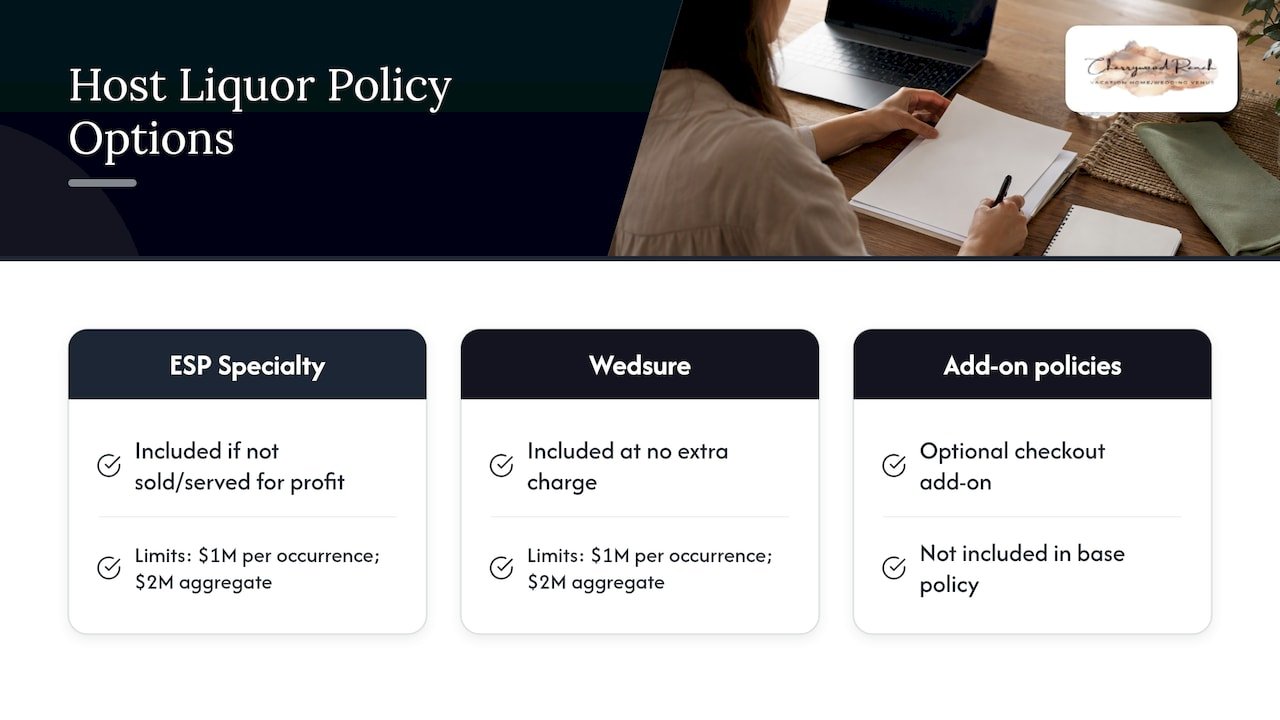
Not automatically. Some wedding policies fold host liquor into the base price. ESP Specialty states that its standard wedding policy carries $1 million per occurrence and $2 million aggregate general liability and includes host liquor coverage when the insured is not selling or serving alcohol for profit. Wedsure advertises $1 million/$2 million liability with host liquor included at no extra charge. Other products make it an option you tick at checkout.
The practical rule: read the declarations page of whatever you buy and find the words “host liquor” before you pay. A policy that lists general liability alone may not respond to an alcohol claim.
What it covers and what it leaves out
Host liquor applies to third-party claims for bodily injury or property damage related to alcohol consumption. ESP Specialty says that includes qualifying open-bar and BYOB events where guests do not pay for access to alcohol. Picture a guest who leaves your reception, causes a crash and injures another driver, and that driver’s lawyer names you as a defendant. Or a guest who stumbles into a rented sculpture and breaks it. Those are the situations the coverage is built for.
Common gaps to know before you buy:
- Your own property. Insurance Canopy’s wedding policy page excludes damage to the insured’s own property, décor or owned items from its venue and rental property damage coverage. Your dress, rings and flowers are not protected by liability coverage.
- Alcohol you sell. Host liquor assumes drinks are free to guests. More on that below.
- Policy limits. Coverage stops at the stated limit. A serious injury claim can exceed $1 million, which is why some venues ask for higher limits.
When a venue asks for it
Most couples first meet this topic when a venue contract arrives with an insurance clause. A few typical requests, drawn from published guidance:
- Wedsure’s Georgia page reports that venues commonly ask for proof of $1 million/$2 million liability and a certificate listing the facility as additional insured, and that some require higher limits.
- WedSafe notes that a venue requiring wedding liability may also require liquor liability when alcohol is available, and may ask to be added to the policy as an insured.
- Public facilities spell it out. DeKalb County, Georgia’s 2026 facility rental agreement requires at least $1 million in general liability, additional-insured status for the county, and a host-liquor endorsement for organizations serving alcohol. It separately requires an event caterer to carry at least $1 million per occurrence in liquor liability.
Two terms worth defining. A certificate of insurance is a one-page document from your insurer proving the policy exists and listing its limits. Additional insured means the venue is named on your policy, so a claim that touches the venue can be handled under your coverage.
For a fuller walk through contract language, our guide to what venues require for wedding insurance goes clause by clause.
Who is pouring changes which policy you need
The cleanest way to choose coverage is to ask who is serving and whether anyone is paying.
| Scenario | What usually applies |
|---|---|
| You buy the alcohol and guests drink free (open bar, BYOB, toasts) | Host liquor liability on your event policy |
| Guests pay by cash, ticket or per glass | Retail liquor liability, which is a separate add-on |
| A licensed bartender or caterer pours | Their own liquor liability, plus ask whether your venue also wants host liquor from you |
| The venue’s staff serve | Ask the venue for proof of its liquor liability |
Insurance Canopy states that host liquor is included when drinks are complimentary and that retail liquor liability is available as an add-on when alcohol is sold by cash, ticket or per glass. Its 2026 host guide advises getting proof of liquor liability from venue staff or a hired bartender or caterer, and checking whether the venue also requires the host to show host-liquor coverage.
If you are bringing your own alcohol, the venue’s policies matter as much as the insurance. Our pages on BYO alcohol wedding venues and corkage fees at a wedding cover the questions to ask, and the wedding bar setup checklist puts the pour plan in order.
Georgia’s host law in plain terms
Georgia handles both bars and private hosts in one statute, Ga. Code § 51-1-40. Nolo’s summary explains that the starting rule is that drinking, not serving, causes alcohol-related accidents. Liability can attach when someone knowingly provides alcohol to a person who is underage, or to someone noticeably intoxicated, knowing that person will soon be driving.
What that means for a wedding host:
- Do not serve anyone under 21.
- Stop serving a guest who is visibly drunk, and arrange a ride.
- Treat the statute’s narrowness as a reason to plan, not a reason to skip coverage. Even a claim that fails still has to be defended, and defense costs are part of what liability policies are designed to address.
Laws differ by state, so if you are coming from Florida, the Carolinas, Tennessee or Alabama for a Georgia wedding, the Georgia rule is the one that applies to a party held here. Check your own policy’s territory and terms, and an attorney can tell you how a specific situation would be treated.
What it costs
Single-event policies are inexpensive compared with most wedding line items, though the price moves with guest count, event length, limits and options.
- Wedsure says its wedding liability starts at $128 and includes $1 million/$2 million liability, free host liquor and $1,000 of cancellation or postponement coverage.
- Insurance Canopy states that event host insurance starts at $88 per event, with price depending on event type, attendance, duration and selected limits.
- The underwriter product sheet cited earlier lists liquor liability limits of $1 million per occurrence and $1 million aggregate for that product, a reminder that liquor limits can be lower than general liability limits.
These are starting prices published by each provider, and quotes change, so confirm yours at checkout. For a broader look at how liquor policies price risk, this overview of liquor liability costs and coverage explains bodily injury and property damage claims involving alcohol.
How to buy the right policy, step by step
- Read your venue contract first. Note the required limits, whether the venue must be additional insured, and whether liquor liability is named separately.
- Decide how alcohol will be served. Free for guests, sold, or poured by a licensed professional. This choice picks the coverage type.
- Count guests honestly. Price and limits depend on attendance, so use your real headcount. If you are still estimating drinks, how much alcohol to buy for 75 guests helps you size the bar.
- Get a quote that names host liquor. Confirm the phrase appears on the quote, not only in the marketing copy.
- Request the certificate of insurance with the venue named as additional insured if the contract asks for it, and send it before the deadline in your contract.
- Collect your vendors’ proof. Ask any bartender or caterer for their own liquor liability certificate and keep copies together.
- Buy early enough to meet the deadline in your agreement, and keep the paperwork where you can reach it on the wedding weekend.
The hospitality side matters as much as paperwork. This guide to private event rules at a restaurant shows how deposits and a written event order set expectations with a venue, and the same habit of putting service details in writing helps with alcohol.
A lodging wedding changes the risk picture
The biggest alcohol risk at a wedding is the drive home. When guests sleep where the party is, there is no drive home. That is the logic of a venue with onsite lodging, and it is why some couples choose a full wedding weekend over a one-day event. Our overview of what a luxury vacation home wedding is explains the format, and the vacation rental wedding rules page covers the addendum a couple signs.
Our view
We built Cherrywood Ranch around the idea that a wedding is better when the celebration does not end with everyone scattering to different hotels. Our North Georgia mountain property combines the wedding space and an elegant vacation home that sleeps up to 16 guests, with a pool and hot tub, so your closest people can stay together for the weekend.
For a couple planning an alcohol-friendly reception, that setup is a planning advantage. Fewer people need to travel between locations at the end of the night, and the toast, the dancing and the sunset all happen in one place. Pair that with a sensible bar plan and the right event policy, and you can enjoy your own wedding.
Our advice is simple. Read your contract, decide how drinks will be served, get host liquor coverage named in writing, and plan the night so guests have somewhere to rest. We coordinate events here, and we are glad to talk through your weekend and your bar plan with you.
Luis
Plan your wedding weekend at Cherrywood Ranch
If you are picturing a mountain ceremony, a relaxed reception and family staying on site, Cherrywood Ranch offers a private setting with lodging for up to 16 guests. See our wedding packages and pricing for one-day and three-night wedding options.
If Georgia is new to you, our destination wedding venue page is a good place to see how a weekend here works.
FAQ
Is host liquor included in general liability?
Sometimes. Some wedding policies include it in the base price, as ESP Specialty and Wedsure state for their products, while others sell it as an option. Look for the words “host liquor” on your quote and declarations page.
Who pays for liquor at a wedding reception?
Usually the couple or their families buy it, or a caterer or bartender service supplies it as part of a contract. Who pays also decides the coverage: free drinks fall under host liquor, while charging guests requires retail liquor liability.
What is special event liability insurance?
It is a short-term policy covering one event date, typically bundling general liability with host liquor. It is built for hosts such as couples who are not in the business of selling alcohol, and it often produces the certificate of insurance a venue asks for.
How much does wedding liquor liability insurance cost?
Published starting prices run from $88 per event with Insurance Canopy to $128 with Wedsure, which includes host liquor and cancellation coverage. Your quote depends on guest count, event length, limits and whether alcohol is sold.
Sources
- ESP Specialty: Wedding Insurance
- Special Event Liability product information
- DeKalb County, Georgia: 2026 facility rental agreement
- WedSafe: Liquor Liability Insurance and Host Liquor Liability
- Wedsure: Georgia Wedding Insurance
- Wedsure: Wedding Insurance FAQs
- Insurance Canopy: Wedding & Special Event Insurance
- Insurance Canopy: Do I Need Insurance to Host Weddings
- Insurance Canopy: Host Liquor Liability Insurance
- Nolo: Georgia Dram Shop Laws and Social Host Liability