
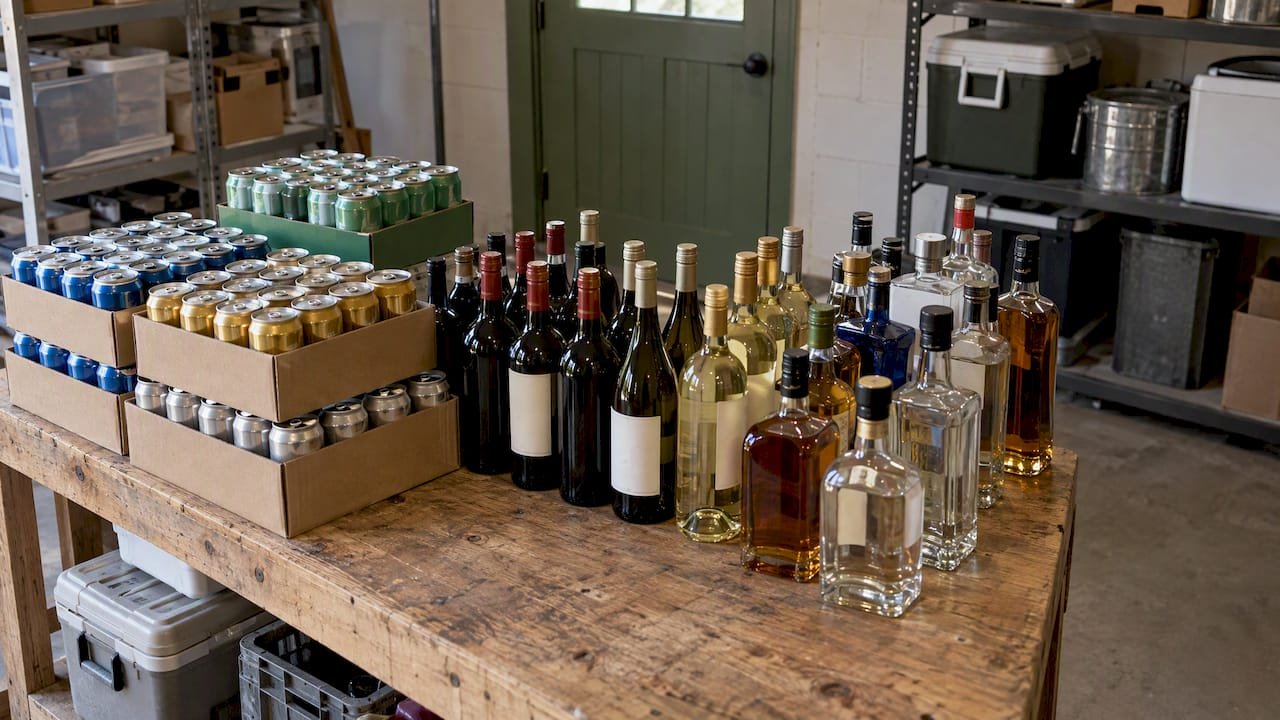
For 75 guests at a four-hour reception, plan for about 360 drinks. That works out to roughly 36 bottles of wine, 4 cases of beer and 5 liters of liquor, according to one popular wedding bar calculator. That figure includes a safety buffer. A leaner plan, with one drink in the first hour and three-quarters of a drink each hour after, lands closer to 245 drinks. Below you will find both versions, the bottle math behind them, how the numbers shift for 50 guests, and what changes when your guests are sleeping onsite.
TL;DR
- 75 guests, 4 hours: budget 300 drinks (one per guest per hour), add a buffer, and you land near 360 drinks.
- 50 guests, 4 hours: about 240 drinks, or 24 wine bottles, 3 cases of beer and 3 liters of liquor.
- Yields to remember: a 750 ml bottle gives about 5 glasses of wine, 6 of champagne or 14 liquor pours.
- Daytime or small crowds: you can usually shave 20% to 30% off.
- Overnight guests: with everyone staying on property, the driving problem goes away, but you still need food, water and a plan for the morning after.
Table of Contents
- The quick formula for any guest count
- What counts as one drink
- Turning drinks into bottles: a shopping list for 75 guests
- Alcohol for 50 guests: the same plan, scaled down
- Day guests vs. overnight guests
- Overnight guest etiquette around the bar
- Stocking a BYO bar
- Our perspective
- Plan a wedding weekend where everyone stays
- FAQ
- Sources
The quick formula for any guest count
Start with three numbers: guests, hours, and drinks per guest per hour.
The simplest version of the formula is one drink per guest per hour. For 75 guests over 4 hours, that is 75 × 4 = 300 drinks. Add a buffer on top. The calculator above builds in 20% and notes that outside guidance often says 10% to 15%. That gives you 360 drinks at 20%, or about 345 at 15%.
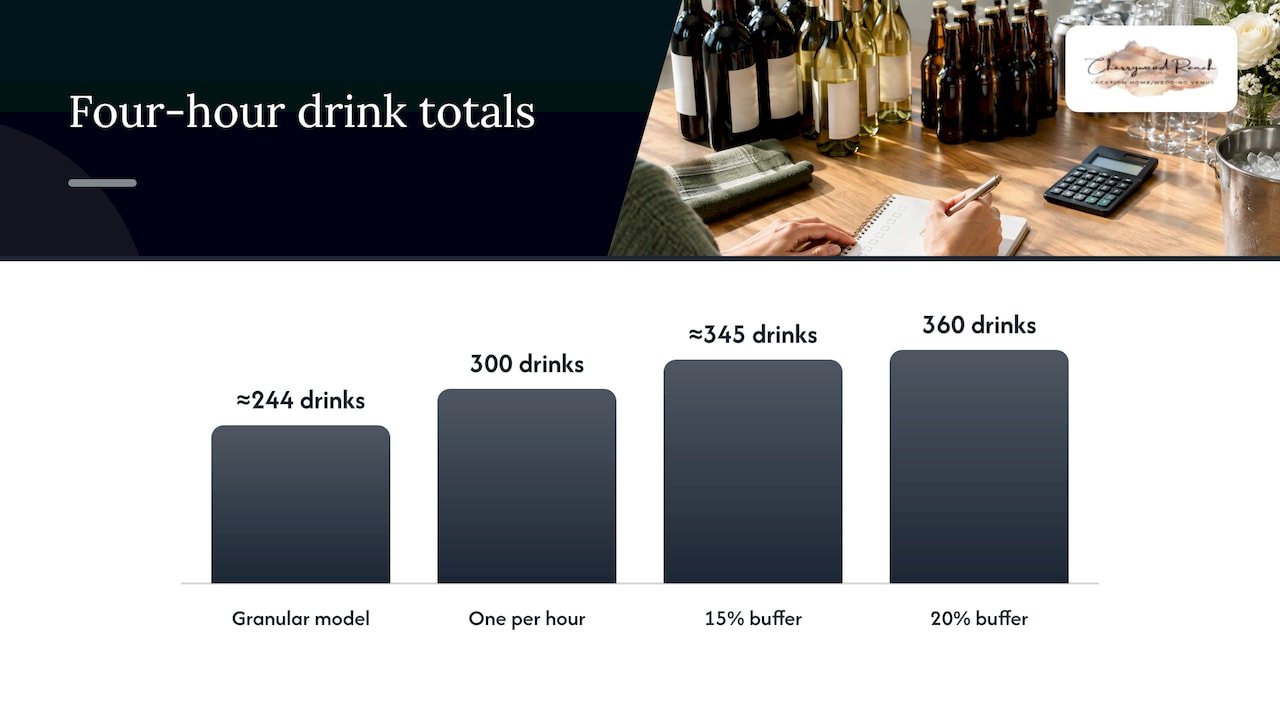
A more granular model reflects how people actually drink. One planning guide estimates a typical guest has 1 drink in the first hour and 0.75 drinks per hour after that, which totals about 4 drinks across five hours. For a four-hour reception, that is 3.25 drinks per guest, or about 244 drinks for 75 people before any buffer.
Which should you use? Think of the first number as your floor and the second as your ceiling:
| Approach | Drinks per guest (4 hours) | Total for 75 guests |
|---|---|---|
| Front-loaded (1 first hour, 0.75 after) | 3.25 | about 244 |
| One per hour | 4 | 300 |
| One per hour plus 20% buffer | 4.8 | 360 |
If you will be able to return unopened bottles, buy toward the top of the range. The same calculator notes that most liquor stores take back unopened bottles. Confirm that with your store, in writing, before you buy. Running dry at 9 p.m. is a worse problem than a few extra cases to return.
What counts as one drink
The math only works if every pour is the size you assumed. In the United States, a standard drink is 12 ounces of regular beer, 5 ounces of table wine or 1.5 ounces of 80-proof spirits, according to the National Institute on Alcohol Abuse and Alcoholism.
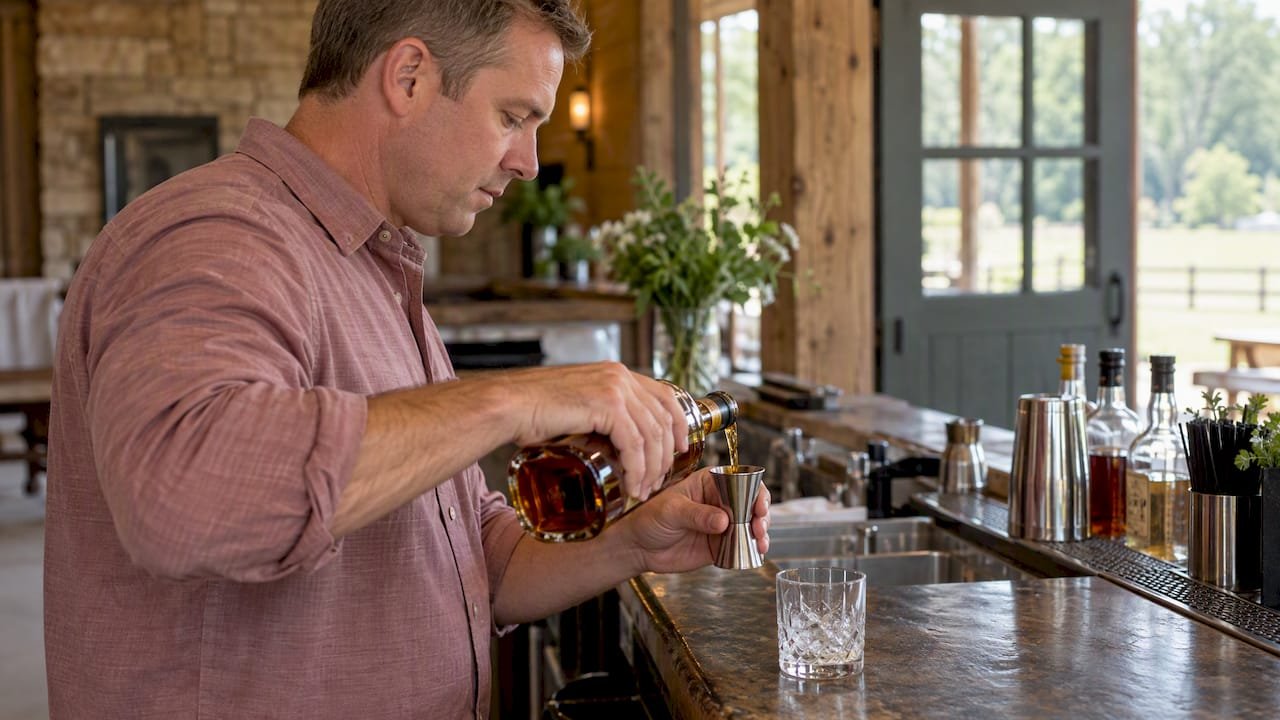
That matters for two reasons. A heavy-handed friend behind the bar who pours 3 ounces of bourbon has just doubled that drink. And a big stemmed wine glass filled generously can hold more than 5 ounces. If you are using volunteers, hand them a jigger and show them what a 5-ounce pour looks like in your actual glasses.
Turning drinks into bottles: a shopping list for 75 guests
Bottle yields are the bridge between drinks and a receipt. The Knot lists a 750 ml wine bottle at 5 drinks, a 750 ml champagne bottle at 6, and a 750 ml liquor bottle at 14.
The next question is the split. The Knot suggests a mix of 50% liquor, 25% beer and 25% wine, then adjusting to your guests’ tastes. Here is what that looks like for 360 drinks, and what a wine-leaning crowd might need instead:
| Liquor-leaning (50/25/25) | Wine-leaning (50% wine, 25% beer, 25% liquor) | |
|---|---|---|
| Liquor (750 ml bottles) | 180 drinks, about 13 bottles | 90 drinks, about 7 bottles |
| Beer (12 oz cans or bottles) | 90, about 4 cases of 24 | 90, about 4 cases of 24 |
| Wine (750 ml bottles) | 90 drinks, 18 bottles | 180 drinks, 36 bottles |
The bottle counts are our arithmetic from the yields above, rounded up. The wine-leaning column lines up with the calculator’s 36 wine bottles, 4 cases of beer and about 5 liters of liquor for 75 guests.
Add the toast. If you are pouring sparkling wine for a toast only, one glass per guest is enough. At 6 glasses a bottle, 75 guests need 13 bottles (75 ÷ 6 = 12.5, rounded up). That is separate from the drinks above, so do not subtract it from your wine count unless you are serving sparkling as a main wine.
Pick the mix that matches your crowd
The formula assumes an average crowd, and no crowd is average.
- Younger crowds lean toward spirits and cocktails. Older crowds lean toward wine, according to one planning guide.
- Warm weather pushes demand toward white wine, beer, refreshing cocktails and water. The Knot advises planning for more of those than red wine in summer.
- Daytime or brunch receptions can need 20% to 30% less alcohol, per the same planning guide.
If you are not sure, a signature cocktail or two plus beer and wine is a cleaner, cheaper approach than a full open liquor bar. You buy two or three spirits instead of eight, and your bottle math gets simpler.
Alcohol for 50 guests: the same plan, scaled down
For 50 guests over four hours, the calculator suggests 240 drinks: 24 wine bottles, 3 cases of beer and 3 liters of liquor. For a five-hour reception with 50 guests, The Knot estimates about 200 drinks excluding champagne: 5 one-liter liquor bottles, 50 beers and 10 bottles of wine. The two figures differ because they assume different mixes, buffers and drinking rates. That is normal. Pick one method, stick with it, and decide in advance whether you want a cushion.
Here is a side-by-side for a four-hour reception:
| 50 guests | 75 guests | |
|---|---|---|
| Total drinks | 240 | 360 |
| Wine bottles | 24 | 36 |
| Beer | 3 cases | 4 cases |
| Liquor | 3 liters | 5 liters |
If you are deciding how many people to invite in the first place, our guide to what number is right for an intimate wedding walks through the tradeoffs, and bar cost is one of the clearest ones: every extra guest adds drinks, glassware and ice.
Day guests vs. overnight guests
Most calculators assume guests arrive, drink, and leave. A wedding weekend with onsite lodging is different, and it changes the math in both directions.
| Day guests | Overnight guests | |
|---|---|---|
| Getting home | Need a driver, ride or shuttle | Walk to bed |
| Pace of drinking | Often paced by the drive home | Often looser, and longer |
| Where drinking happens | At the reception | Reception, after-party, pool, porch |
| Morning after | Not your problem | Coffee, water and breakfast are |
The honest planning point: if guests can stay put, plan a bit higher for the evening and a lot more for the second day. A welcome dinner, a reception, a late night on the porch and a Sunday brunch can add up to three or four drinking occasions. Buy for each one separately instead of stretching a single reception number across the weekend. Our ideas for a welcome party that gets guests talking can help you size the first night.
Who is staying matters too. With a mixed group, some staying onsite and some coming in from town, treat the two groups differently. The day guests still need a safe way home. Brides recommends providing transportation for out-of-town guests when alcohol is served, and coordinating group transportation to and from events at a destination wedding is a thoughtful touch. Our piece on wedding transportation with onsite lodging covers how to cut shuttle hours and costs.
Overnight guest etiquette around the bar
When you are hosting people in a house, the rules are less formal and more important.
- Say the plan out loud. Tell guests in the invitation or welcome note where the bar is, when it opens and what is included. Surprises about who pays are the worst kind.
- Keep non-drinkers in the party. The NIAAA’s tips for hosts include emphasizing food, serving alcohol-containing drinks in cups or glasses, and keeping bottles and containers elsewhere so guests who are not drinking are not surrounded by triggers.
- Offer real alternatives. Water, juice and sparkling soda are not an afterthought. The NIAAA recommends them because they can counter dehydration and may slow alcohol absorption. Have a good nonalcoholic option in a real glass.
- Feed people. The same NIAAA brochure says food can reduce the peak level of alcohol in the body by about one-third. Passed appetizers during cocktail hour and a late-night snack are worth the budget. If you want to time it properly, a guide on cocktail hour timing helps you plan when the first drinks and bites land.
- Plan quiet hours. Overnight guests include grandparents and kids. Agree on when the music and the porch conversation wind down.
- Have a rule for anyone who needs to leave. Even with onsite lodging, someone may need to go to a hotel or drive an older relative home. Name designated drivers or save a ride-hailing number ahead of time, as the NIAAA recommends.
Stocking a BYO bar
Bringing your own alcohol is often the biggest way to control cost, and it comes with a checklist. Before you buy a single bottle:
- Confirm the rules in writing. Does your venue allow BYO? Is there a corkage fee? Are there limits on hard liquor? Our guides on how BYO alcohol venues work and corkage fees and what to ask list the questions.
- Decide who pours. A self-service bar can reduce labor costs but needs safety planning. Without a bartender, add bar stations so lines stay short, and consider individual servings such as canned wine or cocktails to control portions and reduce waste.
- Count your glassware, ice and coolers. Mixers, garnishes, ice and bins are what couples forget. Ask your caterer or rental company for their guidance for your guest count, and buy a little more ice than you think you need.
- Keep the receipts. Returnable unopened bottles and cases only help if you can prove where you bought them.
- Assign someone to close the bar. Name a person, not a committee, to count what is left, lock it up and handle returns.
- Plan the coffee. A late-night or morning coffee station keeps the party civil. This guide on self-service wedding coffee bars has useful ideas on keeping lines short.
Cost-wise, remember that bar pricing varies a lot by place. Brides notes that open bars abroad tend to cost more than at U.S. weddings and suggests a caterer’s bar package as one way to keep costs down. For the bigger picture, our wedding weekend budget guide breaks out per-guest math.
Our perspective
We host weddings where the guests stay under the same roof, and that changes how we think about the bar. The question is not only “how many bottles,” it is “how does the whole weekend flow.”
When family and friends can step from the ceremony lawn to the pool, the hot tub or the porch without getting in a car, people relax. They linger. They drink a little slower over a longer stretch, and they eat more. We designed our weekends around that: a single property for up to 16 overnight guests, with outdoor space for the ceremony and reception, so nobody has to leave to get to the next part.
Our advice to couples with 50 to 75 guests is to buy from a plan rather than a feeling. Use the front-loaded math as your floor, add a buffer you can return, and put the real money into food and good nonalcoholic options. Then give yourselves one less thing to worry about: the drive home.
Luis
Plan a wedding weekend where everyone stays
If you are weighing a venue for 50 to 75 guests, think about what the bar plan looks like when no one needs a ride. Cherrywood Ranch is a private North Georgia mountain venue with onsite lodging for up to 16 guests, a pool and hot tub, and outdoor spaces for the ceremony and reception. Our services page lists our wedding offerings and a $10-per-guest fee for each guest over 75. You can see published rates and availability on our booking page.
Want to see how a weekend can run? Our guide to a poolside wedding weekend in North Georgia shows how guests move between events without shuttles.
FAQ
How many bottles of wine do I need for 75 guests?
For a four-hour reception with a wine-leaning mix, about 36 bottles. That is 180 wine drinks at 5 glasses per 750 ml bottle. If wine is only one quarter of your bar, plan for about 18 bottles, then add a few whites in warm weather.
How much alcohol do I need for 50 guests?
For four hours, plan on about 240 drinks: 24 bottles of wine, 3 cases of beer and 3 liters of liquor. For a five-hour reception, one popular planner estimate is about 200 drinks excluding champagne, with 5 one-liter liquor bottles, 50 beers and 10 bottles of wine. Adjust for your crowd and the time of day.
Should I buy extra in case we run out?
Yes, as long as you can return it. A 10% to 20% buffer is common. Ask your liquor store in advance whether it takes back unopened bottles and cases, and keep your receipts.
What should I serve besides alcohol?
Water, juice and sparkling soda at minimum, plus food throughout the evening. Water and other nonalcoholic drinks can counter dehydration, and food can lower the peak level of alcohol in the body. Put a good nonalcoholic option in a real glass so non-drinkers feel included.
Do overnight guests drink more than day guests?
Not necessarily, but they have more occasions to drink, because the weekend stretches over a welcome dinner, the reception and a late night. Count each event separately and keep water and food flowing. Day guests still need a safe ride home.
Sources
- Wedding Alcohol Calculator: Bottles, Cases and Kegs
- How to Stock the Bar at Your Wedding, The Knot
- How Many Drinks Per Wedding Guest
- Defining How Much Alcohol Is Too Much, NIAAA
- Risky Drinking Can Put a Chill on Your Summer Fun, NIAAA
- Tips for hosting a party including guests who may not be drinking, NIAAA
- What to Know About a Self-Service Bar at Your Wedding, Brides
- How Much Does a Destination Wedding Cost?, Brides