
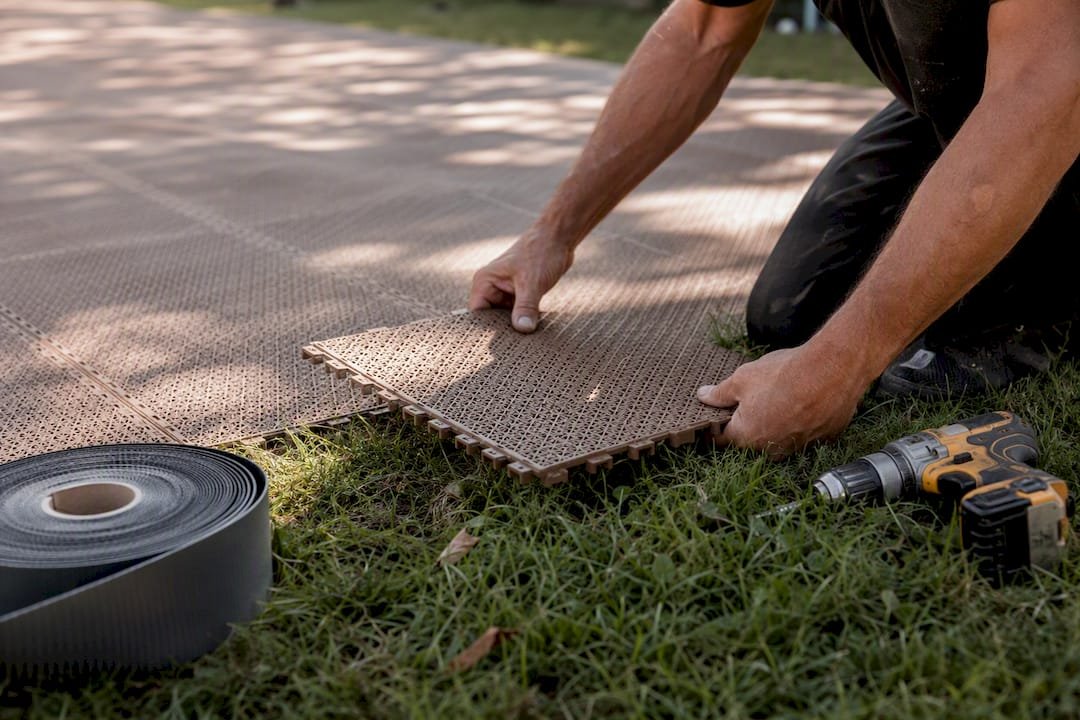
For most outdoor weddings and events, the best move is outdoor-rated modular interlocking tiles set over a protective mat or thin plywood base. That combination handles uneven lawn, sheds rain, and goes down in a few hours with a small crew. Two situations call for something else: if you want a true parquet look and expect a band, a bar cart, or 150+ guests dancing at once, build a plywood subfloor with a vinyl or Marley overlay instead. If the ground is genuinely soft (recent rain, low spots, sandy soil), start with composite ground-protection mats before anything else touches the grass.
The one-line rule that decides which path you take: test the firmness and slope of the actual site, not the general conditions in your area. A lawn that seems fine in October can be spongy after a wet week in June.
Buy versus rent comes down to frequency. A single wedding almost always makes more sense as a rental with an install crew included. A venue or planner doing several events a year usually saves money buying modular panels within one or two seasons.
- Firm, flat lawn, one event: rent modular tiles
- Soft or sloped ground: composite mats first, tiles or plywood on top
- Formal parquet look, heavier loads: plywood plus vinyl overlay
- Repeat use across a season: buy and store panels
Key Takeaways
A stable outdoor dance floor on grass depends on matching the subfloor to real site conditions, not the flooring product alone.
| Point | Details |
|---|---|
| Match subfloor to ground | Firm lawn suits modular tile; soft or sloped ground needs composite mats or plywood on sleepers first. |
| Test the site yourself | Walk the exact footprint, ideally after rain, to catch soft spots before booking a vendor. |
| Rent for one-off events | A single wedding almost always costs less as a rental than a purchase. |
| Book crews 6 to 10 weeks out | Peak wedding season fills flooring vendor calendars fast, especially May through October. |
| Watch for the dawn dew | A dry forecast doesn’t guarantee dry ground; build a same-morning recheck into your install plan. |
| Cherrywoodranchweddingvenue handles it | The venue coordinates flooring vendors, site prep, and delivery timing so couples skip the DIY logistics. |
Table of Contents
- What Type of Dance Floor Works Best on Grass?
- Should You Rent or Buy Your Outdoor Dance Floor?
- How Do You Assess a Grass Site Before Installing a Floor?
- Which Subfloor Should You Use Under a Grass Dance Floor?
- What Are the Steps to Install a Dance Floor on Grass?
- How Big Should Your Dance Floor Be?
- How Do You Prevent Trips and Slips on an Outdoor Dance Floor?
- How Do You Take Down and Store a Grass Dance Floor?
- What Happened When We Installed a Dance Floor at Cherrywood Ranch
- Where Can You Find Vendor Specs and Venue Booking Details?
- Book a Venue That Already Handles the Flooring Logistics
- A Few Things Worth Prioritizing First
- Sources
What Type of Dance Floor Works Best on Grass?
Four flooring categories show up again and again in real outdoor installs, and each solves a different site problem. Picking the wrong one is usually what leads to a floor that wobbles, pools water, or sinks a heel into soft turf mid reception.
Modular polypropylene interlocking tiles are the workhorse option. Systems like the EverDance modular polypropylene tile system use 12 inch tiles with UV inhibitors and built-in drainage channels, so rain runs through instead of pooling on the surface. EventReadySupply’s own product page for the EverDance package notes it’s built for repeated indoor and outdoor use, which matters if you’re renting from a company that reuses the same floor across a dozen weddings a season. Greatmats takes a similar modular approach with raised-base ventilation that keeps moisture from wicking up into the tile, and its own installation guide is blunt about the limits: tiles work on grass, but they perform best on firm, relatively flat ground and need a protective underlayer when the lawn is soft.
Plywood plus a vinyl or laminate overlay is the route for a formal look. Floor Chem Depot’s build guide describes exterior-grade three-quarter inch plywood set on sleepers, with proper drainage gaps and a vinyl or Marley surface layered on top for a safe dance surface. It’s stiffer than modular tile, handles concentrated weight better, and looks like an actual dance floor rather than an outdoor mat. Beyond Tent’s commercial laminate and parquet lines, sold with the subfloor frame included, show what that finished look costs: their listings for products like the Maple Plank and White Checkered Laminate Portable Dance Floor illustrate why a parquet finish runs noticeably higher than plain modular tile.
Composite ground-protection mats and vehicle-grade turf grids solve a different problem entirely: soft, saturated, or uneven soil that would swallow any lighter system. Ventura Rental’s outdoor flooring guide recommends composite base mats or raised platforms specifically to keep the wear surface above shifting or soft ground, and these mats double as load-bearing paths for catering carts or golf carts crossing the lawn.
| Product / System | Best For | Outdoor Durability | Subfloor Needed | Install Effort | Typical Cost Shape |
|---|---|---|---|---|---|
| EverDance modular polypropylene tile system | Fast installs on firm or slightly uneven turf | UV treated, drainage channels | Optional on firm ground | Low, small crew | Rental or purchase, mid-range |
| Greatmats | Balance of look, portability, durability | UV treated, raised ventilation base | Recommended on soft turf | Low to moderate | Mid-range purchase |
| SnapLock Portable Dance Floor Kit | General event use on variable terrain | Weather resistant polymer | Optional | Low | Mid-range |
| EZ Portable Dance Floor Tile | Budget outdoor events | Weather resistant | Optional | Low | Lower to mid-range |
| Rosco Adagio Touring Portable Floor | Touring productions, formal events | Durable vinyl surface | Yes, panel base | Moderate | Higher, rental common |
| Sprung Dance Floor Full Panel | Formal receptions, heavier loads | High load rated | Yes | Moderate to high crew | Higher, purchase or long rental |
| Portable Dance Floor Seamless Wood Grain Cam Lock | Parquet look without full plywood build | Weather resistant surface | Often includes frame | Moderate | Mid to higher |
Retail listings, including the range of consumer-grade tiles sold through outlets like Amazon’s outdoor dance floor category, show how wide the price spread really is between a basic backyard tile and a commercial rental-grade system. Rental companies tend to push modular tile and composite mats because they’re light to transport and quick to reset between events; buyers leaning toward plywood or Sprung panel systems are usually venues planning to reuse the same floor all season.
Should You Rent or Buy Your Outdoor Dance Floor?
A single wedding almost always favors renting. You’re paying for delivery, install labor, and pickup, but you avoid storage headaches and skip the risk of buying a system that turns out wrong for your site.
Frequent use flips that math. A venue hosting six or more events a season typically recoups the purchase cost of modular tiles like SnapLock Dance Floor XL Standard Tiles or SnapLock Dance Floor Plus Premium Tiles within a year or two, especially once you factor in what repeat rental fees would have cost.
Lead time matters more than most planners expect:
- Book rental crews 6 to 10 weeks out for peak wedding season (May through October)
- Confirm exact square footage and site access at least 2 weeks before delivery
- If buying, order 4 to 6 weeks ahead to account for shipping on heavier panel systems like Sprung Dance Floor Full Panel
- Add a buffer week if your event depends on a specific finish, like Tap Dance Floor Kit surfaces or a Theatrical No Glare Floor Full Bolt system for photography-heavy events
How Do You Assess a Grass Site Before Installing a Floor?
Ground preparation is the factor vendor guides agree matters more than any product choice. Greatmats’ own installation guidance treats site assessment as the deciding step before you even pick a flooring type, and that ordering is correct. The right floor on the wrong ground still fails.
Work through this sequence before ordering anything:
- Check the slope. A rough but reliable threshold is one inch of drop for every 10 feet of run. Beyond that, you need shimming, a leveling subfloor, or a different section of lawn.
- Test firmness. Walk the site the morning after rain if you can. If your heel sinks visibly, that area needs a composite mat or plywood base, not tile laid straight on grass.
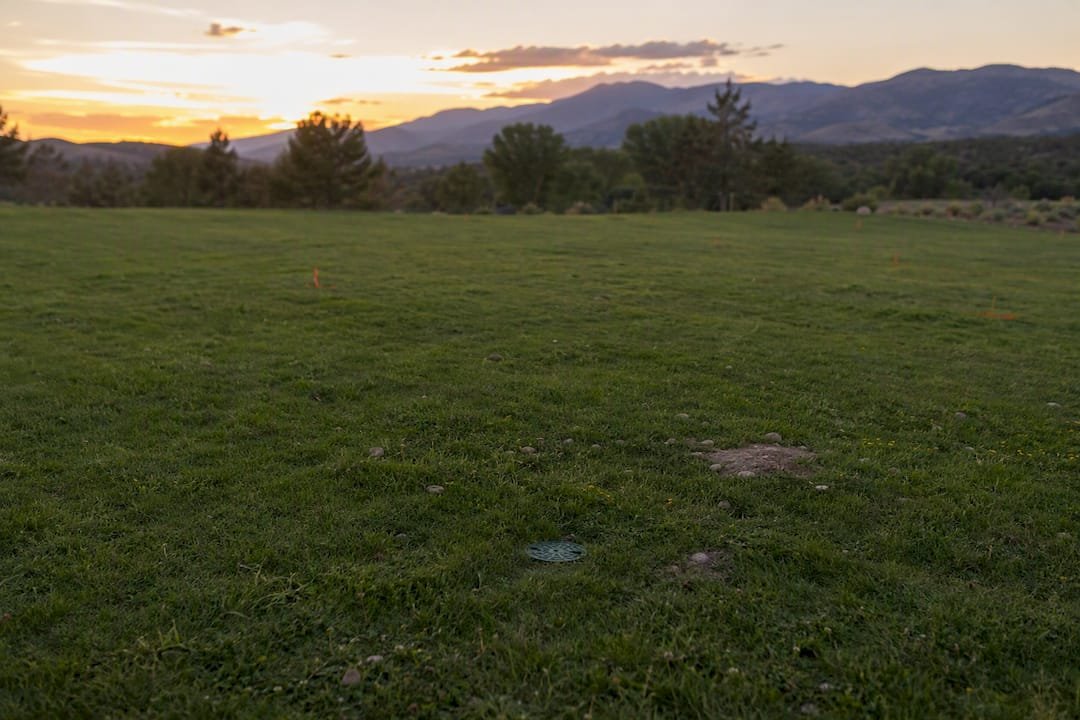
- Map irrigation and utilities. Locate sprinkler heads, buried lines, and septic access points. Installing over a sprinkler head is a guaranteed mid-reception failure.
- Clear surface obstructions. Rocks, roots, low branches, and anything that snags a tile edge.
- Prep the lawn. Mow short two to three days ahead, clear debris, tamp down shallow depressions by hand, and lay a weed barrier if the floor will sit down longer than a day.
Pro Tip: Walk the exact footprint of the dance floor yourself, in the shoes you’ll be wearing, at the same time of day as the event. A firm lawn at 10 a.m. can be a different story after evening dew or an afternoon sprinkler cycle.
Sprinkler heads and utility marks are easy to miss when you’re focused on square footage. Skipping this step is the single most common reason a floor looks perfect at 4 p.m. and has a soft spot by 8.
Which Subfloor Should You Use Under a Grass Dance Floor?
Your subfloor choice depends on soil firmness, expected load, and how long the floor stays down. Three approaches cover almost every real-world scenario.
Sleepers and plywood give you the most control. Set treated 2×4 sleepers at 16 to 24 inch spacing, then fasten three-quarter inch exterior-grade plywood on top, leaving small drainage gaps between sheets. Floor Chem Depot’s build guide walks through fastener spacing and material grades in detail, and it’s the approach most planners use under Dance Studio Subfloor Elite or Sprung Dance SubFloor DIY Customize systems when a rigid, dead-level surface matters more than speed.
Composite mats and turf grids win on speed. Vehicle-grade grids can support golf carts and catering equipment moving across a lawn, not just dancers, and Ventura Rental’s guide points to these as the go-to fix for soft or shifting ground where sleepers would take too long to install correctly.
A rough but useful decision rule: ground preparation determines outcome more than product selection far more often than planners assume, which is why a cheaper tile on a well-prepped composite mat regularly outperforms a premium floor dropped straight onto damp grass.
- Firm, flat turf: modular tile with a thin protective underlayer
- Soft, uneven, or previously waterlogged ground: composite mats or turf grids first
- Slopes near or beyond the one-inch-per-10-feet threshold: shimmed plywood on sleepers
- Heavy concentrated loads (bands, buffet stations): plywood subfloor regardless of ground condition
What Are the Steps to Install a Dance Floor on Grass?
Treat installation as a sequence with checkpoints, not a single afternoon task. Skipping a check early costs you time later when a seam won’t close or a corner won’t sit flush.
Before crew arrives:
- Confirm any venue permissions or HOA rules about staking into the lawn
- Mark the exact footprint with flags or spray chalk based on your sizing calculations
- Assign roles: one person on layout and leveling, one on panel connection, one running quality checks behind them
Assembly sequence:
- Lay the subfloor or protective mat first, checking level with a long straightedge or laser level
- Set the first row of tiles or panels against a fixed reference line, usually the tent edge or a marked chalk line
- Interlock each subsequent row, checking seam gaps by hand every few tiles rather than waiting until the whole floor is down
- Install edge trim or ramped transitions around the full perimeter
- Walk the entire floor in flat shoes and again in heels if possible, checking for lift, gaps, or soft spots
Anchoring for wind and crowd load:
Outdoor floors under tents need real anchoring, not just weight. Stake perimeter trim into the ground where the surface allows, and use sandbags or water-filled anchors at tent corners if a storm system is anywhere in the forecast. A floor that’s fine under a static crowd can shift once 80 guests start moving to a live band.
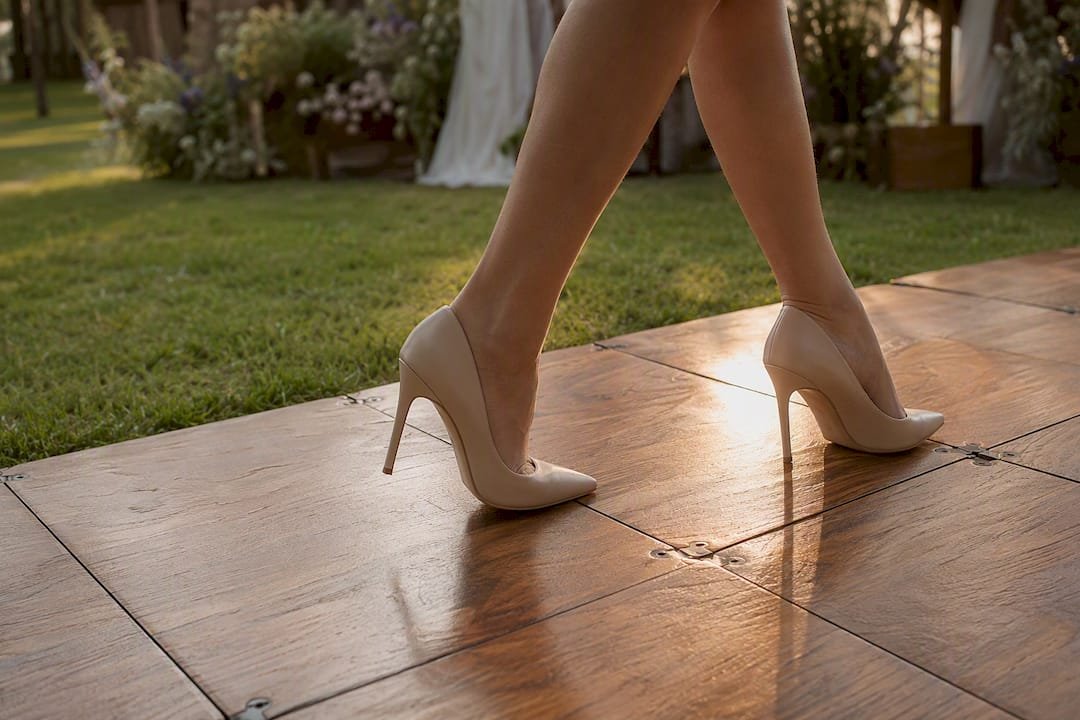
Pro Tip: Do a “heel test” before guests arrive: have someone walk the entire floor in stiletto heels. Event pros lean on tight-tolerance interlocks and ramped edge trims specifically because heel-catching gaps are one of the most common injury complaints at outdoor receptions.
How Big Should Your Dance Floor Be?
Square footage scales with guest count, but the common mistake is sizing for total guests instead of the number actually dancing at once. A reasonable planning figure is 3 to 4.5 square feet per dancer, assuming roughly a third to half of your guest list is on the floor at peak moments.
| Guest Count | Dancers at Peak (approx.) | Recommended Floor Size |
|---|---|---|
| 40 | 20 | 12 ft x 12 ft |
| 80 | 40-40 | 16 ft x 16 ft |
| 150 | 80-80 | 20 ft x 24 ft |
Bands, DJ booths, and bar setups change the math. A live band with amplifiers and monitors needs its own reinforced section, usually on the plywood-and-sleeper subfloor rather than lighter modular tile, since concentrated equipment weight in one spot is a different load profile than distributed foot traffic. If you’re adding a Court Floor Tile Flat Top section for a photo booth or a Portable Dance Floor Wood Cart setup for staging, budget extra square footage and a firmer subfloor under that specific zone.
- Round up floor size by 10 to 15% for irregular dancing patterns and edge clearance
- Add a dedicated reinforced pad for bands, generators, or heavy catering equipment
- Keep at least 3 feet of clearance between the dance floor edge and any seating to reduce trip risk
How Do You Prevent Trips and Slips on an Outdoor Dance Floor?
Tight seam tolerances matter more outdoors than indoors, because grass installs are more prone to shifting than a floor set on concrete. A heel that catches even a quarter-inch gap can end a night early, which is why event crews consistently favor systems with close interlocking tolerances over anything with visible seam play.
Ramped edge trim around the entire perimeter isn’t optional for a formal event. Aim for a gentle slope rather than a hard lip, and make sure the trim color contrasts with the dance surface so guests see the edge, especially once the sun sets and string lights take over as the main light source.
Wet surfaces need a separate plan. Even a light dew overnight can leave a surface slick by morning, and any floor left down overnight should be checked and, if needed, wiped or lightly dried before the first dance.
- Choose modular tiles or panels with tight, verified interlocks, not loose click-together designs
- Install ramped trim on every open edge, not just the main entry point
- Keep a few absorbent mats or towels on hand for spot-drying wet patches during an evening event
Pro Tip: If your event runs into evening dew territory, plan for a quick 15 minute dry-down pass before doors open, especially on any vinyl or laminate overlay surface, which gets noticeably more slippery than textured polypropylene tile when damp.
How Do You Take Down and Store a Grass Dance Floor?
Teardown timing affects your lawn almost as much as installation does. Pull the floor once the surface is fully dry, ideally mid-morning after any overnight moisture has evaporated, rather than tearing down at night when you can’t see turf condition clearly.
- Remove edge trim and anchors first, then work inward panel by panel
- Stack and inspect each tile or plywood section for cracks, warped edges, or damaged fasteners before storage
- Clean surfaces with a mild detergent rinse if there’s spilled drink residue, then let them dry fully before stacking
- Rake and lightly aerate any compressed turf sections, then water the area generously within 24 hours
- Leave temporary “recovering lawn” signage up for a few days if the area sees regular foot traffic
Floor Chem Depot’s plywood-specific guide backs this order, pairing removal-when-dry with immediate post-event watering and aeration as the fastest way to bring compressed grass back. If rain is a real risk during your event window, a practical rain contingency plan built in advance saves you from an emergency teardown in the middle of a storm.
What Happened When We Installed a Dance Floor at Cherrywood Ranch
A recent wedding weekend at Cherrywood Ranch put 42 guests on a modular tile floor set up on a gently sloped section of lawn near the mountain view line. The site checked out fine during the daytime walkthrough: firm ground, minimal slope, no obstructions.
The problem showed up the next morning. Overnight dew softened one corner where the ground dipped slightly, and by ceremony time that section had a faint spring to it underfoot. The fix was simple: the crew slid a thin composite shim under that corner and re-leveled before guests arrived, a 20 minute correction that would have been a bigger job mid-reception.
That’s exactly the dawn dew problem planners underestimate: a forecast-dry night doesn’t mean dry ground by sunrise.
- Confirm vendor arrival time allows for a same-morning recheck, not just a night-before install
- Ask any flooring vendor whether their crew re-levels on-site the morning of the event
- Coordinate flooring delivery windows with other vendors, including DJ and entertainment setup, so equipment placement doesn’t conflict with the dance floor footprint
Pro Tip: If your floor goes down more than 12 hours before the event, build a same-morning recheck into your vendor contract. It’s a small ask that prevents the exact soft-spot problem a dew-heavy night can cause.
Where Can You Find Vendor Specs and Venue Booking Details?
The following pages cover the product specs, installation guidance, and venue logistics referenced throughout this piece.
- Greatmats’ outdoor installation guide for modular tile specs and grass-specific prep advice
- EverDance modular tile package details for UV treatment and drainage specifications
- Floor Chem Depot’s plywood build guide for sleeper spacing and vinyl overlay steps
- Beyond Tent’s laminate parquet listings for finished-floor pricing examples
- Cherrywood Ranch’s outdoor reception planning guide for layout and sightline advice
- Plan a weekend getaway wedding for scheduling multi-day install and teardown windows
Book a Venue That Already Handles the Flooring Logistics
Most of what this article covers, site assessment, subfloor selection, vendor scheduling, is work Cherrywoodranchweddingvenue already handles for every wedding weekend it hosts. Instead of researching modular tile specs and coordinating a separate flooring rental on top of catering, lodging, and a DJ, you book one weekend and the venue’s team manages vendor arrival, site prep, and setup timing around your ceremony and reception.

Cherrywoodranchweddingvenue works from a preferred vendor list built around its own North Georgia mountain grounds, so flooring crews already know the slope, the soil, and where the dew tends to sit heaviest by morning. That local knowledge is the difference between a floor that needs a same-morning fix and one that doesn’t. Staff onsite coordinate delivery windows so your flooring, tent, and entertainment vendors aren’t tripping over each other’s setup schedules the day before your wedding.
If you’re weighing a DIY grass installation against a venue that already has this solved, start by checking available weekend dates on the Cherrywood Ranch destination wedding venue page and ask about current vendor coordination for outdoor dance floor setups.
A Few Things Worth Prioritizing First
Get the ground right before you get the floor pretty. Protecting the turf underneath matters as much as the surface guests see, and it’s the step most planners rush. Book your flooring vendor early enough that a site recheck the morning of the event is still possible, not an afterthought.
— Luis
Sources
- Build Outdoor Dance Floor on Grass – Greatmats
- Outdoor Dance Floor Guide: Best Options for Grass, Sand & Uneven Surfaces – Ventura Rental
- How to Build a Temporary Dance Floor on Grass for Events – Floor Chem Depot
- EverDance floor package – EventReadySupply