
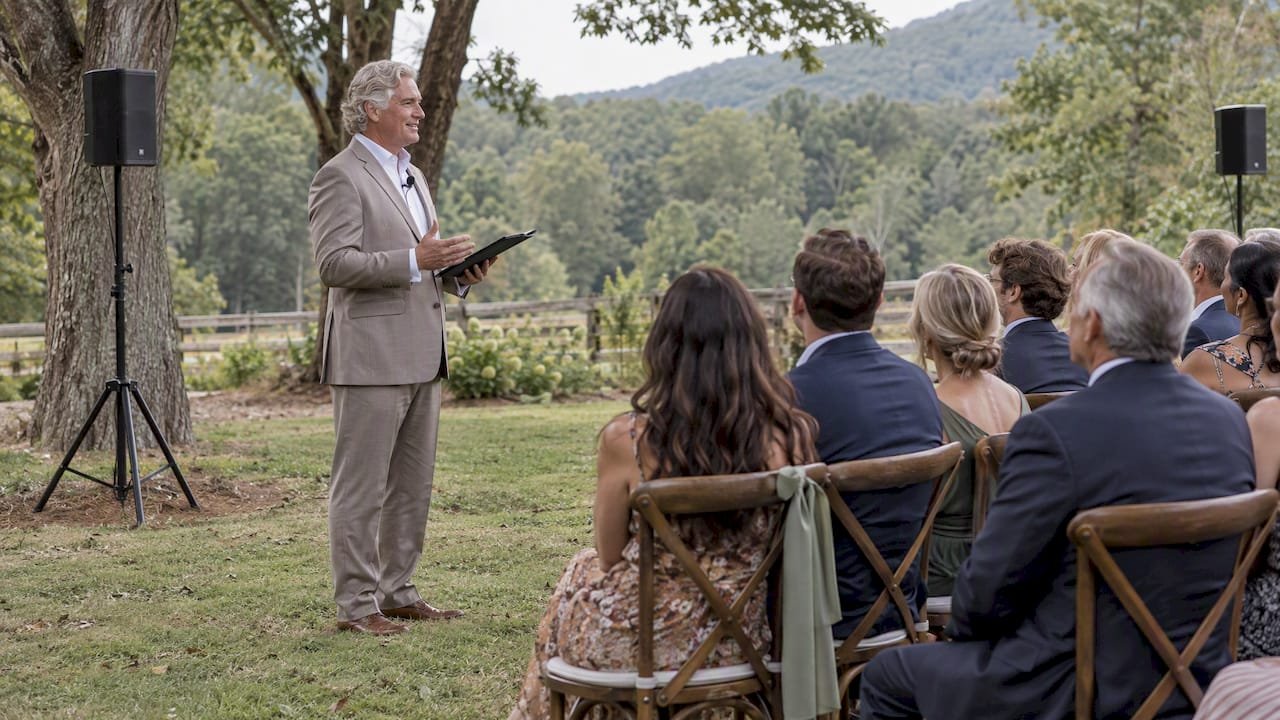
For most outdoor ceremonies, the answer is a wireless lavalier microphone on the officiant, a second one for each partner if you are saying personal vows, a handheld mic for readers and as a backup, and one or two small speakers aimed at your guests. Add a real windscreen on every mic, test at the spot where you will stand, and keep a spare ready. The rest of this guide explains why, and how to get it right on a mountain hillside, a lawn or a beach.
TL;DR
- Use a microphone unless your ceremony is tiny. Roughly 15 guests or fewer may not need one; anything bigger usually does.
- Put a wireless lavalier on the officiant, and lavaliers on the couple if you want vows heard clearly. Keep a handheld as backup or for readers.
- Aim one or two compact speakers at guests from in front of the couple, and keep them away from the microphones to avoid feedback.
- Wind is the real enemy outdoors: windscreens on every mic, lavs hidden under clothing, speakers upwind if you can.
- Test at the actual ceremony spot with fresh batteries, and have a plugged-in backup ready.
Table of Contents
- Do you need a microphone outdoors?
- Which microphone for which person
- Speakers: place them for the guests
- Beating wind noise
- Preventing feedback
- Power when there is no outlet
- The test and the backup
- Our perspective on ceremony sound
- Hosting your ceremony at Cherrywood Ranch
- FAQ
- Sources
Do you need a microphone outdoors?
Usually yes. Open air has no walls to bounce a voice back to the audience, so speech disappears quickly. The Association of Music Merchants-style guidance from AMM recommends a microphone in almost all scenarios, with the exception of an elopement or a ceremony of about 15 or fewer guests.
A professional sound rental company also advises treating amplification as necessary whenever guests may struggle to hear, including at smaller ceremonies affected by traffic, surf or other background noise.
A quick test: stand where you will say your vows and have a friend sit in the last row. If they cannot repeat what you said at a normal speaking voice while a breeze blows, you need a mic. Remember that the older relatives who most want to hear you are often the ones seated farthest back or with hearing loss.
Which microphone for which person
The officiant speaks the most, the couple speak the most important lines, and readers come and go. Each job suits a different tool.
| Person | Best choice | Why | Backup |
|---|---|---|---|
| Officiant | Wireless lavalier or headset | Hands-free, speaks the most, stands next to the couple | Handheld |
| Each partner | Discreet wireless lavalier | Vows are captured evenly and clearly | Handheld passed between you |
| Readers and guests | Handheld or stand mic | Quick to hand off, works where they speak | Officiant’s lav if they stand close |
| Ceremony with no movement | Stand mic or wired mic | No batteries or radio dropouts | Wireless lav |
The officiant
Audio-Technica’s U.S. guidance recommends a wireless lavalier on the officiant, because the officiant speaks most and stands close to the couple. Its omnidirectional pickup can also capture the vows.
The AMM tips for officiants and couples say the same, with two cautions: secure the lav away from clothing rub, and shield it from wind. A headset works too, and one wedding audio company advises a headset or wireless lav when the officiant needs to move hands-free, while treating a handheld as a backup rather than the main officiant mic.
One handheld passed around is the classic failure. Another ceremony-audio guide warns against relying on a single handheld shared during the ceremony, since someone always holds it too far from their mouth.
The couple and your vows
If you are writing personal vows, mic yourselves. The same guide suggests two discreet lavaliers for the couple when exchanging personal vows. A handheld can work but looks less clean in photos, and relying on the officiant’s mic alone is not ideal. Another source also recommends lavaliers for both partners so vows come through evenly.
If you want a no-body-pack look, Audio-Technica notes that a boundary microphone near the altar or a shotgun mic aimed at the couple are alternatives. Both are harder outdoors, where wind and distance work against them, so treat them as options to discuss with a sound pro, not a default.
Readers, family and musicians
For readers, a handheld or a podium or stand microphone works depending on where they speak. The AMM guidance explains the tradeoffs: wired mics avoid interference and dropouts but limit movement, while handhelds allow roaming and handoffs. If a stand mic sits on a lawn, put it where readers naturally stop, and tell them to speak close, about a hand’s width from the mic.
Musicians raise a feedback question. Ask where a singer or guitarist will sit relative to your speakers before the day, a point one outdoor sound company flags as a common cause of squeal.
Speakers: place them for the guests
Microphones only help if sound reaches the back row evenly.
- Start with one or two compact speakers. U.S. wedding DJ guidance suggests placing them forward of the couple and aimed at guests, with ceremony audio kept separate from reception audio. Delay speakers are for unusually deep seating, not for making the front louder.
- Aim at ears, not the sky. A venue sound guide recommends speakers at or slightly above ear level, aimed toward guests and spaced evenly across larger areas.
- Do not mount high. One outdoor-speaker planning guide says to avoid mounting speakers much higher than 10 feet above the listening area, and to shelter them from rain where possible.
- More speakers, lower volume. Yamaha suggests more speakers at lower volume rather than fewer played loudly; around a defined seating area, place them around the perimeter facing inward.
- Check the whole audience area. An outdoor event sound company says to walk the front, sides and rear, because ground reflections, nearby surfaces and obstructions change what guests hear.
A Virginia sound professional puts the principle simply: even coverage matters more than one loud front speaker, and placement should account for seating depth, guest count and wind.
For a 25 to 75 guest wedding, which is where most of our couples land, two small speakers on stands or a single speaker for the smaller end is usually plenty. Most of the work is in the aim and the sound check, not in buying bigger gear.
Beating wind noise
Wind does two things. It rumbles across the microphone capsule, and it carries voices away from guests. One outdoor ceremony guide describes both and recommends substantial wind protection, lavaliers shielded under clothing, and speakers upwind where practical.
Practical steps:
- Put a windscreen on every mic. Shure says to use a windscreen outdoors and minimize handling noise. Foam is fine for a light breeze; a furry cover is the better choice for gusts.
- Hide the lav. Mount it under a lapel or behind a placket, as the outdoor ceremony guide suggests, so fabric covers the capsule without rubbing it. For a dress, ask your sound person about placing it on a neckline or bodice seam, taped so it cannot shift.
- Pick a mic built for wind. Shure’s guide to the Beta 58 says its grille reduces wind noise outdoors. That is the sort of handheld to keep for readers and backup.
- Turn the ceremony. One beach-wedding sound company suggests turning the couple to block wind. On a ridge, that might mean facing the view with the wind at your side rather than in your face.
- Check the setup at the actual spot. A 2026 outdoor wedding guide says wind protection, mic position, gain and speaker placement all contribute, and the sound check should happen at the ceremony location.
Wind affects more than audio. If your site is exposed, our guide to a windy outdoor wedding covers arches, decor and veils.
Preventing feedback
Feedback is a microphone hearing its own speaker. Shure’s guidance explains that it happens when a mic picks up loudspeaker sound and advises keeping speakers to the sides or aimed away from the microphone.
- Speakers in front of mics. Sweetwater’s PA guidance says main speakers belong in front of the microphones, pointed away, never behind them, with as much practical distance as possible.
- Know your pickup pattern. Audio-Technica’s ATM510 documentation notes that its cardioid pattern improves isolation and feedback control. For a supercardioid mic, Shure specifies maximum rejection at about 120 degrees behind it, so a speaker belongs roughly 60 degrees behind rather than directly behind.
- Speak close. Shure gives under 6 inches (15 cm) as a close vocal position for a handheld. Closer speech means lower gain and less squeal.
- Do not walk in front of speakers with a handheld. Readers should stay behind the speaker line.
Power when there is no outlet
Lots of beautiful ceremony spots are far from a plug. Options:
- Battery speakers. A sound company lists battery speakers or generators as solutions when power is poor or unavailable. Check battery levels before guests arrive.
- Generators. Keep them far from the ceremony area to cut noise. For clean current and low noise, wedding DJ guidance recommends inverter generators, along with mapping outlets, measuring cable runs and using outdoor-rated cables secured with covers or gaffer tape.
- Plan the load. Audio for a ceremony is small next to lighting, cooling and catering. Our outdoor wedding power guide walks through the whole-day load, and the outdoor wedding lighting article covers avoiding power failures after sunset.
Wireless lavs and handhelds run on their own batteries, so a ceremony can be cabled-free except for the speakers.
The test and the backup
Do a rehearsal with sound. A sound rental company advises doing so to correct microphone technique, using brand-new batteries in wireless mics and having backup equipment plugged in and ready.
A simple checklist:
- Fresh batteries in every transmitter, plus spares in a pocket of whoever runs sound.
- Walk the seating area with the officiant talking, front row to back, and then the sides.
- Have each partner say a line of their vows at their actual speaking volume.
- Check each mic while the wind is up, not only in a calm moment.
- Switch on the backup handheld and confirm it reaches the speakers.
- Mute mics when nobody is speaking, including during the processional music.
If you have a rain plan, test the sound there too. Our rain plan for an outdoor wedding explains how to prepare, and the ceremony ideas page shows layouts that suit amplified sound.
Our perspective on ceremony sound
We host intimate mountain weddings, with the whole party staying on the property for the weekend. That changes how we think about ceremony audio. With up to 16 guests sleeping in the vacation home and a typical wedding of 25 to 75, many ceremonies sit right on the line where a mic is optional for the small ones and needed for the bigger ones.
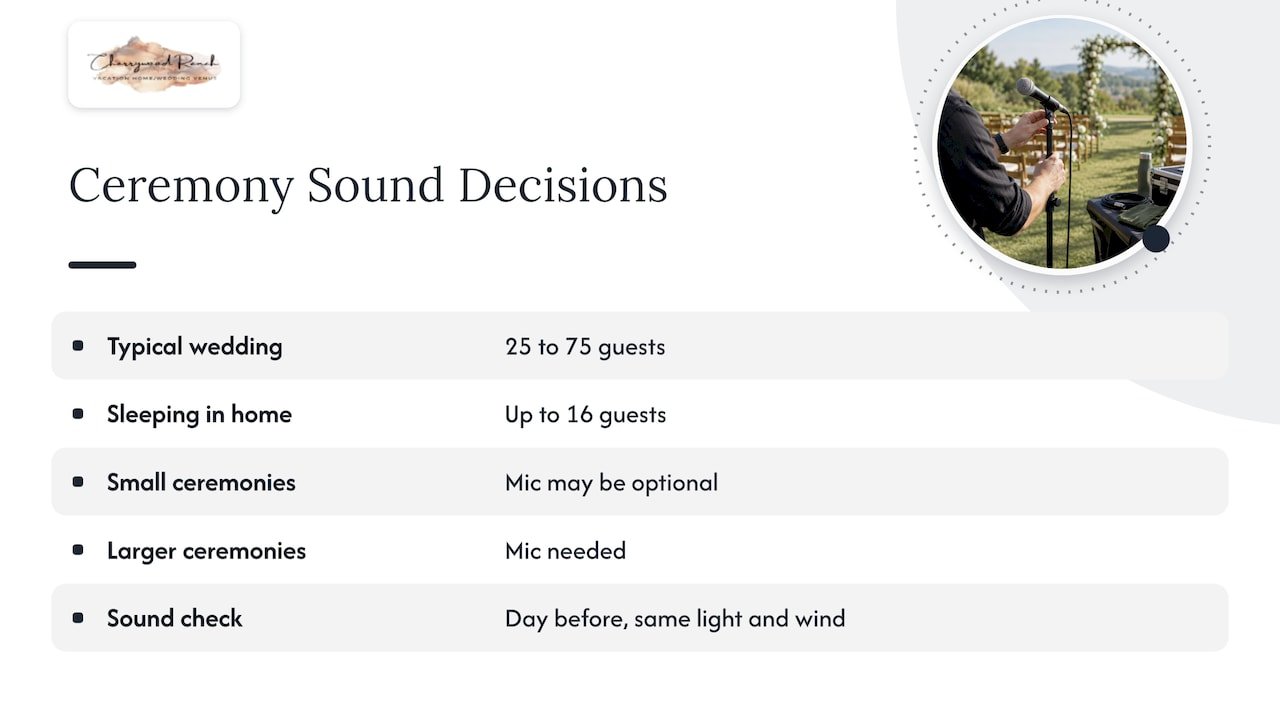
Our advice is to decide based on your most distant, quietest guest, not on your own voice. Mountain air carries breezes in ways flat lawns do not, so a hidden lav and a windscreen are cheap insurance. The weekend format also helps: because you are not rushing between venues, you can run a proper sound check the day before, in the same light and wind you will have at the ceremony.
And if you are planning an elopement with a handful of people, skip the gear and enjoy the quiet.
— Luis
Hosting your ceremony at Cherrywood Ranch
Cherrywood Ranch is a private wedding venue and luxury vacation home in the North Georgia mountains, with outdoor ceremony and reception spaces, a pool and hot tub, and lodging for up to 16 guests. You can see packages for weddings, elopements and the 3-day wedding option on our services page. Published rates, including the $10 per guest fee above 75 guests, and hourly and day sessions, are on the booking page. Ask us about sound when you inquire, and plan a sound check into your weekend.

FAQ
Can I just use a Bluetooth speaker and a cheap mic?
For a very small ceremony, maybe. For outdoor use with more than about 15 guests, a wireless lavalier with a proper windscreen and a speaker aimed at guests will serve far better than a phone-style setup. Test it at the ceremony spot first, because cheap gear is where wind and dropouts show up.
Should the couple wear microphones?
If you want guests to hear personal vows, yes. Two discreet lavaliers keep both voices even, and a handheld is a workable but less tidy alternative. If your vows are private, you can skip them and let the officiant’s mic carry the ceremony.
What do I do if the microphone dies mid-ceremony?
Keep a backup handheld on and ready, with spare batteries, and ask the officiant to know where it is. Put fresh batteries in before the ceremony rather than reusing ones from the rehearsal.
Where should the speakers go?
In front of the couple, aimed at guests, and never behind the microphones. One or two compact speakers are enough for most small weddings, and a sound check across the whole seating area will show you any dead spots.
Sources
- To Mic or Not to Mic, That is the Question (AMM)
- Microphone Tips for Wedding Officiants and Couples (AMM)
- How to Set Up Microphones and Sound Systems for a Wedding Ceremony
- How Do You Mike a Wedding Ceremony (Audio-Technica)
- The Wedding Ceremony Mic Setup for the Officiant, Couple, and More
- Ceremony Audio 101
- Outdoor Wedding DJ Setup in 2025
- Outdoor Event Sound System Setup Guide 2026
- Wedding Venue Sound System Setup Guide (Gemini Sound)
- Outdoor speakers system planning guide (Crutchfield)
- How to Enjoy Great Outdoor Sound (Yamaha)
- Outdoor Wedding Microphone Guide (Blue Ridge Sound)
- Outdoor Ceremony Sound: What Goes Wrong
- Beta 58 User Guide (Shure)
- How to Control Feedback (Shure)
- SM58 Microphone Guide (Shure)
- ATM510 (Audio-Technica)
- How to Set Up a PA System (Sweetwater)
- How Much Time Is Needed to Set Up for an Event? (Humecky)
- Your Beach Wedding Ceremony (Sound In Motion)