
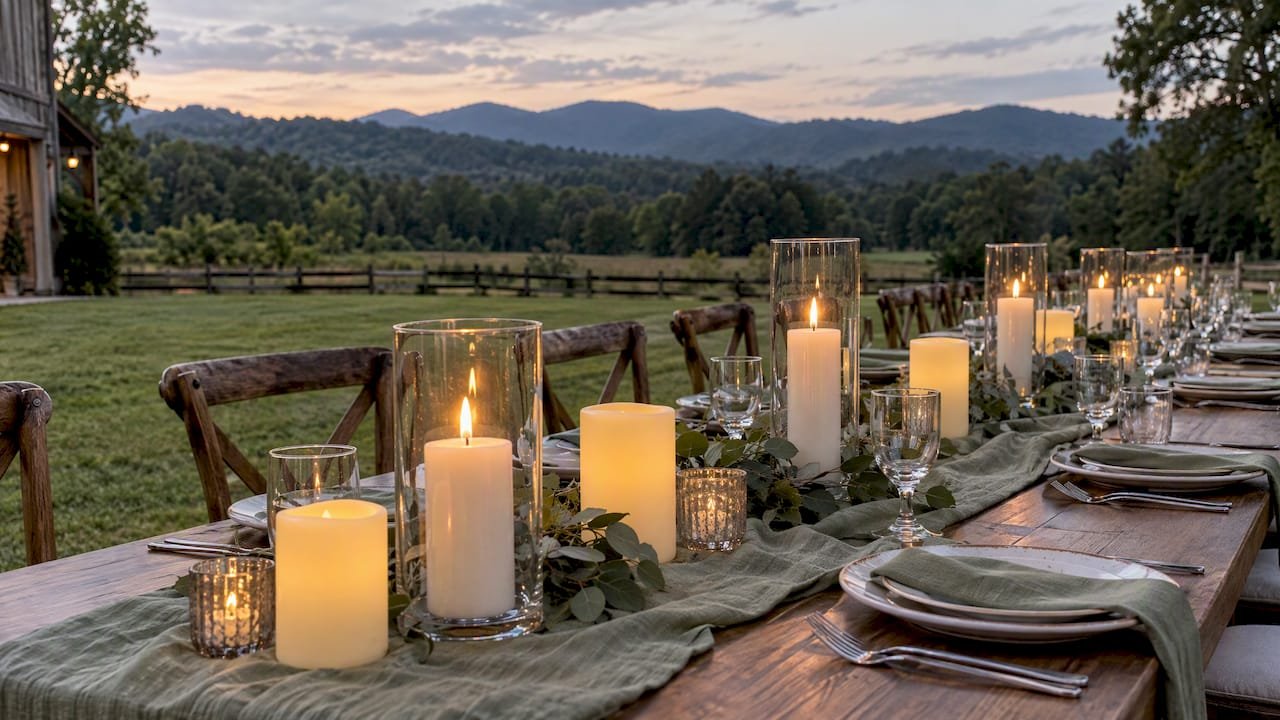
Choose LED candles when your venue bans open flames, when the wind will blow, or when candles sit near fabric, flowers or guests. Choose real candles when the venue allows them, the setting is sheltered, and you want true flame in a few small, protected spots. Most couples end up with a mix. Whichever way you lean, get the venue’s open-flame policy in writing before you buy a single candle.
TL;DR
- Real candles give the most authentic glow and movement. LED candles give you safety, wind resistance, no wax and no one assigned to babysit them.
- Many venues restrict or ban open flames, so confirm the policy in writing before your florist or decorator sources anything.
- The NFPA and the U.S. Fire Administration both point to battery-operated flameless candles as a safer choice, and both set a 12-inch distance from anything that can burn for real flames.
- Outdoors in Georgia, tents and membrane structures carry their own fire-code limits on open flames, and some public venues ban outdoor flames entirely.
- A hybrid plan (LED for aisles, tables and anything near fabric, real flame only in sealed holders where allowed) gets you the look without the risk.
Table of Contents
- Real candles vs. LED candles at a glance
- What venues usually restrict
- The safety case in numbers
- Why wind is the real enemy outdoors
- Wedding candles outdoors in Georgia
- How long do LED candles last?
- Making LED candles look real
- Where each type works best
- What this costs in practice
- Plan a wedding weekend where the lighting is simple
- A simple checklist before you order
- FAQ
- Sources
Real candles vs. LED candles at a glance
Real candles are wax with a live flame. LED candles are battery-powered lights built to imitate one. Jia Decor’s comparison describes real candles as the more authentic and emotionally symbolic option, while LED candles produce no wax drips or smoke and cope better with wind, outdoor settings and busy rooms.
| Factor | Real candles | LED candles |
|---|---|---|
| Look | True flame, natural movement and warmth | Convincing flicker at table distance, less so in close-up photos |
| Fire risk | Open flame that can ignite anything that burns | No open flame |
| Wind | Blows out without a shade or glass | Unaffected |
| Mess | Dripping wax, smoke, soot | None |
| Attention | Need monitoring and relighting | Can run without staff attention |
| Venue approval | Often restricted, sometimes banned | Almost always accepted |
| Setup | Light and extinguish every one | Switch on, or use a timer or remote |
| Reuse | Burned down | Reusable after the event |
The honest summary: real candles win on authenticity, LED wins on nearly everything practical. The rest of this article helps you decide where each belongs in your day.
What venues usually restrict
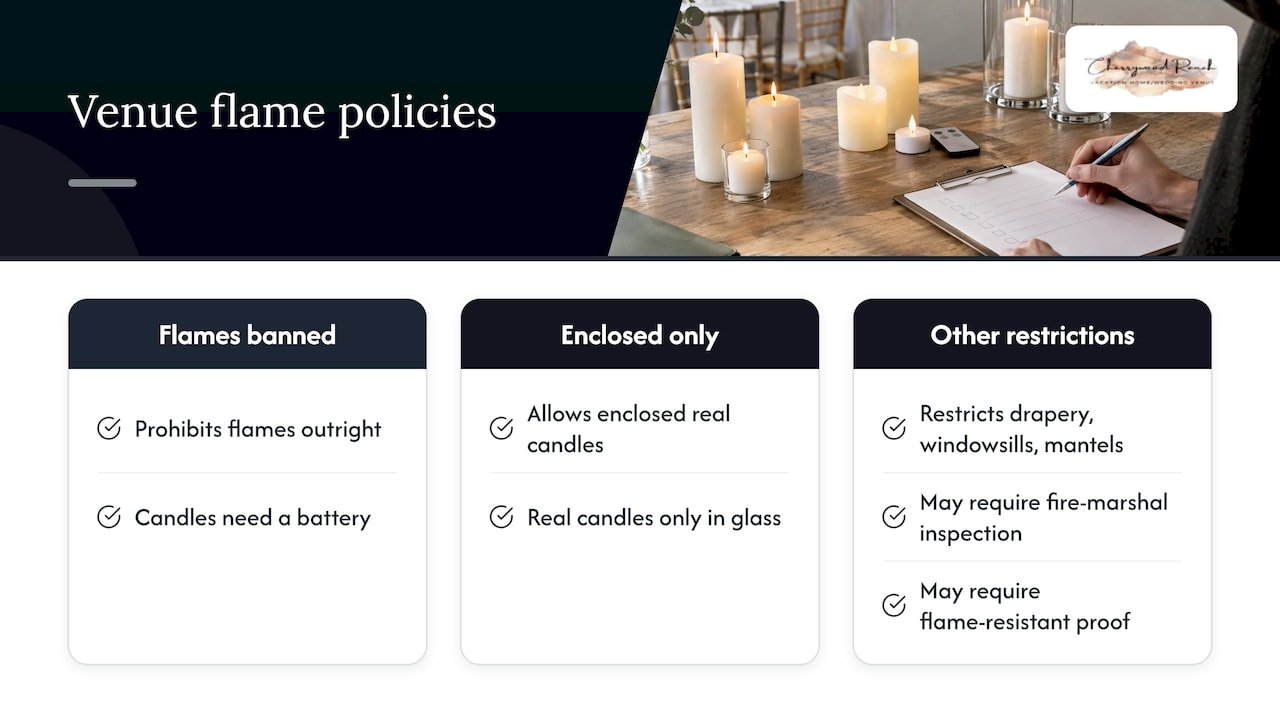
“Open flame policy” can mean very different things from one venue to the next. According to Poppy’s venue logistics guide, a policy may prohibit flames outright, allow only enclosed real candles, or restrict candles near drapery, windowsills and mantels. Some venues also ask for fire-marshal inspection or proof that materials are flame-resistant.
That range matters because it changes what you order. A venue that allows only enclosed flames still lets you have real candles, but only in glass. A venue that bans flames means every candle on your mood board needs a battery.
Policies also shape the rest of your décor. Anything that sits near a flame, such as paper lanterns, tulle, greenery and balloon arches, becomes part of the fire question. If you are planning installations alongside candlelight, it is worth reading about venue decor restrictions and fire codes so your lighting and styling plans do not collide.
Questions to ask before you buy
- Are open flames allowed indoors, outdoors, both or neither?
- If allowed, must candles be enclosed in glass, and how tall must the shade be?
- How far must candles sit from fabric, florals, walls and ceilings?
- Does the venue’s insurance or your event insurance require a certificate or a fire-marshal sign-off?
- Who lights them, who watches them and who puts them out?
- Are battery-operated candles always allowed, including flickering models?
Ask for the answers in an email or in your contract. A verbal “it should be fine” does not help you when your florist has already built the centerpieces.
The safety case in numbers
Candles are a small decoration with a real fire record. The NFPA estimates 5,894 candle-related home structure fires a year in the U.S. from 2020 to 2024, causing an annual average of 63 civilian deaths and 532 civilian injuries. Those are home fires, not weddings, but the mechanism is the same one a reception table presents: a flame near something that burns.
That mechanism is the main cause. NFPA 2026 data shows more than half of candle fires start when decorations, curtains or furniture sit too close to the flame. A wedding reception is full of exactly those things: linens, programs, florals, draped fabric and guests in long dresses.
Both national fire authorities say the same thing in practice:
- The NFPA says candles are open flames that can ignite anything that burns and suggests battery-operated flameless candles as a safer alternative.
- The U.S. Fire Administration recommends considering flameless candles because they can look, smell and feel like real ones. If you do use lit candles, it advises stable holders, at least 12 inches from combustibles, and extinguishing them whenever you leave.
- NFPA’s candle safety tip sheet repeats the 1-foot clearance, a sturdy holder on a stable surface, and putting candles out before leaving the room.
What about the “three-hour rule”?
You may see a three-hour rule for candles mentioned in wedding forums. The official guidance from NFPA does not hinge on a clock. Its emphasis is that candles are never left unattended and are put out before you leave. At a reception, that means a named person (a coordinator or a trusted friend, not the couple) owns the candles from lighting to snuffing, and the plan for that handoff is settled before the day.
Why wind is the real enemy outdoors
Even if flames are allowed, outdoors they are a losing fight. Glass hurricane shades protect flames from the drafts of indoor halls and the breezes of outdoor venues, and many venues require them. A shade solves two problems at once: it keeps the flame lit and keeps it contained.
But shades are not magic on a gusty mountain evening. Jamali Garden notes that LED candles are often the more practical pick for long events and outdoor spaces where wind would keep snuffing real flames. If you are planning on a ridge, a hillside or an open lawn, our guide to a windy outdoor wedding covers how to plan for gusts, and the same thinking applies to your lighting.
A practical test: set one real candle in your intended shade outdoors at the hour of your ceremony. If it fails in ten minutes of ordinary breeze, it will fail with 60 guests watching.
Wedding candles outdoors in Georgia
Georgia adds a few rules worth knowing before you plan a candlelit evening.
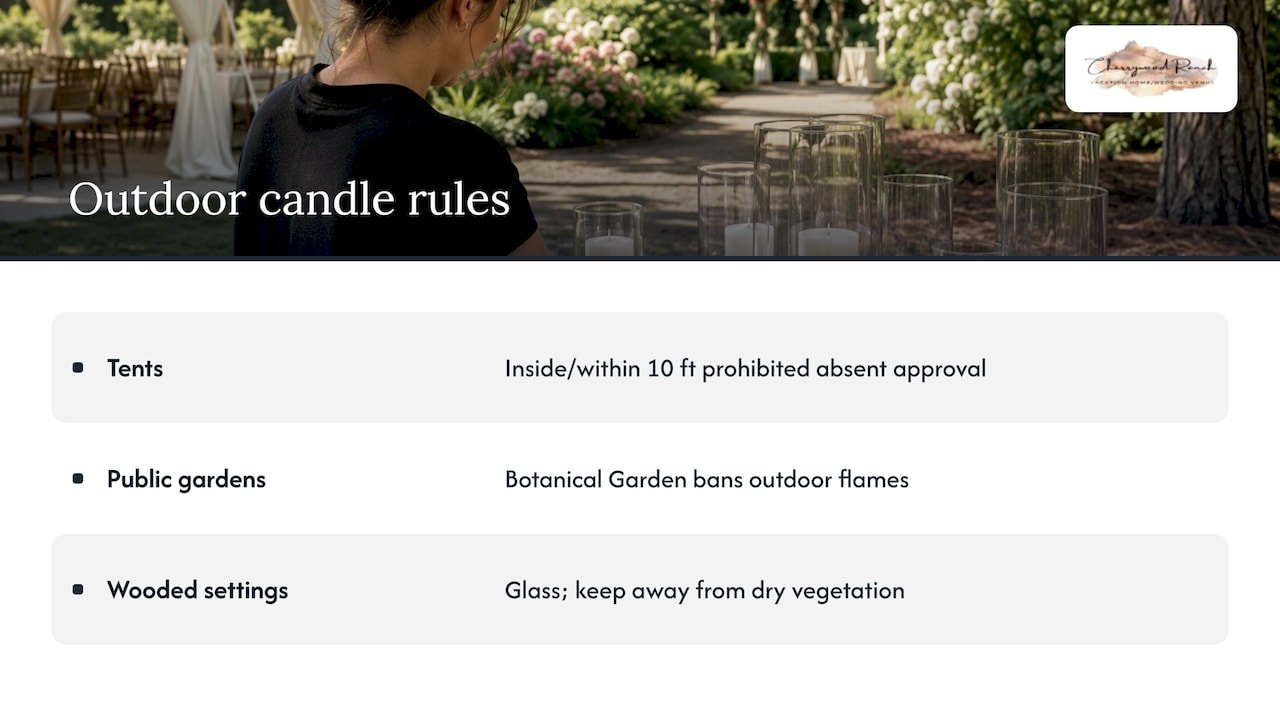
Tents and membrane structures. Under the Georgia State Minimum Fire Prevention Code 2024, open flames or devices emitting flame, fire or heat are prohibited inside or within 10 feet of tents or membrane structures while open to the public, unless the fire code official approves them. If your reception includes a tent, assume real candles inside it need approval or are off the table. LED candles sidestep the issue.
Public venues. Some venues simply ban flames outdoors. The State Botanical Garden of Georgia, for example, prohibits outdoor open flames, including candles and sparklers. That is one venue, not a statewide rule, but it shows how common an outright ban is at gardens and similar spaces.
Dry, wooded settings. Mountain properties have pine needles, leaf litter, wooden decks and railings. Even where flames are permitted, keep real candles inside glass and away from dry vegetation, and keep a plan for extinguishing them.
If you are hoping for a send-off with light and sparkle, our piece on sparkler alternatives for private weekend weddings shows photo-ready ways to get the same glow.
How long do LED candles last?
Battery life varies a great deal by product, so check the listing for the exact model you buy. As one example, Eledea’s LED pillar candles are listed at 400+ hours on two AA batteries each, with timer options available. For a single evening of five or six hours, even a much more modest rating covers you with room to spare.
A few habits make the batteries a non-issue:
- Buy a few more candles than your count, and keep spares in the kit.
- Install fresh batteries the week of the wedding, not the week you bought them.
- Choose candles with a timer or remote if you have dozens to switch on, so no one is crawling around lanterns at dusk.
- Test every candle the day before and mark any weak ones.
Making LED candles look real
The biggest worry couples have is that LED looks fake. It can, but it does not have to. Flickering LED candles can look convincing at table distance, and the difference mostly shows in close-up photos, according to one comparison. A few choices close that gap:
- Pick warm white. Cool or bluish light is the giveaway. Look for a soft, amber tone.
- Use flicker mode. A gentle dimming and brightening reads as flame. Avoid strobe-like, fast flicker.
- Hide the hardware. Frosted glass, hurricane lanterns and votive cups hide the lens, so guests do not see the bulb.
- Group them. Clusters of varied heights look natural. Single candles in a perfect row look staged.
- Add layered light. Candles are accents. String lights, lanterns and a good moon do the heavy lifting, so think about lighting as a whole. Our guide to outdoor wedding lighting covers how to avoid power failures and keep the evening lit, and a wedding gobo projection can add a monogram or pattern to a dance floor or wall without a flame in sight.
Where each type works best
Choose LED candles for
- Aisle lanterns and ceremony arch details, where wind and guest traffic are highest
- Centerpieces mixed with florals, linen runners or greenery
- Tents, barns, covered pavilions and any space with a fire-code restriction
- Long receptions where no one should be assigned to relight candles
- Spots near children, elderly guests or dancing
Choose real candles for
- A sheltered indoor cake table or a mantel where the venue allows flames
- A unity candle or small ritual moment, with a designated person watching
- Sealed votives inside deep glass, set on a hard surface far from fabric
The hybrid plan
Most couples get the best result by separating the two jobs. LED does the quantity (the glow along tables, steps and aisles). A few real flames, if the venue permits, do the moment (the unity candle, the cake table, one set of photos). You keep authenticity where the camera looks and safety where the guests move.
If you are planning a smaller gathering, the ideas in our intimate wedding reception guide show how few light sources a room of 10 to 80 guests actually needs, and our notes on long table seating help you place candles so they never crowd place settings.
What this costs in practice
The price difference rarely decides it. Real candles are a consumable you buy per event, plus shades. LED candles cost more up front but are reusable and can be resold or reused for an anniversary dinner. Your real savings come from avoiding the extras: fire-marshal inspections, additional insurance riders, and staff time lighting and monitoring flames. Whatever you choose, build a small decor buffer in your budget. Replacement batteries or extra glass are cheap, but they are much cheaper bought before the day.
Our perspective
We host weddings in a private setting in the North Georgia mountains, and the weather is the thing that shapes our advice on candles. Evenings up here bring breezes that a candle flame does not survive, and a wedding weekend gives you many hours of light to plan, from the ceremony through the reception and the late hang-out on the deck.
Because the whole property is yours for the weekend, you are not sharing the space with a second event or working around a venue’s catering schedule. That gives you room to plan lighting calmly. Our view is simple: use LED candles for the volume and the safety, put your energy into layers of light, and treat any real flame as a small, planned, supervised moment rather than the backbone of the decor.
Our guests are often family and friends staying under one roof. That is a good reason to keep the evening relaxed and the hardware simple. A battery-powered glow means no one is patrolling candles at midnight, and everyone can enjoy the party.
Luis
Plan a wedding weekend where the lighting is simple
If you want a setting where the decor questions stay manageable, our private North Georgia property combines wedding spaces with onsite lodging for up to 16 guests, so you can plan the full weekend in one place.

Our day session is listed at $1,950 per day, and shorter options are on our booking page. For weddings, elopements and the 3-day package, see our services page or contact us through our site to talk through your plans. Before you book any venue, ask for its candle and decor rules in writing, and if you are comparing vacation-rental style options, our guide to vacation rental wedding rules explains what to put in a signed addendum.
A simple checklist before you order
- Get the open-flame and decor policy in writing from your venue.
- Ask whether a tent or covered structure is involved, and what the local fire official requires.
- Decide where real flame (if allowed) will live, and who will watch it.
- Order LED candles in warm white with flicker mode, plus spares and fresh batteries.
- Test everything outdoors at the hour of your ceremony.
- Keep any real candle at least 12 inches from anything that can burn, in a stable holder.
- Assign a person to switch on and put out every light at the end of the night.
FAQ
Are LED candles allowed at most wedding venues?
Usually, yes, and often they are the required alternative. Many venues restrict or ban open flames, and flameless candles are the common workaround. Still, confirm that flickering models and any lanterns you plan to use are approved before you order.
Can I have real candles at an outdoor wedding in Georgia?
Sometimes, depending on the venue and the setup. Georgia’s 2024 fire code prohibits open flames inside or within 10 feet of tents and membrane structures unless the fire code official approves, and some public venues ban outdoor flames altogether. Ask your venue first, and use glass shades if flames are permitted.
How long do LED wedding candles last?
It depends on the model. Some pillar candles are listed at 400 or more hours on two AA batteries, which is far more than a single wedding evening needs. Install fresh batteries before the event and bring spares.
Do LED candles look fake in photos?
At table distance, good flickering LEDs can look convincing, and differences show mostly in close-ups. Warm white light, flicker mode and frosted glass or lanterns that hide the bulb make the biggest difference.
What is the safest way to use real candles at a wedding?
Follow the national fire guidance: a sturdy holder on a stable surface, at least 1 foot from anything that can burn, and never unattended. Put them out before anyone leaves the room. Use enclosed glass where possible and give one person responsibility for them.
Sources
- Safety with candles, NFPA
- Cook and use candles with caution on Valentine’s Day, NFPA
- Candle Safety Tips, NFPA
- Candle Fire Safety, U.S. Fire Administration
- Chapter 31 Tents, Temporary Special Event Structures and Other Membrane Structures, Georgia fire code 2024
- FAQ, State Botanical Garden of Georgia
- Wedding Venue Logistics Guide, Poppy
- A Guide to Using Glass Hurricane Candle Shades for Weddings
- LED Candles vs. Real Candles, Jamali Garden
- LED Candles vs. Real Candles for Weddings & Events, Jia Decor
- LED Candles vs Real Candles for Receptions
- 3-Pack Box Set, Eledea