
Hosting a wedding at a vacation rental is often possible for a small, well-planned event, but it’s never automatic. Before you send a single save-the-date, confirm three things: written host approval through a signed event addendum, local permit and noise ordinance limits, and event insurance and deposit terms. If the platform bans events, an HOA prohibits gatherings, or you’re planning a large vendor-heavy reception without a permit. Stop and look elsewhere.
TL;DR:
- Confirm that the host provides a signed event addendum stating guest numbers, vendor access times, and damage policies before booking.
- Be aware that Airbnb’s party ban is strict and proactively screens reservations, while Vrbo may explicitly permit events through house rules—but only if approved in writing beforehand.
- Local permits, noise restrictions, parking limits, and occupancy rules can override platform allowances, so check with municipal offices well in advance.
- Expect to pay for liability insurance, a security deposit, cleaning fees, and equipment rentals, especially for larger weddings with more guests and amplified sound.
- Use a detailed, signed contract that clarifies all rules, guest counts, vendor timings, and cleanup plans to prevent disputes during or after the wedding weekend.
Table of Contents
- What Vacation Rental Wedding Rules Should You Check First?
- Does Airbnb or Vrbo Allow Weddings?
- Which Local Rules Affect a Rental Wedding?
- What Insurance and Deposits Should You Expect?
- How Do You Build a Reliable Event Agreement?
- What Does a Rental Wedding Actually Cost and When Should You Plan?
- A Venue Owner’s View on Rules, Neighbors, and Trust
- Cherrywood Ranch: A Venue Built for Wedding Weekends, Not Just a Rental With a Backyard
- Official Resources and Must-Check Links
- Sources
- FAQ
What Vacation Rental Wedding Rules Should You Check First?
Getting verbal permission from a host is not the same as getting a legal green light. Text messages disappear, hosts change their minds, and platforms can remove listings mid-conversation. A written event addendum or signed agreement is the only version of “yes” that holds up if something goes wrong on the wedding weekend itself.
A defensible addendum spells out the details that informal chats always skip. It should separate overnight guest counts from daytime attendee counts, since a rental that sleeps ten comfortably might turn chaotic with sixty guests parked in the driveway for a reception. It should also name specific vendor access windows (when the caterer can arrive, when the DJ can start setup), any restrictions on moving furniture or hanging décor, and exactly who handles trash and post-event cleanup.
Money terms belong in writing too. Property managers who allow events typically build a Wedding & Special Event Addendum into the rental contract that spells out guest limits, parking rules, security deposit amounts, and event insurance requirements before the booking is confirmed.
Before you sign anything, ask the host or property manager for:
- A dated, signed copy of the event addendum (not just an email confirming “sounds good”)
- Written vendor access hours and a list of any vendors the property restricts
- Clear language on furniture moving, décor attachment points, and what counts as damage
- A specific deposit amount, refund timeline, and the contact person for post-event disputes
Keep every approval in one place. Save the signed PDF, screenshot the message thread where the host confirmed guest counts, and file the rental manager’s event form together in a folder you can pull up in thirty seconds if a neighbor complains or a vendor asks for proof.
Pro Tip: Ask the host to confirm overnight and day-guest numbers separately in writing. Confusion over “how many people are actually staying here” is one of the most common reasons hosts pull approval days before the event.
Does Airbnb or Vrbo Allow Weddings?
Short answer: it depends entirely on which platform, which listing, and which house rules apply, and the two major platforms handle this differently enough that treating them as interchangeable is a mistake.
Airbnb made its ban on parties and disruptive gatherings a permanent, global policy, and the platform actively screens reservations it flags as high risk for unauthorized events. That screening doesn’t just block obvious party rentals. It can flag a quiet 20-person wedding weekend if the booking pattern looks similar to reservations Airbnb associates with parties, like a one-night stay booked by someone local with a mismatched guest count.
Vrbo takes a more direct approach. Many Vrbo listings include an “events allowed” setting in their house rules, and hosts who enable it are explicitly opting into weddings, reunions, and similar gatherings. That setting doesn’t remove the need for a written agreement. It just means the host has pre-cleared the category of event, not your specific guest count, vendor list, or amplified sound plan.
What happens if you skip this step and book anyway? The consequences land on both sides:
- Guests can be evicted mid-event with no refund if a neighbor reports an unauthorized gathering
- Hosts risk listing suspension or permanent removal for repeated violations
- Neither party can rely on platform host-protection coverage for an event the platform didn’t know about
Guidance from rental-focused planning resources consistently points the same direction: get explicit written approval before booking, not after you’ve already paid a deposit.
Which Local Rules Affect a Rental Wedding?
City hall doesn’t care what your Airbnb listing says. Local government sets its own rules on top of whatever the host and platform allow, and those rules are usually the ones that actually get enforced when a neighbor calls to complain.
Four categories come up again and again:
- Special event permits. Many municipalities require a permit for any gathering above a certain guest threshold, even on private property. Some towns’ short-term rental pages spell out exactly when tenants must contact local authorities about event rules before hosting anything larger than a normal overnight stay.
- Noise ordinances. Amplified sound, whether it’s a DJ or a live band, is often capped by time of day and sometimes banned outright in residential zones after a set hour.
- Parking restrictions. Street parking for 40 wedding guests in a residential neighborhood is one of the fastest ways to trigger a formal complaint, even before the ceremony starts.
- Occupancy limits. Fire and safety codes cap how many people can legally be on a property at once, separate from whatever the rental listing advertises as its “sleeps” number.
HOA and subdivision rules add another layer entirely. A property can sit outside city limits and still be bound by a homeowners association that prohibits commercial events, extended guest parking, or outdoor amplified sound, regardless of what the rental host agrees to. Check the CC&Rs or ask the property manager directly rather than assuming rural or suburban means unregulated.
Pro Tip: Call the municipal clerk’s office or code enforcement line and ask, in plain language, “Do I need a permit for a 50-person outdoor wedding at a private residential rental?” Get the answer in writing or note the date and name of who you spoke with.
What Insurance and Deposits Should You Expect?
Event liability insurance protects the host, the couple, and often the guests if something goes wrong: a fall on a wet patio, property damage from a dropped catering tray, an injury during the reception. Hosts increasingly request proof of this coverage before confirming a booking, and for good reason. Standard homeowner or short-term rental policies frequently exclude coverage for hosted events entirely, which means an undisclosed wedding could leave both sides without protection if a claim comes in.
Coverage gaps get worse when rules were broken to begin with. If a host quietly allows an event the platform or local ordinance prohibits, insurance protections may not apply when a claim is filed, leaving both host and couple financially exposed.
Deposit structures typically combine two pieces:
- A refundable security deposit held against damage, usually returned within one to two weeks after move-out
- A separate, non-refundable event fee that compensates the host for wear and extra cleaning regardless of how the day goes
Vendor insurance deserves its own line item. Photographers, caterers, and rental companies should carry their own liability coverage, and a responsible couple asks each vendor for a certificate of insurance naming the property owner, not just a verbal assurance that “we’re covered.”
How Do You Build a Reliable Event Agreement?
Platform messages and text threads make weak evidence. They can be deleted, edited, or simply forgotten by the time a dispute happens six weeks later. A separate signed contract, distinct from whatever booking confirmation the platform generates, creates an independent record that protects the host and the couple if anyone’s memory of “what we agreed to” starts to drift.
Cherrywood Ranch’s rehearsal dinner run-sheet reflects a pattern worth borrowing regardless of which property you book: put the schedule, vendor windows, and guest expectations on paper before the weekend starts, not during it.
A solid signed addendum or contract should include:
- Overnight guest count versus total day-of attendee count
- Vendor arrival and departure windows for setup and teardown
- Parking instructions, including where overflow vehicles go
- An amplified-sound cutoff time
- Rules on moving furniture, hanging décor, or altering landscaping
- A cleanup and trash-removal plan with a named responsible party
- An emergency contact number for the property owner or manager
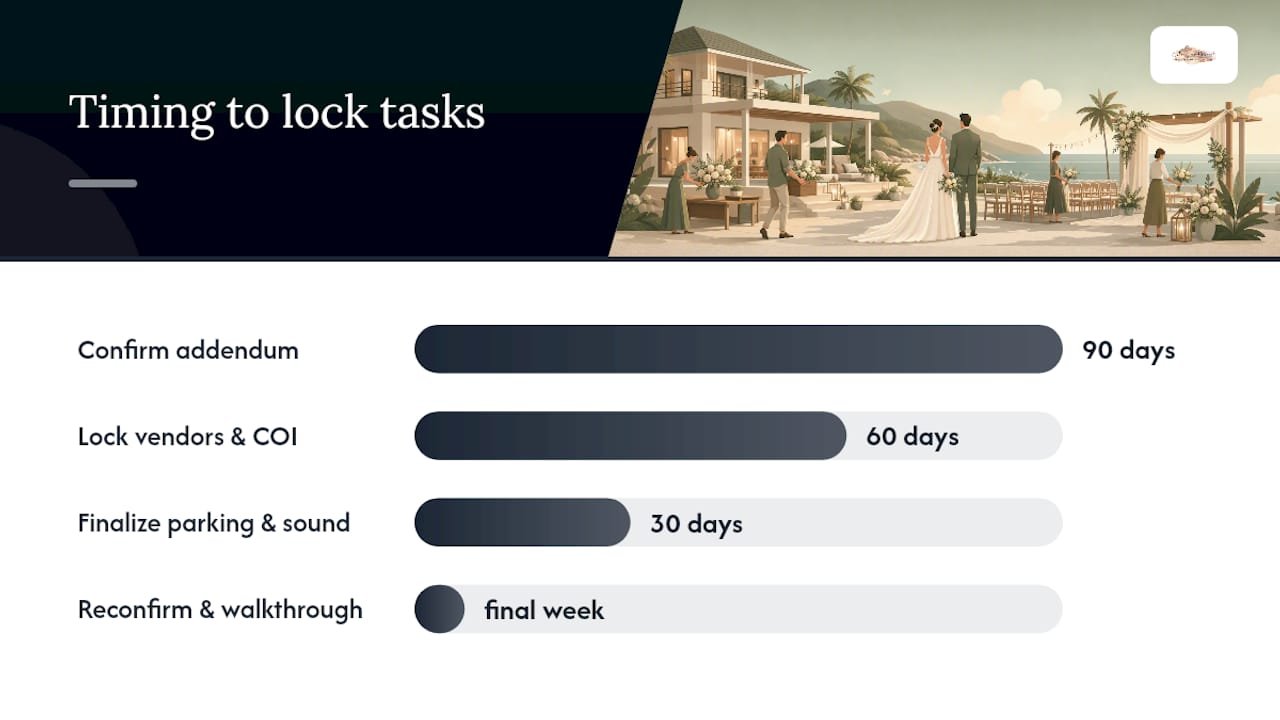
Timing matters as much as content. Confirm the signed addendum and guest-count estimate at 90 days out. Lock vendor contracts and certificates of insurance by 60 days. Finalize the parking plan, sound cutoff, and cleanup assignments at 30 days. In the final week, reconfirm every detail in writing and walk the property with the host or manager, checking:
- Final headcount matches what’s on the signed addendum
- All vendor certificates of insurance are on file
- Emergency contacts are shared with the wedding party, not just the couple
What Does a Rental Wedding Actually Cost and When Should You Plan?
Budget and timeline move together. At 6 to 12 months out, narrow down properties that explicitly allow events and confirm that with the host in writing, not just by reading the listing description. At 90 days, secure the signed addendum and lock your headcount. At 60 days, book vendors and collect their insurance certificates. At 30 days, confirm parking, sound rules, and cleanup logistics. In the final week, reconfirm everything and pay any remaining deposit or event fee balance.
Cost line items to budget for include:
- Local permit fees, if your municipality requires one for the guest count you’re planning
- Event liability insurance, often a modest one-time premium for a single-day policy
- Extra cleaning fees on top of the standard rental cleaning charge
- A refundable security deposit hold, separate from the rental payment itself
- Vendor setup and teardown fees, especially for caterers and rental companies
- Equipment rentals: chairs, tables, a tent, and portable restrooms if the property doesn’t already have enough capacity
The cost picture shifts dramatically depending on scale. An elopement or micro-wedding with a dozen guests and no amplified sound often skips permit requirements entirely and keeps insurance costs minimal. A full reception with 50 or more guests, a live band, and multiple vendors almost always triggers permit requirements, a higher insurance premium, and rental equipment costs that can rival the venue fee itself. Browsing elopement examples is a useful gut check for which category your guest list actually falls into.
A Venue Owner’s View on Rules, Neighbors, and Trust
Strict rules exist because hosts carry the licensing risk, the noise complaints, and the wear on their property long after the wedding party leaves. That’s not bureaucracy for its own sake. It’s what keeps a property bookable next season.
Clear written agreements protect both sides precisely because they remove guesswork. A couple who confirms sound cutoffs, parking plans, and guest counts in advance rarely runs into enforcement problems. Respectful weekends look the same everywhere: guests park where they’re told, music stops on time, and everyone treats the property like they’d want their own home treated.
— Luis
Cherrywood Ranch: A Venue Built for Wedding Weekends, Not Just a Rental With a Backyard
Most of the friction couples run into with vacation rental weddings comes from the same root problem: a property built for overnight stays being stretched to handle a large reception it was never designed for. Some venues skip that mismatch entirely by being designed specifically for wedding weekends, with on-site lodging, a defined run-sheet, vendor guidance, and event coordination help included.
That structure solves the exact problems this article just walked through. There’s no ambiguity over whether events are “allowed,” no platform screening algorithm second-guessing your guest count, and no HOA hovering in the background. You get a venue built for a private wedding weekend from the start, with mountain views, a pool and hot tub for the family gathering around the ceremony, and a team that already knows what a wedding weekend actually requires.
If you’d rather spend your planning months on flowers and playlists instead of permit offices and insurance certificates, check available dates and review the venue’s wedding weekend packages to see if the setup fits your guest list.
Official Resources and Must-Check Links
Before booking, review your platform’s actual policy language, not a summary of it. Airbnb’s party and disturbance policy explains what triggers screening. Your city or county’s short-term rental page, similar to Nags Head’s event guidance, shows the permit process. A sample event addendum template gives you model contract language to request from your host.
Sources
- Short-Term Rentals (Nags Head, NC)
- Airbnb officially codifies party ban
- How to have a wedding at an Airbnb (Touchstay)
- Wedding & Special Event Addendum (KEES Vacations)
FAQ
Is It Legal to Host a Wedding at an Airbnb?
It depends on the specific listing’s house rules, your local permit and noise ordinances, and whether the host has agreed in writing. There’s no blanket legal ban, but Airbnb’s global policy against disruptive gatherings means an undisclosed event can get a booking canceled or a guest evicted.
What Is the 50/20/30 Rule for Weddings?
This isn’t a standard legal or platform rule for vacation rental weddings. If you’ve seen it referenced as a budget guideline, it typically refers to allocating roughly half of a wedding budget to the venue and catering, with the remainder split across attire, photography, and other categories, though exact splits vary by planner.
Can I Get Married on the Beach for Free in Florida?
Some public beaches in Florida allow small wedding ceremonies without a fee, but many counties and municipalities require a permit for gatherings above a certain size or if you’re using chairs, arches, or amplified sound. Check the specific county’s parks department before assuming a beach ceremony is permit-free.
What Wedding Etiquette Rules No Longer Apply?
Rules like requiring guests to write “and guest” invitations instead of naming plus-ones, mandating formal receiving lines, banning children unless explicitly noted, and insisting on all-white bridesmaid prohibitions have loosened considerably. Guest comfort and clear communication, especially around venue rules like parking and dress code, matter more to modern couples than rigid tradition.
Does Vrbo Allow Weddings More Easily Than Airbnb?
Many Vrbo listings include an explicit “events allowed” house rule setting, giving couples clearer upfront signals than Airbnb’s case-by-case screening approach. Either way, get the host’s specific written approval for your guest count and vendor plan before booking.