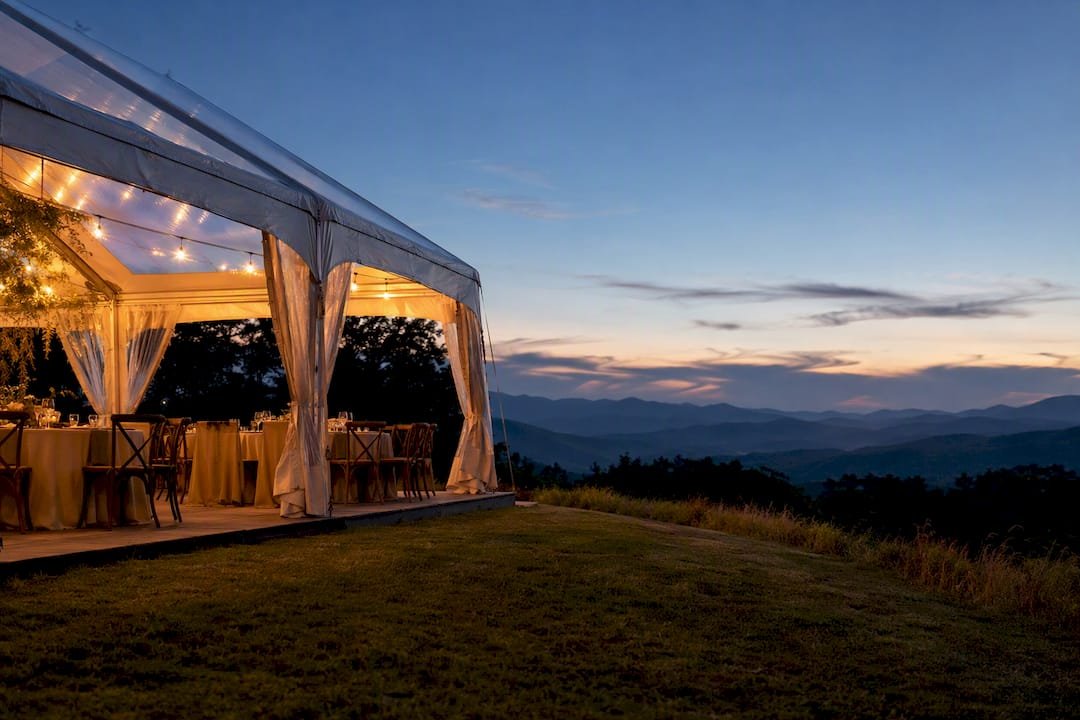
A tented mountain wedding gives you panoramic backdrops and a layout you design from scratch, but it comes with real trade-offs: tent style affects both anchoring and how much of the view survives, uneven ground needs deliberate leveling, and evening temperatures can drop fast even in July. Cherrywood Ranch and other venues that run regular site surveys can tell you within minutes whether a spot works. Choose the right tent and prep the ground properly, and the mountains do most of the decorating for you.
TL;DR:
- Pole tents require relatively level ground or specialized anchoring, while frame tents are better suited for uneven or rocky mountain sites due to their freestanding design.
- Conducting a formal site survey is essential to identify buried utilities, soil stability, and drainage, and should include a detailed anchoring and access plan before booking a vendor.
- Building comfort with portable heaters, retractable sidewalls, and weather-aware layouts reduces risks of temperature drops and wind, with contingency plans for mid-event weather changes.
- Using neutral colors, organic textures, and open seating arrangements maximizes mountain views and prevents the tent from competing with the landscape.
- Choosing a venue that offers all-inclusive wedding weekends with onsite lodging simplifies logistics and ensures site preparation, staging, and permitting are already managed.
Table of Contents
- What Tent Types Work Best in Mountain Settings?
- Site Survey, Flooring, and Installation on Uneven Ground
- Weather, Comfort, and Contingency Planning for Mountain Days
- Design That Keeps the Mountain View the Star
- Guest Logistics: Drive Time, Lodging, and Weekend Planning
- Site-Survey Checklist and What a Real Mountain Host Does
- Permits and Regulations for Mountain Tented Weddings
- Power and Lighting Setup Options for Remote Mountain Locations
- Vendor Coordination and Delivery Logistics for Mountain Venues
- Safety Considerations Unique to Mountain Terrain
- Waste Management and Environmental Impact in Mountain Areas
- The Planning Mindset That Actually Works for Mountain Weddings
- Cherrywood Ranch: One Venue, One Weekend, No Vendor Juggling
- Sources
- FAQ
What Tent Types Work Best in Mountain Settings?
The tent you pick determines how much of the mountain you actually get to see, and how hard your installer has to work to keep it standing.
Pole tents give you that classic peaked silhouette everyone pictures at a wedding, but they lean on center poles and perimeter staking for stability, which usually means they need reasonably level ground or specialized anchoring systems to handle a slope. Frame tents skip the interior poles entirely. They’re freestanding, which makes them a better match for gravel pads, patios, or sloped sites where staking a pole tent would be a fight you don’t win.
Sail cloth tents and clear tops trade some of that structural simplicity for atmosphere. Sailcloth’s translucent, billowing fabric glows at golden hour and reads as elegant rather than utilitarian. Clear tops let guests see the peaks straight through the ceiling. Both demand an installer who has actually rigged one on a slope before. This isn’t a job for a general party rental crew.
- Pole tents: classic look, need flatter ground or engineered anchoring
- Frame tents: freestanding, best for uneven or hard surfaces
- Sailcloth and clear tops: maximize view and ambiance, require experienced installers
- Sidewalls: add warmth and wind protection but can block the exact view you’re paying for
Site Survey, Flooring, and Installation on Uneven Ground
You cannot eyeball a mountain lot and assume it will hold a tent. Professional planners and installers treat a formal site survey as non-negotiable precisely because uneven terrain hides problems: buried irrigation lines, septic fields, tree roots, and soil that looks solid but shifts under a loaded tent frame.
The good news is that unevenness is a design problem, not a dealbreaker. Installers commonly solve it with adjustable-leg platform systems that create a level interior floor over a sloped exterior, temporary flat flooring laid over graded ground, or split-level designs that turn a slope into distinct zones for ceremony, cocktail hour, and reception. That last option, treating terrain changes as an opportunity rather than a limitation, often produces a more interesting layout than a flat field would.
Before you sign with any tent company, ask them to walk through this list on-site to understand the costo noleggio tensostruttura and their installation approach:
- What does the slope map show, and where exactly will the tent footprint sit?
- Have they probed for buried utilities, septic lines, or septic fields in that footprint?
- What’s the drainage plan if it rains the night before setup?
- What anchoring or platform system will they use for this specific ground?
- How will crews and vehicles access the site for delivery and load-in?
Pro Tip: Get the installer’s ground-condition limits and anchoring plan in writing before you pay a deposit. A verbal “it should be fine” is not a guarantee, and mountain sites are exactly where “should be fine” falls apart.
Weather, Comfort, and Contingency Planning for Mountain Days
Summer months draw the most mountain weddings for good reason. But that same window can swing hard within a single afternoon: a sunny 2 p.m. ceremony and a 9 p.m. reception that needs sweaters and heaters are both realistic outcomes on the same date.
Build comfort into the plan instead of hoping for the best. Portable heaters near seating areas, sidewalls you can drop or roll up depending on wind and temperature, fans for warm afternoons, and a blanket or wrap station near the exit all earn their cost.
- Portable heaters positioned near tables, not just the dance floor
- Retractable sidewalls that respond to wind and temperature in real time
- A blanket station guests can grab from as the sun drops
- A stocked water and shade station for the ceremony hour
Wind and snow loading matter more here than at a flat-field venue. Every legitimate tent installer specifies wind ratings and load limits for their structures, and those numbers should shape which tent you pick and how the crew stakes it. Your contingency plan needs an indoor backup space, built-in timeline buffers, and a clear emergency access route for vendors if weather turns mid-event.
Design That Keeps the Mountain View the Star
The best tented mountain weddings treat the landscape as the primary design element and decorate to complement it, not compete with it. That means resisting the urge to overload the space with color and pattern.
Neutral palettes and organic textures, think raw wood, wicker, and rattan, read as intentional rather than empty, and they let the peaks outside do the visual heavy lifting. Seating choices matter just as much as color: ghost chairs and long communal tables keep sightlines open in a way that rows of solid white folding chairs never will.
- Neutral linens and natural materials over saturated color schemes
- Ghost chairs or slim wooden seating to preserve views from every angle
- Long tables or staggered cocktail clusters instead of tight, view-blocking rows
- String lights and warm-toned chandeliers timed for golden hour photos
- Locally sourced florals and seasonal greenery for a place-based feel
A thoughtfully placed ceremony arch can frame the peaks instead of hiding them, and it’s worth spending more time on arch placement than on arch decoration. Photographers consistently point to the 30 to 40 minutes before sunset as the window where mountain light and skin tones both look their best, so build your timeline around it rather than around convention.
Guest Logistics: Drive Time, Lodging, and Weekend Planning
Most mountain venues that draw destination-style bookings sit within a 1.5 to 2.5 hour drive of a major metro area. That’s close enough for a weekend trip, far enough to feel like an escape.
Lodging strategy shapes the whole guest experience. On-site lodging or nearby rentals let couples build a multi-day celebration instead of a single rushed day, which takes pressure off same-day travel and gives everyone a chance to actually enjoy each other’s company. Send lodging options, drive times, and RSVP deadlines in one clear communication rather than scattering details across texts and social posts.
- Offer on-site lodging where available, with nearby hotels or glamping as a backup
- Set clear parking zones and a shuttle plan for guests staying off-site
- Plan drop-off points and pathways for guests who need accessible routes over uneven terrain
- Build a full weekend itinerary so vendors and guests both know what’s happening each day
Accessibility deserves specific attention on sloped sites. Temporary matting or ramped pathways from parking to the tent entrance make a real difference for guests using mobility aids, and it costs far less to arrange in advance than to improvise on the day.
Site-Survey Checklist and What a Real Mountain Host Does
Before you book, ask any venue or installer to produce a run sheet covering these five items:
- A slope map of the ceremony and reception footprint
- Utility probing results (irrigation, septic, buried lines)
- A drainage assessment for heavy rain scenarios
- A written anchoring or platform plan matched to the actual ground
- A vendor access and staging plan for delivery vehicles
Some mountain wedding venues build tented events around this kind of preparation, pairing onsite coordination with weekend lodging so couples aren’t juggling separate hotel logistics on top of tent logistics. Staging areas and access routes get mapped before a single stake goes into the ground.
Pro Tip: Ask for the installer’s written wind rating and ground-condition limits, not just a verbal assurance. If a venue can’t produce one, that’s a red flag worth taking seriously.
Permits and Regulations for Mountain Tented Weddings
Permit requirements for a tented wedding depend heavily on whether you’re on private land, in a national forest, or within a county or municipal boundary, and mountain jurisdictions often layer extra rules on top of standard event permits.
Most counties require a temporary structure permit once a tent exceeds a certain square footage, commonly around 400 square feet, though the exact threshold varies by jurisdiction. Fire marshal sign-off is common for any tent housing open flame, generators, or a large guest count, and some mountain counties require a separate burn or fireworks permit if you’re planning sparkler exits or a bonfire. Land within a national forest or state park adds its own permitting layer entirely, often with lead times of several months and restrictions on amplified sound, guest counts, and vehicle access.
Private venues typically absorb much of this complexity into their own standing permits and relationships with local fire and building officials, which is one of the clearest practical advantages of booking a venue that hosts weddings regularly rather than a raw piece of land you’re permitting from scratch. If you’re working with an unpermitted or first-time site, start the permit conversation with the county planning office at least four to six months out, since mountain counties often have smaller staff and slower turnaround than urban jurisdictions.
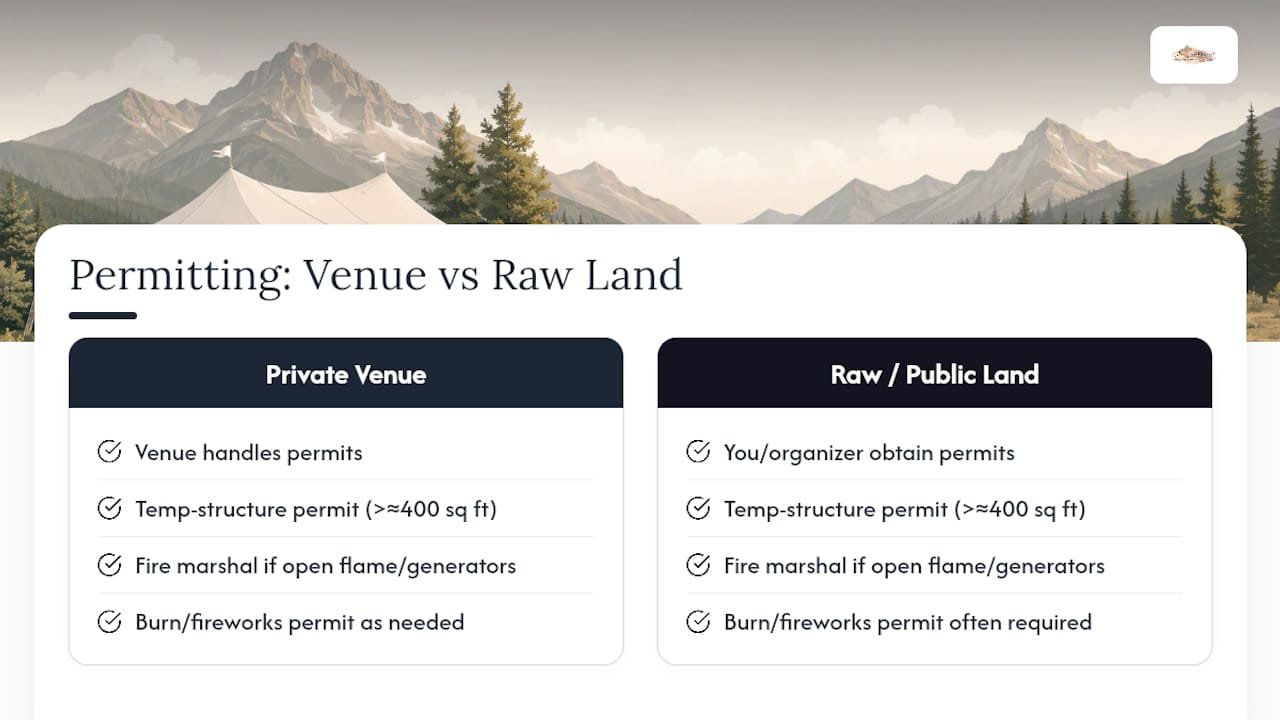
Ask any venue directly what permits are already in place and what falls to you. A venue that can’t answer that question clearly is asking you to take on liability you didn’t sign up for.
Power and Lighting Setup Options for Remote Mountain Locations
Remote mountain sites rarely have the buried electrical infrastructure a hotel ballroom does, so power planning starts with an honest assessment of what’s actually available on-site versus what needs to be trucked in.
Quiet generators are the standard solution for tented events without direct utility access, and the sizing matters more than couples expect. A DJ setup, string lighting, catering equipment, and a few phone-charging stations can draw more power than a single small generator handles, so experienced installers typically calculate load requirements ahead of time and bring a properly sized unit with a backup on standby. Generator placement matters too: crews position them far enough from the tent and seating to cut down on noise and exhaust, with cable runs buried or covered to avoid becoming a trip hazard on already uneven ground.
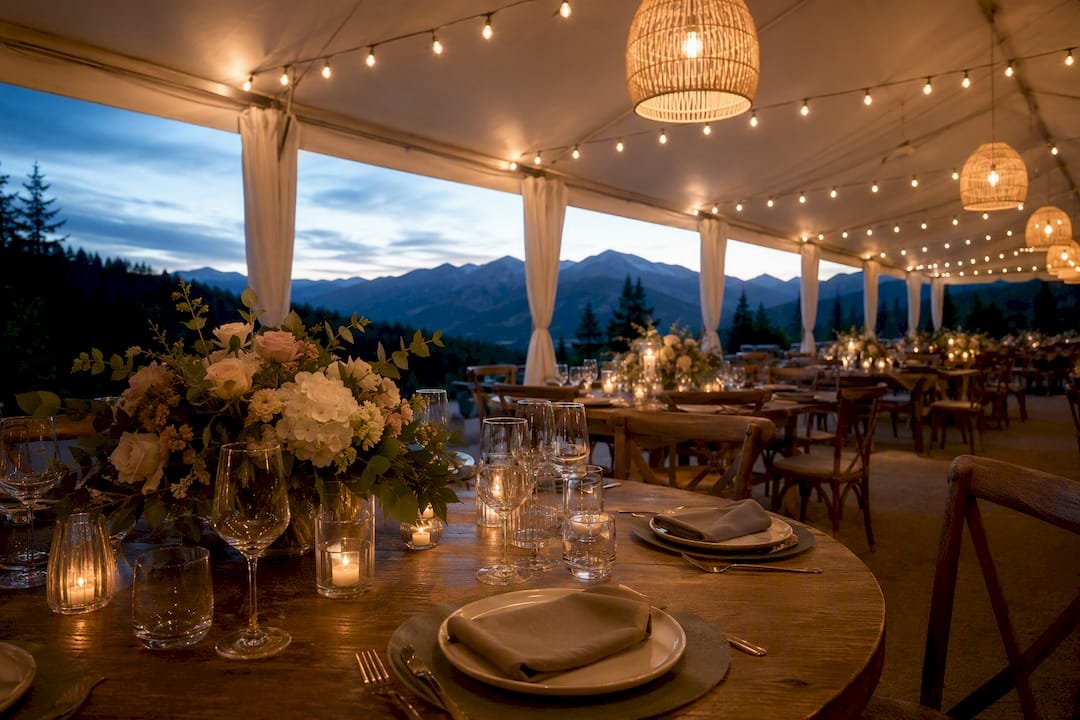
Lighting does double duty at a mountain wedding: it needs to flatter faces and extend the usable hours of the event once the sun drops behind the peaks, which happens noticeably earlier than a flat-horizon sunset. String lights strung across the tent interior or between trees create ambient warmth without competing with the view during daylight. Warm-toned chandeliers or lanterns work well for reception tables. Pathway lighting, whether string lights, lanterns, or simple stake lights, is a safety necessity along any uneven walking route between parking, the ceremony site, and the tent, not just a design flourish.
Battery-powered options have improved enough to handle smaller lighting loads without a generator at all, which is worth asking about if you’re aiming for a lower-noise, lower-fuel event.
Vendor Coordination and Delivery Logistics for Mountain Venues
Mountain venues complicate the one thing most vendors take for granted: a straightforward driveway and loading dock. Delivery trucks for catering, florals, rentals, and the tent itself all need a realistic route in, and steep grades or narrow switchbacks can rule out full-size trucks entirely.
Confirm vehicle size limits with your venue early, not the week of the wedding. Some mountain properties require vendors to transfer loads to smaller vehicles partway up an access road, which adds time and sometimes a transfer fee that couples don’t anticipate. Building extra buffer time into the delivery schedule protects against the fact that mountain roads take longer to navigate than GPS estimates suggest, especially for anyone hauling a loaded trailer.
Coordination works best when one point person, whether that’s a day-of coordinator, the venue’s own staff, or the couple’s planner, manages arrival windows for every vendor rather than letting each vendor show up whenever their own schedule says. Staggered arrival times prevent a cocktail hour, a catering truck, and a florist all trying to use the same narrow access point simultaneously. Venues that host tented weddings regularly typically have this sequencing worked out already, since they’ve watched it go wrong at least once.
Cell service is inconsistent in many mountain areas, which means vendor communication plans built entirely around text messages and phone calls can fail at the worst possible moment. A printed timeline with arrival windows, backup contact numbers, and a designated meeting point solves most of that risk without relying on a signal that may not exist.
Safety Considerations Unique to Mountain Terrain
Wildlife and altitude both deserve honest, upfront planning rather than an afterthought mentioned in passing.
Wildlife encounters, most commonly deer, but occasionally bears or other larger animals depending on the region, are a real consideration for evening receptions with food service. Securing catering waste promptly, closing dumpster or bin lids, and avoiding leaving food out unattended after the reception winds down all reduce the odds of an unwelcome visitor. Venues in bear country often have specific protocols for food storage that couples should ask about directly.
Altitude affects guests differently depending on where they’re traveling from. A wedding at even a modest elevation gain can leave guests from sea level a little more winded or dehydrated than expected, particularly if there’s dancing, hiking between parking and the ceremony site, or alcohol involved. Stocking extra water stations and keeping a first aid kit accessible addresses most of what actually comes up.
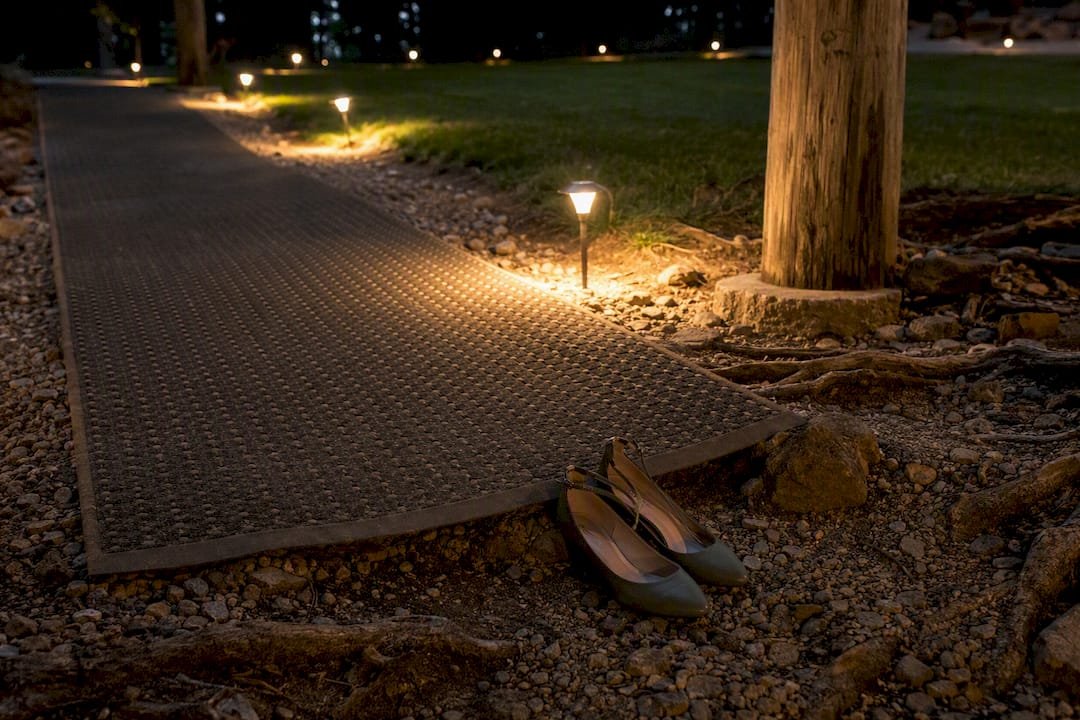
Uneven terrain itself is the most common safety issue, not wildlife or altitude. Loose gravel, exposed roots, and grade changes near the tent entrance are where twisted ankles happen, especially for guests in heels navigating in low light. Temporary matting, clearly marked pathways, and adequate lighting along every walking route reduce this risk more than almost any other single investment. A venue with regular event experience will already have solved this for the paths guests actually use.
Waste Management and Environmental Impact in Mountain Areas
Mountain venues sit inside ecosystems that don’t tolerate careless waste handling the way a downtown event space does, and runoff, wildlife attraction, and soil disturbance are all real considerations, not just environmental talking points.
Grease and food waste from catering need dedicated containment rather than open bins, both to avoid attracting wildlife and to prevent runoff into nearby streams or watersheds that mountain properties often sit close to. Renting proper waste and recycling stations, and confirming who hauls them out after the event, should be settled before the wedding, not negotiated the morning after.
Tent installation itself carries an environmental footprint worth asking about. Staking and anchoring methods that avoid deep ground disturbance protect root systems and soil structure, which matters more on a slope where erosion is already a bigger risk than on flat ground. Reputable installers use anchoring approaches suited to the specific terrain rather than defaulting to whatever’s fastest, and asking about this during your site survey conversation is a reasonable, low-friction question.
Couples increasingly ask venues about composting options for catering waste and about sourcing florals locally rather than shipping them in, both of which cut down on the event’s overall footprint while often improving the look and feel of the day. A venue that’s used to hosting events regularly in a mountain setting will generally have these logistics already worked out, since repeated exposure to the same terrain tends to sharpen practices that a one-off rental site never develops.
The Planning Mindset That Actually Works for Mountain Weddings
Constraints sharpen good design more often than they ruin it. A slope that rules out a pole tent pushes you toward a split-level layout that ends up more interesting than a flat field would have produced anyway.
The couples who end up with the best version of a tented mountain wedding are usually the ones who hired local installers and planners who’ve solved these exact problems before, rather than trying to import a flat-ground vendor team into terrain they’ve never worked. Local experience converts logistical friction into moments nobody else’s wedding has. If you’re weighing your own site, it’s worth a direct conversation before you commit to a layout on paper.
— Luis
Cherrywood Ranch: One Venue, One Weekend, No Vendor Juggling
If everything above sounds like a lot to coordinate, that’s because it usually is when you’re assembling a tent company, a caterer, a lodging block, and a permit strategy separately across a mountain property that’s never hosted a wedding before.

Some venues take a different route: offering an all-inclusive wedding weekend in the mountains that pairs outdoor ceremony and reception space with onsite lodging and amenities like a pool and hot tub for guests to enjoy together instead of scattering to separate hotels. Because the venue is privately managed and hosts these events regularly, the site survey, staging areas, and access logistics that eat up so much planning time on a raw piece of land are already sorted out before you sign anything. That’s the real advantage of a done-for-you property over piecing together vendors from scratch: less coordination, fewer unknowns, and a weekend that starts feeling like the wedding the moment your guests arrive.
If a tented mountain celebration with a built-in place to stay sounds like what you’re picturing, check availability for your date and start the conversation with the venue directly.
Sources
- Tips for planning a tented wedding — The Planners Vault
- 17 unique ways to host a mountain wedding — Brides
- Tented Montana wedding with jagged mountain views — Rocky Mountain Bride
FAQ
Are Tented Weddings Cheaper Than Indoor Venues?
Not necessarily. Tents themselves can cost less than renting an indoor ballroom, but flooring, lighting, heating, generators, and site prep on uneven mountain ground often close that gap or exceed it, especially at a raw site with no existing infrastructure.
What Is the 50/20/30 Rule for Weddings?
It’s a budgeting guideline that suggests allocating roughly 50% of your budget to venue and catering, 20% to attire and beauty, and 30% to everything else, including décor, photography, and entertainment, though most couples adjust the split based on priorities.
What Does a $10,000 Wedding Look Like?
At that budget, couples typically host around 30 guests, choose a venue with built-in amenities like lodging or existing decor to cut rental costs, and lean on a simpler tented or outdoor setup rather than a fully custom build.
What Is the Rarest Month to Get Married?
January and February see the fewest weddings nationally, largely due to winter weather, though a tented mountain wedding in those months can still work with the right heating and contingency plan in place.
Do I Need a Permit for a Tented Wedding on Private Land?
Often yes, depending on tent size, guest count, and county rules, particularly if a fire marshal needs to sign off on open flame or generator use; private venues that host weddings regularly typically already hold the permits you’d otherwise need to secure yourself.