Use the timings, sample counts and suggested sequences in this guide as planning examples. Confirm the actual schedule, quotations and responsibilities with the venue and the suppliers you choose.
This guide covers which signs to make, what to write on them, where to put them, what materials hold up outdoors, and how to handle lighting and accessibility.
TL;DR
- Plan signs for the entrance, parking, ceremony, cocktail hour, reception, restrooms and lodging, then place them at path entrances, intersections and every fork.
- Use three to five words per sign, high-contrast lettering and one clear arrow.
- Add battery lights for anything guests need after sunset, and route guests to accessible parking, entrances and restrooms.
- Assign one person to set up the signs, with a simple map of where each goes.
Table of Contents
- Which signs a mountain wedding actually needs
- Wording that works at a glance
- Where to place directional signs
- Materials that survive wind, rain and sun
- Lighting for signs after sunset
- Accessibility: signs that lead everyone to the right place
- Personalizing mountain-themed signs and making your own
- Matching signs to your ceremony and reception spaces
- A sample sign plan for a weekend wedding
Which signs a mountain wedding actually needs
A mountain setting changes the weight of each one. On a flat city rooftop, guests see everything at once. On a ridge or a wooded property, the ceremony lawn may be out of sight from the parking area, the reception may be down a slope, and the road in may have several driveways that look alike. A UK sign printer’s signage checklist notes that directions matter most when parking, the ceremony, the drinks reception, the evening party, toilets, accommodation and transport sit in different areas. Spread-out mountain properties fit that description.
Here is a practical set to start from:
- Road signs at the turn-in and at any fork on the approach.
- Parking and drop-off signs.
- Welcome sign at the start of the walking path.
- Ceremony arrow at the first path junction.
- Cocktail hour and reception arrows where guests move between spaces.
- Restroom signs, including the accessible route.
- Lodging signs if guests are staying on site or nearby.
- Optional: Shuttle pick-up, guest book, photo area and bar.
If your guests stay on the property, you need far fewer road and shuttle signs. We cover that trade-off in our piece on wedding transportation with on-site lodging.
Wording that works at a glance
Guests read directional signs while walking, often in heels, often carrying a gift or a child. Short beats clever. WeddingTemplates suggests copy of roughly three to five words and an arrow nobody can misread. Love & Lavender recommends blunt, high-contrast wording such as “Wedding Parking,” “Shuttle Pick-Up” and “Drop-Off Only,” and adding your names if the venue hosts more than one event.
Use this as a starting point:
| Where it goes | Wording | Notes |
|---|---|---|
| Turn-in from the road | “Smith Wedding, Turn Here” | Names help when a venue hosts other events |
| Parking area | “Wedding Parking” | Add a second sign at the lot entrance |
| Drop-off point | “Drop-Off Only” | Keep it separate from parking |
| Start of path | “Welcome” plus your names and date | Doubles as the first photo spot |
| Path junction | “Ceremony This Way →” | Arrow points the real direction of travel |
| After the ceremony | “Cocktails This Way →” | Place where guests exit the ceremony |
| Reception entrance | “Reception” | Pair with a seating chart if needed |
| Restrooms | “Restrooms” with accessible symbol | Show the accessible route, not just the closest door |
| Lodging path | “Guest Cabins” or “To the House” | Match the name guests already know |
A few habits make the difference. Put the destination first and the arrow last. Use the same names everywhere: if the invitation says “the Lawn,” the sign should too. And say “this way” only when the arrow is the point, not as decoration.
Where to place directional signs
Placement matters more than design. UPrinting recommends putting signs at decision points, such as entrances and intersections, and repeating them along complicated routes. Newlywed points to natural entry points like the car park, a garden path or the ceremony entrance for welcome markers.
For the drive in, Love & Lavender advises repeating signs at the first turn and every fork, with large arrows and wording readable from a moving car. On a mountain road, that means bigger lettering than you would use on a path, and mounting it high enough to clear roadside brush.
Walk the route as a guest
The best test is physical. Park where guests will park, then walk to the ceremony without looking at a map. Every time you pause, that is a sign location. Do it again from the lodging to the reception, and once more at dusk, since a junction that is obvious at 2 p.m. can vanish in shade.
Tell guests before they arrive
Signs work best when they confirm what guests already know. LinkInvitation’s 2026 directions guide recommends giving guests the exact entrance or gate, the parking location, the drop-off point, arrival time, shuttle details, accessibility information and a day-of contact. For rural venues it adds a few specifics worth copying: describe the turn-in, name a landmark before the turn, mention the parking surface and walking distance, and warn about weak phone service.
That last point is the one mountain couples forget. If a guest’s GPS drops out two miles from the venue, your road signs and a printed set of directions in the invitation suite become the plan.
Materials that survive wind, rain and sun
Mountain weather changes fast, and a sign that falls over is worse than no sign. A few rules of thumb from outdoor-sign guidance:
- Paper and thin foam board are out. A wedding signs guide from Paperlust recommends printed PVC board over paper outdoors, because it resists wind and light moisture.
- Choose rigid, weather-tolerant materials. Newlywed suggests acrylic, treated wood or laminated designs for outdoor ceremonies, with weighted or anchored stands where it is windy. A Wyoming planner’s mountain wedding signage advice lines up with that: heavier frames, wood, acrylic or metal, weighted easels, secure fastening and an indoor backup location.
For stability, ground stakes suit grass and soft soil, while weighted bases suit gravel or decks. Newlywed’s guidance covers both options: weighted bases or ground stakes outdoors. Test each sign by pushing it, not just looking at it. If it leans under your hand, it will not stand through a ridge gust.
Stay out of the wind’s way in layout too. Tall, solid signs act like sails. Where possible, use low arrows on stakes, hang lightweight signs from sturdy posts with secure ties, or choose open-frame designs that let air through.
Lighting for signs after sunset
Mountain evenings arrive earlier than many couples expect, especially in a valley or on a west-facing slope shaded by a ridge. If guests will walk between spaces after dark, your signs need light. Newlywed suggests battery LED lights, string-light surrounds or spotlights for signs needed after sunset.
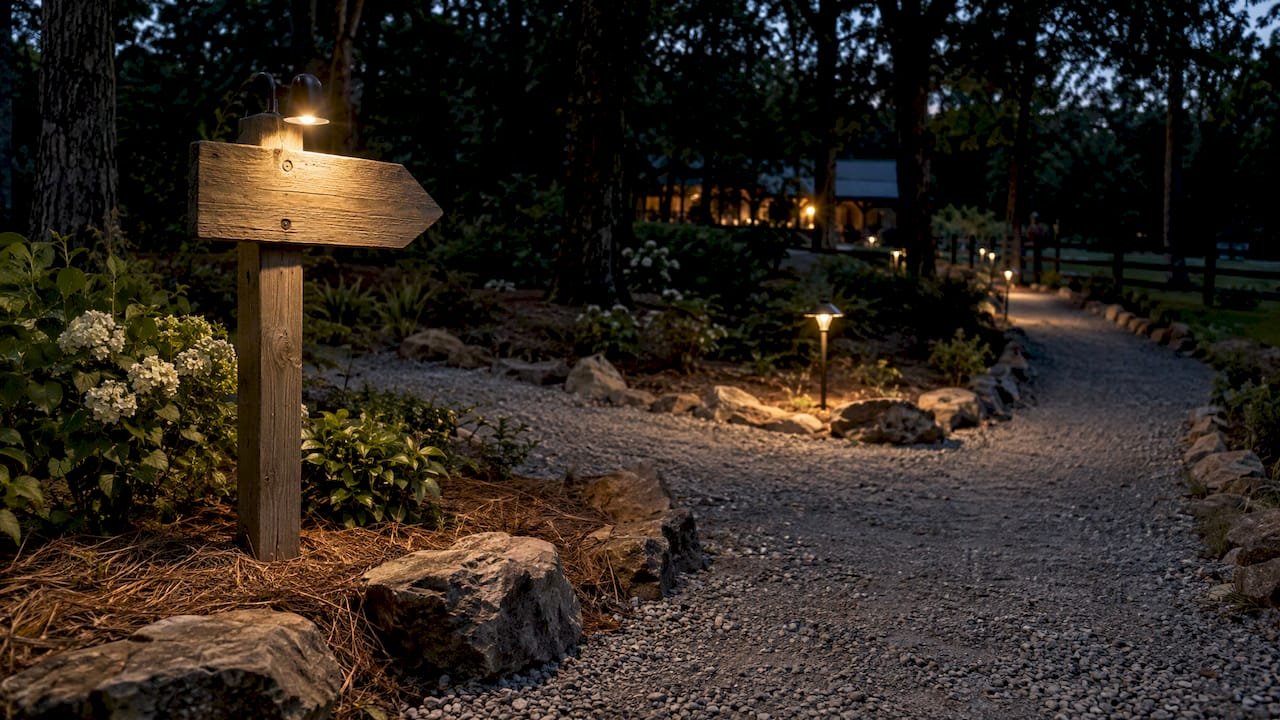
Two practical additions: use warm-white lights so signs stay readable without glare, and put fresh batteries in on the day. Pair sign lighting with path lighting. A sign guests cannot reach safely is no help.
High-contrast lettering helps in both directions. Paperlust’s guide notes that high-contrast typography reads better in bright or dim conditions, so dark lettering on a light board, or white on dark slate, beats pale script on a cream background.
Accessibility: signs that lead everyone to the right place
You are planning a private event, not a public building, so these figures are a useful benchmark rather than a checklist you must certify. They are still the best published yardstick for what “accessible” looks like. Your venue can tell you which paths meet it.
- Sign the firmest, flattest route to the ceremony, even if it is longer.
- Add an “Accessible Route” arrow at the first junction where the routes split.
- Place an accessible drop-off sign near the walkway, which LinkInvitation also lists as something rural venues should explain to guests.
- Mention the route in your invitation website, so guests are not surprised.
Personalizing mountain-themed signs and making your own
Couples can personalize signs with names, dates, meaningful quotes or illustrations, according to Newlywed. In the mountains, the setting does a lot of the work for you.
Ideas that suit the landscape
- Rough-cut or reclaimed wood arrows on a single post, with hand-painted lettering. Our favorite for path junctions.
- Slate or black acrylic with white lettering for evening readability.
- Metal signs with a topographic line or a ridge silhouette behind the text.
- Hand-lettered signs with your own coordinates or a nod to a trail you hiked together.
If you make them yourself
- Sketch the sign list and measure the distance guests will read from.
- Cut boards from treated lumber or use exterior-grade board, and seal them.
- Paint with exterior paint, using dark lettering on a light ground or the reverse. Skip thin script.
- Attach arrows with screws, not glue alone.
- Stake or weight each sign and test it in the wind a week before.
- Label the back of each sign with its location number so setup is simple.
Trading a little polish for stability is almost always the right call. A slightly plain sign that stands is better than an elaborate one on the ground.
Signs can also direct guests to the fun parts. A dessert table, for instance, deserves its own arrow and a small label. If you are planning one, these wedding dessert table ideas pair well with a coordinated sign style, so the labels match the rest of your signage.
Matching signs to your ceremony and reception spaces
Sign style should follow how you use the land. A ceremony under a frame needs a single clear approach, and our collection of mountain ceremony arch ideas shows how a frame can also become the visual endpoint for your path signs. For a meal outdoors, our outdoor reception ideas cover layouts where signs and seating stay simple. If you plan a tent, this one-venue tented wedding guide explains how fewer vendors means fewer sign decisions to coordinate.
Timing also changes your sign list. Cooler, shorter days mean earlier lighting and sturdier stands, and we compare seasons by elevation in our guide to the best time for a mountain wedding. For a bigger picture of what else belongs on the checklist, see how to plan a mountain wedding weekend.
A sample sign plan for a weekend wedding
This is how the pieces fit together for a wedding where guests arrive on Friday, marry on Saturday and leave on Sunday:
| Moment | Signs | Who sets up |
|---|---|---|
| Friday arrival | Turn-in, parking, “Welcome” at the house | Couple or coordinator, the day before |
| Saturday morning | Path arrows, restroom signs, accessible route | Coordinator or a trusted friend |
| Ceremony | “Ceremony This Way,” seating signs | Same person, one hour before guests arrive |
| Cocktails and reception | “Cocktails This Way,” bar, dessert table, “Reception” | Venue or catering contact |
| Evening | Battery lights on, path markers lit | Assigned helper |
| Sunday | Breakfast or farewell sign, then removal | Family volunteer |
A single person owning that table beats five people each assuming someone else has it.