
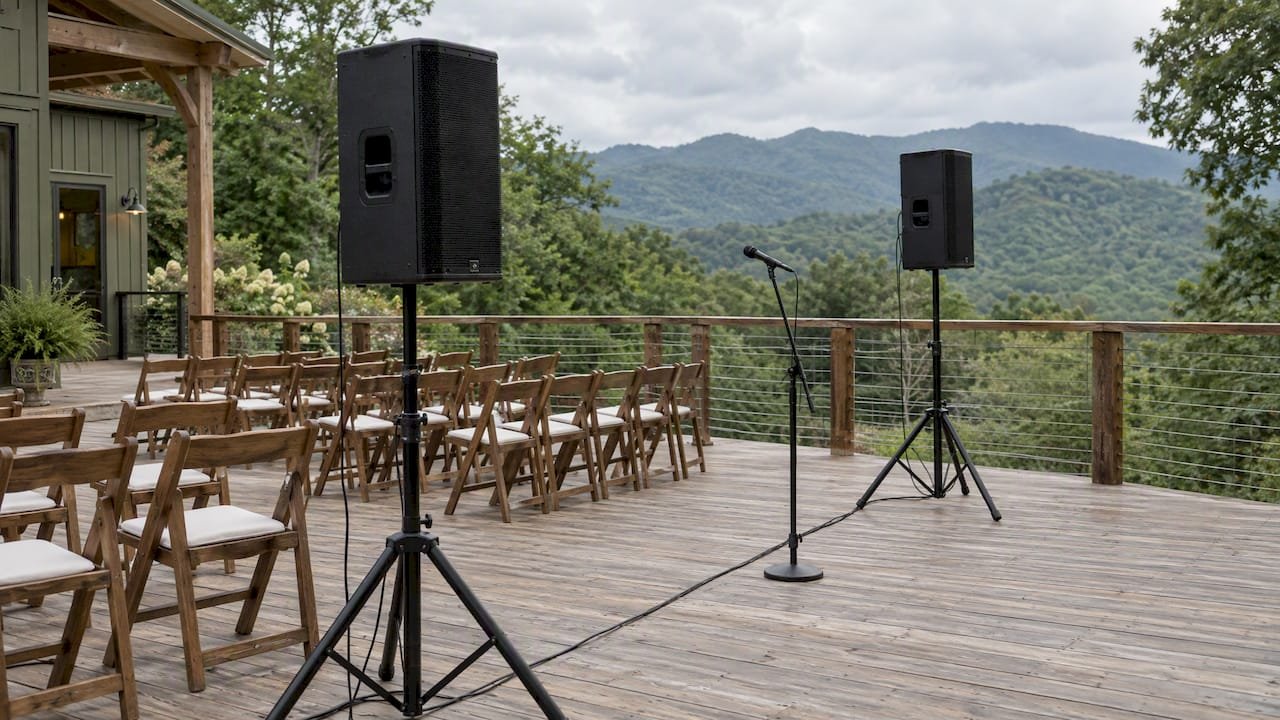
Yes, plan for sound at an outdoor ceremony, whatever the guest count. Open air has no walls to hold your voices in, so vows, readings and music fade fast, especially in wind. The fix is simple: one or two small speakers placed in front of the couple and aimed at the guests, a wireless mic for the officiant, windscreens on everything, and a test run with real people in the seats. This guide walks through each piece, what it costs to hire help, and how to protect the setup from weather and power trouble.
TL;DR
- Outdoor ceremonies need amplification at any size, because wind, ambient noise and open space reduce how far sound carries.
- Put one or two compact speakers forward of the couple, angled toward guests, and add fill speakers for deep seating.
- Use a wireless lavalier for the officiant, a handheld mic for readings, and a windscreen on every mic.
- Test in the real ceremony spot with guests present, and write down a weather and power backup plan.
- Hire a sound technician if nobody on your team can own the audio from the first cue to the last song.
Table of Contents
- Why outdoor sound is harder than it looks
- What a good outdoor ceremony setup includes
- Where to put the speakers
- Microphones for vows, readings and the officiant
- Testing: the step couples skip
- Weather, heat and power
- What the reception needs
- DIY, rental or a sound technician?
- A simple outdoor ceremony sound plan for 25 to 75 guests
- Plan your wedding weekend with us
- FAQ
- Sources
Why outdoor sound is harder than it looks
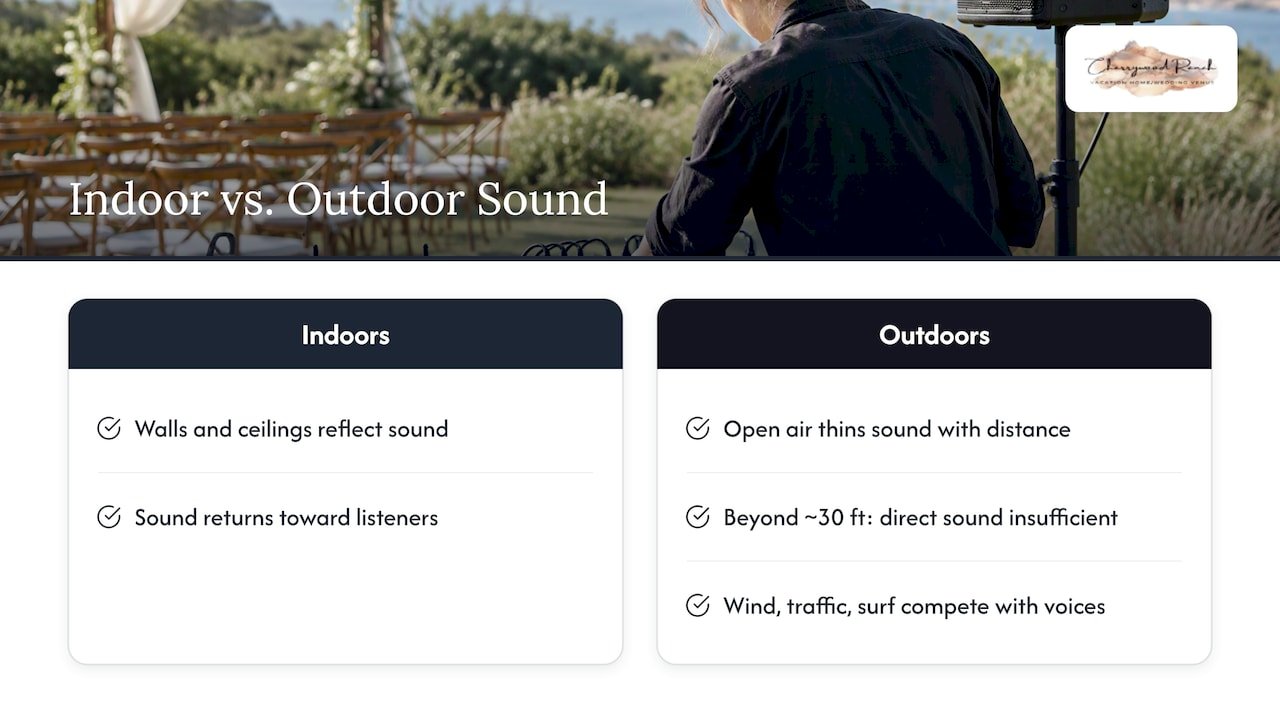
Indoors, walls and ceilings bounce sound back toward the listeners. Outside, that help is gone. Sound spreads into open air and thins out with distance. In acoustics research on listening spaces, direct sound can become insufficient beyond about 30 feet at typical ambient noise levels. That is roughly the distance from the front row to the back row at a modest ceremony with a few rows of chairs.
Then add the competition. Wind creates low-frequency rumble, sound dissipates in open spaces, and noise such as traffic or ocean surf competes with the voices. In the mountains, the list changes but the problem does not: a breeze across a ridge, a creek, cicadas, a passing car on the road below.
People also differ. Speakers, readers, vocalists and musicians project very differently. Your soft-spoken best friend doing a reading and your booming uncle will not sound alike without a mic. Amplification evens them out.
Do small ceremonies need a system?
Some vendors say a very small gathering, under about 50 people, may get by without a full sound system, particularly in a quiet spot with a strong-voiced officiant. Others say outdoor ceremonies of any size need one. Our advice: even at 25 guests, a small battery-powered speaker and one wireless mic cost little and remove the risk that your grandmother in the back row misses your vows. At 25 to 75 guests, treat sound as part of the plan, not an extra.
What a good outdoor ceremony setup includes
Think of the system as four jobs: voices, music, distribution and power.
| Job | What to use | Why |
|---|---|---|
| Officiant voice | Wireless lavalier or headset mic | Hands free, consistent distance from the mouth |
| Readings and toasts | Handheld wireless mic | Easy to pass from person to person |
| Music and cues | Laptop, phone or player run by one person | One owner means no missed cues |
| Speakers | One or two compact powered speakers, plus fills for deep seating | Even coverage at a comfortable volume |
| Power | Battery-powered units or a planned outlet or generator | No dead air mid-vow |
A battery-powered all-in-one PA speaker is a popular pick. One DJ company calls it the safest choice for ceremonies under 100 guests, because there are no cables to trip over or outlets to find. That is one vendor’s view, but it matches what we see at intimate weddings: simple setups fail less often.
Where to put the speakers
The common mistake is one loud speaker at the front. Guests in the first row get blasted and the back row still strains. Instead, place one or two compact speakers forward of the couple and angle them toward guests, adding fills for deep seating areas. Using two or more well-placed speakers often gives more even coverage at a lower, more comfortable volume.
Two placement approaches are worth knowing:
- Flanking speakers. One on each side of the couple and officiant, facing the audience. This is the basic, reliable option.
- Hidden speakers around the audience. One audio design firm describes speakers placed on the ground or in the landscape around the guests as giving better distribution at lower volume. It looks cleaner in photos, since nothing sits behind the arch, though it takes more time to set up.
Keep speakers ahead of the mics
Feedback, that piercing squeal, happens when a microphone picks up a speaker. The cure is geometry: speakers go forward of the microphone locations and aim toward the audience. Never let the officiant or a reader stand in front of a speaker with a live mic.
Think about your backdrop
Your ceremony arch, florals and photo angles decide where speakers can sit. Walk through the layout with your photographer and decide in advance. Our outdoor wedding ceremony ideas can help you settle the seating and focal point before you place a single stand.
Microphones for vows, readings and the officiant
Most couples worry about the vows. There are a few good ways to handle them, and none requires you to wear a headset on your wedding day.
- Officiant: a wireless lavalier is the standard recommendation, with a handheld for readings, according to one outdoor DJ setup guide.
- Vows, option one: each of you wears a small lavalier.
- Vows, option two: the officiant’s mic picks up your voices, and you practice speaking toward it.
- Vows, option three: pass a handheld mic back and forth.
Those three vow options come from an event audio company’s ceremony guide, which also stresses that the goal is clear speech, not just loud speech. Coach your readers to speak slowly and toward the mic. Intelligibility beats volume every time.
Windscreens are not optional
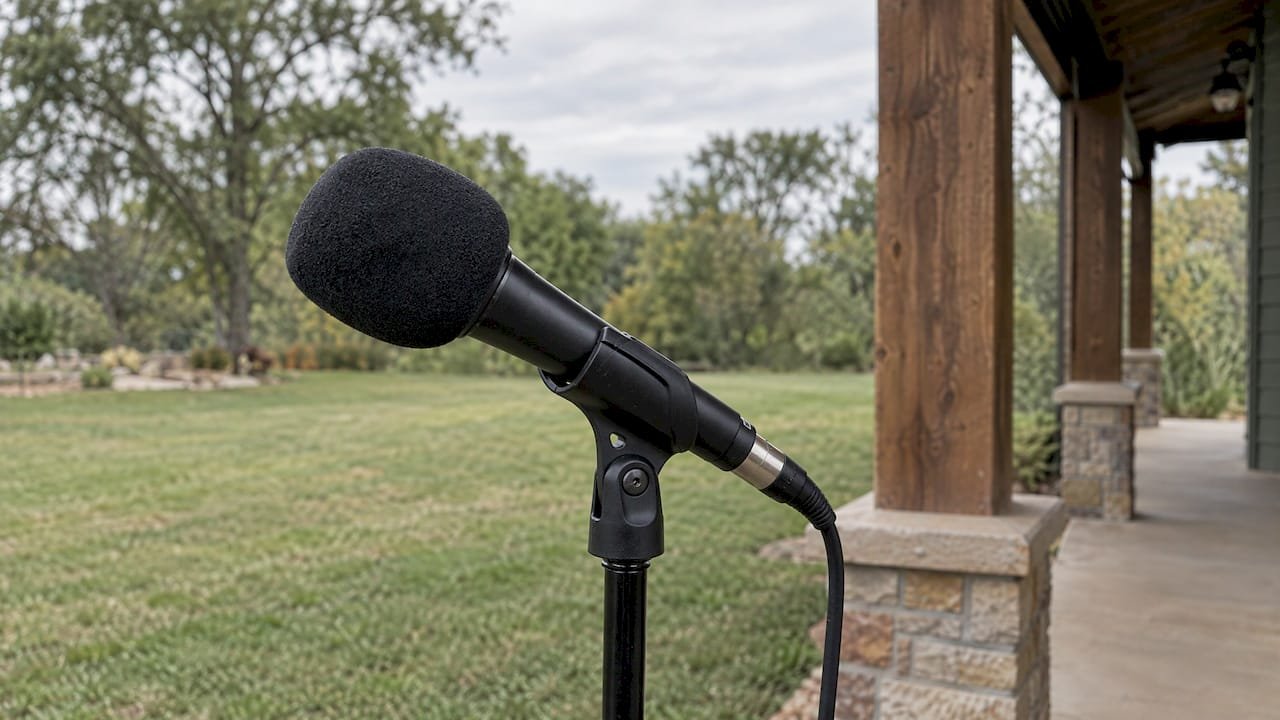
Wind across a microphone creates a thump that no equalizer fixes. The manufacturer Shure recommends a windscreen whenever a microphone is used outdoors. Put foam or fur covers on every mic, including the backups. A lavalier tucked under a lapel or hidden in a dress neckline also needs its own small cover.
If gusts are a real concern at your date and spot, read our guide to a windy outdoor wedding for layout and seating choices that help sound as well as hair and décor.
Testing: the step couples skip
A rehearsal without a sound check is half a rehearsal. Do these on site:
- Test every mic and every music cue before guests arrive. This includes the processional, the recessional and any live musician. A rental company’s guide says to test every microphone and cue and agree on a weather pivot.
- Test wireless gear with people present. Bodies absorb radio signals and can shorten the effective wireless range, so a mic that works in an empty field may drop out in a full one.
- Walk the seating area. Stand in the back row and the far corners while someone speaks at normal volume. If you cannot understand every word, add a fill speaker.
- Set the volume low and even. If the first row is comfortable and the last row can hear, you are done.
- Keep spare batteries and a spare mic within reach.
Allow time. Online audio forums suggest a basic system takes about an hour to set up, so plan the ceremony timeline around that and not around the moment guests arrive. If you are building a full weekend, our weekend wedding schedule templates show where a sound check fits.
Weather, heat and power
Sound gear is electronics, and it lives outside for your whole ceremony.
- Rain threatens powered equipment, connectors and electrical components, while direct sunlight raises temperatures around powered speakers and their amplifiers. Shade the speakers with a tent edge or a covered stand, and keep cables off wet ground.
- Wind moves sound away from the audience as well as rumbling across mics, a point one wedding audio company stresses. Face speakers into the breeze where possible.
- Power needs a plan. Ask how long batteries last, where outlets are, and what happens if one fails. A vendor checklist on ceremony audio covers wind, power needs, battery runtime and a backup for microphone failure.
- Weather pivot. Decide in advance who moves equipment, where power relocates and how long it takes. Then write it into your day-of timeline.
For the bigger picture, see our rain plan for an outdoor wedding, our guide to outdoor wedding power, and our notes on North Georgia wedding weather, which explain why afternoon storms matter when you pick a ceremony time in the mountains.
What the reception needs
The reception asks more of your system than the ceremony: music for dancing, toasts, an emcee, announcements. Plan a separate check for it, because the speaker positions that suit seated guests rarely suit a dance floor.
Speeches deserve thought, too. Toasts that run long drain the room. Some planners swap part of the speeches for something shorter and more personal, and a roundup of wedding speech alternatives shows how to keep the heartfelt moments in three to seven minutes. Fewer speeches also means fewer mic handoffs for whoever runs your audio.
After sunset, sound and lighting share the same power budget. If you stay outdoors for dancing, our guide to outdoor wedding lighting explains how to avoid power failures, and these wedding lighting ideas offer sets and a checklist to plan the look around your speakers and cables.
DIY, rental or a sound technician?
The right choice depends on guest count, how many mics you need, and who on your team can stay focused on audio instead of enjoying the wedding. One rental company puts the principle plainly: someone, ideally an engineer, should own the audio from the first cue to the last song.
| Option | Best for | Typical cost in the U.S. |
|---|---|---|
| DIY battery speaker and mic | Very small, quiet ceremonies with a trusted friend running it | The price of the gear you buy or borrow |
| Ceremony-only rental with delivery and setup | 25 to 75 guests, one ceremony spot | $400 to $800 |
| Rental plus on-site technician | Ceremony and reception, several mics, live musicians | Technician adds $400 to $1,200 |
| Combined ceremony and reception package | Full weekends | $700 to $1,500 is common |
Overall, professional rentals for U.S. weddings in 2026 range from $400 to $3,500. These are vendor-published ranges, so use them to budget and then get quotes in your area.
A technician earns the fee when things get busy. According to a 2026 cost guide, a technician manages microphone handoffs, adjusts levels and fixes problems during the event. A technician is also the person who notices that the wireless mic is cutting out when the full guest list sits down.
Questions to ask any audio vendor
- How do you handle wind, and do you bring windscreens for every mic?
- What are the power needs, and how long do batteries run?
- What is your backup if a microphone fails?
- Do you test wireless gear with guests seated?
- Will you stay through the ceremony, or drop off the equipment?
- What happens if the ceremony moves to the rain location?
For local vendors who know our area, browse our vendor list.
A simple outdoor ceremony sound plan for 25 to 75 guests
Use this as a starting template and adjust it to your layout.
- Two compact powered speakers on stands, one each side, ahead of the couple and aimed at the seating.
- One fill speaker midway down the aisle if rows run deep.
- A wireless lavalier for the officiant and a handheld for readings.
- Foam windscreens on all mics, with spares.
- One person assigned to music cues and volume, who is not a bridesmaid or groomsman.
- A sound check 60 to 90 minutes before guests arrive, then a quick re-check with people seated.
- A written rain and power plan on the day-of timeline.
This fits an intimate celebration where everyone is within earshot and the goal is for every vow to land without anyone raising their voice.
Perspective
We host intimate weddings and family celebrations on a private North Georgia mountain property, with lodging for up to 16 guests on site. After watching how couples build a whole weekend here, we think sound deserves the same attention as the flowers.
Here is our view. A mountain setting is exactly why you want your vows heard: the scenery is the point, and it is quiet enough that every word can carry if you give it a little help. Because your family and friends stay together on the property, you also have time to do what many one-day venues cannot: a relaxed sound check the day before, a rehearsal at the real ceremony spot, and a calm morning-of walk-through instead of a rushed hour.
Our advice is to keep it simple and own it. Pick one person to run the audio. Choose small speakers over big ones. Decide your rain plan early. A private venue gives you the freedom to plan around your own timeline, and that is the best asset you have for getting sound right.
Luis
Plan your wedding weekend with us
If you picture saying your vows with mountain views behind you and your closest people staying right on the property, we would love to talk. Cherrywood Ranch is a private North Georgia venue with onsite lodging for up to 16 guests, an outdoor ceremony and reception space, and a pool and hot tub for the rest of the weekend. Our published rates start with a DAY SESSION at $1,950 per day, PER HOUR at $350 per hour, or a Mini Session at $175. Weddings, elopements and 3-day wedding packages are described on our services page.

Tell us your guest count and ceremony style, and we will help you think through the layout, timing and backup plan, including where your audio setup will work best.
FAQ
Do I need a microphone for an outdoor ceremony?
Yes, in nearly every case. Wind and open space weaken even a strong speaking voice, and vows are usually spoken softly. A wireless lavalier on the officiant, plus a handheld for readings, covers most ceremonies. Practice speaking toward the mic so your vows carry.
How many speakers do I need for an outdoor wedding?
One or two compact speakers are enough for many intimate ceremonies. Place them forward of the couple and angle them toward the guests. Add a fill speaker if the seating runs deep, since several well-placed speakers can give even coverage at a lower volume.
Can I use Bluetooth speakers from home?
A small Bluetooth speaker can work for background music at a very small gathering, but it will struggle with spoken words in wind. For vows and readings, use a speaker made for public address with a wireless mic input, and test it at the ceremony spot. Keep spare batteries or a power source on hand.
How much does outdoor wedding sound cost?
In the U.S., a ceremony-only rental with delivery and setup typically runs $400 to $800, and an on-site technician can add $400 to $1,200, according to a 2026 cost guide. Combined ceremony and reception packages often fall between $700 and $1,500. Get quotes in your area.
What should I do if it rains?
Decide before the wedding who moves the equipment, where the power relocates and how long it takes. Keep speakers and connectors covered and off wet ground, and shift the ceremony only once the audio plan is ready. Write it on your timeline so nobody is improvising.
Sources
- Does My Wedding Ceremony Need a Sound System? (SPN Events)
- Room Acoustics: Design for Listening (Canadian Building Digests)
- Outdoor Ceremony Sound: What Goes Wrong (Eventful Productions)
- Wedding Ceremony Sound System Guide (Sifient)
- Why Do I Need a Sound System for My Outdoor Ceremony? (Steve’s Mobile Music)
- Best Outdoor Wedding Sound System Picks (DJ Brian C)
- Outdoor Wedding DJ Setup in 2025: Sound, Power, and Lighting
- What Is the Best Ceremony Sound for My Outdoor Wedding? (Design Sound)
- Ceremony Audio 101: How to Make Vows Crystal Clear (Sir Force)
- PGA58 Wired Microphone User Guide (Shure)
- Wedding Sound System Rental: What You Need (Mo’Pro Crew)
- How Much Does a Wedding Sound System Cost? (Paperlust)
- Wedding speech alternatives
- Wedding lighting ideas