

A corkage fee is what a venue or caterer charges to open and serve alcohol you bring yourself. In the US it is most often billed per bottle, and wedding guides commonly quote somewhere between $15 and $75 a bottle, depending on the venue and the type of drink. The fee itself is rarely the real story. What matters is what it covers, what sits outside it, and whether bringing your own alcohol saves you money once staffing and glassware are added.
TL;DR
- Corkage is a per-bottle (sometimes flat) charge for serving outside alcohol. Typical US quotes for wine run about $25 to $35 a bottle, with wider planning ranges of $15 to $75.
- It usually pays for staff time, glassware, storage and liability exposure. Chilling and storage are often included but not guaranteed.
- Judge corkage next to bartender labor, service charges, ice, mixers and insurance, not as a standalone number.
- Some venues and caterers ban outside alcohol entirely, and alcohol rules differ by state and even by town.
- Ask for the policy in writing before you sign, including whether unopened bottles can be returned.
Table of Contents
- What a corkage fee is
- What a corkage fee costs in the US
- What the fee usually covers
- Per bottle, per head or flat fee
- Is bringing your own alcohol actually cheaper?
- Rules to check before you buy a single bottle
- Questions to ask the venue
- Negotiating corkage
- Our perspective
- How our weekends are priced
- Hidden costs that sit next to corkage
- Choosing what to serve
- FAQ
- Sources
What a corkage fee is
The name comes from the cork. When you bring a bottle of wine to a restaurant, the restaurant charges you to open it, pour it and wash the glasses. Weddings work the same way, just at a larger scale. Brides describes corkage as a charge for opening and serving wine brought in from outside, particularly when the venue sells wine of its own.
The same article quotes event planners who explain the logic from the venue’s side: corkage is most commonly tallied per bottle to offset the in-house beverage sales a venue loses when you supply your own. So the fee is part labor cost and part lost revenue. Knowing that helps in a negotiation, because the venue’s real concern is usually one of those two things.
The term gets stretched in wedding contracts. You may see it applied to beer, champagne and spirits, or replaced with words like “outside beverage fee”, “BYO fee” or “service fee”. Whatever the label, read what it actually charges for.
What a corkage fee costs in the US
There is no standard price. Figures vary with the region, the venue’s type, and whether the fee applies to wine only or to everything you bring.
| Source | What it reports |
|---|---|
| Planner quoted by Brides | Many hotels and wedding venues allow outside wine for about $25 to $35 per bottle |
| Brides, broader range | $25 to $75 per bottle for planning purposes, with some vineyards charging as much as $125 |
| The Wedding Brigade | A US planning example of $15 to $35 per supplied bottle |
| Redline contract guide | Caterer examples of $15 to $30 per 750 ml wine bottle and $5 to $15 per beer or spirit; $25 per 750 ml bottle for approved toast wine |
These come from Brides, The Wedding Brigade and Redline’s catering contract guide. Treat them as planning ranges, not quotes. A vineyard with its own wine program will price differently from a barn that rents you the space and lets a caterer handle the bar.
A quick example
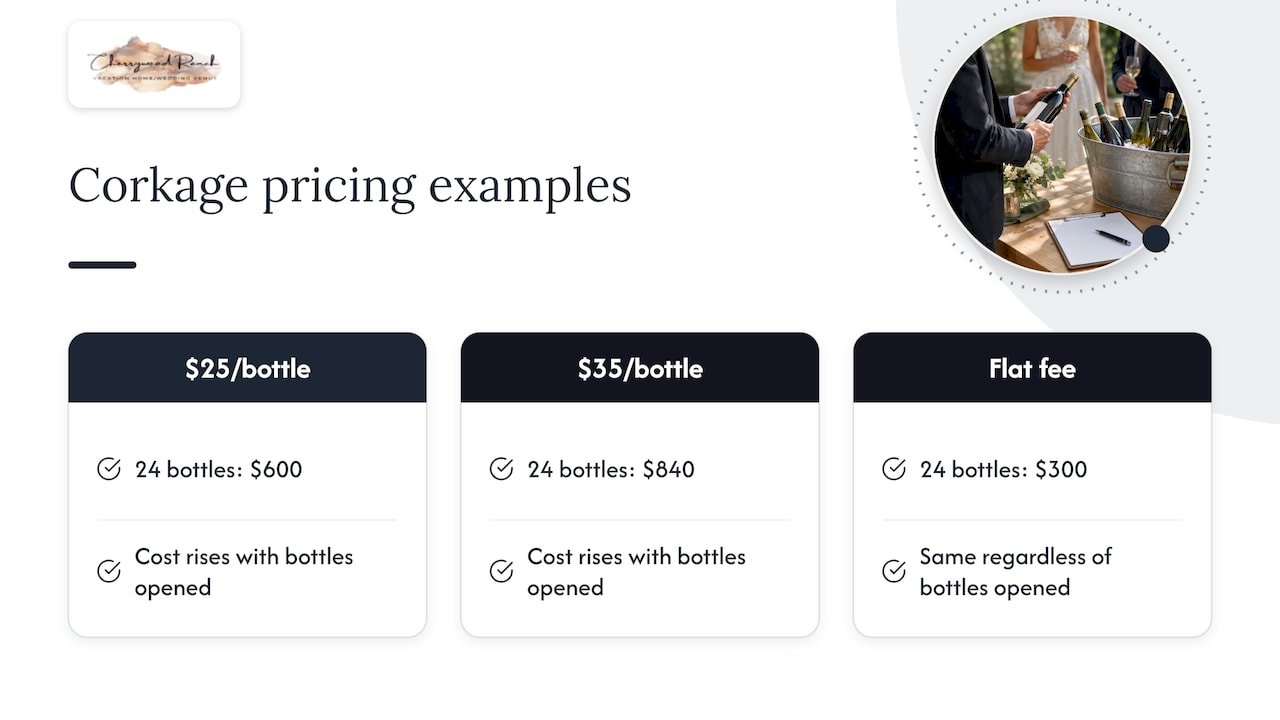
Say you serve wine at dinner for 60 guests and your bartender estimates 24 bottles will be opened. At $25 a bottle, corkage is $600. At $35 it is $840. At a flat fee of, say, $300, you would pay $300 no matter what. That last figure is invented purely to show the arithmetic; your venue’s number will be its own. The point is that per-bottle pricing rises with your guest list and your drinking habits, while a flat fee does not.
What the fee usually covers
According to the Brides guide, corkage can cover opening and operational costs such as staffing, glassware, storage and liquor liability. Chilling and storage are often included, though not guaranteed. In practice, ask the venue to list what is included, because the answers differ more than the prices do.
A few things corkage often does not cover:
- Glassware rental. If the venue does not own enough stemware, someone has to rent it.
- Ice, mixers and garnish. The Wedding Brigade warns these may be billed separately from the drink price.
- A licensed bartender. The same guide says most jurisdictions and nearly all venues require one.
- Service charges and gratuity. Redline’s advice is to check whether venue and caterer fees stack, including corkage, administrative fees, service charges and gratuity.
Per bottle, per head or flat fee
Venues more often tally corkage per bottle, but a flat fee is another option, and some charge per guest. Each structure rewards a different kind of wedding.
Per bottle suits a small, light-drinking crowd or a limited toast. You pay for what is opened, if the contract says so.
Flat fee suits a heavy-pour crowd or a large list. You know your cost in advance.
Per guest is closer to a bar package than corkage, so compare it directly with the venue’s own package.
The key contract question is whether you are charged for bottles opened or bottles delivered. Brides advises confirming whether you pay for bottles consumed, and saving the empties so you can check the bill against them. If you can return unopened bottles, you are far less exposed to over-ordering. Ask for that in writing.
Is bringing your own alcohol actually cheaper?
Often, but not always. Buying wholesale and paying a bar service for staff and equipment can come out well below a venue’s per-person bar package. One planning guide estimates savings of $800 to $1,500 at 100 guests even after corkage. That is a directory’s estimate, not a guarantee, so run your own numbers.
Build a simple comparison:
- Venue bar package: price per person times guest count, plus any service charge and gratuity.
- Bring your own: alcohol cost, plus corkage, plus bartender or bar-service fee, plus glassware, ice, mixers, garnish and any insurance.
- Hybrid: the venue’s beer and wine package, plus a few outside bottles for a toast or a signature bottle.
The hybrid is the most common compromise, and many venues that ban outside alcohol will still allow one special bottle for a toast. Where they do, corkage is the price of that exception.
If you are building a full budget around this choice, our wedding weekend budget guide shows how beverage costs sit alongside food, lodging and rentals in $20,000 to $50,000 plans.
Rules to check before you buy a single bottle
Corkage is a money question, but the first questions are about permission.
Is outside alcohol allowed at all?
Some venues welcome it, some allow only wine or beer, and some prohibit it. Redline warns that some catering contracts ban outside alcohol entirely and require every beverage to come through the caterer’s program. If your venue and caterer are separate companies, ask both.
Who holds the liquor license?
The Wedding Brigade’s checklist asks who holds the license, whether outside service is permitted, whether unopened bottles can be returned, whether insurance is required and whether local last-call limits apply. Laws vary widely by state. A State Bar of Wisconsin analysis shows how local the rules can be: Wisconsin treats wedding barns as public places subject to municipal licensing, with a limited exception for no-sale event venues. Your own state may be very different. If you are unsure, your county or state alcohol beverage authority is the right place to ask, not a blog.
Do you need insurance?
Venues often ask couples to carry event insurance when alcohol is served, especially hard liquor or mixed drinks. Our explainer on what venues require for wedding insurance covers how that works and what to ask your insurer.
Who serves it?
Your cousin behind a folding table is a liability issue, not a savings strategy. Hiring a licensed, insured bartender is usually both the venue’s requirement and the safer choice for you. If you tip your bar staff, see our vendor tipping guide so you do not double up with a service charge already on the contract.
Questions to ask the venue
Take this list to every tour and email it afterward so the answers exist in writing.
- Can we bring our own wine, beer, champagne or liquor, and which of those?
- Is corkage per bottle, per guest or flat? What is the exact amount?
- Are we charged for bottles opened or bottles delivered?
- Can unopened bottles go home with us?
- Does the fee include chilling, storage, glassware and opening?
- Who must serve, and do they need a license or insurance?
- Are ice, mixers, garnish and glassware extra?
- Does a service charge or gratuity apply on top of corkage?
- Are there size limits, such as no magnums?
- What is the last-call time?
Negotiating corkage
Corkage is sometimes negotiable, particularly at venues that are not tied to an exclusive caterer. Reasonable asks include a volume discount if you bring a case, a cap on the total, a waiver for a single toast bottle, or a credit if you also buy something from the venue. If a venue’s fee looks high, ask what it covers. A fee that includes service staff and glassware is a different product from one that only pays for opening.
If the venue refuses, run the comparison again. A fixed bar package at a fair price may beat a negotiated fee once labor and rentals are counted.
Our perspective
We run a private mountain venue with lodging on site for up to 16 guests, so we see the beverage question differently from a banquet hall. When your guests are staying in the same house where the celebration happens, nobody is driving between a ceremony site, a reception hall and a hotel. Your drinks plan can be simpler, and the weekend is about more than one evening’s bar tab.
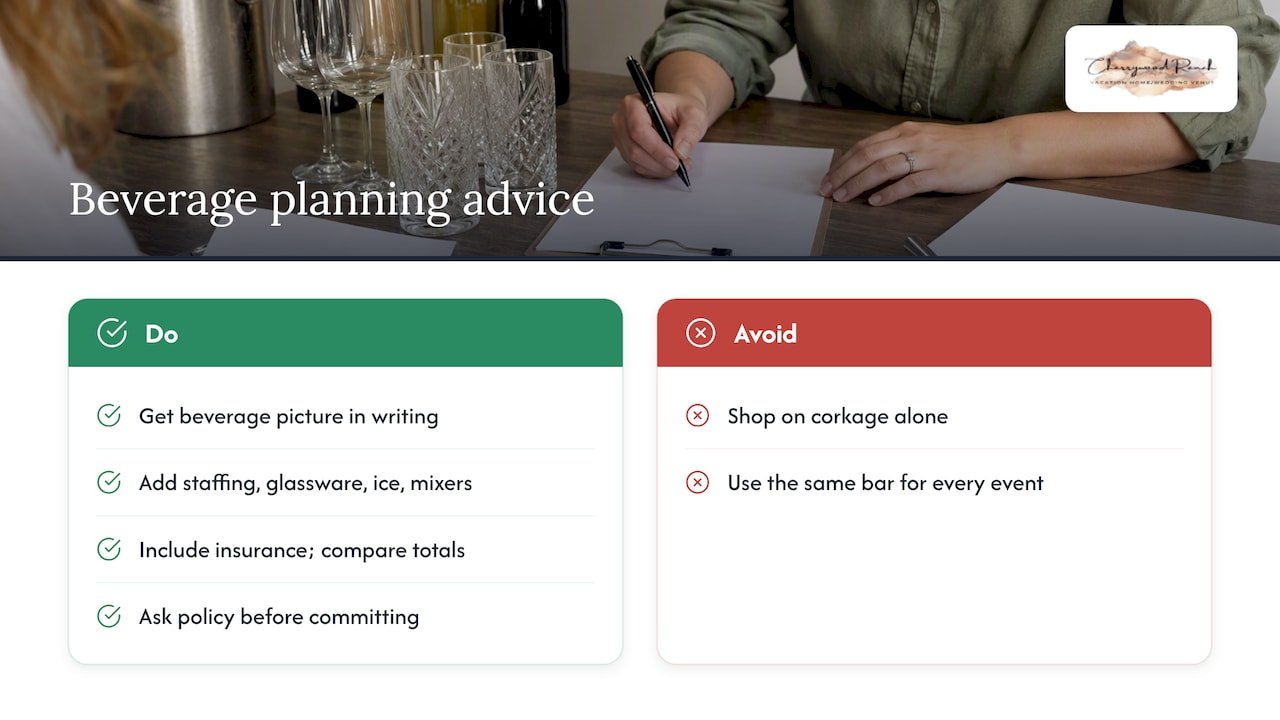
Our honest advice is the same for any venue, ours included: do not shop on corkage alone. Ask for the whole beverage picture in writing, add up staffing, glassware, ice, mixers and insurance, and compare the totals. Then decide what you want your weekend to feel like. A welcome toast on Friday, a relaxed dinner and a Saturday celebration do not all need the same bar.
Before you commit to any alcohol plan with us, ask for our current policy during your inquiry so there are no surprises on the contract.
— Luis
How our weekends are priced
If you are comparing venues, it helps to see published numbers up front. Our booking page lists a Mini Session at $175, hourly access at $350 per hour and a Day Session at $1,950 per day. Our services page covers elopement, wedding and 3-day wedding packages, and notes guest fees of $10 per guest over 10 and $10 per guest over 75. We do not publish package prices for weddings or elopements, so ask us for a quote.
Cherrywood Ranch is a private North Georgia mountain venue where the ceremony, reception and lodging are on one property. If a full weekend with your people under one roof sounds right, see the wedding packages or send us your date and guest count.
For ideas on setting up the party itself, our guides to outdoor reception ideas and buffet versus plated weekends pair well with a drinks plan, since food pacing affects how much your guests pour.
Hidden costs that sit next to corkage
Couples who focus on the corkage line often miss the lines around it. Watch for these:
- Stacked fees. A venue fee, a caterer’s administrative fee and a service charge can each apply to the same drink.
- Staffing minimums. Bar service may require a minimum number of hours or bartenders regardless of guest count.
- Overage on guest count. If your headcount grows, per-person bar pricing grows too.
- Disposal and cleanup. Some contracts add charges for bottle and cup disposal.
- Sales tax and gratuity. Confirm whether quoted prices include them.
Redline’s contract guidance is simple: read the whole beverage section and check what stacks. That is as true for a barn rental as for a ballroom.
Choosing what to serve
The cheapest way to cut corkage is to bring less that needs it. A few approaches couples use:
- One signature cocktail plus beer and wine. Fewer categories means fewer rules to follow and less glassware.
- A single toast bottle. Many venues will allow one bottle even where they ban the rest.
- Wine at dinner, beer for the rest. Beer is often cheaper to buy and, depending on the venue, may carry a lower or no outside-service fee.
- Welcome drinks at the lodging. At a venue with on-site lodging, an informal welcome drink on arrival day is easier than a formal bar.
Whichever mix you pick, count servings the way your bar service does and add a margin, rather than guessing from bottle count alone.
FAQ
What is a reasonable corkage fee for a wedding?
In the US, planners quoted by Brides say many venues allow outside wine for $25 to $35 a bottle. Broader planning ranges run $25 to $75, and some vineyards charge more. Anything far above that deserves a question about what the fee includes.
Do all wedding venues charge corkage?
No. Some venues charge nothing for outside alcohol, some charge corkage, and some prohibit outside alcohol and require you to buy from them. Policies also differ by state and town, so ask for the venue’s rule in writing.
Is a corkage fee charged per bottle or per guest?
Per bottle is the most common structure, though a flat fee or per-guest charge is possible. Ask whether you pay for bottles opened or bottles delivered, and keep the empties to check your final bill.
Can I save money by bringing my own alcohol?
Sometimes. One planning guide estimates savings of $800 to $1,500 at 100 guests after corkage, but only when outside alcohol is allowed and you add up bartender fees, glassware, ice, mixers and insurance. Compare the full totals before you decide.
Sources
- What Are Corkage Fees and How Do They Impact Your Wedding (Brides)
- Wedding Bar Services: Costs, Models and What to Ask (The Wedding Brigade)
- Wedding Catering Contract guide (Redline)
- Alcohol Regulation in Wisconsin (Wisconsin Lawyer, State Bar of Wisconsin)