
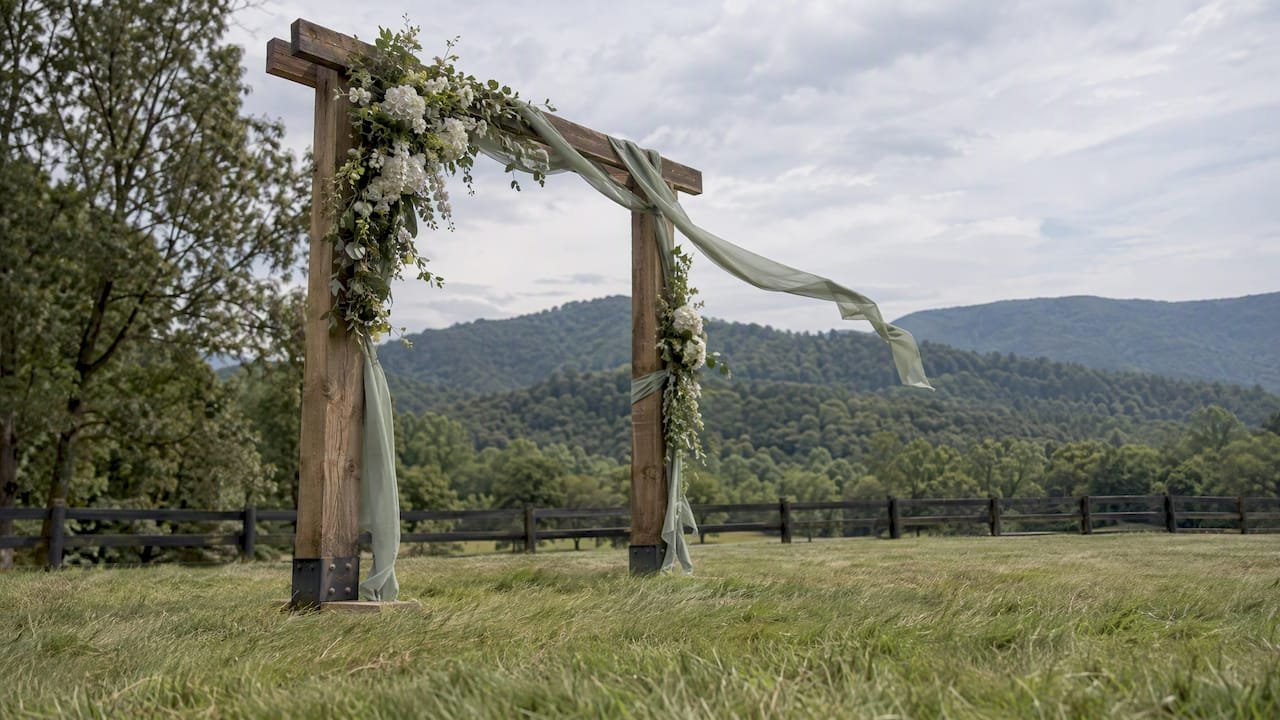
A windy outdoor wedding is manageable when you decide three things before the day: the wind speed at which the plan changes, where the ceremony moves, and who makes the call. Everything else, from veil clips to sandbags to the microphone, is detail that follows from those choices. Below is how we would set up each piece, with guidance from the National Weather Service and working wedding professionals, and what it means if your ceremony is on a mountainside.
TL;DR
- Pick a wind threshold in advance and name one person, a weather watcher, to track the forecast and radar and tell you when to switch plans.
- Anything tall, light or lit with an open flame is a risk: weigh it down, lower it or swap it out.
- Wind steals vows. Plan a windscreen, a backup microphone and speaker placement, and turn guests away from the gusts.
- Mountain weather changes fast, so choose a real backup space and write down who decides to move and how much notice vendors need.
- A simpler, calmer setup beats a perfect one fighting the weather.
Table of Contents
- Why wind is harder to plan for than rain
- Set your wind limits before the day
- Choose your ceremony spot and direction
- Secure décor, flowers and tabletop details
- Protect your vows: sound on a windy day
- Hair, veil, attire and photos
- Planning a windy mountain wedding
- Keep guests comfortable and safe
- A one-page wind plan you can hand to your coordinator
- Our perspective on wind at a mountain wedding
- Plan your wedding weekend with us
- FAQ
- Sources
Why wind is harder to plan for than rain
Rain announces itself. Wind comes in gusts, shifts direction during the hour you have scheduled, and affects nearly everything at once: hair, veil, flowers, programs, candles, sound and how comfortable guests feel. Colorado planner Jennifer Lourie lists the same set of effects for mountain weddings: hair, florals, ceremony audio, décor, table settings and guest comfort. That is why wind deserves its own plan rather than a line inside your rain plan.
There is also a safety side. The National Weather Service warns that strong winds can blow materials and tents around, disrupt events and cause injuries, and it recommends deciding on wind limits for temporary canopies and tents before the event. A breeze that ruffles a veil is a styling question. A gust that lifts a tent leg is a guest-safety question. Your plan needs to tell the two apart.
Set your wind limits before the day
The single most useful thing you can do is decide in advance. A couple who checks the forecast at 7 a.m. on the wedding day, with family around and emotions high, makes worse calls than a couple who agreed on numbers months earlier. One planning guide puts it simply: set wind thresholds ahead of time so you can make a quick, confident call when you look at the forecast.
What the official guidance says
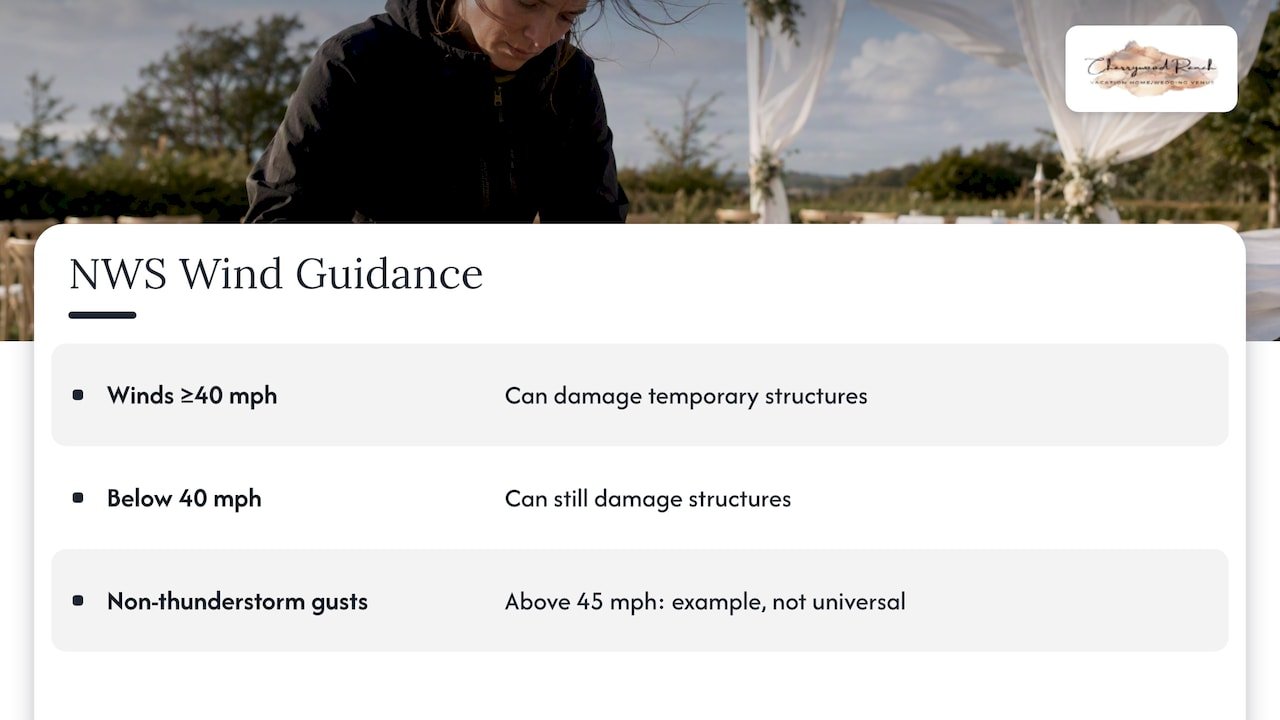
The National Weather Service’s Weather Watcher guide tells event organizers to designate shelter areas, define weather thresholds and assign a person with reliable internet and current radar to monitor conditions. It gives non-thunderstorm gusts above 45 mph as one example of a threshold. Treat that as an example of how to write a rule, not as a number that is right for every setup.
The NWS Hazardous Weather Action Plan template is more cautious about temporary structures. It notes that winds of 40 mph or more can cause damage, that winds below 40 mph can still damage temporary structures, and that loose structures should be secured. When a strong-wind advisory or warning applies, it recommends considering postponement or cancellation of the activity.
A practical way to write your thresholds
One planner suggests that if sustained wind is forecast above 15 to 20 mph, the ceremony moves to a covered space. That is a planner’s rule of thumb, not an official standard, but the structure is worth copying. Write three tiers on one page:
- Go as planned: wind is steady and light enough that décor and sound hold up with your wind kit.
- Adjust: gusts are strong enough to threaten décor or audio. Shorten the ceremony, rotate the layout, remove candles and tall pieces, or move the ceremony to a more sheltered spot.
- Move or delay: gusts reach the level your tent or structure supplier and the NWS guidance treat as unsafe, or a thunderstorm approaches. Everyone goes to the backup space.
Ask any tent or rental company for the wind rating of what they are installing, and put that number in tier three. Give your weather watcher authority to say “we are in tier two” without needing a debate. Choose someone calm who is not in the wedding party, such as a coordinator, a trusted cousin or the venue host.
Choose your ceremony spot and direction
Wind is not equally strong everywhere on a property. Open ridgelines, hilltops and wide lawns catch the most. Tree lines, buildings and slopes cut it down. Walk the site at the hour of your ceremony, ideally on a day with some breeze, and notice where it hits.
Two simple layout moves help. A company that photographs and films ceremonies suggests rotating the ceremony so guests face away from the wind where possible, and angling the aisle so the processional is not walking straight into it. Guests sit more comfortably, programs stay in laps, and the couple is not squinting into gusts. Bring your photographer into this conversation, since turning the layout changes the background in your photos. For more ideas on ceremony layouts, see our guide to outdoor wedding ceremony ideas that actually work, and for how tents and flooring fit around your zones, the five-zone outdoor wedding layout.
Secure décor, flowers and tabletop details
The rule is that anything light and tall will move, and anything with a large flat surface acts like a sail. Florists say it plainly: a floral installation behaves like a sail, and a structure that is stable when bare can become unstable once covered, because wind load is dynamic rather than steady. Ask your florist and rental company about the base and anchoring of any arch, before you fall in love with a design.
A simple wind kit
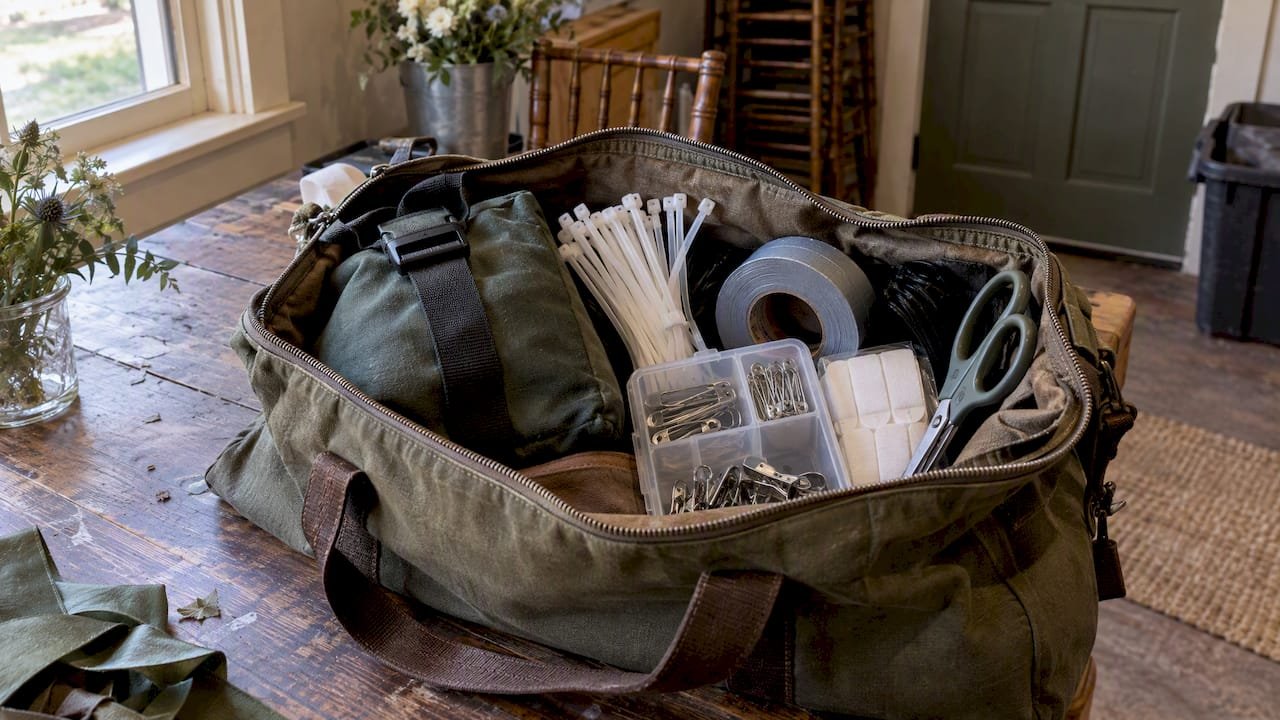
Build a small kit and hand it to your coordinator. Wedding videographers recommend sandbags, zip ties, removable adhesive strips and alien tape, and some add gaff tape and industrial Velcro. Keep it in a labeled bag with scissors, extra pins and a few clips.
What to change in the design
A Wisconsin wedding planning team gives a useful set of fixes: sandbags at the base of tall signs or put them on the ground, tape the base of small glass vases, tuck menus under chargers and keep centerpieces low. Plan A Wedding adds weighted vases, anchored centerpieces and hurricane lanterns in place of open outdoor candles. Use this checklist:
- Signs and easels: lay them flat on a table or ground, or weight them.
- Programs: skip them, or use a heavier card stock held by a basket at the entrance.
- Aisle petals and runners: loose petals scatter, and lightweight runners lift. Consider anchored or heavier alternatives.
- Candles: enclose flames in glass lanterns or switch to battery-powered ones.
- Table linens and napkins: use weights, clips or heavier fabric.
- Lighting: string lights and hanging pieces need secure anchor points. Our guide to outdoor wedding lighting covers how to avoid power failures.
Simpler also reads better in photographs. One experienced planner’s view is that couples are more upset by chaos than by simplified décor. If a design needs constant adjusting, cut it.
Protect your vows: sound on a windy day
This is where windy ceremonies most often disappoint. Wind noise across a microphone turns vows into rumble, and guests in the back row hear nothing. Plan it early:
- Confirm the microphone type and that it has a windscreen.
- Ask your DJ or musicians where speakers will sit relative to the wind and the guests.
- Have a backup microphone ready. These steps come from a wedding production company’s windy-ceremony guide.
- Keep the ceremony short and the officiant close to the microphone.
For a deeper look at what a ceremony needs for amplification outdoors, this explainer on outdoor wedding amplification walks through the options. If you plan live music, tell the musicians about the wind. Sheet music, light stands and delicate instruments are all affected. Power is another piece to settle early: our page on outdoor wedding power explains how to size it.
Hair, veil, attire and photos
Wind does not have to ruin a look. Decide ahead rather than hoping. The Wisconsin planning team above suggests choosing hair and veil styles in advance, keeping extra hairpins and a brush handy, and remembering that wind can create movement in photos. Plan A Wedding mentions veil clips, braiding or removing the veil as planned solutions.
A few ideas that fit that advice:
- Ask your stylist for a style that holds, then do a trial with a hair dryer on high or an outdoor test.
- Pick a veil weight and length with the wind in mind, and agree when it comes off: ceremony only, or after portraits.
- Choose a skirt that does not billow, or that you are comfortable holding. Bring a clip or small weight sewn in by your seamstress.
- Tell the photographer you want some of the wind. A fashion-and-wedding media outlet notes that gusts can bring a wild, romantic energy and movement-filled images. Schedule portraits for the calmest part of the day if you can.
Planning a windy mountain wedding
Mountain settings give you views and also exposure. Weather shifts quickly, and sun at elevation can feel intense even when the air is cool. A Colorado planning team recommends water, layers and a real indoor option or workable tent backup. Another source advises choosing the season and site with mountain weather in mind and documenting where the ceremony will move, who decides, and how much notice vendors need.
Jennifer Lourie’s mountain guide adds that couples should consider changing the ceremony time, moving to a covered area, using a tent or going indoors. Those are the same levers wherever you are, including the North Georgia mountains. Elevation, terrain, travel and temperature all belong in the plan. If you are still choosing a date, our page on choosing a mountain wedding date by elevation is a good starting point, and our North Georgia wedding weather guide covers afternoon storms in particular.
Time of day matters
Wind often builds through the afternoon as the ground heats. If your site is exposed, consider an earlier ceremony or a later one near sunset, and ask your venue what the property is like at each hour. Moving the ceremony by an hour can be the easiest fix you have.
Keep guests comfortable and safe
Guests did not choose this plan, so look after them. A Utah planning team suggests blankets or shawls, hydration stations, clear signage and transport such as golf carts or shuttles where terrain requires it, and shade, fans or heaters depending on the setting and season. Add these for wind:
- Seat older guests and anyone with mobility needs in the most sheltered rows.
- Put a basket of hair ties and clips at the entrance.
- Keep tents anchored and well away from walkways when the wind picks up.
- Tell guests the backup plan in your welcome note or on the wedding site, so a move does not cause confusion.
When wind comes with thunder
Wind is often the first sign of a storm. The NWS plan template is clear that tents and pavilions are not suitable shelter in thunderstorms: guests should go to a solid, enclosed building, and outdoor activity should not resume until roughly 30 minutes after the last thunder. A planning guide gives the same advice in plain terms: move guests to a building, not a tent. Build that into your tier three. Our rain plan for an outdoor wedding goes through what that move looks like step by step.
A one-page wind plan you can hand to your coordinator
Write it down so the plan survives a stressful morning. Include:
| Item | What to write down |
|---|---|
| Weather watcher | Name, phone number, the radar and forecast source they will use |
| Tier one, two and three thresholds | Wind speeds and gusts for each, plus thunderstorm rules |
| Backup space | Where it is, capacity, how long a switch takes |
| Decision time | When the call is made, and who makes it |
| Vendor notice | Who needs to be told, and how much lead time each needs |
| Wind kit | What is in it and who carries it |
| Sound plan | Windscreen, backup microphone, speaker placement |
| Attire plan | Veil, hair and clip choices, and when the veil comes off |
Share it with your photographer, florist, DJ or musicians, officiant and venue contact a week before the date, and again when the forecast firms up.
Our perspective on wind at a mountain wedding
We host weddings in the North Georgia mountains, and we think of wind the way we think of every part of the weekend: as something to design around instead of hope against. Our venue pairs outdoor ceremony and reception spaces with onsite lodging for up to 16 guests, so your closest people are already on the property if the schedule shifts. A move from lawn to a sheltered spot, or a ceremony pushed back an hour, does not require shuttling anyone between locations.
The couples who enjoy a gusty day most are the ones who decided early. They picked the thresholds, simplified the décor, rehearsed with the microphone and made peace with the veil coming off for the ceremony. If you tour with us, ask us to walk the property at the hour you plan to marry and talk through where you would stand, where guests would sit and where we would move if the day asked for it. We would rather have that conversation in advance than at 2 p.m. on your wedding day.
— Luis
Plan your wedding weekend with us
If you want a private mountain setting where the ceremony, reception and lodging sit on one property, take a look at our wedding venue with lodging in Georgia. Our published booking options include a Mini Session at $175, $350 per hour and a Day Session at $1,950 per day, all on our booking page. We also offer elopement, wedding and three-day wedding packages, plus guest fees of $10 per guest over 10 and over 75, described on our services page. For a closer look at how a tented weekend works on one property, read about our tented mountain wedding.
FAQ
How windy is too windy for an outdoor wedding?
There is no single number, but the NWS gives useful reference points. It cites non-thunderstorm gusts above 45 mph as one example threshold, and says winds below 40 mph can still damage temporary structures. Your tent supplier’s wind rating and your venue’s experience should set your own limits, and a planner’s rule of thumb of 15 to 20 mph sustained is a reasonable trigger for moving the ceremony under cover.
Can you have a ceremony on a windy day?
Yes, in many cases. Rotate the seating away from the wind, use a windscreen and a backup microphone, keep décor low and weighted, and shorten the program. If gusts or storms reach your higher threshold, move to the backup space instead.
What should a bride do about her veil and hair in the wind?
Decide before the day. Options include veil clips, a braided or secured style, or removing the veil after the ceremony. Keep extra pins and a brush with your bridesmaids or coordinator for touch-ups between photos.
Are tents safe in strong wind?
Only within their rating and when properly anchored. The NWS recommends setting wind limits for temporary canopies and tents, and it says tents are not suitable shelter in thunderstorms. Ask your supplier for the wind rating in writing and move guests to a solid building when storms approach.
Sources
- National Weather Service Weather Watcher Guide
- NWS Event Ready for Special Events
- NWS Hazardous Weather Action Plan template
- Windy outdoor wedding ceremony guide, Southern Productions
- Windy wedding day tips, Ray and Kelly
- Installation mechanics, Florist Heaven
- Wedding weather contingency planning guide, Plan A Wedding
- Your guide to a mountain wedding in Colorado
- How to plan an outdoor mountain wedding
- Colorado wedding weather plan
- Backup plans for outdoor weddings
- Planning an outdoor wedding in Utah
- How to handle windy weather on your outdoor wedding day
- Outdoor wedding amplification