
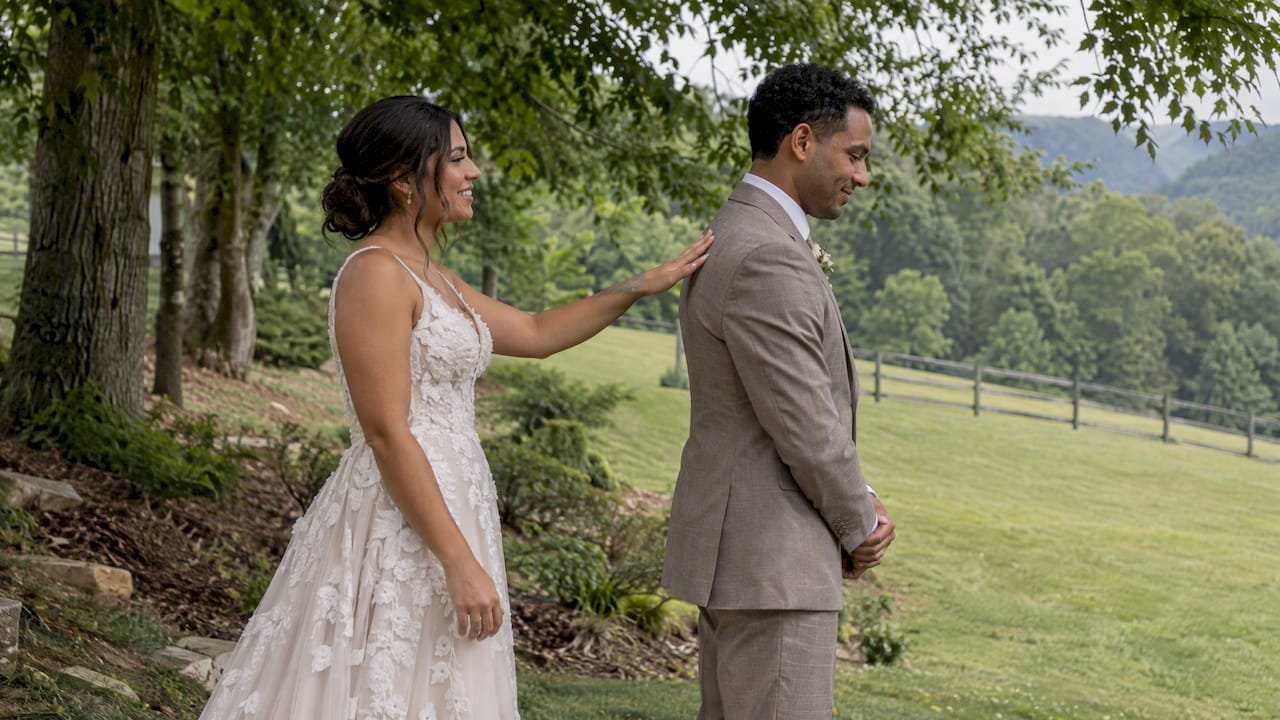
The best first look location is private, softly lit and easy to walk to in wedding shoes. It also sits away from where guests park, gather and get ready. Most couples who regret their first look didn’t pick an ugly spot. They picked a pretty one that anyone could wander into. This guide shows how to choose, time and back up your spot, with examples from mountain weddings in North Georgia.
TL;DR
- Choose privacy first, then light, then easy walking. A beautiful view that guests can see is the wrong spot.
- Plan 15 to 30 minutes for the reveal itself, then 30 to 45 minutes of couple portraits, and add a 15-minute buffer between photo blocks.
- In the mountains, work backward from sunset. October sunsets in North Georgia fall around 6:50 PM, and December ones around 5:30 PM.
- Choose a covered or indoor backup before the day, and set a decision time. Hourly rain forecasts only become dependable within about 36 hours.
- A venue where you stay overnight removes most of the logistics, because nobody drives between getting ready, the first look and the ceremony.
Table of Contents
- What a first look is, and why the location matters
- The three tests every first look spot should pass
- Types of first look locations that work
- Timing your first look around the light
- Build the backup before you need it
- Our perspective: why the first look is easier when you stay on site
- Booking time at the ranch
- Common first look mistakes
- A quick checklist for choosing your spot
- FAQ
- Sources
What a first look is, and why the location matters
A first look is a planned moment when the two of you see each other before the ceremony. It usually takes place at or near the ceremony site, as The Knot explains. The photographer is nearby, but the moment is staged so that it feels like it belongs to the two of you.
The location matters more than most couples expect. Two things happen in that spot. You have a rare, unhurried minute alone on a day when you will be surrounded by people. And you start your portraits while you are still fresh and the light is still good.
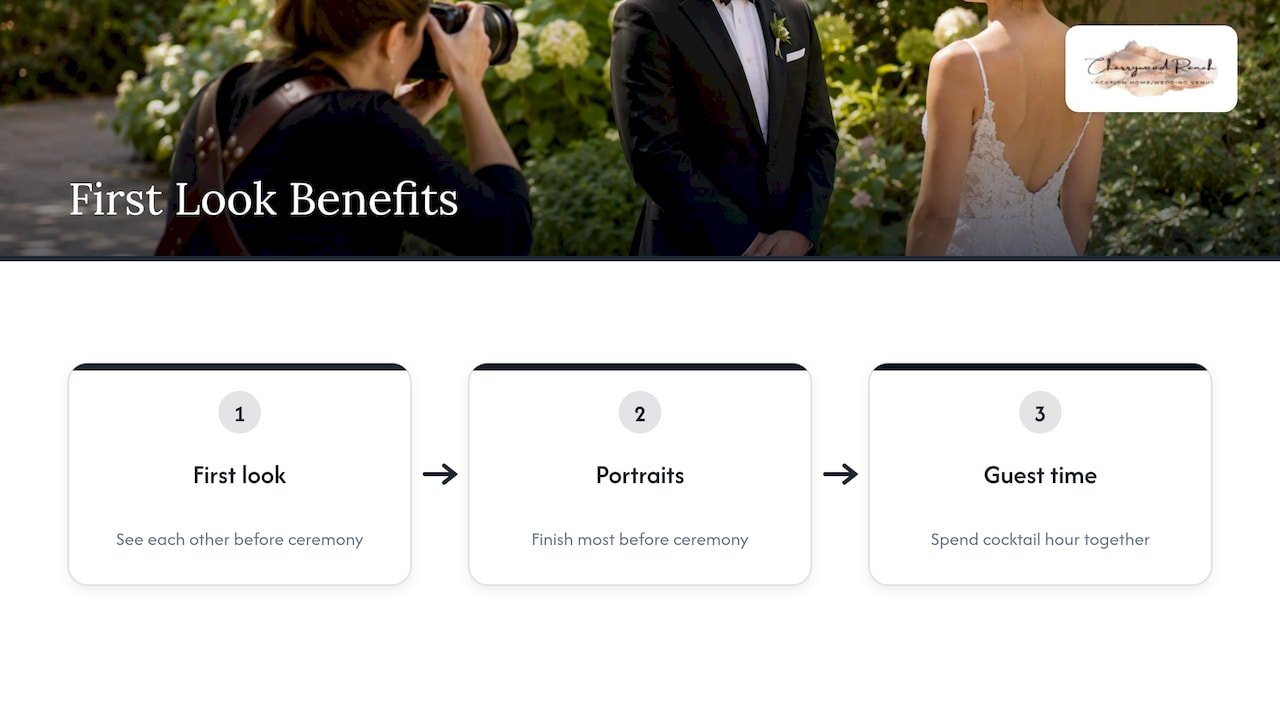
Photographers describe the first look as a stress-relief valve. One wedding photographer notes that finishing most portraits before the ceremony turns a rushed cocktail hour into time you can actually spend with guests. The spot you choose decides whether that benefit is real. If guests keep walking through the frame, you lose both the intimacy and the time.
The three tests every first look spot should pass
Planners tend to return to the same three criteria. WedKit’s logistics guide frames them as privacy, aesthetic quality and accessibility. Here is how each plays out in practice.
Privacy
The spot should be shielded from guest arrival paths and prep areas. Paperlust calls out a common mistake: choosing a pretty place that offers no privacy. Walk the property at the time guests will arrive and look back at your spot from the driveway, the porch and the parking area. If you can see it, so can they.
Good privacy usually comes from something physical: a tree line, a building, a hedge, a slope. Asking guests to “please stay inside” works for about ten minutes, and only if somebody is assigned to enforce it.
Light
Look for flattering natural light. That often means open shade rather than harsh direct sun, which WedKit lists as a core criterion. On a mountain property, a covered porch, the edge of a tree line or the side of a building facing away from the sun can all give you soft, even light on faces. Standing in full midday sun means squinting, shadows under the eyes and a rushed reveal.
Accessibility
The spot has to work for what you are wearing. The same WedKit guide warns against terrain that risks damaging bridal attire. Steep grass, loose gravel, wet leaves and long walks over uneven ground are all poor choices for a long dress or formal shoes. Mountain properties are slopes by nature, so ask yourselves how many steps and how much grade stand between the getting-ready room and the spot. Also think about anyone who needs a flat route, such as a grandparent who might sneak a look from a distance.
Types of first look locations that work
The most useful way to think about locations is by type. Every venue offers some mix of these.
| Location type | Why it works | Watch out for |
|---|---|---|
| Tucked-away garden or courtyard | Natural privacy, soft greenery, minimal background distraction | Needs a closed route so guests can’t wander in |
| Covered porch or deck | Open shade, weatherproof, usually close to getting-ready rooms | Railings and furniture can clutter photos |
| Tree line or woodland edge | Dappled light and depth for portraits | Uneven ground, bugs, wet leaves after rain |
| Overlook or open field with a view | Dramatic mountain backdrop, great at golden hour | Exposure to sun, wind and sightlines from the driveway |
| Window-lit corridor or indoor room | Reliable in any weather, calm and quiet | Less scenery, so it works best as the backup |
| Poolside or lawn | Lots of room to move, easy for photographers | Guests tend to gather there early |
Planners often recommend window-lit corridors, private gardens and tucked-away courtyards because they cut down on background distractions and foot traffic. The overlook is the classic mountain choice, but only if you can control who sees it.
Why mountain settings are different
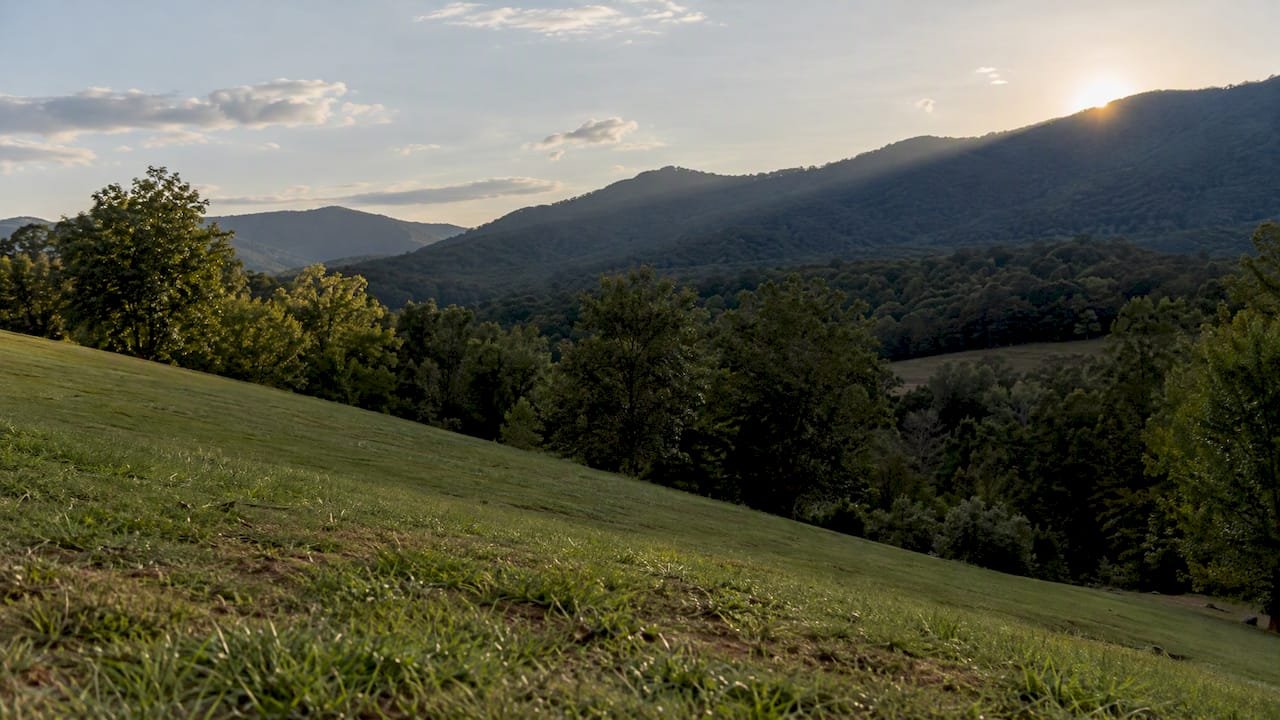
Mountain venues give you views that city venues can’t. They also bring slope, shade from ridgelines and weather that changes fast. A ridge to your west can drop the sun behind it long before the official sunset time. A valley can hold cool air in the morning. Choose your spot by visiting it at the hour you plan to use it, not at noon on a site tour.
Timing your first look around the light
A first look needs 15 to 30 minutes of dedicated time, and it works best a few hours before the ceremony. The Knot’s sample timeline allots 15 minutes for the first look, followed by 30 to 45 minutes of couple portraits, with family formals completed before the ceremony.
In the mountains, the sun sets the schedule. Ever Weddings points out that golden hour begins roughly an hour before civil sunset, and recommends working backward from there. They also note that North Georgia sunsets sit around 6:50 PM in October and around 5:30 PM in December. That is a swing of more than an hour, and it changes everything about when you meet.
For current local times, the Axios Atlanta report on fall sunsets shows how quickly evening light disappears after summer, based on NOAA data. If you want a feel for how photographers and hosts think about seasonal light in mountain country, these seasonal sunrise and sunset spots in another Appalachian-area gorge show how much the angle and warmth of the light change from one viewpoint to the next.
A sample timeline
Here is an example for an October ceremony with a sunset around 6:50 PM. It is an illustration, not a rule. Shift it to match your own sunset and your own ceremony time.
| Time | What happens |
|---|---|
| 1:00 PM | Photographer arrives for detail shots: rings, invitations, attire |
| 1:30 PM | Hair and makeup wrap up |
| 2:00 PM | Weather decision time: outdoor plan or backup |
| 2:30 PM | First look, about 15 to 30 minutes |
| 3:00 PM | Couple portraits, 30 to 45 minutes |
| 3:45 PM | Buffer, then wedding party photos |
| 4:30 PM | Family formals |
| 5:30 PM | Guests seated, ceremony begins |
| 6:00 PM | Ceremony ends, cocktail hour, short sunset portraits |
The small buffer rows matter. WedKit notes that transitions between locations often take longer than expected, especially with more than four people, and recommends a 15-minute cushion between photography blocks. In a small group like ours, with a large share of the wedding party staying on site, those transitions get shorter. They never disappear.
Build the backup before you need it
North Georgia weather can change in an afternoon. In our own guidance on North Georgia wedding weather, we explain why storms tend to build in the middle of the day, and why the backup space matters as much as the main plan.
The forecasting advice from the professionals is consistent. A meteorologist quoted by one photographer advises against obsessing over the forecast weeks ahead, since reliable hourly rain predictions only appear within roughly 0 to 36 hours. Ever Weddings suggests agreeing on an indoor pivot plan with a fixed decision time, for example 2:00 PM, so nobody is deciding in a panic.
For the first look, this means choosing two spots in advance:
- Plan A: your best outdoor option, with a view and private access.
- Plan B: a covered or indoor space that still feels private, ideally a porch, a large window or a room with good natural light.
A wet first look under a covered porch can be lovely, with soft light and a hush from the rain. A first look that is delayed while everyone argues about the sky is the real problem. Our rain plan guide for outdoor weddings walks through how to set that up.
Our perspective: why the first look is easier when you stay on site
Most first look advice assumes you are driving. You get ready at a hotel, shuttle to a venue, find a hidden corner, and hope a guest hasn’t beaten you there. Each step adds time and risk.
At Cherrywood Ranch, the wedding and the lodging are the same place. Our vacation home sleeps up to 16 guests, and the grounds include extensive outdoor spaces, mountain views, a pool and a hot tub. That changes how a first look works. Nobody has to travel between getting ready and the reveal. The couple can choose a spot in the morning, walk it, and adjust the plan with the photographer without anyone waiting on a shuttle.
It also changes who is around. With a weekend format, your closest family and friends are staying with you, so you can tell them exactly when and where they need to be elsewhere. Guests who arrive for the ceremony only find the first look spot empty and quiet because they were never there.
We suggest couples do three things when they stay with us:
- Walk the property together the day before, at the hour planned for the first look, and note where the sun falls.
- Pick one outdoor spot and one covered backup, and tell the photographer both.
- Keep the 15-minute buffers. A relaxed weekend is the point, so don’t fill every minute.
These are the same principles in our guide to choosing the right venue for a mountain weekend wedding. A first look is the smallest version of a bigger idea: fewer moving parts make for a calmer day.
— Luis
Booking time at the ranch
If you want to see how our spaces work for a first look, the practical first step is to book time on the property. Our published rates are $175 for a Mini Session, $350 per hour, and $1,950 per day for a Day Session. You can see all of them on our booking page.
For full weddings, elopements and the 3-day wedding package, see our services page or contact us about a wedding weekend. Those packages don’t have published prices, so we quote them directly. Guest overage fees are $10 per guest over 10 and $10 per guest over 75.
Common first look mistakes
- Choosing for the view only. Check sightlines from the driveway, porch and parking area first.
- Scheduling too close to the ceremony. Leave a few hours, as the sample timelines do, so portraits don’t crowd the ceremony.
- Ignoring the sun’s angle. Look at the spot at the planned hour. Mountain ridges can cast shade earlier than you expect.
- Skipping the backup. Pick a covered space and set a decision time.
- Forgetting the shoes and the dress. Test the walk. Steep or wet ground can ruin an outfit and a mood.
- Planning no buffer. Add 15 minutes between photo blocks.
- Inviting an audience. If the first look is meant to be private, tell your wedding party where they should not be.
A quick checklist for choosing your spot
- Visit at the planned time of day, not at noon.
- Look back at the spot from every place guests will stand.
- Check the surface under your shoes, and the slope.
- Identify the open shade and the direction of the sun.
- Choose a covered backup that is also private.
- Agree on a weather decision time with your photographer and planner.
- Tell your wedding party exactly which areas to avoid until the reveal is done.
If you are still deciding between seasons, our mountain wedding seasons guide explains why fall dates book 12 to 18 months ahead, and why the evening light matters for your photo plan.
FAQ
How long should a first look take?
Plan 15 to 30 minutes for the private moment and first portraits, according to The Knot’s sample timeline. Portraits of the two of you usually run another 30 to 45 minutes. Add a buffer so you never feel hurried.
Can we do a first look if it rains?
Yes. Choose a covered or indoor backup in advance, such as a porch or a window-lit room. Set a decision time like 2:00 PM, as Ever Weddings suggests, because reliable hourly forecasts only arrive within about 36 hours of the event.
What time of day is best for a first look?
A few hours before the ceremony, and ideally before the light turns harsh or fades. In North Georgia, work backward from sunset: it falls around 6:50 PM in October and around 5:30 PM in December, so the same plan can’t be used in both seasons.
Is a first look worth it at a small wedding?
Often more so. With a smaller guest list, a first look still gives you a private moment and moves portraits ahead of the ceremony. You then spend the reception with your people instead of a photographer. If you prefer to see each other for the first time at the aisle, that is a valid choice too.
Sources
- The Knot: Sample wedding timeline for a 4 p.m. ceremony
- The Knot: The pros and cons of a first look
- WedKit: Wedding first look logistics
- Paperlust: Wedding first look guide
- Ever Weddings: Mountain wedding tips for North Georgia
- Mandi Mitchell: Wait to check the weather
- Katie Ralynn: How to photograph first looks
- Axios Atlanta: Atlanta sunset times, fall 2026