
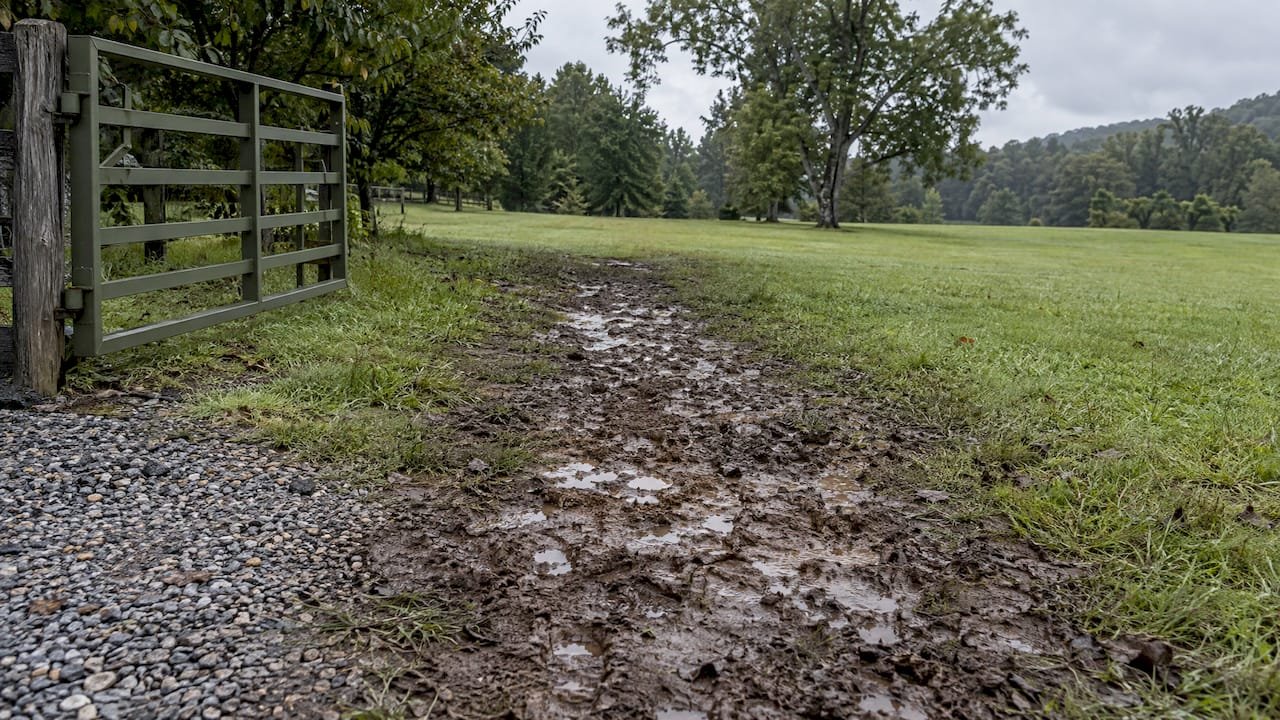
You control mud at an outdoor wedding by protecting the routes guests actually walk, not by trying to cover the whole property. Walk the site early, fix low spots and thin grass, put firm surfaces under the busiest paths and gathering areas, and keep a written wet-weather call schedule. Guests in heels get a few simple tools too. Staying at a venue where the wedding weekend happens on one property makes every step easier, because you can see the ground, in all kinds of weather, before the day that matters.
TL;DR
- Mud comes from wet soil plus foot traffic. Plan the routes first, then decide what to cover.
- Fix the ground weeks ahead: level low spots, fill bare patches and check where water collects.
- Put mats or flooring where traffic concentrates: parking, ceremony seating, restrooms, cocktail hour, reception and vendor access.
- Heel savers help on firm, damp grass but are not a substitute for flooring on soggy ground. Block heels or a backup pair are safer.
- Set a trigger-based rain and mud plan with a decision schedule so the call is never made in a panic.
Table of Contents
- Why outdoor weddings get muddy
- Start with a walk of the site
- Fix the ground before you cover it
- Cover the routes that matter
- Build a wet-weather plan with triggers
- Heel savers for grass: what they do and when they help
- Questions to settle before you book a venue
- Our perspective on mud and mountain weddings
- Plan the whole weekend in one place
- FAQ
- Sources
Why outdoor weddings get muddy
Mud is a traffic problem as much as a weather problem. Rain softens soil, then dozens of people walk the same short paths between the parking area, the ceremony lawn, the bar and the restrooms. Compacted, thin turf drains badly, so the same spots turn to slop first.
Turf specialists describe this pattern in lawn care terms. The University of Massachusetts Extension lists redirecting traffic patterns and aerifying soil as core practices for reducing compaction and helping turf recover after heavy use. That is useful for a couple because it tells you where to put your effort: spread out the traffic, and give water somewhere to go.
The good news is that you do not need to protect every square foot. A wedding has a small number of high-traffic zones, and those are what you plan around.
Start with a walk of the site
The single most useful thing you can do is walk the grounds with the person who runs the venue, ideally more than once and at least once after rain. Look for:
- Low spots where water pools after a storm.
- Bare or thin grass, especially near gates, steps and under trees.
- Slopes that could turn slick, particularly on the way from parking to the ceremony.
- Vendor access points, where heavy carts, a rental truck or a caterer will cross the lawn.
Some flooring suppliers suggest doing this ground-focused walk-through 8 to 12 weeks before the wedding, which leaves enough time to fix what you find. If you are still comparing venues, our venue walkthrough checklist covers what to look at before you sign, and ground conditions belong on that list.
Take photos on the walk. Mark the paths on a simple sketch: where guests park, where they enter, where they sit, where the restrooms are and where the vendors load in. That sketch is the plan for everything below.
Fix the ground before you cover it
Soil work comes before flooring, because a covered problem is still a problem. Landscapers recommend planning guest routes, mowing and watering the lawn, filling bare or thin patches with sod or seed, leveling low spots and checking drainage ahead of an event.
For a couple, that translates into a short list of requests to the venue or whoever maintains the grounds:
- Level the dips. A shallow depression in the middle of the ceremony aisle will hold a puddle long after the rest of the lawn is dry.
- Patch bare ground early. Seed and sod need weeks to root. Starting two months out is far better than starting two weeks out.
- Water and mow normally. Healthy, dense turf takes foot traffic better than stressed grass.
- Redirect traffic. Give guests a clear, attractive path, such as a mulched or gravel walk or a row of lanterns, so they do not make their own shortcut across the softest ground.
- Ask about aeration. Loosening compacted soil helps water soak in, which is the same practice turf guidance recommends for recovery after heavy use.
If your wedding is in a mountain setting, remember that slopes shed water downhill. A path that runs across a slope can carry runoff; a path that runs along the contour is usually easier to keep dry. Mark any spot where water crosses your route.
Cover the routes that matter
Once the ground is in the best shape it can be, add firm surfaces where traffic is heaviest. One flooring supplier’s guidance recommends prioritizing the routes guests really use: parking, entrances, ceremony seating, restrooms, cocktail hour, the reception and vendor access. It suggests full flooring in key gathering spots and mats or walkways elsewhere, rather than flooring everything.
That matches how budgets actually work. Here is how the main options compare.
| Option | Best for | Watch out for |
|---|---|---|
| Interlocking composite or plastic mats | Walkways from parking, aisle, paths to restrooms | Pick a system rated for the loads and traffic it will carry |
| Interlocking tiles under a tent | Cocktail areas and dance floors that need a level, draining surface | Edges and transitions can become trip points |
| Raised subfloor (plywood platform) | Sloped or very uneven ground, heavy furniture, staging | Needs ramps or safe transitions |
| Carpet, vinyl or wood-look flooring | A polished finished look inside a tent | Lay over a proper subfloor, never straight onto muddy grass |
| Mulch, wood chips, gravel paths | Informal garden paths and rustic styles | Needs spreading and maintenance before the day |
Mats for walkways
Interlocking composite mats can create stable platforms and anti-slip pedestrian pathways over wet, soft or uneven ground, and the manufacturer notes that you should choose a system suited to the application and the weight load. Walkway mat makers also describe traction patterns, drainage perforations and mats that rinse clean, which matters when a path has to look decent in photos as well as work.
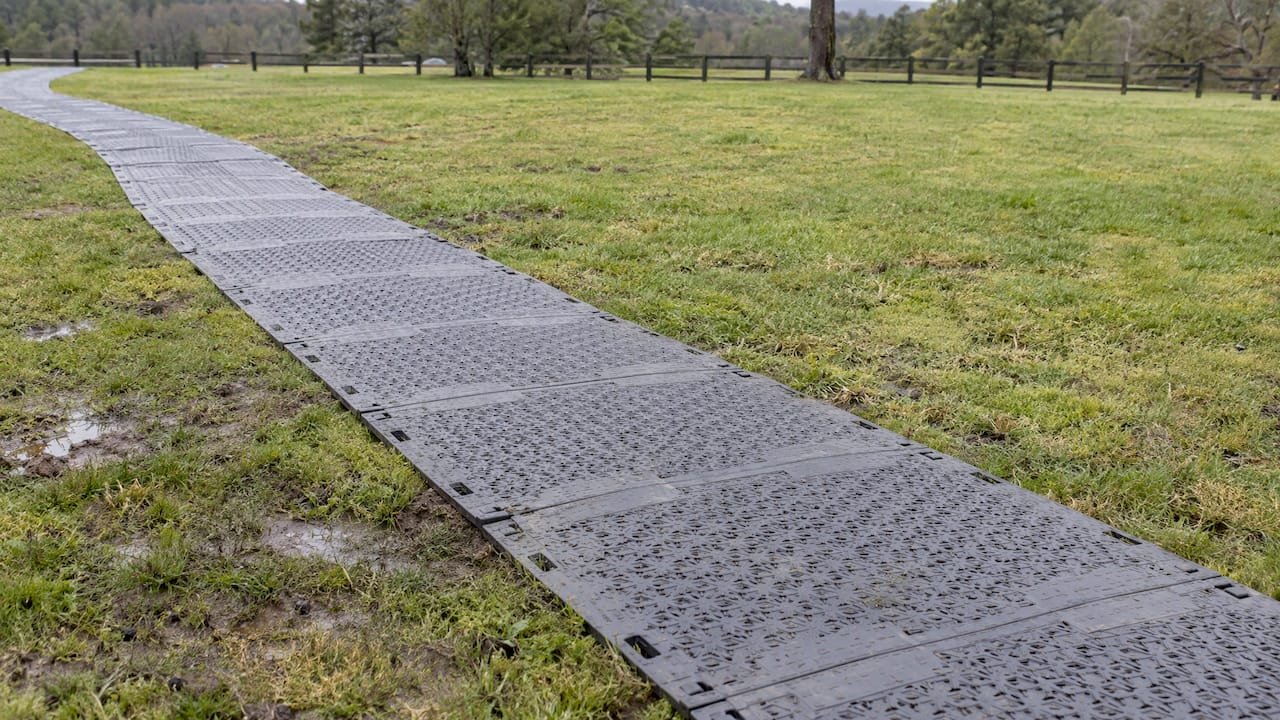
Keep people and vehicles on separate routes. If a catering van or rental truck crosses the same path as guests, wet ground can mean both unsafe walking and equipment sinking in, so use a mat system rated for the vehicle load wherever trucks go.
Flooring under the tent
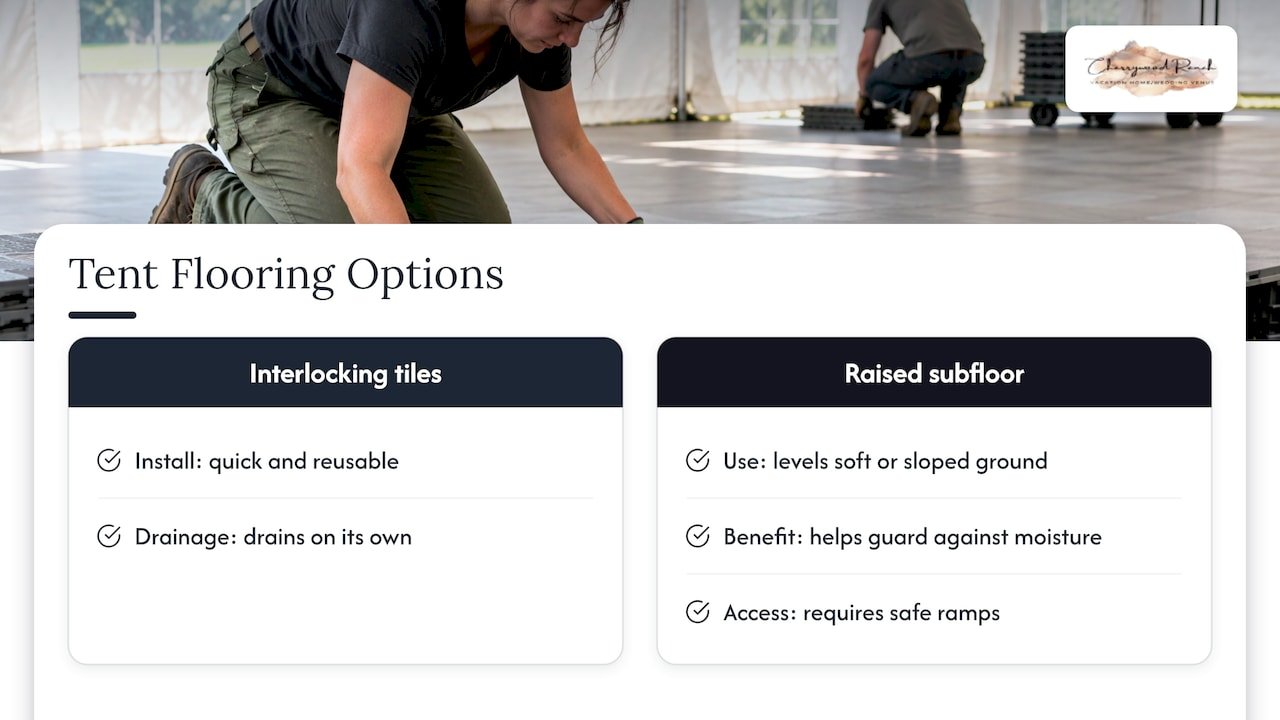
A floor cannot stop a flood, but it can keep a reception usable. Under a tent, interlocking polypropylene tiles install quickly, are reusable and drain on their own. On badly sloped or soft ground, a raised plywood subfloor can level the surface and help guard against ground moisture.
If you want carpet or a wood look inside the tent, lay it over a proper subfloor rather than directly on muddy grass. Carpet is comfortable but not waterproof and stains easily; vinyl is waterproof and durable but needs a flat base underneath.
Before you sign a rental order, confirm the details that cause problems on the day: traffic class, panel connections, edge finishing, trip hazards, width, slope stability, ramps and transitions. Raised floors in particular need ramps, so anyone using a wheelchair, walker or stroller can get on and off safely. If you are laying out where the tent, dance floor and bar sit, our five-zone outdoor wedding layout puts tents and flooring first for exactly this reason.
Do not forget the restrooms and the approach
Restrooms are where mud follows guests indoors or into a trailer. Put a mat outside each door, and give portable restrooms a stable walkway rather than a lawn crossing. Lighting and extension cords along those routes need to be checked before guests arrive, since cords in wet grass are both a trip and an electrical concern. The same goes for power for the tent and band: our guide to outdoor wedding power explains how to size it.
Build a wet-weather plan with triggers
Mud control is half physical and half decision-making. Most couples lose a day of calm because nobody decided in advance what “too wet” means. Write down a schedule that works backward from the ceremony, with a single named person making each call, and decide in advance:
- At what point do mats go down? For example, once the forecast shows a meaningful chance of rain for the days before the wedding.
- When does the tent or sidewalls go up? Sidewalls also help with wind, which often arrives with storms. Our guide to a windy outdoor wedding covers that side.
- When does the ceremony move? Many planners use a decision schedule of roughly 72, 48, 24 and 6 hours out, with the final call made before guests leave for the site.
- Who tells guests and vendors? A text, a wedding website banner and one point of contact keep everyone on the same page.
Outdoor wedding guidance commonly asks for rain and wind contingency plans, sidewalls and flooring for uneven terrain, and a vendor walkthrough weeks ahead. Our full rain plan for an outdoor wedding goes through the triggers, the run sheet and the budget.
For general weather planning on a backyard-style event, this backyard wedding planning checklist is worth a skim for sidewalls and flooring ideas for receptions.
On the day itself, a short routine helps:
- Walk every route one hour before guests arrive, from parking to the last restroom.
- Check mat joints and edges for lifted corners.
- Put a basket of flip-flops, towels or spare socks near the entrance of the reception.
- Keep a few people on shuttle or umbrella duty so guests do not cut across soft turf.
- Photograph the first look and portraits on the firmest surfaces, such as a deck, a patio or a mat-lined path, so dress hems stay clean.
That last point answers a common worry from brides who plan a first look and photos before the ceremony and fear a muddy dress. Choose the portrait locations from your site walk, and lay a pathway to them.
Heel savers for grass: what they do and when they help
Guests in stilettos or thin heels sink into soft lawn, and heel savers are the cheap, popular fix. They are small caps that fit over a narrow heel tip. By widening the contact area, they spread pressure and reduce sinking into grass while adding stability, and many use clear material with textured or anti-slip bases.
How to choose and fit them
- Measure the heel tip and compare it with the manufacturer’s size guide. Correct sizing makes protectors less likely to come off or scuff the shoe.
- Try them on at home, walk on a lawn and check that they stay on.
- Pack a spare pair, since small caps are easy to lose.
Their limits
Heel savers work on firm, dry or lightly damp grass. On saturated lawns or very soft mud, any heel can sink, so they do not replace firm flooring. For those conditions, wider block heels, wedges and flats are more dependable, and a backup pair of comfortable shoes in the car is good insurance. A good rule is to choose shoes for the softest surface you will meet, not the hardest.
If you want guests in dress shoes without worry, give them a firm path from parking to the seats and the dance floor. Include a line on your wedding website, such as: “Our ceremony is on a lawn. Block heels or flats are the most comfortable choice, and heel protectors are a great addition.” Guests appreciate knowing ahead of time, and it costs nothing.
Questions to settle before you book a venue
Mud control is far easier when you ask about it before you commit. Ask any venue:
- Where do guests park, and how far is the walk to the ceremony?
- Is there a hard-surface route, such as a deck, patio, paved or gravel path?
- Where does water collect after heavy rain, and has the venue ever had to move a ceremony?
- Is there a tent or covered area, and can flooring or sidewalls be added?
- Where will vendors load in, and is that route separate from guest paths?
- What is the backup plan, and who calls it?
If the answers are vague, you will be solving mud problems on your own with a rental company and a deadline. That is the strongest argument for choosing a venue where the ceremony, reception and lodging all sit on one property: you see the real ground and real weather over a weekend rather than a single afternoon. For an overview of this approach, see how our tented mountain wedding weekend works without vendor juggling, and outdoor reception ideas that hold up when the weather turns.
Our perspective on mud and mountain weddings
Most couples picture the ceremony and forget the walk to it. Mud is rarely about one bad patch of lawn. It is about the dozens of small trips guests make over a weekend: to the car, to the restroom, to the bar, to the photos at sunset.
That is why we like the wedding weekend format. At Cherrywood Ranch, up to 16 guests can stay in the luxury vacation home on the property, with a pool and hot tub, so the family is not shuttling between a hotel and a venue. Fewer car trips and a private property mean fewer unknowns for you to manage.
Our advice is the same whatever you choose: walk the ground early, decide your wet-weather plan in writing and spend your budget on the routes people actually use. A couple who has done that can relax when the clouds roll in over the mountains.
Luis
Plan the whole weekend in one place
Cherrywood Ranch has an outdoor ceremony lawn, covered reception pavilion, and lodging for up to 16 overnight guests with a three-night package. See our wedding packages and pricing and discuss your wet-weather layout on a tour.

If you are weighing a weekend wedding against a one-day event, our guide to the all-inclusive weekend venue rental explains what is included and why it simplifies planning.
FAQ
How do I keep an outdoor wedding from getting muddy?
Fix the ground first by leveling low spots, patching bare turf and checking drainage. Then put mats or flooring on the busiest routes and gathering areas, and keep guests on those paths. Add a written rain plan with a decision schedule so you act early rather than react late.
Do I need to floor the entire venue?
No. Focus on parking, entrances, ceremony seating, restrooms, cocktail hour, reception space and vendor access. Full flooring makes sense in the main gathering areas, while mats or walkways usually cover the rest at a lower cost.
Do heel savers for grass really work?
They work best on firm or lightly damp lawns, where the wider base keeps a narrow heel from sinking. Measure the heel tip so the fit is snug, and bring a spare pair. On saturated ground, block heels, wedges or flats are more dependable.
Can I put carpet or vinyl directly on wet grass?
It is better to lay carpet, vinyl or wood-look flooring over a proper subfloor. Carpet stains and is not waterproof, while vinyl needs a flat base. A raised platform also helps with slopes and ground moisture.
Sources
- Best Management Practices for Lawn and Landscape Turf, UMass Extension
- How Should You Prepare Your Landscape for an Outdoor Wedding or Event
- Wedding Venue Ground Protection Checklist
- Tent Flooring for an Outdoor Wedding: Options, Costs and Planning Tips
- Outdoor Event Flooring: Portable Composite Mats for Events
- Outdoor Walkway Mats and Matting
- Marquee Flooring: Complete Guide to Event Tent Floor Options
- Tent Flooring Options: Camping, Events and Weddings Guide
- The Ultimate Outdoor Wedding Guide
- STOPPERS Heel Protectors
- The 5 Best Heel Protectors For Grass
- Backyard wedding planning checklist