
For a private multi-day wedding on North Georgia property, expect to need a county special event permit, proof of liability insurance, a site plan, and vendor or health approvals, plus an alcohol permit if drinks are sold or a cover charge applies. Most counties want the application filed several weeks before your first event date. The best first move is a call to your venue’s county development services office, environmental health division, or fire marshal, since each handles a different piece of the approval.
TL;DR:
- Applying for a special event permit requires a complete application, site plan with measurements, proof of liability insurance at a minimum of one million dollars, and vendor or health permits, all submitted at least 30 days before the event.
- Structures over 400 square feet need manufacturer specifications and anchoring details to meet fire code requirements, with early fire marshal review to avoid last-minute rejections.
- Hosting alcohol sales, charging cover charges, or selling drinks at the wedding demands a separate state license, generally filed at least 10 days before the event.
- Confirm vendor permits and insurance coverage beforehand, as unpermitted vendors can trigger enforcement actions and jeopardize the event approval.
- Choosing a single-location venue with onsite lodging simplifies permit logistics by reducing the number of approvals and site layout complexities.
Table of Contents
- 1. At-a-glance permit checklist for private weddings in North Georgia
- 2. How to apply: timeline, required forms, and what to include
- 3. Site, safety, and temporary structure rules you can’t skip
- 4. Alcohol at private weddings: when you need a special license
- 5. Vendor vetting and health permits: catering and mobile bars
- 6. Common permit pitfalls and quick fixes
- 7. Cherrywood Ranch perspective: how a private venue supports permit compliance
- 8. Why county paperwork, not the wedding itself, trips up most couples
- Book Cherrywood Ranch: how we help you plan a compliant wedding weekend
- FAQ
- Sources
1. At-a-glance permit checklist for private weddings in North Georgia
Before you call anyone, it helps to see the whole picture in one place. County offices process dozens of these applications a season, and the ones that move fastest are the ones that show up complete.
- Special event permit from the county development or planning office, covering the event dates and setup/teardown days.
- Site plan showing tents, parking, pathways, sanitation stations, and emergency access points.
- Certificate of insurance naming the county as additional insured, commonly at a $1,000,000 minimum.
- Tent documentation, including manufacturer specs and anchoring details, for any structure over 400 square feet.
- Sanitation plan listing portable restroom counts and servicing schedule.
- Vendor health permits confirming caterers and mobile bars are authorized to operate.
- Occupancy and fire marshal sign-off based on expected guest count and structures used.
- Noise or quiet-hour compliance with local ordinance limits.
Many North Georgia counties request special event applications several weeks before the event, and they expect a site plan and proof of insurance submitted alongside it, not after. Waiting until two weeks out is the single most common reason applications stall.
2. How to apply: timeline, required forms, and what to include
Treat your permit application like another wedding vendor contract: it needs a deadline and a checklist, not a vague intention to “get to it.”
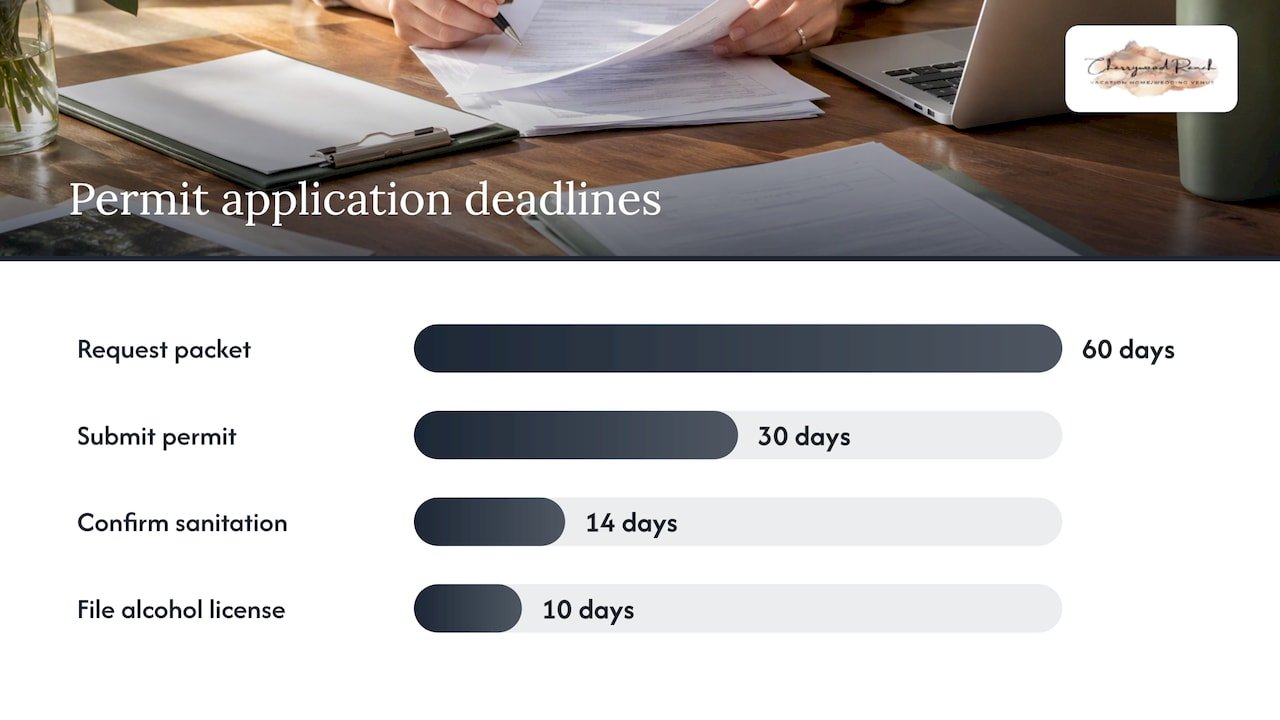
- At 60 days out, confirm which county office handles special events for your venue’s address and request their current application packet.
- At 30 days out, submit the special event permit application with your site plan, insurance certificate, and vendor list, since Cherokee County’s special event process and similar North Georgia counties use this as their standard window.
- At 14 days out, confirm vendor health permits are filed and your sanitation servicing schedule is documented, since Georgia DPH expects portable units serviced at least every seven days.
- At 10 days out, file for any special event alcohol license if one applies, since Georgia’s state portal recommends this minimum lead time.
Your site map doesn’t need professional drafting software, but it does need real measurements: tent footprint, parking rows, distance from toilets to the ceremony area, and a marked emergency vehicle route. Mark whether paths are paved or grass, since several county applications ask directly.
Pro Tip: Photograph your actual property layout and sketch over a printed copy. Counties care more about accuracy than polish.
3. Site, safety, and temporary structure rules you can’t skip
Tents, toilets, and fire access sound like small details until they’re the reason a permit gets kicked back. These thresholds show up across nearly every North Georgia county application.
- Tents over 400 square feet typically require manufacturer set-up and anchoring specifications, tied to International Fire Code compliance.
- Fire marshal review is usually triggered by guest count or temporary structure size, and early contact prevents late rejections, according to Cherokee County’s film and special-use application.
- Occupancy limits get set by the fire marshal based on exits, structure size, and parking capacity, not just guest headcount.
- Septic and water capacity matter for any property hosting an overnight crowd, and county staff reports for venues with lodging flag this as a common sticking point, per a Hall County staff report on an event venue with lodging.
- Restroom servicing schedules need to appear in writing, not just exist on-site, since enforcement can follow if units aren’t serviced on the required cycle.
If your parking plan relies on an off-site overflow lot, document legal access through an easement or written owner permission, since counties can require proof before approving the plan.
4. Alcohol at private weddings: when you need a special license
Hosting an open bar at your own wedding is different, legally, from selling drinks or charging guests a cover. The distinction decides whether you need a license at all.
- Host-provided alcohol with no sale or cover charge generally doesn’t require a special event alcohol license under most local rules.
- Charging for drinks, selling tickets that include alcohol, or hiring a cash bar typically triggers the need for a special event license.
- Georgia processes these through centralized state systems, and the Department of Revenue’s special event licensing guidance points applicants to the Georgia Tax Center and Alcohol and Licensing Portal.
- The state recommends filing at least 10 days before the event, though earlier submission avoids last-minute denials.
- Expect to provide proof of the event date, venue address, and sometimes local county sign-off alongside the state application.
If you’re unsure whether your bar setup counts as a sale, ask the county office directly before finalizing your catering contract. It’s a five-minute call that saves a permit headache later.
5. Vendor vetting and health permits: catering and mobile bars
The organizer, not the vendor, is usually the one on the hook if an unpermitted caterer or bar shows up at a private event. That makes vendor vetting part of your permit work, not a separate task.
- Request a copy of each food or beverage vendor’s current health permit before signing a contract.
- Confirm liability insurance coverage for each vendor, separate from the venue’s own policy.
- Get a local contact name and phone number for each vendor team arriving on-site.
- Add a written clause to vendor contracts requiring proof of permits before arrival, since Georgia DPH’s temporary event guidance places enforcement responsibility on the event organizer, not just the vendor.
Pro Tip: Ask every caterer and mobile bar for their permit number in writing, then keep copies in one folder you can hand to county staff if asked.
6. Common permit pitfalls and quick fixes
Most denials and delays trace back to a short list of repeat mistakes. Fixing them early is cheaper than fixing them the week of the wedding.
- Late submission: file the special event application at the 30-day mark, not closer.
- Vague site maps: include real measurements, not a rough sketch.
- Insurance below the minimum: confirm your policy meets the $1,000,000 threshold before submitting.
- Unpermitted vendors: collect permit copies before signing any vendor contract.
- Tent noncompliance: get manufacturer anchoring specs ready if your tent exceeds 400 square feet.
- Noise ordinance conflicts: check local quiet hours and consider a sound assessment for outdoor venues if amplified music is planned.
On the day itself, keep one responsible party, a vendor contact list, and permit copies on hand in case a county inspector stops by.
7. Cherrywood Ranch perspective: how a private venue supports permit compliance
A destination wedding venue in North Georgia that hosts one group at a time removes several of the usual permit headaches before they start. We book a single wedding party per weekend with onsite lodging, which keeps occupancy, parking, and sanitation planning far simpler than a venue juggling multiple bookings or public access.
Because the property functions as both ceremony space and lodging, there’s no need to coordinate separate permits for overnight guests arriving at a different address. Couples planning their event typically work from a known site layout and established vendor relationships already familiar with local county expectations, which cuts down the back-and-forth that usually slows down a first-time filer.
8. Why county paperwork, not the wedding itself, trips up most couples
The permit process intimidates people because it sounds bureaucratic, but the actual requirements are predictable once you see them laid out. The real risk isn’t the paperwork itself. It’s treating the permit as an afterthought behind flowers and seating charts.
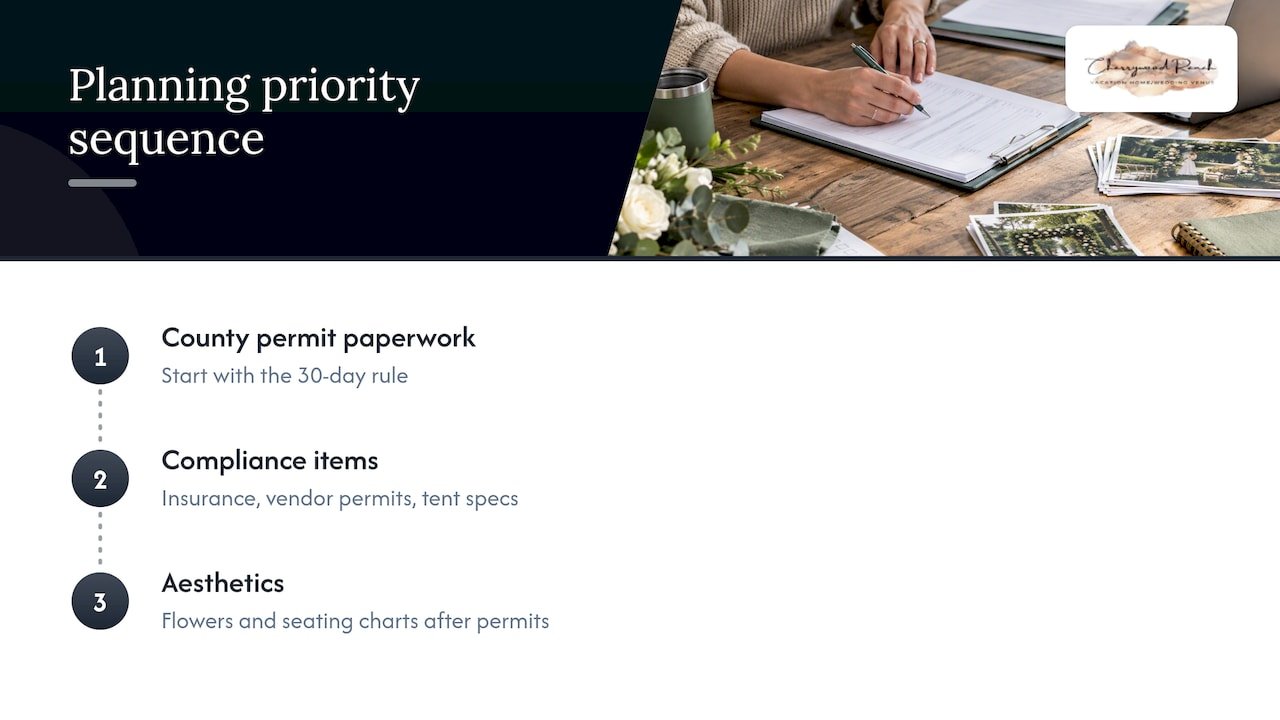
Conventional wedding planning advice spends most of its energy on aesthetics and almost none on the fact that a tent over 400 square feet or an unpermitted caterer can shut down an event hours before it starts. That’s backward. A beautiful reception with no fire marshal sign-off is not a backup plan, it’s a canceled wedding.
If you take one thing from this guide, make it the 30-day rule. Everything else, insurance limits, vendor permits, tent specs, flows from having that window of time to fix problems before they become emergencies. Couples who treat the county office like just another vendor to schedule tend to have calmer wedding weeks than those who treat it like a formality.
— Luis
Book Cherrywood Ranch: how we help you plan a compliant wedding weekend
We offer elopement packages and a 3-day wedding package with onsite lodging, so your ceremony, reception, and guest accommodations sit on one property instead of three separate addresses needing three separate approvals. That single-location model is the practical advantage: fewer moving pieces for county offices to review, and a property team familiar with what local permitting actually requires.
We can walk you through what a typical North Georgia county expects for site plans, insurance, and vendor documentation as part of planning your weekend with us.
- Browse available dates and session options to see what fits your timeline.
- Review elopement and multi-day wedding packages to compare what’s included.
- Reach out directly to ask about permit preparation support before you book.
FAQ
Do I need a permit for a small backyard-style wedding on private land?
Most counties still require a special event permit once you exceed a certain guest count or add tents, amplified sound, or vendors, even on private property. Check with your county’s development services office, since thresholds vary by jurisdiction.
How far in advance should I apply for a North Georgia wedding permit?
Plan to submit your special event application at least 30 days before your first event date, which matches the window many North Georgia counties request, including Cherokee County’s special event process. Alcohol licensing has a shorter minimum window of about 10 days, but earlier filing is safer.
What insurance minimum do counties typically require?
Many county special event applications ask for a certificate of liability insurance commonly at a $1,000,000 minimum, naming the county as additional insured. Confirm exact requirements with your specific county.
Does Cherrywood Ranch help with permit paperwork?
Cherrywood Ranch’s team can share what local counties typically expect for site plans, insurance, and vendor documentation as part of planning your wedding weekend with us. Specific permit filing remains the responsibility of the couple or their planner.
What happens if a vendor at my wedding isn’t properly permitted?
Georgia DPH guidance places responsibility on the event organizer to confirm that caterers and mobile bars hold current health permits before the event. An unpermitted vendor operating on-site can result in enforcement action and puts your own event approval at risk.
Sources
- Cherokee County special events permit
- Georgia DPH temporary event organizer application (DPH guidance)
- Georgia DOR special event licensing memo
- Cherokee County film/production application (film permit PDF)
- Hall County staff report (event venue with lodging)