
A self-catered wedding weekend works when you plan meals by who is actually at the table each day, choose dishes that cook ahead and reheat well, and hand every job to someone other than the couple. This guide gives you the meal-by-meal plan, the quantities, a prep timeline, the food safety numbers and the Georgia permit question to settle early.
TL;DR
- Plan five anchor meals: Friday dinner, Saturday breakfast, Saturday lunch, the wedding dinner and a Sunday brunch.
- Choose food that holds, travels and reheats: pasta bakes, roasted meats, taco bars and grain salads beat delicate last-minute plates.
- Start from about 1 pound of food per adult for a full meal, then adjust for who arrives and leaves when.
- Keep cold food at 40°F or below, hot food at 140°F or above, and reheat cooked-ahead dishes to 165°F.
- In Georgia, a private label like “DIY” does not settle whether a permit applies, so ask your local health authority before you sign anything.
Table of Contents
- What a self-catered wedding weekend really means
- The meal-by-meal plan
- Self-catered wedding menu ideas that hold up
- How much food to buy
- A make-ahead timeline
- Food safety: the numbers that matter
- Do you need a permit in Georgia?
- Equipment, helpers and the people who should not be working
- Plan your weekend at Cherrywood Ranch
- FAQ
- Sources
What a self-catered wedding weekend really means
It means you or your people buy, cook and serve the food, instead of one caterer doing it. For a weekend, that is not one meal but five or six, spread across two or three days, for guests who arrive and leave on different schedules.
That is why the weekend format suits a smaller group in one place. When everyone sleeps under one roof or on one property, breakfast happens naturally, a late arrival can still get a plate, and nobody drives to a restaurant. It is also why the work is mostly logistics, not cooking. The best self-catered weekends are the ones where the menu was designed around the labor available.
The meal-by-meal plan
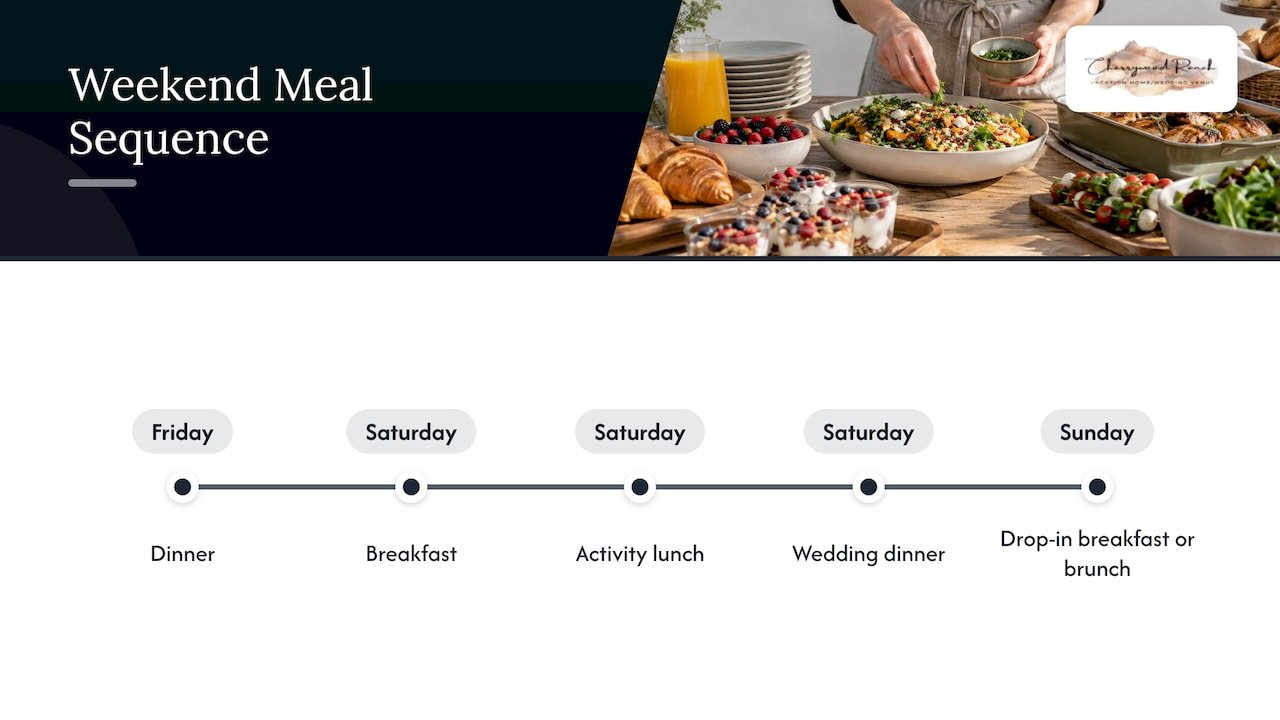
A common weekend structure runs Friday dinner, Saturday breakfast, a Saturday activity with a lunch break, the Saturday wedding dinner and a Sunday drop-in breakfast or brunch. Build your menu on that frame. If you want to see how these meals sit inside the full timeline, our weekend wedding schedule templates show four versions, from micro to destination.
Friday: the welcome dinner
Keep it loose. Early arrivals are tired, and the couple should be greeting people, not plating. For a welcome gathering, a charcuterie or hors d’oeuvres table works, as do taco, potato-bar or pasta-bar stations. WebstaurantStore lists cocktail-style, buffet and station formats as suitable for self-catering. Stations are forgiving: guests who arrive at 6:00 and guests who arrive at 8:30 both eat well.
If you want the evening to do more than feed people, our welcome party ideas cover how to get a group talking within two to three hours.
Saturday breakfast and lunch
Breakfast should need no supervision: baked egg casseroles assembled the day before, yogurt and fruit, bagels, coffee, and a pitcher of juice. Lunch is a break between a morning activity and wedding-day prep, so think sandwich platters, grain salads or a soup in a slow cooker. Nothing here should require the couple.
Saturday: the wedding dinner
For a simple wedding menu, WebstaurantStore suggests salads, rotisserie meats, pasta, roasted vegetables and rice dishes. Pick one protein, one starch, two vegetables, a salad and bread. A buffet lets guests serve themselves, and chafing dishes help keep hot food at safe temperatures. If you are weighing service styles, our guide to buffet versus plated wedding weekends explains why to ask for roughly 20% more food on a buffet.
Planning a sit-down for a larger group? See how family-style dinners work on site.
Sunday: the farewell brunch
Set it up as a drop-in. Guests leave at different times, so food that sits well for two hours is ideal: breakfast casseroles, pastries, fruit, a coffee station. Leftovers from Saturday can fill gaps, as long as they were chilled promptly (see the food safety section).
Self-catered wedding menu ideas that hold up
The rule that keeps self-catering sane: reliability beats sophistication. Dishes that portion, travel, hold and reheat predictably give guests a better experience than delicate food finished at the last second. Practical formats include roasted meats, pasta bakes, grain salads, sheet-pan vegetables, taco bars and sliders.
| Meal | Easy menu | Why it works |
|---|---|---|
| Friday welcome | Taco or pasta bar, charcuterie board | Guests serve themselves as they arrive |
| Saturday breakfast | Baked egg casserole, fruit, bagels | Assembled the day before, reheated in the morning |
| Saturday lunch | Sandwich platters, grain salad | Cold, no cooking during the busy day |
| Wedding dinner | Roast chicken or pork, pasta, roasted vegetables, salad, rolls | Holds in chafers, feeds a crowd |
| Sunday brunch | Pastries, fruit, French toast bake | Sits well while guests drift in |
One tip from Offbeat Wed: choose foods that can be cooked weeks ahead, frozen and reheated, and favor dishes with complex flavor, such as Indian or Mexican food. The same source cautions that appetizers and tapas often need more on-site work than entrees and sides, so keep passed small plates to a minimum.
Drinks are their own project. Our wedding bar setup checklist walks through it step by step.
How much food to buy
A widely used starting point is 1 pound of food per adult for a full meal. The same guide suggests:
- 6 to 8 pieces per guest for a one-hour cocktail hour
- for a buffet, per guest: 5 ounces of cooked protein, 4 ounces of starch, 4 ounces of vegetables, 1 cup of salad and 1.5 rolls
- one cake slice and about four drinks per adult across a four-hour reception
- children under 12 counted as about half an adult, with about 15% added for a buffet
For 100 guests, that guide works out to 32 pounds of buffet protein, 25 pounds of starch, 25 pounds of vegetables and 150 rolls. For a 25 to 40 person weekend, scale down proportionally and round up on protein.
Then adjust by day. Do not buy one grocery count for the whole weekend. Guests come and go, so build a simple grid: each meal down the side, each guest group across the top, and fill in who is there. That prevents both waste and shortages, a point Foodcrew’s weekend food plan makes about changing headcounts.
A make-ahead timeline
Exact timing depends on the dish, but this pattern works for most weekends:
- About a week out: cook and freeze soups, stews, casseroles, baked goods and suitable sauces.
- Several days out: move frozen items to the refrigerator to thaw. Chop vegetables, cook grains, mix marinades and dressings.
- The day before: assemble casseroles and cold salads. Pack coolers.
- The morning of service: reheat, garnish and set up warming equipment.
One exception from USDA: stuffing should not be mixed and held uncooked in the refrigerator. Dry and wet ingredients can be prepared separately, then mixed right before cooking, or frozen immediately if made ahead.
Food safety: the numbers that matter
With many guests, warm weather and food made in advance, safety is not optional. The USDA’s guidance for catered and DIY wedding food gives clear limits:
- Keep cold food at 40°F or below and hot food at 140°F or above during transport and service.
- Use insulated coolers with ice and thermometers for cold food, and insulated containers or chafers for hot food.
- Reheat cooked-ahead food to at least 165°F. Bring sauces, soups and gravy to a boil.
- Discard perishables left out more than two hours, or more than one hour when it is above 90°F.
- Store leftovers in shallow containers, refrigerate them promptly, and eat or freeze them within four days.
- Separate raw and ready-to-eat foods, wash hands and surfaces, and check temperatures with a food thermometer.
For the drive to the venue, USDA’s tailgating guidance recommends carrying cold perishables in an insulated cooler with ice or frozen gel packs and an appliance thermometer, wrapping raw meat and poultry securely, and bringing clean utensils for preparing and serving.
Do you need a permit in Georgia?
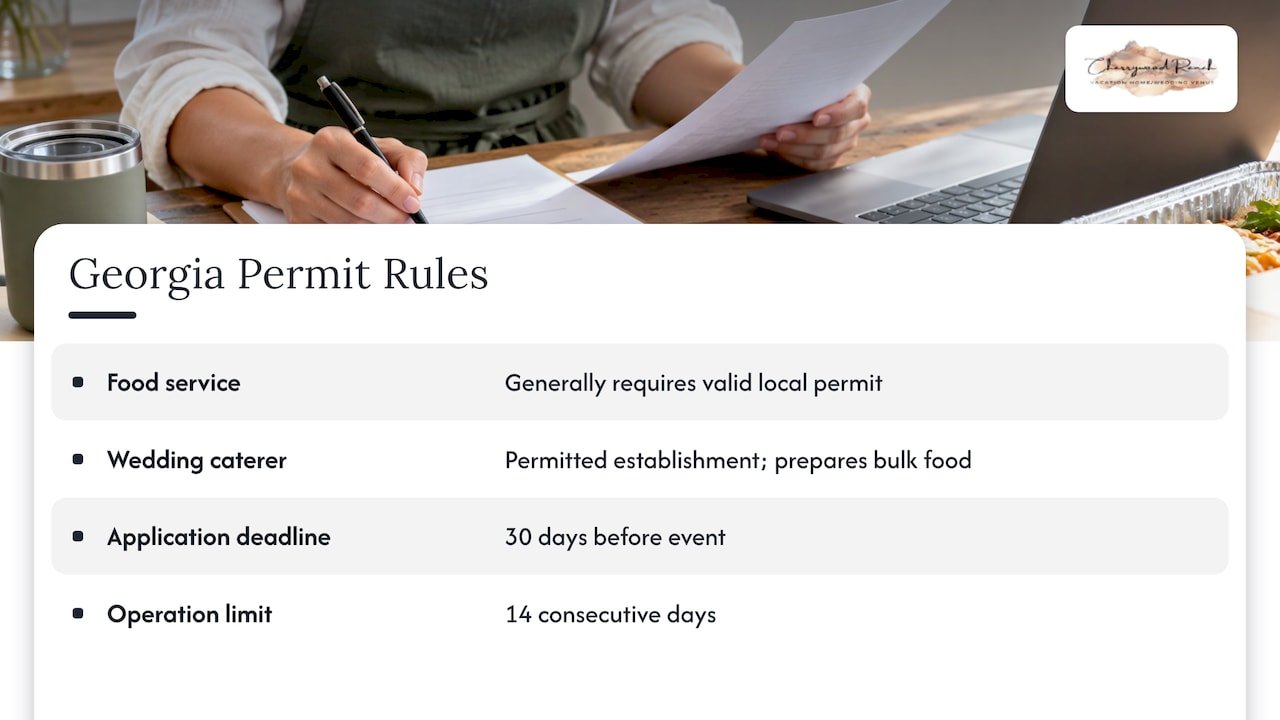
Ask this before you finalize the plan, not after. Georgia’s Department of Public Health states that operating a food-service operation, including catering, generally requires a valid permit from the local Health Authority. The state’s perspective is that classification follows how the operation runs and what food is served, so calling an event “DIY” does not by itself mean no permit or approved preparation facility is needed.
Two more details are worth knowing. The state’s interpretation manual describes a wedding caterer as a permitted food-service establishment contracted to prepare bulk food for a specific date, time, location and guest count. And a temporary food service application must be received 30 days before an event, with no operation beyond 14 consecutive days.
The practical step: call the county health department where the wedding takes place, describe who is cooking, whether anyone is paid, and where the food is prepared, and get the answer in writing. If you hire any helper to cook, that changes the picture, so say so on the call.
Equipment, helpers and the people who should not be working
Before you plan a single dish, list what the kitchen has. Offbeat Wed suggests checking the venue’s kitchen equipment, dishes, cookware, serving equipment, refrigerator, oven, dishwasher, storage space and grocery access. USDA’s guide for group cooking adds the basics: cutting boards, utensils, food thermometers, cookware, shallow storage containers, soap, paper towels, clean water, and enough refrigerator and freezer space.
Then assign people. The same USDA guide advises putting one person in charge to instruct volunteers and oversee preparation, service and cleanup. A workable split:
- Lead coordinator: owns the timeline and answers every question so the couple does not have to
- Food captain: runs the kitchen and temperature checks
- Setup crew: tables, chafers, serving lines
- Beverage attendant: the bar and coffee station
- Cleanup crew: dishes, trash, leftovers into shallow containers
The people being celebrated should not be the ones shopping, cooking or washing dishes. Our coordinator duties and run of show shows how to hand off the day hour by hour, and our guide to vendor meals reminds you to feed the photographer and anyone else working your event.
Our view from the ranch
We built Cherrywood Ranch around one idea: your people should celebrate together for the whole weekend, without driving between a venue, a hotel and a restaurant. Our private North Georgia mountain property sleeps up to 16 guests in the luxury vacation home, and the pool, hot tub and outdoor spaces give a group things to do between meals.
For couples who want to handle food themselves, we think that setup is the right one. Meals become part of the weekend instead of a logistics problem: breakfast on the porch, a relaxed Friday supper, a Saturday dinner with the mountains behind it.
Our advice is to keep the menu simple, give every job a name, and let the setting do the rest. We would rather you spend the weekend with your family than at the stove.
Luis
Plan your weekend at Cherrywood Ranch
See our wedding packages and pricing for one-day and three-night options. If you’re planning to prepare food on the property, confirm your kitchen plans with the venue before booking.

To see how a stay would fit your guest count, start with our Georgia destination wedding venue page or get in touch through the ranch site. For ideas that make a multi-day stay feel special, browse our guest experience ideas and our guide to coordinating a multi-day celebration.
FAQ
How many meals do I need to plan for a wedding weekend?
Most weekends need five anchor meals: Friday dinner, Saturday breakfast, Saturday lunch, the wedding dinner and Sunday brunch. Add snacks and a coffee station for the gaps. Count heads for each meal separately, since guests arrive and leave at different times.
What is the easiest menu for self-catering a wedding?
Buffet-style food that holds well: roasted meats, pasta, roasted vegetables, a big salad and rolls. Taco or pasta bars suit the welcome dinner. Skip delicate dishes that need last-minute plating, and keep passed appetizers minimal because they take more on-site work.
How far ahead can I prepare wedding weekend food?
Soups, stews, casseroles and baked goods can be frozen about a week ahead and thawed in the refrigerator. Chop vegetables and mix dressings a few days before, assemble salads and casseroles the day before, and reheat on the day. Reheat cooked-ahead food to at least 165°F.
Can I cook my own wedding food in Georgia without a permit?
It depends on how the event operates, not on what you call it. Georgia’s health rules treat catering and food service as generally permitted activities, and a “DIY” label does not settle the question. Call the county health department where the wedding is held and describe your plan before you commit.
Sources
- How To Have A Wedding Weekend, A Practical Wedding
- How to Cater Your Own Wedding, WebstaurantStore
- Tips and tools for planning your self-catered wedding, Offbeat Wed
- Wedding Food Quantities, Feed My Guests
- Destination wedding weekend food plan, Foodcrew
- Food Safety Tips for Catered and DIY Wedding Food, USDA FSIS
- Tailgating Food Safety Q & A, USDA FSIS
- Stuffing and Food Safety, USDA FSIS
- Cooking for Groups: A Volunteer’s Guide to Food Safety, USDA FSIS
- GA Food Rules and Regulations, Georgia DPH
- Georgia Food Service Interpretation Manual, Georgia DPH
- Temporary Food Service Establishment Application, Georgia DPH