
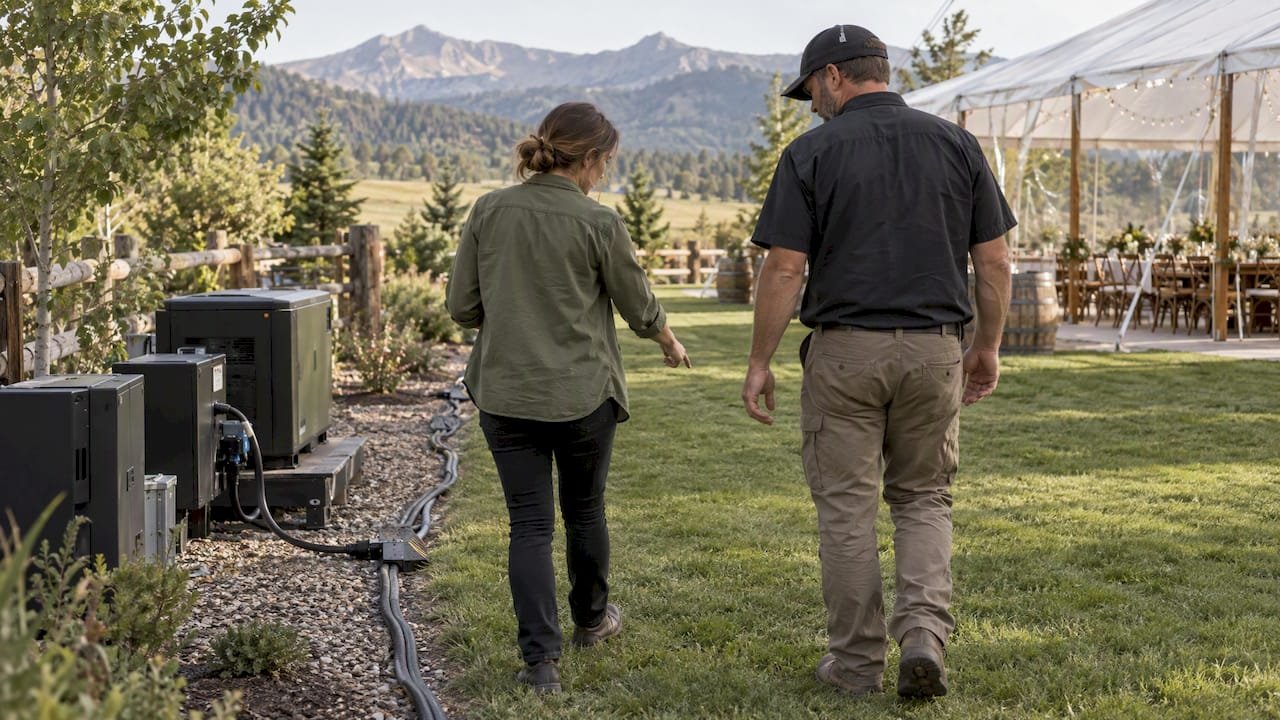
Choose venue mains when available, silent battery stations for quieter ceremonies, or a properly sited generator for heavier loads, and always line up a tested backup before the big day. Confirm permits and safety checks early since they affect where equipment can sit.
TL;DR:
- Medium outdoor weddings typically require around 11 to 12 kWh, with a recommended buffer raising the total to about 13 to 16 kWh to account for surges and last-minute additions.
- Selecting between mains electricity, fuel generators, and battery power stations depends on noise sensitivity, capacity needs, and venue restrictions, with combining sources often optimal.
- Proper placement, permit verification, and safety measures, such as maintaining exhaust clearance and grounding, are crucial to prevent fire hazards, carbon monoxide buildup, and code violations.
- Conducting a load test with actual equipment before the event is more critical than detailed wattage calculations to identify surge issues and wiring mistakes that could cause shutdowns.
- Solar panels paired with battery stations work well for daytime periods but should be supplemented by generators for evening loads, especially in cloudy weather or shaded sites.
Table of Contents
- Quick checklist: record every item that needs power
- How to convert watts and hours into kWh and size your power source
- Compare venue mains, fuel generators, and battery power stations
- Safety, code, and permit essentials you must check
- Setup and cable routing best practices on the day
- Backup, testing, and vendor coordination
- Cherrywood Ranch practical examples: lighting plans, rain plan integration, and vendor coordination
- Integration of renewable energy options for outdoor weddings
- Power load management during the event (peak times, staggered use)
- Coordination with venue staff and vendors regarding power access and restrictions
- What outdoor wedding power planning gets wrong
- Book a site walk-through and power plan with us
- FAQ
- Sources
Quick checklist: record every item that needs power
Before calling a rental company, walk through your day and write down every device that plugs in. This list becomes the basis for your wattage math and tells vendors exactly what you need.
- Decorative lighting: string lights, uplighting, chandeliers
- Pathway and tent lighting for guest safety after dark
- Ceremony sound: PA system, wireless microphones, speakers
- Reception sound: DJ booth or live band amplifiers
- Catering equipment: warmers, refrigeration, coffee stations
- Vendor gear: photo booths, projectors, video equipment
- Charging stations and miscellaneous extras
Pull wattage numbers from three places: your vendor’s technical rider, the label on the equipment itself, or the manufacturer’s spec sheet online. A band or DJ rider often lists exact amperage needs, and our outdoor wedding lighting guide breaks down typical fixture wattages if you’re building your own lighting plan from scratch.
- List every device by category above.
- Record its wattage and expected hours of use.
- Note any item with a high startup surge, like refrigeration compressors.
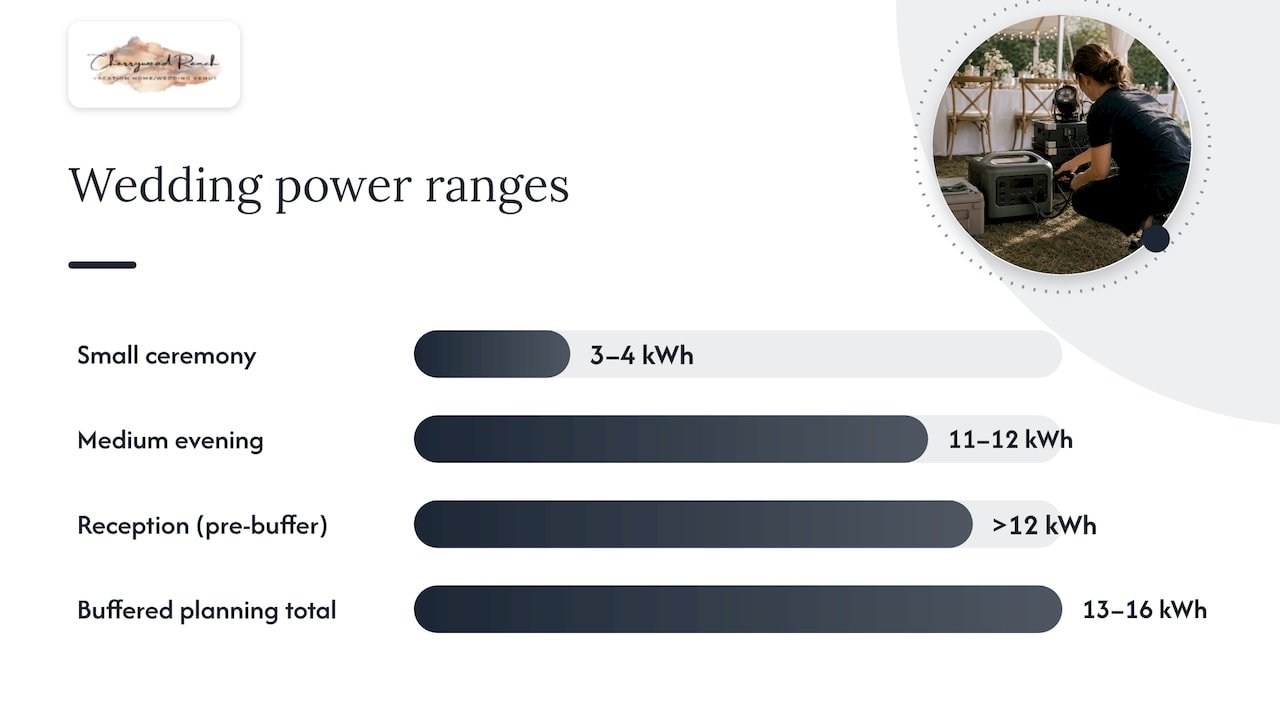
For scale, a medium outdoor wedding commonly totals around 11 to 12 kWh for an evening, which gives you a rough benchmark before you run your own numbers.
How to convert watts and hours into kWh and size your power source
The math is simpler than it looks. Multiply each item’s watts by the hours you’ll run it, divide by 1,000, and you get kilowatt-hours. Add up every item on your checklist for a total.
- Watts × Hours ÷ 1,000 = kWh for a single item.
- Repeat for every item on your checklist, then sum the results.
- Add a 20 to 30% buffer to the total for startup surges and last-minute additions.
- Match your buffered total to a generator’s continuous watt rating or a battery station’s inverter rating, not just its peak rating.
Startup surge matters because motors, like those in refrigeration units or sound amplifiers, draw two to three times their running wattage for a second or two when they switch on. If you size your power source only for steady-state use, that first surge can trip a breaker or stall a generator.
A medium-sized outdoor wedding commonly totals about 11 to 12 kWh for an evening event. That figure, plus the recommended 20 to 30% buffer, means most couples should plan for roughly 13 to 16 kWh of usable capacity once surge margin is included. A small ceremony with just a sound system and string lights might land closer to 3 to 4 kWh, while a reception with a full band, catering warmers, and extensive lighting can push past the 12 kWh mark before any buffer is added.
Compare venue mains, fuel generators, and battery power stations
Your choice depends on what the venue offers, how much noise matters, and how much power you actually need.
- Venue mains: Often the cheapest and quietest option, but you need to verify panel access, circuit amperage limits, and GFCI protection before committing your full load to existing outlets.
- Fuel generators: Deliver the most capacity per dollar for large loads, but they require exhaust clearance, grounding, isolation from guests, and often a permit for distribution setups.
- Battery and silent power stations: Quiet, clean, and predictable in cost, with the ability to recharge from solar during the day. They suit ceremonies and moderate reception loads well but can get expensive to rent at very high wattages.
Combining sources often works best: battery stations for the ceremony and cocktail hour, then a generator staged well away from guests for a high-draw reception with a full band and catering line.
Pro Tip: Ask your band or DJ for their exact power spec sheet. A typical wedding band setup may call for two dedicated 20-amp circuits or a 6,000-watt generator, which changes your whole sizing calculation.
Safety, code, and permit essentials you must check
Power planning is as much about placement and permits as it is about math, and skipping this step is how weddings end up with tripped breakers, carbon monoxide risk, or a last-minute shutdown from an inspector.
- Keep generators at least 20 feet from any tent or membrane structure, with exhaust pointed away from openings to prevent carbon monoxide buildup.
- Isolate generators from guests with a physical guard and roughly 3 feet of clearance around the unit.
- Use a grounding electrode conductor sized correctly per NEC guidance, generally not smaller than 4 AWG for temporary event setups.
- Confirm GFCI protection on every outdoor receptacle, since this is a standard requirement for temporary event power.
- Large tents and stages often need a minimum clearance from overhead conductors, commonly around 15 feet, so check this before placing equipment near power lines.
Many municipalities require an electrical permit for portable generators feeding a distribution setup, and inspection before the event. Get written confirmation from your venue or electrical contractor on permit status, and walk the distribution panel yourself before guests arrive.
Setup and cable routing best practices on the day
Cables running across a lawn or dance floor are a trip hazard waiting to happen, and exposed connectors don’t hold up well against dew or an afternoon shower.
- Route cables along edges or overhead when the layout allows, rather than straight across walkways.
- Use outdoor-rated cables and waterproof connectors to handle dew, light rain, or a spilled drink.
- Secure every ground-level run with slip-resistant cable covers, especially near entrances and the dance floor.
- Position generators and battery banks behind barriers, away from guest traffic, with fuel locked up and signage marking restricted zones.
Our five-zone layout guide covers where tents, flooring, and equipment typically sit relative to each other, which helps when you’re mapping cable runs in advance.
Pro Tip: Do a final walk-through an hour before guests arrive: covers down, circuits labeled, vendor contact numbers in hand.
Backup, testing, and vendor coordination
A power plan only works if you’ve tested it under load, not just on paper.
- Run a load test with your actual equipment plugged in, checking that startup surges don’t trip breakers or overload the inverter.
- If you’re using dual supplies or an automatic transfer switch, test the cutover before the event, not during it.
- Write a one-page contingency plan: who to call, where spare cables and fuses are kept, and the exact sequence for switching supplies.
- Bring in a licensed electrician or event power specialist for anything beyond a single generator and a few circuits, and ask them to confirm grounding, GFCI protection, and panel capacity in writing.
Cherrywood Ranch practical examples: lighting plans, rain plan integration, and vendor coordination
We’ve built our own templates from years of hosting multi-day weekends on-site. Our outdoor reception ideas and rain plan guide show how lighting and power routing shift when weather changes mid-event. Hosting everything in one location over a full weekend means fewer setup trips and vendors who already know where panels and outlets sit, since they’re not rebuilding a power plan from zero at a new site each time.
Integration of renewable energy options for outdoor weddings
Solar is increasingly practical for daytime ceremonies and cocktail hours, especially paired with battery stations that can recharge from panels between uses. A portable solar array feeding a battery bank works well for low-draw items like string lights, charging stations, or a small sound system during an afternoon ceremony, cutting fuel use and noise at the same time.
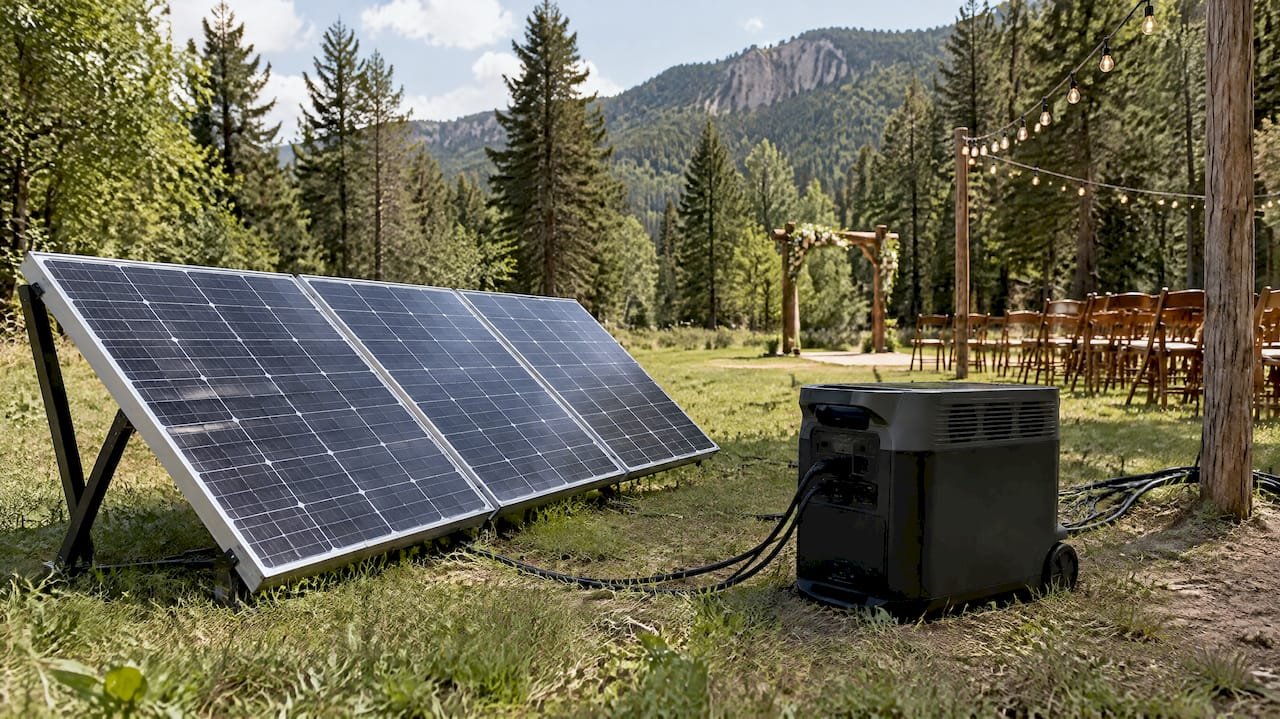
The tradeoff is capacity and weather dependence. Solar panels need direct sun to recharge at a useful rate, so an overcast day or a shaded ceremony site limits how much you can rely on them. Most couples use solar as a supplement rather than a sole source: topping off battery stations during the day so they’re fully charged before the reception’s heavier evening load kicks in.
Hybrid setups, a battery station with a small solar array and a generator held in reserve, give you flexibility without betting the whole event on sunshine. If your ceremony and cocktail hour happen in daylight, that’s the window to lean on solar-charged batteries. Once the sun goes down and the band starts, you’re back to whatever battery capacity you’ve stored or a generator staged out of sight.
Power load management during the event (peak times, staggered use)
Not every device needs to run at full draw simultaneously. Catering warmers often hit peak demand right before dinner service, while lighting and sound run steadily through the evening. Staggering high-draw equipment, running warmers before the band’s heaviest set rather than during it, keeps your total load below your buffered capacity instead of spiking past it.
Coordinate timing with your caterer and band or DJ in advance so their highest-draw moments don’t overlap. A coffee station and a round of plate warming at the same time as a full band soundcheck can push a system past its margin even when the math looked fine on paper. Assign someone, a day-of coordinator or venue staff member, to monitor the load and know which circuits can absorb a temporary spike.
Coordination with venue staff and vendors regarding power access and restrictions
Every venue has its own rules about where generators can sit, which outlets are available, and how much load existing circuits can handle. Ask early: what’s the maximum amperage per circuit, are there restrictions on generator placement or noise curfews, and does the venue require sign-off on your power plan before the event.
Share your itemized checklist and kWh total with the venue and every vendor who brings equipment, so nobody shows up with a device that wasn’t accounted for. This is also the point to confirm who provides extension cords, who’s responsible for weatherproofing, and who walks the site with you beforehand. A short planning call with your caterer, band, and venue coordinator two to three weeks out catches most conflicts before they become day-of problems.
What outdoor wedding power planning gets wrong
Most advice on this topic treats wattage math as the hard part. It isn’t. The math takes ten minutes with a calculator and a vendor spec sheet. The part couples underestimate is logistics: permits, exhaust clearance, cable routing, and who actually tests the system before guests arrive.
A generator sized correctly but placed too close to a tent, or routed through cables that cross a walkway, creates more risk than a slightly undersized power source that’s properly tested and positioned. Conventional wedding planning content leans hard into capacity and barely mentions grounding, GFCI protection, or the fact that many jurisdictions require a permit for portable generator distribution.
If you take one thing from this, prioritize the test run over the spreadsheet. A load test with your actual equipment, done a day or two before the event, catches surge problems and wiring mistakes that no amount of watt-hour math will reveal. Quiet, clean power matters for the atmosphere, but a tested, code-compliant setup is what keeps the day running.
— Luis
Book a site walk-through and power plan with us
Planning outdoor wedding power gets easier when you’re not juggling multiple vendors and locations. We host full wedding weekends on one property in the North Georgia mountains, with lodging and facilities to accommodate your wedding weekend, so your lighting, sound, and catering setup happens in a space our team already knows well.

- Request a site walk-through during booking to map out power access and placement before your event.
- Ask about our elopement and wedding packages for a weekend built around your guest count.
- Pair your wedding day with lodging so your family and vendors stay in one place all weekend.
Reach out through our booking page to check availability and start mapping your power plan with us.
FAQ
What is the 50/20/30 rule for weddings?
This is a budgeting guideline some planners use to divide wedding spending into broad categories, though definitions vary depending on the source. It’s a general budgeting framework rather than a fixed rule, so couples should treat it as a starting point and adjust based on their own priorities.
Who walks mom down the aisle?
Tradition varies widely by family and culture, and there’s no fixed rule for who walks a parent down the aisle. Many couples choose to have both parents, a sibling, or another close family member accompany them, based on what feels right for their own ceremony.
Do I need a permit to have a wedding in my yard?
You may need a permit specifically for temporary electrical distribution if you’re using a portable generator to power the event, since many municipalities require inspection and permitting for this setup. Check with your local building department, and confirm with your electrical contractor whether your specific setup requires sign-off before the event.
What is the rarest month to get married?
Wedding frequency varies by region and season, with winter months generally seeing fewer weddings than spring and fall in most of the United States. Exact rankings shift from year to year and by location, so couples interested in off-peak dates should check availability directly with venues in their target season.
Does Cherrywood Ranch help with power planning for weddings?
We offer onsite coordination as part of our wedding weekend packages, including a site walk-through where couples can map out lighting, sound, and catering power needs ahead of the event. Reach out through our services page to ask about what’s included for your specific package.
Sources
Noise is often the deciding factor between a fuel generator and a battery station, and it matters most during the ceremony itself. A generator running even 50 feet away can be audible during vows, which is why many couples choose silent battery stations for that part of the day and reserve a generator, if needed, for the reception once music and conversation mask the hum.
Emissions are the other consideration. Battery stations produce no exhaust on-site, which matters both for air quality near guests and for carbon monoxide risk around tents. Fuel generators require the clearance and ventilation rules covered earlier precisely because of this risk.
For couples weighing environmental impact alongside practicality, a mixed approach, battery power for the ceremony and any solar topping available, with a generator only where load truly demands it, tends to balance quiet, clean power against total cost.
- Carbon Monoxide Safety Guide — GenTent
- Special events temporary electrical power — City of St. Paul guidance
- How to power an outdoor wedding (October guide) — EcoFlow