
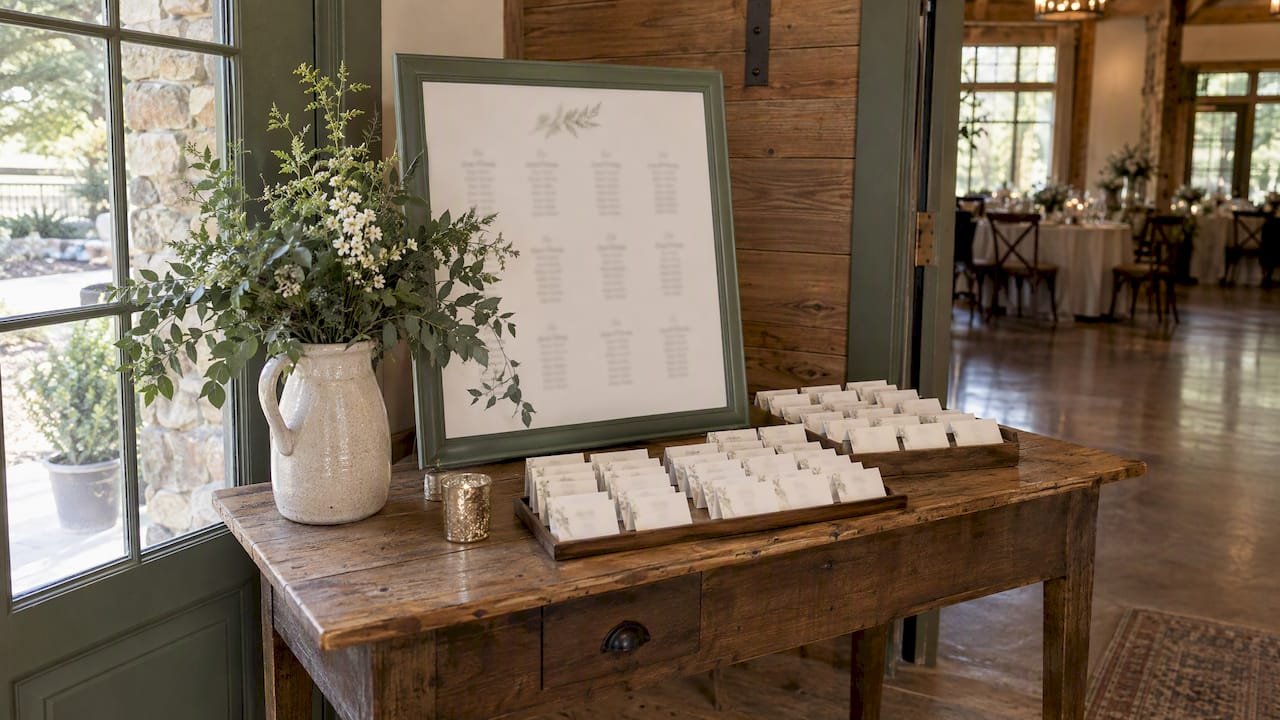
A small wedding seating chart comes down to three decisions: how many tables you need, how many people sit at each, and who sits next to whom. For 20 to 75 guests, most couples land on tables of 7 or 8, a layout that leaves real room to dance and mingle, and a chart they can still change a week before the wedding. Below you will find the numbers, the people rules, and a step-by-step method.
TL;DR
- Under 50 guests, assigned seating is optional but still helpful. The Knot recommends it for weddings over 50 guests.
- Seat 7 or 8 per table, not 10. Tables of 10 fit on paper but feel crowded in person.
- A 75-guest reception works out to about 10 tables of 8 at 60-inch rounds and roughly 1,500 to 1,800 square feet, according to Lovely Seating.
- Build the chart in a free spreadsheet or on sticky notes, and print the final display as late as you can.
- Seat people by who they know and enjoy, not by label.
Table of Contents
- Do you need a seating chart at a small wedding?
- How many tables you need, by guest count
- Floor plan basics for a small reception
- Who sits where: the people part
- Build the chart: a method that survives RSVP changes
- Seating display ideas that work at small scale
- A 75-guest reception layout, step by step
- Our perspective: why small weddings feel different
- Hosting your wedding at Cherrywood Ranch
- Mistakes to avoid
- FAQ
- Sources
Do you need a seating chart at a small wedding?
Not always. At a casual gathering of 20 or 25 people around one or two long tables, guests will sort themselves out, and a hand-lettered place card at each seat may be all you need. The Knot says open seating can work for very casual events and that assigned seating becomes the safer choice above 50 guests, when unassigned seating tends to create bottlenecks. Between 30 and 50 guests it is a judgment call.
We lean toward assigning seats even for small groups, for three reasons:
- Nobody hovers with a full plate. At a 36-person wedding, a few seconds of indecision multiplies.
- You control the mix. Your college roommate and your grandmother’s neighbor will not choose to sit together. You can.
- The kitchen or caterer gets a clean count. Meal choices, allergies and high chairs are easier to track when every seat has a name.
If you want a middle path, assign tables but not seats. Guests choose their chair at a table you picked for them.
How many tables you need, by guest count
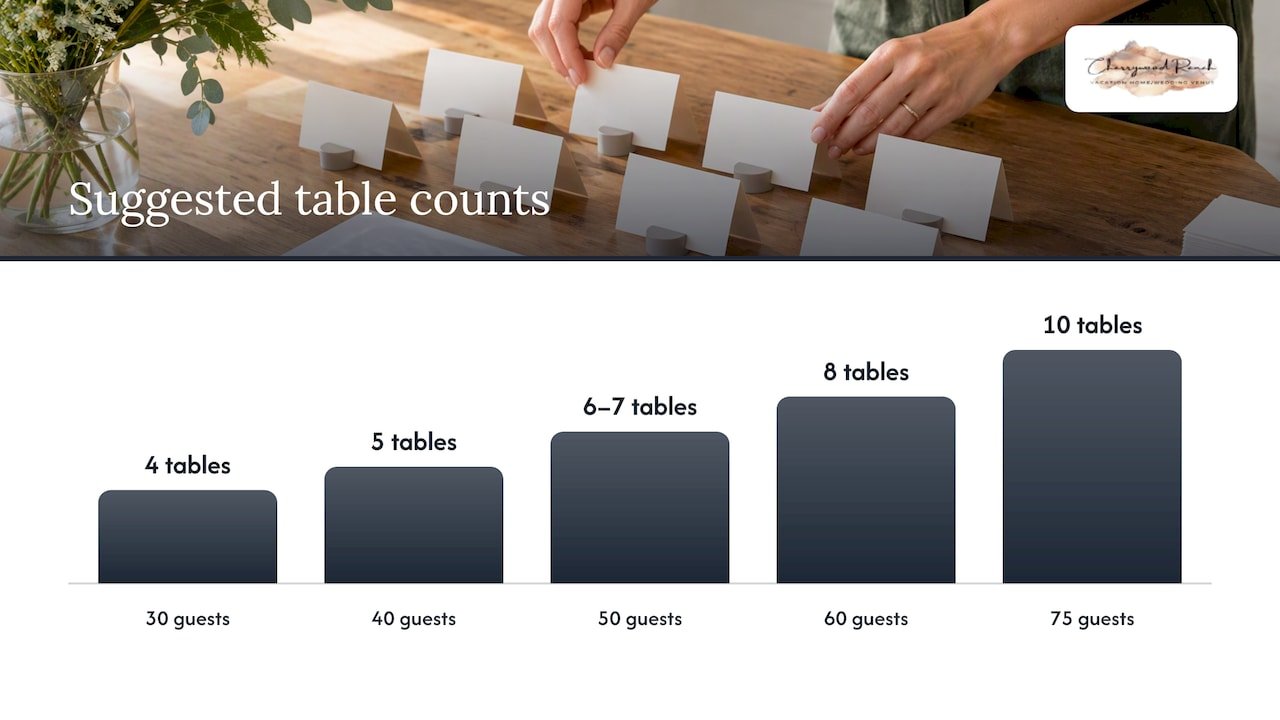
Start with seats per table, then divide. The numbers below assume round tables and a comfortable fit. Lovely Seating puts a 75-guest wedding at 10 tables of 8 on 60-inch rounds, or 8 tables of 10 on 72-inch rounds, and the same logic scales down.
| Guests | Tables of 8 (60-inch rounds) | Tables of 10 (72-inch rounds) | Our suggestion |
|---|---|---|---|
| 20 | 3 (one with 4 seats) | 2 | One or two long tables |
| 30 | 4 | 3 | 4 rounds of 7 or 8 |
| 40 | 5 | 4 | 5 rounds of 8 |
| 50 | 7 | 5 | 6 or 7 rounds of 7 to 8 |
| 60 | 8 | 6 | 8 rounds of 7 to 8 |
| 75 | 10 | 8 | 10 rounds of 7 to 8 |
The row for 75 comes from the source above. The other rows are our own arithmetic, simply dividing guest count by seats per table and rounding up.
Why not seat 10 at every table just because you can? A Knot Community thread makes the point that many small-wedding tables work better with 7 or 8 guests, which keeps conversation lively without overcrowding. It also gives you slack: if two guests cancel, no table looks empty, and if two extra arrive, you can add a chair without rebuilding the room.
A venue’s published numbers are worth checking against your own reality. One venue guide on The Knot’s vendor platform lists 60-inch rounds seating up to 8 and 72-inch rounds seating up to 12. That is the maximum, not the comfortable number.
Floor plan basics for a small reception
The chart only works if the room works. Before you assign a single name, sketch where things go.
Place the fixed items first
The order we recommend: the sweetheart or head table, the dance floor, the bar, the buffet or kitchen door, and any band or DJ. Then fit tables around them. Keep guests’ paths clear between the bar, the restrooms and the dance floor.
Size the room honestly
For 75 guests, Lovely Seating estimates about 1,500 to 1,800 square feet with a dance floor, bar and head table. For bigger groups, EventDiagram works a 100-guest example at 13 round tables of eight, a 15 by 15 foot dance floor, and a room of roughly 41 by 61 feet at standard rental spacing. That is a useful ceiling for comparison if your guest list keeps growing.
Outdoors, the same math applies, plus tents, flooring and weather backup. Our own five-zone outdoor wedding layout walks through setting those pieces first and the tables second.
Decide on the head table
A traditional head table puts the wedding party in a row, which eats space and splits the couple from everyone else. A sweetheart table seats just the two of you. We compare the trade-offs in sweetheart versus head table for intimate weddings.
Consider long tables
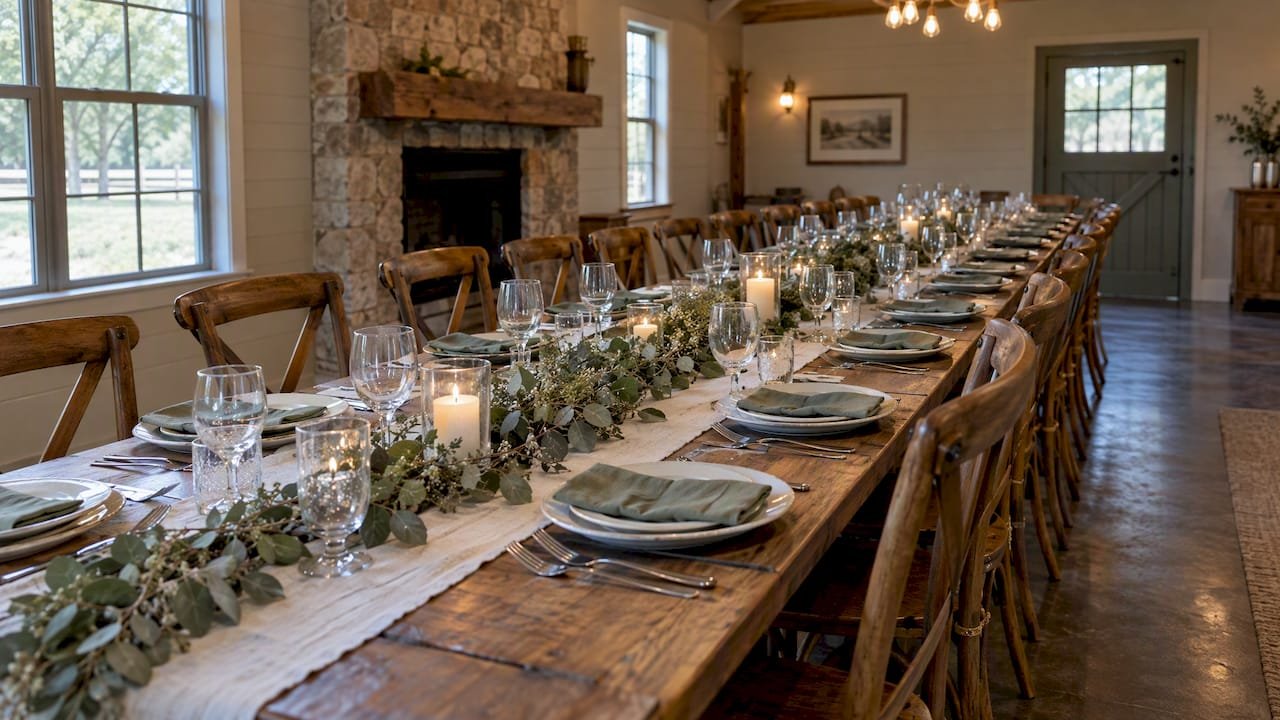
Under about 40 guests, one or two long tables can replace rounds entirely. Everyone can talk across the table, and the room looks like a dinner party rather than a banquet. Our long table seating guide covers the etiquette and how to seat people at the ends.
Who sits where: the people part
This is the hard part, and the numbers do not help. The Knot and Emily Post both frame the goal as guest comfort. Their advice, as summarized in The Knot’s etiquette guide, is to group people with shared interests rather than force a singles table, which can feel isolating.
A practical way to do it:
- Start with the anchors. Immediate family, the wedding party, and anyone with a complicated relationship (divorced parents, for example) go first. Put them at separate tables with people they like.
- Cluster by connection. College friends together, coworkers together, cousins together. Within a cluster, mix in one or two people who would enjoy meeting them.
- Never strand a solo guest. Someone who arrives alone and knows nobody else should sit with at least one familiar face. That alone makes a guest feel settled.
- Keep children near parents. Or give them a table of their own with a trusted older cousin, if the evening runs long.
- Put mobility needs first. Place older relatives away from speakers and close to restrooms and exits.
At a small wedding, every guest is noticed. A table of strangers that would pass at a 200-person event feels pointed at 40. So take the extra hour on this step.
Build the chart: a method that survives RSVP changes
Step 1: Make a color-coded mock-up
Draw the room on a large sheet of paper or poster board and write each guest on a sticky note, a color for each group, such as family and college friends. The Knot’s roundup of TikTok wedding hacks recommends this because you can move names without erasing and redrawing lists as RSVPs come in.
Step 2: Move to a spreadsheet
Once the sticky-note version feels right, copy it into a spreadsheet. RH Seating’s free templates in Excel, CSV and Canva are an example of the cheapest route: a free template and a standard print size such as 18 by 24 inches or 24 by 36 inches. You do not need paid software for a guest list under 75. If you want to avoid reprinting the whole display every time something shifts, this guide on skipping full seating chart reprints shows how to update only what changed.
Step 3: Plan for the late changes
Someone will cancel. Someone will add a plus-one. Emily Post’s advice on handling guests with grace is to stay calm and ask your caterer or venue how they can accommodate surprises. Treat the chart as a living document and keep your final print date as late as your printer allows. For a tighter system for the last 48 to 72 hours, see these steps for handling last-minute RSVP changes.
Step 4: Mark your place cards
Emily Post notes that place cards, set at tables or organized on an entry table with table numbers, are a must at all but the most casual weddings. For small groups, you can skip the entry display and put a name card at each seat instead, which also doubles as a meal-choice marker.
Step 5: Give the caterer a final list
Send a table-by-table list with dietary notes. Do this a few days before the wedding, after your own RSVP cutoff.
Seating display ideas that work at small scale
With fewer tables, the display itself can do more. A few ideas that suit a group under 50:
- A single framed chart with each table named after a place you have traveled together instead of numbered.
- Place cards doubling as favors, such as a small candle or a local jam with a name tag.
- Handwritten cards on a ribbon line that guests pick up on the way in.
- A printed menu with the seating plan on the back, saving a separate sign.
At a mountain or outdoor wedding, weather is a factor. Paper charts curl in humidity and blow in wind, so a framed or weighted display on an easel is safer.
A 75-guest reception layout, step by step
The search for a 75-guest reception layout usually comes from couples whose list grew past what they planned. Here is how we would lay it out, using the figures above.
- Allow 1,500 to 1,800 square feet.
- Set 10 round tables of 8 at 60 inches, with 5 extra seats’ worth of space to spare.
- Put the sweetheart table where it has the best view and the least foot traffic.
- Keep the dance floor central or adjacent to the band or speaker, not tucked in a corner.
- Place the bar away from the entrance so guests do not queue at the door.
- Leave wide aisles between tables, and wider ones on the way to restrooms.
If you are at the edge of your venue’s guest count, ask whether tables can be set a little smaller. Seating 7 instead of 8 at a few tables gives you buffer for late additions.
Our perspective: why small weddings feel different
We host weddings at a private North Georgia mountain home with lodging for up to 16 guests, so we see the seating question from an unusual angle. When most of your guests are staying under the same roof, the reception is only one part of a multi-day weekend. People have already met at a welcome dinner, shared breakfast, and floated in the pool or hot tub. The seating chart matters less for introductions and more for the moments you want to design.
Our advice is to be deliberate about the dinner and relaxed about the rest. Assign seats for the main meal, because that is when the toasts happen and the photographs get taken. Let everything else, from breakfast to the rehearsal dinner, be open. That is also why we recommend a longer table over many small rounds when the guest count allows it, and why our guides on an at-home rehearsal dinner and welcome party ideas suggest giving guests a chance to mix before the wedding day.
Finally, treat your chart as a draft until the last possible moment. In our experience, the couples who enjoy the day most are the ones who built a plan with room in it.
— Luis
Hosting your wedding at Cherrywood Ranch
If you are weighing a venue for a small wedding, we offer a private mountain setting in North Georgia with onsite lodging for up to 16 guests, outdoor ceremony and reception spaces, a pool and hot tub, and packages that range from elopements to a 3-day wedding. Published rates on our booking page include a Mini Session at $175, hourly rental at $350 per hour, and a Day Session at $1,950 per day. Guests over 75 are an extra $10 each. For full wedding and elopement packages, see our services page or ask us about your guest count and layout.
Mistakes to avoid
- Seating by label. A table of all the single people is rarely a good idea. Group by interests.
- Cramming 10 per table. Leave space to move, serve and dance.
- Printing too early. RSVPs shift. Print the display last.
- Ignoring the guest list. A tighter list makes every seating decision easier, and our guide to who to invite and who to cut can help.
- Skipping the budget check. More tables mean more rentals. Our 50-guest wedding cost breakdown is a good reference.
For more reception ideas at any size from 10 to 80, see our intimate reception ideas.
FAQ
What is the cheapest way to make a wedding seating chart?
Use a free spreadsheet or Canva template and print it at a standard size, such as 18 by 24 inches. RH Seating lists free Excel, CSV and Canva options for this. A poster board and handwritten cards cost even less.
What is the easiest way to do a seating chart?
Write each guest on a sticky note, color-coded by group, and move the notes around a sketch of your room. Once it feels right, copy it into a spreadsheet. This avoids erasing and rewriting as RSVPs change.
How many guests per table at a small wedding?
Seven or eight is the comfortable range for most round tables. A 60-inch round seats 8 comfortably, while 10 per table feels tight. Using fewer per table also gives you room for late additions.
How many tables do you need for 50 guests?
Six or seven rounds of seven to eight guests, or five rounds of ten if your room and tables allow it. We suggest the first option, because the table feels less crowded. Check your venue’s table sizes before you decide.
Sources
- Your Etiquette Guide to a Seating Arrangement at a Wedding, The Knot
- Seating Chart for 75 Guests: Tables, Layouts and Room Size, Lovely Seating
- Wedding reception layouts: room sizes for 50 to 300 guests, EventDiagram
- Free Wedding Seating Chart Templates, RH Seating
- Seating Charts are Hard, The Knot Community
- 20 TikTok Wedding Hacks to Save Time, The Knot
- Venue guide to seating arrangements, The Knot vendor marketplace
- Handling Your Guests With Grace, Emily Post
- Printed Items for Your Wedding, Emily Post