A good venue walkthrough answers one question: does this place work for your wedding, not just look good in photos? Bring your real guest count and schedule, walk the day from arrival to cleanup, measure and photograph what matters, and get every promise in writing. This checklist covers the first tour, the final visit, and the extra questions to ask if the venue also houses your guests.
TL;DR
- Tour with your real guest count, timeline and vendor list, then walk the whole day in order: arrival, ceremony, reception, send-off, cleanup.
- Check what photos hide: restroom count, power, load-in path, shade, the rain plan and accessible routes.
- Turn every verbal promise into a line in the contract, including what is and is not in the fee.
- Go back 30 to 60 days before the wedding for a final walkthrough to confirm layout, timing and vendor access.
- If guests sleep on site, tour the bedrooms, bathrooms and shared spaces as carefully as the ceremony spot.
Table of Contents
- Walkthrough, tour or final meeting: they are different visits
- Before you go: what to bring
- Arrival and guest flow
- The ceremony space
- The reception space
- Power, load-in and vendor logistics
- Money and contract: move from what you see to what you sign
- Tour a working venue if you can
- If the venue also lodges your guests
- Photography and light
- The final walkthrough: a day-of rehearsal on paper
- Our view on walkthroughs
- See Cherrywood Ranch in person
- FAQ
- Sources
Walkthrough, tour or final meeting: they are different visits
Couples tend to use these words interchangeably, but you will make two or three separate visits, and each has a different job.
| Visit | When | Main job |
|---|---|---|
| First tour | Before you book | Decide whether the venue fits your guest count, budget and style |
| Contract walkthrough | Before you sign | Match what you see to what the contract promises |
| Final walkthrough | About 30 to 60 days out | Confirm layout, timeline, vendor access and details with the venue manager |
One planning team suggests going back to your venue 30 to 60 days before the wedding, once the details are no longer theoretical. That is also when your photos and notes from the first visit pay off.
A useful way to think about it comes from a venue-inspection guide: a walkthrough is about whether the room works for your specific event, not how it looks. Marketing photos show the best angle on the best day. You are there to see the rest.
Before you go: what to bring
Preparation changes the quality of the tour more than anything you do on site.
- Your real numbers. Expected guest count, a rough budget ceiling and your likely date range. Use the same details with every venue so quotes are comparable.
- Your rough timeline. Ceremony time, cocktail hour, dinner, dancing, end time.
- Your vendor wish list. Caterer, DJ or band, photographer, florist, rental company. Ask which of these the venue requires or restricts.
- A tape measure, a phone and a notebook. Photograph the ceremony spot, the reception area, the restrooms and the path vendors will use. Measure doorways, aisles and the dance floor area.
- One decision-maker plus one skeptic. Bring the person who will fall in love with the place and the person who will ask about the parking.
If you can, ask for a visit at a time similar to your event. A late afternoon tour tells you about sun angle and heat. A morning tour tells you very little about a 5 p.m. ceremony.
Arrival and guest flow
Start where your guests start: the road.
- Directions and signage. Is the last mile easy to follow, or will guests rely on a phone signal that may not exist? In the mountains, ask whether cell coverage is reliable at the property.
- Parking. Count the spaces and ask where the overflow goes. Plan one space for roughly every two to three guests as a starting estimate, then ask the venue how it has handled your size before.
- Drop-off point. Is there a spot where grandparents can be dropped near the entrance?
- Distance between spaces. Walk from the parking area to the ceremony, from the ceremony to the reception, and from the reception to the restrooms. Time it at a guest’s pace, not yours.
- Bottlenecks. Look for narrow paths, steps and gates where 50 people will stack up at once.
Accessibility
Do not leave this for the final visit. If any guest uses a wheelchair, walker or cane, walk the route as they would. The U.S. Department of Justice’s ADA guide for small towns describes an accessible route as an unobstructed path connecting key points, and notes that accessible parking, paths from drop-off to the entrance and accessible restrooms are the essentials. It also says that when portable restrooms are used, at least one at each location must be accessible.
On your tour, check:
- Is there a step-free path from parking to the ceremony and reception?
- Is the surface firm, or is it gravel, grass or a slope?
- Is at least one restroom usable by a person in a wheelchair?
- Where can someone sit down and rest in the shade?
A venue that has thought about this will answer without hesitation. A long pause is information too.
The ceremony space
- Sightlines. Stand where the back row will sit. Can you see the couple? Is there a tree, post or tent pole in the way?
- Aisle width and surface. Heels sink into soft ground. Ask about flooring or pathway options.
- Sun and shade. Look at where the sun sits at your ceremony time. Squinting guests and harsh shadows in photos are common surprises.
- Sound. Is a microphone available? Wind and open air carry vocals away, and a quiet officiant can lose a whole back row.
- The backup plan. Ask to see it, not just hear about it. One wedding-planning checklist lists a backup indoor option alongside sightlines and aisle width as a core ceremony check. Stand in the backup space and imagine your full guest list inside it.
Weather deserves more than a shrug, especially outdoors. In the southern Appalachians, afternoon storms are a real planning factor, which is why we wrote about North Georgia wedding weather and backup plans and a practical rain plan for an outdoor wedding. Ask any venue: if it rains at 3 p.m., who decides, by what time, and what changes?
The reception space
- Seated capacity, not standing capacity. A room that holds 100 standing may seat far fewer with tables, a dance floor and a buffet. Ask for the number with your layout.
- Dance floor and band or DJ area. Mark where each goes and where the bar and cake table sit.
- Table shapes. Round tables, rectangles and long tables change both capacity and conversation. If you like the idea of family-style seating, read our notes on long table seating and etiquette.
- Lighting controls. Can lights be dimmed? Is there string lighting, and who installs it?
- Temperature. Outdoor and tented spaces can run hot or cold. Ask about heating, fans and tent sides.
- Restroom proximity. Guests will walk there all night. Count the stalls: a venue with two restrooms for a large crowd will have lines.
If you are planning outside, a layout with tents, flooring and service areas arranged in zones prevents a lot of day-of improvising. Our five-zone outdoor wedding layout and outdoor reception ideas are useful to read before you tour so you know what to look for.
Power, load-in and vendor logistics
This is the section most couples skip and most vendors care about.
Load-in
Beautiful venues can be miserable to work in. A narrow path, no loading area or a tight access window can push vendors into overtime fees or a rushed setup. A venue-walkthrough guide advises asking to see the path from the street to the prep area exactly as a vendor would use it. Ask:
- When can vendors arrive, and when must they be out?
- Can a vehicle get close to the setup areas, and is the route level?
- Where do caterers prep, and is there water and refrigeration?
- Where does trash go, and who handles it?
Power
The same guide points out that a band or DJ with serious lighting and audio can trip a venue’s breakers, and suggests asking directly whether a band has ever tripped a breaker there. Note where the power drops are relative to your stage and bar. If the venue relies on extension cords, fire codes may restrict how they can be used.
Outdoors, power gets more complicated: lighting, music, coffee, a fridge and a generator all compete. Our guide to outdoor wedding power, noise and code readiness walks through how to size it.
Safety and exits
Ask where the emergency exits are and whether they stay unlocked and clear during the event. OSHA’s crowd control guidance lists clear, unobstructed exit routes, exit doors that are not locked or blocked, and a named staff contact for emergency responders among key safety practices. A wedding is smaller than a stadium event, but the habit is the same: know who the contact is and where people go.
Money and contract: move from what you see to what you sign
A tour is the cheapest time to find out what is not included. Professionals advise confirming exactly what the fee covers, such as tables, chairs, AV, setup and cleanup, and what triggers extra service charges, overtime fees or insurance requirements. Do not sign on verbal promises.
Use this list at the table after the walk:
- What is the base fee, and what does it include? Ask for an itemized list.
- What is the time window? Does it cover setup, the event and cleanup, or only the event?
- What are the overage fees? For example, per-guest charges past a set count, or hourly overtime.
- What are the deposit and payment schedule? When is the balance due?
- What is the cancellation and rescheduling policy? Ask what happens if you must move the date.
- Is insurance required? Ask about liability coverage and alcohol rules.
- What are the vendor rules? Is there a preferred list, a required caterer or an outside-vendor fee?
- What are the noise and end-time rules? These matter most in residential areas.
- Who is on site that day? A coordinator, a manager or no one.
- What is the weather policy? Rain, wind, heat, smoke.
Write the answers next to the venue’s name. After you have seen several, compare on the same rows, not on memory.
Tour a working venue if you can
If the venue is hosting another event during your visit, ask to see a setup or breakdown. An event-planning source notes that this shows how staff handles stress and how noise travels between spaces, and what the flowers and lighting look like in real life rather than in styled photos. If a live event is not possible, ask to speak with a recent couple.
If the venue also lodges your guests
Some venues, including ours, combine the wedding site and the place everyone sleeps. That removes shuttles and transfers, but it adds things to inspect.
- Beds and bedrooms. How many people actually sleep comfortably, and in which configuration? Ask for a room-by-room list.
- Bathrooms. Count them against the number of overnight guests, then think about the morning of the wedding.
- Getting-ready space. Is there somewhere with natural light and mirrors where a full party can dress without crowding the bed?
- Shared spaces. Kitchen, living areas, outdoor seating, pool or hot tub. Ask about quiet hours and rules for the water features.
- Check-in and check-out. Can you arrive the day before? When must everyone leave?
- Who is staying. The wedding weekend works best when you know which family members will be on site and which will drive in.
A stay-and-celebrate format also changes the schedule. You can host a relaxed dinner the night before, and our ideas for a welcome party that gets guests talking fit naturally into that. If your guest list is small, intimate reception ideas for 10 to 80 guests can help you picture the space.
Photography and light
Venue photos are edited, and good venues know it. Plan to check:
- Where the light falls at your ceremony time, and where the golden hour spot is.
- Backgrounds: power lines, parked cars, dumpsters, neighboring buildings.
- Indoor shooting spots if it rains. We keep a list of rainy wedding photo ideas for exactly this reason.
- Whether your photographer can walk the site before the day. Many photographers will gladly tag along on the final visit.
The final walkthrough: a day-of rehearsal on paper
By the final visit, the question changes from whether you like it to whether everyone agrees on every detail. Bring your timeline, your vendor contacts and your floor plan. Then walk it in order:
- Arrival and parking: where signs and a greeter will stand.
- Ceremony: seating layout, aisle, officiant position, music source.
- Cocktail hour: bar location, food stations, shade and seating.
- Reception: table layout, dance floor, head table, cake and gift tables.
- Vendor access: load-in time, power drops, prep area, load-out time.
- Rain and heat plan: the decision time and who calls it.
- Cleanup: who does what, and what must be removed by when.
- Final payment and paperwork: balance due, any remaining forms.
After the visit, send a short email to the venue manager summarizing what you agreed. A written recap prevents the “I thought you said” problem later, and your vendors can use it as a reference.
Our view on walkthroughs
We host weddings in a private setting where the ceremony, reception and lodging are on one property, so we see what couples ask and what they wish they had asked. A few things we would say to any couple, whether they tour us or someone else.
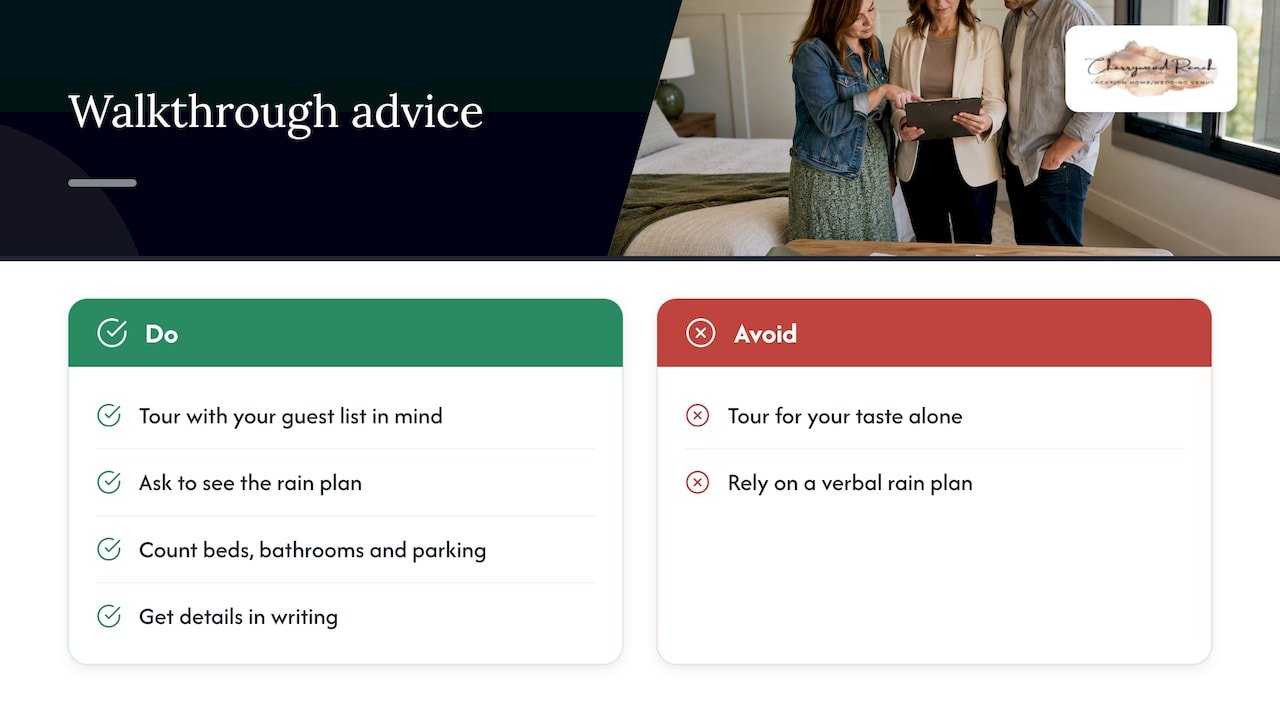
First, tour with your guest list in mind, not just your own taste. You may love a sunset view, but your grandmother needs a smooth path and a place to sit. Second, ask to see the rain plan, not hear about it. Third, count the beds, bathrooms and parking spaces. They are the dull numbers that decide whether a weekend feels relaxed.
We also think the best sign of a good venue is how it answers hard questions. A host who tells you what is not included, shows you the backup space and puts the details in writing is a host you can trust on the day.
— Luis
See Cherrywood Ranch in person
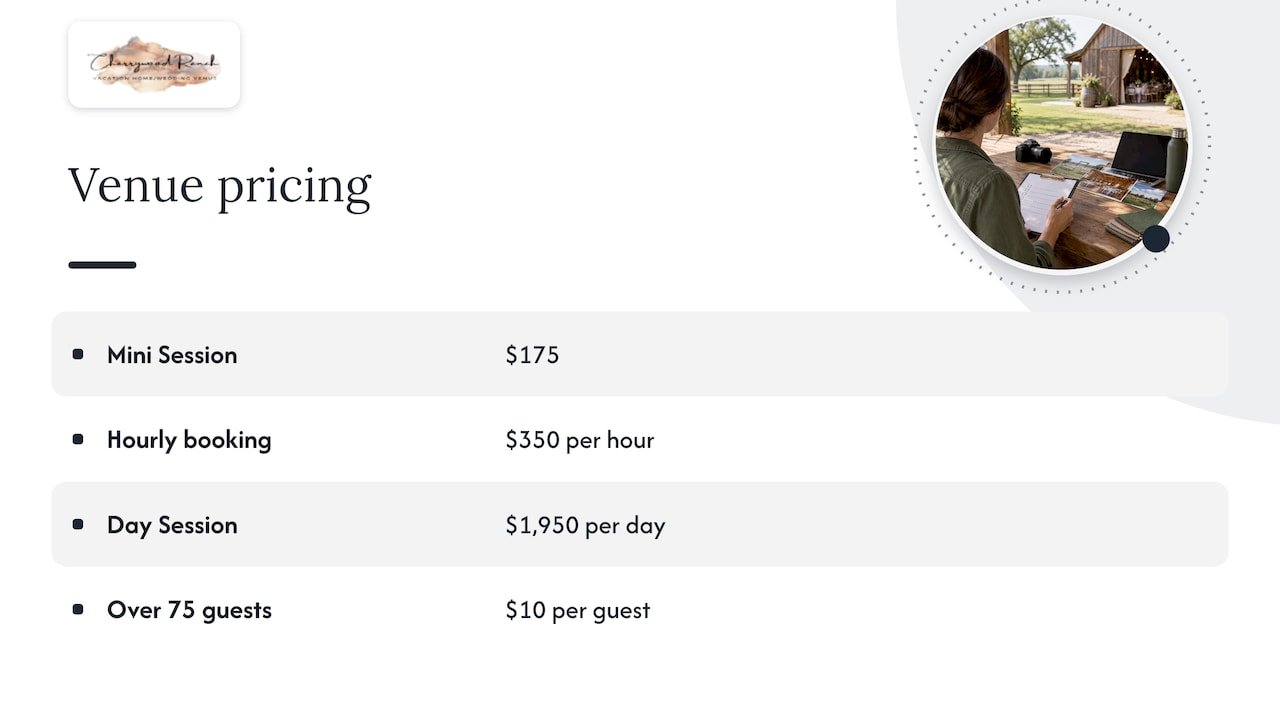
Cherrywood Ranch is a private mountain wedding venue and vacation home in the North Georgia Mountains, with onsite lodging for up to 16 guests, outdoor ceremony and reception space, and a pool and hot tub. Our book your stay page lists a Mini Session at $175, hourly bookings at $350 per hour and a Day Session at $1,950 per day. Wedding, elopement and 3-day wedding packages are on our services page, where you can also see our per-guest fee past 75 guests, $10 per guest. If you want to walk the property with this checklist in hand, start with our wedding weekend overview.
FAQ
What should I include on a wedding venue walkthrough checklist?
Cover arrival and parking, accessibility, ceremony and reception spaces, restrooms, power, load-in access, the rain plan, and the contract terms. Add anything specific to your wedding, such as lodging or a getting-ready room. Photograph and measure as you go so you can compare venues later.
When should I do the final walkthrough?
Most planners suggest going back 30 to 60 days before the wedding. That leaves time to fix problems and update vendors. Bring your timeline and floor plan.
Who should come to the venue tour?
Bring the people making the decisions, and ideally one person who will ask practical questions. Your photographer, planner or caterer can join the final visit, since they will work in the space. Keep the group small so you can focus.
What questions do couples forget to ask?
The common ones are power capacity, the load-in route, restroom count, end times and what happens in bad weather. Also ask what is not included in the fee and what triggers extra charges. Get the answers in writing.
Sources
- SiteWalks: Venue Walkthrough Checklist for Event Planners
- HotelAmplify: Event Venue Inspection Checklist
- Wedding Clever: Essential Wedding Venue Visit Checklist
- U.S. Department of Justice: ADA Guide for Small Towns
- OSHA: Crowd Control guidance
- Everson Events: 5 Reasons to Do a Final Venue Walkthrough