
Golden hour is the warm, soft light in the last stretch before sunset. Blue hour is the short, cool-toned window after the sun has dropped below the horizon. Neither one is better. Golden hour gives you glowing, flattering portraits, and blue hour gives you deep color and a quiet, cinematic mood. If you can, plan for both. This guide explains how each one works, how long you really have, and how to fit them into a wedding day in the North Georgia mountains.
TL;DR
- Golden hour is warm, directional and forgiving on skin. It lasts roughly an hour, depending on place and season.
- Blue hour is cool, moody and brief, usually 20 to 30 minutes, and it begins after the sun has set.
- Mountains cut your golden hour short, because the sun disappears behind a ridge before the official sunset time.
- Start your ceremony about 90 minutes before sunset, shoot portraits in golden light, then keep your couple free for a few minutes of blue hour.
- Build in a weather buffer and a backup portrait spot.
Table of Contents
- What golden hour and blue hour actually are
- Golden hour vs. blue hour at a glance
- How long each one lasts
- Why the mountains change the math
- Which is better for wedding photos?
- A simple timeline that gets both
- Practical tips for photographing both
- What about sunrise?
- Our perspective
- Hosting your golden hour and blue hour at Cherrywood Ranch
- Frequently asked questions
- Sources
What golden hour and blue hour actually are
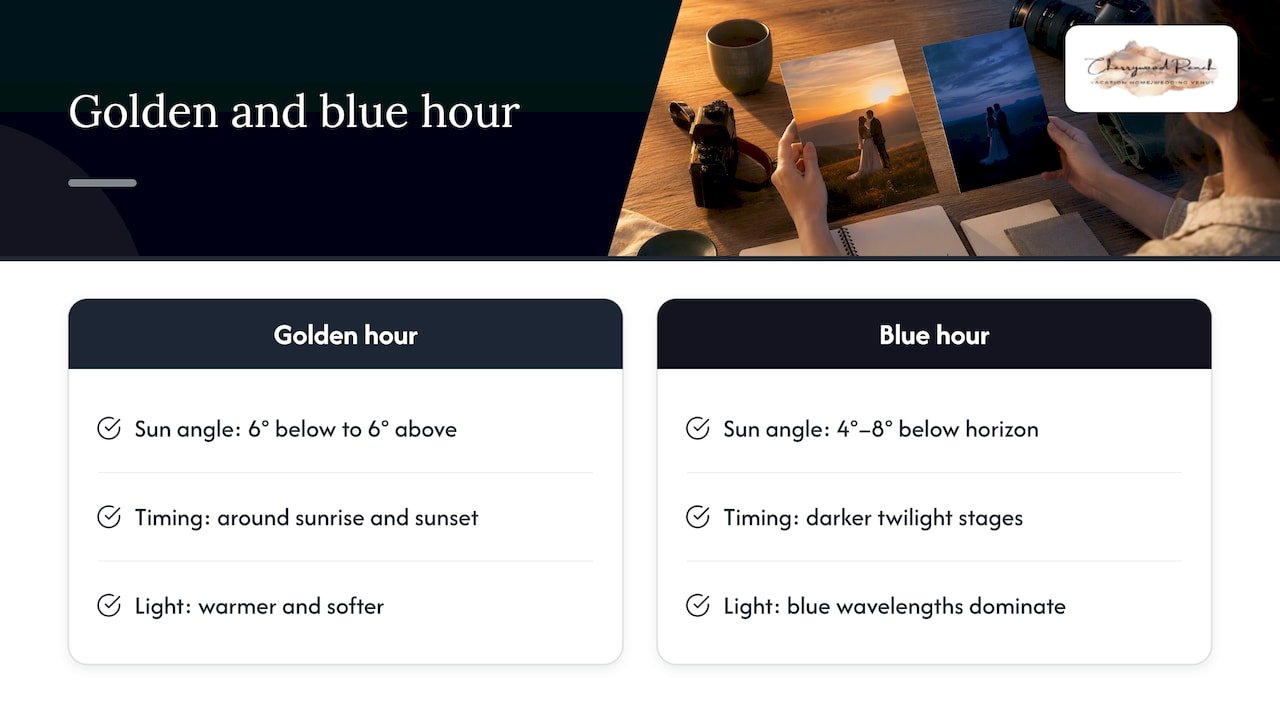
Both names are everyday terms, not scientific categories. Time and Date notes that golden hour is a colloquial term, generally the period when the sun sits between 6 degrees below and 6 degrees above the horizon, around sunrise and sunset. The light is warmer and softer than at midday because the sun’s rays travel through more atmosphere to reach you.
Blue hour is also colloquial. It describes the darker stages of twilight, when the sun is roughly 4 to 8 degrees below the horizon and blue wavelengths dominate the sky. The National Weather Service defines civil twilight as ending when the sun is 6 degrees below the horizon, which is why blue hour overlaps the tail end of that stage and the beginning of the next.
Because nobody agrees on exact degrees, different photographers and websites give slightly different windows. Treat the numbers as a planning guide, not a stopwatch.
Golden hour vs. blue hour at a glance
| Golden hour | Blue hour | |
|---|---|---|
| Sun position | Close to the horizon, still visible | Below the horizon |
| Color | Warm gold, amber, soft pink | Deep blue, cool violet |
| Light direction | Strong and directional | Soft, even, ambient |
| Typical length | About an hour, longer at higher latitudes | Usually 20 to 30 minutes |
| Mood | Romantic, glowing, warm | Calm, dramatic, cinematic |
| Best for | Couple portraits, family groups, ceremony light | Silhouettes, string lights, private couple moments, exits |
| Difficulty | Easy, forgiving | Needs a steady hand or tripod and good exposure |
How long each one lasts
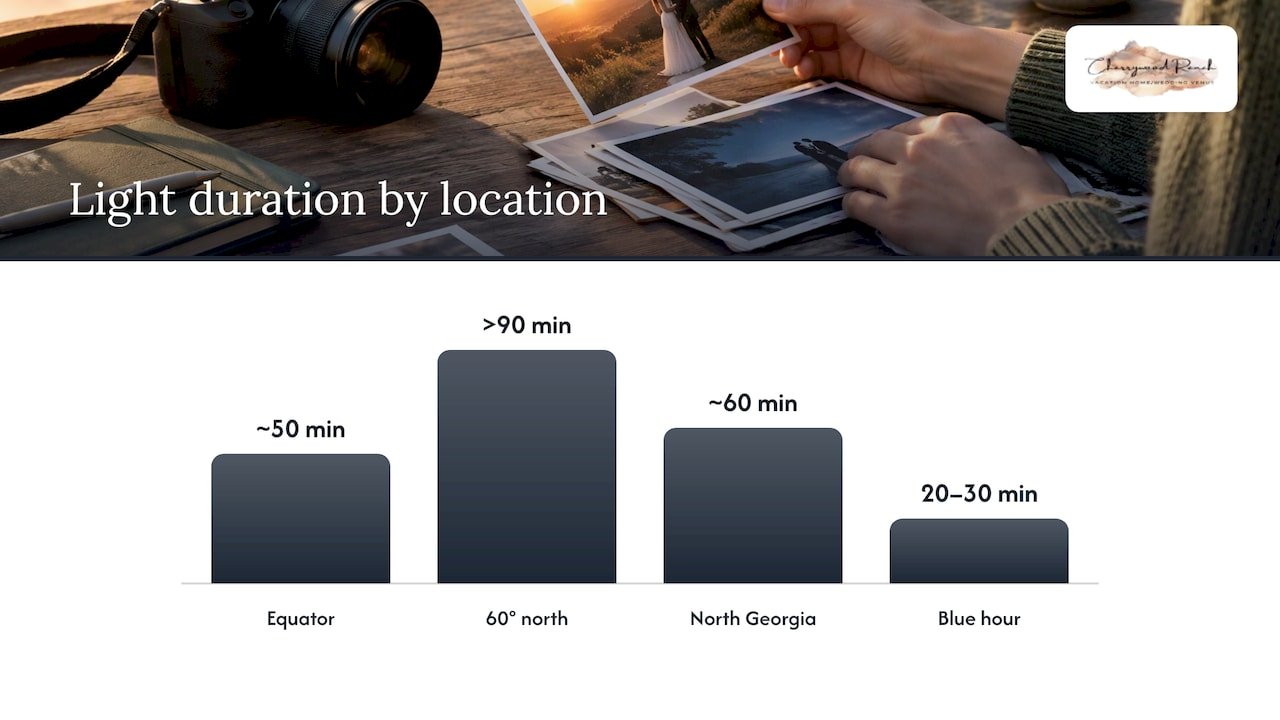
Golden hour gets longer the farther you are from the equator. According to Time and Date, it runs roughly 50 minutes near the equator and more than 90 minutes at 60 degrees north. Around 40 degrees north, about the latitude of New York, it lasts about an hour in March. North Georgia sits a few degrees south of that, so plan on something near an hour, and expect it to change with the season.
Blue hour is the shorter of the two. Twenty to thirty minutes is typical, and the deepest color peaks for just a few minutes within that. This is why wedding timelines that treat blue hour as an afterthought usually miss it. Everyone is still at dinner or toasting when the sky does its best work.
Why the mountains change the math
The sunset time on your phone is calculated for a flat horizon. In the mountains, the sun slips behind a ridge earlier, so the direct golden light you want can end well before the posted time. Ever Weddings points out that mountain sunsets arrive earlier than at sea level, and that you need to work backward from the sunset time for your date.
That same source gives a sense of the swing across the year in North Georgia: sunset falls around 8:45 PM in June and around 5:30 PM in December. A June couple can run a relaxed evening. A December couple needs a ceremony in the middle of the afternoon.
There is an upside. When the sun drops behind the ridge, the sky behind the mountains often stays bright while the valleys fall into shade. That soft, shadowless light is similar to blue hour arriving a little early, and it can be lovely for portraits when you can no longer get direct sun.
Season by season in North Georgia
- Summer (June to August): Long, lush golden hours. Local photographers suggest starting ceremonies 1.5 to 2 hours before sunset so you avoid harsh midday light.
- Fall (October): Peak foliage and earlier sunsets, so evening events need earlier starts. Check the exact sunset for your date with a sunrise and sunset table for your nearest town.
- Winter: Sunset can arrive near 5:30 PM, which makes for a very early golden hour and a quick blue hour. Plan photos before the ceremony if needed.
- Spring: Variable weather. Haze and fast-moving clouds can soften or hide the light.
Which is better for wedding photos?
The honest answer is that they do different jobs. Photographers who shoot weddings generally describe golden hour as the warm, romantic, glowing option and blue hour as the cool, dramatic, moody one. Most recommend a gallery that includes both, because it adds variety and tells more of the day’s story.
Choose golden hour when you want
- Warm skin tones and a soft glow on faces
- Backlit portraits with light in the hair
- Family and wedding party photos that look natural and relaxed
- A ceremony that feels golden from the first minute to the last
Choose blue hour when you want
- Silhouettes against a deep sky
- Fairy lights, lanterns and candles to stand out
- A quiet moment alone with your partner after a busy day
- A dramatic exit or a night-time reveal of the venue lighting
Time and Date notes that blue hour’s high color temperature and calm mood make it a good match for artificial light sources such as fairy lights. That matters if you plan a string-lit reception.
A simple timeline that gets both
Here is a template for a mountain evening, working backward from sunset. Adjust it with your photographer once you know your date.
- 90 minutes before sunset: ceremony begins. Local photographers recommend starting about 90 minutes before sunset, which flows naturally into golden hour portraits.
- 60 minutes before sunset: ceremony ends, cocktail hour starts. Guests eat and drink while you finish family photos.
- 45 to 30 minutes before sunset: couple and wedding party portraits. This is the soft, directional light you came for.
- Sunset: step away for a few minutes. Take a few frames of the sky and light on the mountains.
- 0 to 25 minutes after sunset: blue hour. Silhouettes, a dance under string lights, or a quiet walk.
- Dinner and toasts. Schedule them so the room is not pulling you away at the peak moments.
If you want a fuller walkthrough, we wrote a minute-by-minute guide to golden hour wedding photos. And if you are still deciding on the type of event, our piece on why sunset weddings feel so memorable covers the emotional side.
Practical tips for photographing both
Check the exact times
Use a sunset calculator for your date and nearest town. Photographers urge couples to plan ahead, since these windows are fleeting and camera settings must change continuously, especially aperture and ISO. Ask your photographer to scout the spot beforehand so no time is lost on setup.
Expect a color shift
Blue hour can look very cool on screen, and mixed light from lanterns, house windows and string lights can push color in odd directions. Your photographer will usually edit for a pleasing balance. If you are curious how color temperature gets corrected after the fact, this explainer on fixing white balance in photos shows the idea clearly, even though it is about property images.
Plan for weather
Mountains make their own weather. Local professionals advise building a buffer into your timeline, since fog or fast-moving weather in North Georgia can obscure light. Choose a backup portrait location before the day, ideally somewhere with open sky and a view that still looks good under clouds.
Keep the couple together
Blue hour is short, so protect it. Ask your coordinator to tell guests the couple will step out for ten minutes. You will be glad of the quiet.
What about sunrise?
Golden hour and blue hour both happen in the morning too, in reverse order: blue hour first, then golden light as the sun rises. A sunrise ceremony suits couples who want a private, peaceful start and mist in the valleys. If that appeals, read our notes on sunrise weddings.
Our perspective
We host weddings at a private mountain home in North Georgia, and we see the same pattern again and again. Couples plan a beautiful ceremony, then discover that the light they imagined lasts about as long as the toast. The cause is not the photographer or the schedule. It is that most venues run a one-day event, and everyone is always on the clock.
Because Cherrywood Ranch is a venue and a vacation home in one, with lodging for up to 16 guests, our couples do not have to rush from a ceremony site to a hotel across town. If the sky turns pink earlier than expected, you can move your portraits fifty feet and keep going. If the blue hour is gorgeous, you can walk out onto the property with your partner and no one is waiting for a shuttle.
Our advice is simple: pick your ceremony start from the sunset time, not from the guest list. Give golden hour to portraits and blue hour to yourselves. If you have a pool, hot tub and a mountain view to hand, a calm moment at dusk with family nearby may become the part of the weekend you remember best.
— Luis
Hosting your golden hour and blue hour at Cherrywood Ranch
Our venue gives you the flexibility to chase the light. We offer elopements, weddings and a 3-day wedding package, plus the luxury vacation home for your guests. Published rates include a day session at $1,950 per day, an hourly rate of $350 per hour and a $175 mini session. Weddings, elopements and the 3-day package are quoted individually, and guest overage fees are $10 per guest over 75. See our services and packages, or read about our all-inclusive weekend benefits.
Frequently asked questions
Is golden hour better than blue hour?
Not across the board. Golden hour is easier and more flattering for portraits, which is why most photographers lean on it. Blue hour is moodier and more dramatic, and it works best for silhouettes and lit-up scenes. Most galleries benefit from having both.
What is the difference between golden hour and blue hour?
Golden hour happens while the sun is still near the horizon, and it gives warm, soft, directional light. Blue hour happens after the sun has set, when the sky turns a deep blue. Blue hour is also shorter, usually 20 to 30 minutes.
Does blue hour still exist?
Yes. It happens every day at both dawn and dusk, because the sun’s position below the horizon is what produces the color. Clouds, haze and mountains can mute it, so you may see a stronger or weaker version on different evenings.
How long before sunset should my ceremony be?
For North Georgia, local photographers suggest about 90 minutes before sunset. That leaves time for the ceremony, family photos and a golden hour portrait session. In summer you can stretch to two hours before sunset.
Sources
- Golden Hour – When Sunlight Turns Magical, Time and Date
- Blue Hour – Magic Hour, Time and Date
- Take the Best Sunrise and Sunset Photos, Time and Date
- Twilight Types, National Weather Service
- How to Plan a Mountain Wedding in North Georgia, Shack Photo and Film
- North Georgia Mountain Wedding Tips, Ever Weddings